It’s live right now.
Month: November 2014
Friends And Foes Remember Marion Barry

The four-time DC mayor died yesterday at age 78. David Remnick remarks, “When Marion Barry was running the city as mayor, and then in his wilderness years—as prisoner, outcast, and councilman—what you thought of him depended largely on who you were, what ward you lived in, what your advantages and disadvantages were, what you were willing to tolerate and forgive.” David Plotz, who did his college thesis on Barry, remembers the complicated figure:
He looked at the numbers, and devised a new formula, adapting the machine politics practiced a generation earlier by Irish and Italian mayors. What better way to lock in a loyal voting base than with jobs? By Barry’s second term, D.C. had by far the largest city government in the United States per capita. He coupled a permanent bureaucracy with a massive summer jobs program for kids. When I interviewed Washingtonians in the 1990s about why they were still voting for Marion Barry, an astonishing number cited the summer job he gave them back in the 1970s. …
Marion Barry won the prize of city government at the moment that cities began to slide, and before their recent revival. As a result, he left few tangible accomplishments. He inflicted on my city a bureaucracy that was too big, a mediocre police department, and horrid schools. Since the end of Barry’s ridiculous fourth mayoral term in January 1999, D.C.’s politicians have run away from him. Our mayoral candidates are competent, dreary, and technocratic. Unlike Barry, they seem more interested in governing their city than serving themselves. Marion Barry loomed over D.C. politics for 43 years, but there is no Barryism.
Adam Serwer explains why, despite Barry’s huge flaws, many think of him in a positive light:
Barry who was elected mayor four times, including once after that crack conviction, owed his success to being an unparalleled retail politician who could mollify the city’s powerful business interests, isolate political opponents, and make the city’s working class and poor believe he spoke for them. He was a master at exploiting black racial anxieties, which makes him different from many of America’s most successful politicians only in that his constituency, and therefore his culture war appeals, were black. Within the city, he was a champion who first gave its working-class black residents a taste of the economic prosperity that racial apartheid had long denied them. He was the realization of D.C. residents’ long-denied democratic aspirations. There is much more to Barry than the time he got set up.
From the outside, observers could see only Barry’s flaws, his corruptions and addictions. The mystery of Barry’s political survival despite numerous run-ins with the law, mismanagement of the city government, and numerous allegations of sexual assault is easier to solve if you know the history of the city. Barry didn’t bring corruption to D.C. He changed who benefited from it.
Jack Shafer turns to the Barry seen by journalists:
[H]e continued to make great copy and inspire journalists, as Matt Labash demonstrated in his 2009 Weekly Standard profile, in which he accompanied Barry around the city for several days. Even in his autumn, Barry’s vitality still glowed, but with the softness of a light about to go out. Labash, who unlike so many other journalists accepts Barry on his own terms, collects a quotation from long-time TV news anchor Jim Vance, a Barry friend, that if pared down a few words could serve as his honest tombstone epitaph.
“There were so many of us who had so much hope for Marion,” Vance told Labash. “I don’t know too many people that were more blessed or that had more skills than Marion had, nor too many people who were a bigger disappointment, quite frankly.”
Jason Zengerle recalls Barry’s life in the public eye:
[T]he greatest episode of the Marion Barry Show came in 1990, when he was caught on a FBI-operated surveillance camera smoking crack in a hotel room with a girlfriend and then being led away in handcuffs muttering, “Bitch set me up.” His subsequent trial only heightened the drama. One morning, I took a day off from my summer job (one, alas, that I actually had to work at since it wasn’t through Barry’s program) and took advantage of my new driver’s license to drive down to the D.C. courthouse at 4 o’clock in the morning to get in line to attend that day’s session. I don’t remember much of what occurred inside the courtroom, but outside the courthouse, on the pavilion that became known as “Barry Beach,” it was a circus like I’d never seen. Louis Farrakhan’s Nation of Islam security guards handled crowd control. George Stallings, an excommunicated Catholic priest who’d become Barry’s spiritual advisor, led some sort of prayer circle. And Sam Donaldson tried to interview Al Sharpton about Colin Powell while being harassed by the RC Cola Lady—a woman who dressed in head-to-toe blue spandex and balanced 2-liter bottle of said soda on her braided head and was very eager for her own 15 minutes of fame. After Sharpton had denounced Powell as an “Uncle Tom” for the third time to Donaldson, only to have the shot ruined yet again by the RC Cola Lady, the newsman and the minister agreed to meet up later. And at the center of the circus, conspicuously silent on the advice of his attorney, was Barry—a Barnum-like figure in an expensive suit with a kente-cloth scarf draped around his neck.
And John McWhorter questions the tone of the coverage:
One senses that Barry is being measured on the basis of intentions rather than achievement. As far back as 1984, none other than the Washington Post’s Richard Cohen was enthusing that “Before home rule, there were two trash pickups a week; now there is only one. Before home rule, the traffic signals worked; now they don’t. But the ultimate importance of home rule is not in efficiency, but in pride.”
Pride, indeed—Barry’s lift-off effort was called Pride, Inc. It was about lifting poor black people, and especially ones with checkered backgrounds, into entrepreneurship. There were six gas stations, a candymaking outfit, gardening and maintenance firms. The PR couched its target as an archetypal “Mr. Jones,” a black farm worker from the Deep South down on his luck. But no one today traces their success to Pride, Inc.; the efforts either went under or were refitted as criminal organizations.
(Photo: : Pahel Brunis works on a mural of Marion Barry as people remember the life of the former mayor of Washington, DC on Sunday November 23, 2014 in Washington, DC. By Matt McClain/ The Washington Post via Getty Images)
“A Bomb Planted At The Heart Of The Regulatory State”
That’s how Eric Posner describes Obama’s executive action:
The point is not just that Republican presidents can do what Obama has done. It is that enforcement discretion creates an advantage for Republicans—it favors conservative governance and hurts liberal governance. The reason for this asymmetric effect is that the great bulk of federal law is liberal economic regulation, not conservative morals regulation. A conservative president can refuse to enforce laws, but a liberal president can’t enforce laws that don’t exist. While a President Rand could gut the regulatory state, the opportunities for a President Hillary Clinton to advance liberalism through non-enforcement are much less fecund.
Andrew Prokop isn’t so sure:
Several commentators have been floating various possibilities about how the GOP could take advantage of those powers in ways Democrats would surely hate. “What if a Republican president announced that he would stop enforcing the payment of estate taxes? Or suspend enforcement of regulations on industrial pollution?” wrote Jonathan Chait. But as you dig deeper into these scenarios, it comes clear that some of them just wouldn’t work — and some of them Republicans supported long before Obama’s latest executive actions.
Trende pushes back on Prokop:
This, I think is misguided. Once a president uses executive authority to implement a major, controversial policy that has been under debate in Congress for almost a decade, especially after his party suffered a substantial midterm rebuke, there is no going back. It is going to be used repeatedly, in ways that both parties find appalling.
A “Sticky” Situation
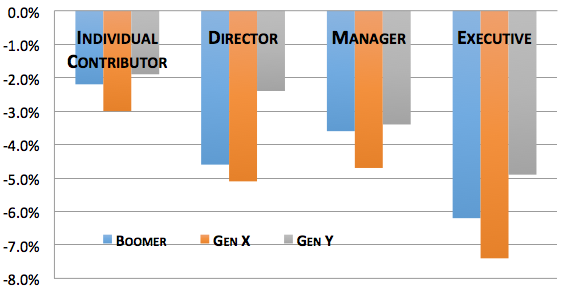
Derek Thompson shares the above chart on gender and generation in the workforce:
Intergenerational economic inequality is declining: The gap between male and female wages among Millennials is lower than it was among boomers or Gen-X. But the pernicious gender gap is reasserting itself as you look higher up in the corporate ladder. Income data shows that middle-aged women fall behind their male peers, particularly when they take time off to be moms. Men with families and children, on the other hand, earn more than their same-aged bachelor colleagues, according to Pew. So as Millennials grow up, today’s entry-level inequality could still yield to middle-age inequality.
If that paragraph doesn’t entirely make sense to you, [the above graph] should make things crystal clear.
It comes from data in a new PayScale and Millennial Branding study. You can see Millennials (in grey) have the smallest gender-wage gap at all levels, but the difference in pay deepens as you move up the corporate ladder.
This is what economists call the “sticky floor” theory of the gender wage gap. Women make very close to men coming out of college, but as men climb the corporate ladder, female salaries stick to the ground. Consider that women account for 49 percent of the bottom 99 percent of earners, but just 11 percent of the 1 percent, and just 9 percent of the top 0.1 percent of earners, according to one recent paper.
Jessica Grose comments on research suggesting that one specific factor may be in play:
A new study of Harvard Business School graduates from HBS’s Robin Ely and Colleen Ammerman and Hunter College sociologist Pamela Stone shows that high-achieving women are not meeting the career goals they set for themselves in their 20s. It’s not because they’re “opting out” of the workforce when they have kids, but because they’re allowing their partners’ careers to take precedence over their own. …
Of course, marital arrangements aren’t the only force holding women back. Part of the reason these women aren’t advancing at the same rate as their male counterparts is that after they have kids, they get “mommy-tracked.” In many ways, they’re not considered management candidates anymore. “They may have been stigmatized for taking advantage of flex options or reduced schedules, passed over for high-profile assignments, or removed from projects they once led,” the authors note. Other studies support these findings, as they have shown that there is a real, substantial motherhood penalty that involves lower pay and fewer promotions for women with kids, because employers assume they will be less dedicated to their jobs (as do, we now know, their husbands).
But the personal piece of the female achievement gap puzzle is important, and it’s something that’s very difficult to shift. The study’s authors note that while millennial HBS grads are a little more egalitarian than their older peers, half of the youngest men still assume that their careers will take precedence, and two-thirds of them assume their spouses will do the majority of child care.
What Alec Baldwin Should Have Done
Or – the best way to fight back against a paparazzo:
Also:
https://twitter.com/lordemusic/status/532779335443558400An Untreated Case Of Market Failure
Jeremy A. Greene is alarmed by the cost of certain generic drugs:
Drugs previously available at pennies per pill now cost hundreds of dollars per bottle. And not just esoteric, small-market drugs, either: the antibiotic doxycycline, a workhorse drug for common infections from sinusitis to pneumonia, cost $20 per 500-count bottle last October. Last month, the average price for the same supply was $1,849. For a drug initially approved by the FDA in 1967, the price hike seems mystifying.
How is this possible?
In the generic drug industry, market failure occurs when a crowd of different companies that once competed to sell a drug like doxycycline ditch it to pursue more profitable drugs, leaving just one generic supplier—or a new gray-market monopoly able to raise prices just like brand-name manufacturers. This happens in part because generic companies are drawn toward the market exclusivity of newer drugs when they come off patent, in part because of bottlenecks in the supply of precursor chemicals, and in part because of shrinking margins in the production of older generic drugs. The stampede leaves the supply of many older but essential medicines in the hands of just a few suppliers, whose production lines are unprepared to deal with surges in demand, leading to shortages of key pharmaceutical agents needed for the treatment of cancer, pneumonia, and heart disease, as well as for basic anesthesia. Prices eventually recede—but by then, usually, other drugs are seeing similar cost surges.
The Norms Obama Broke
Sean Trende is concerned about the unintended consequences of Obama’s executive action:
Contrary to some of the louder reactions, our Republic can withstand this breach. The real problem is that our history suggests that once these norms are violated, Humpty Dumpty can’t be put back together again. We see this with the sorry state of our judicial nomination process. What probably started with an arguably justified filibuster by Republicans and conservative Democrats of Abe Fortas’ nomination as chief justice of the Supreme Court (he really did have some ethical issues), escalated to the defeat of Robert Bork on ideological grounds and a blockade by Democrats of many of George H.W. Bush’s nominees in the final years of his term, to a more extensive blockade of many of Bill Clinton’s nominees for most of his term by Republicans, to the filibuster of many of George W. Bush’s Court of Appeals nominees by Democrats, to Republican threats of dismantling the judicial filibuster in response, to Republican filibusters of Obama’s appellate and District Court nominations, to the actual dismantling of the judicial filibuster by Democrats.
Both parties played a role in these latter developments, and the Bush presidency clearly saw its fair share of broken norms (using the threat of budget reconciliation to pass tax cuts; the midterm firings of U.S. attorneys). But this proves nothing. The point is that once you start down a road, you don’t go back. No one who voted to filibuster Fortas would have agreed that the endgame would be routine filibustering of District Court nominations and the beginning of the end of the filibuster, but that’s exactly what happened. No one really thought that the creation of reconciliation would enable the enactment of $1.3 trillion in tax cuts. And so forth.
Scott Lemieux dismisses such worries:
Both the second Bush administration and the actions of Republicans in Congress make it abundantly clear that the next Republican in the Oval Office is going to push toward – and probably beyond – the limits of his legal authority, no matter what Obama does. (For instance, George W Bush’s warrantless wiretapping program, established by executive order, contradicted a statute outright, which Obama’s order does not.) If hypothetical president Rand Paul wants to refuse to enforce the Civil Rights Act, he’s not going to be dissuaded because Obama refused to act on immigration.
Drum thinks the whole thing is politically brilliant:
Is there a price to be paid for this? If you think that maybe, just maybe, Republicans were willing to work with Obama to pass a few constructive items, then there’s a price. Those items might well be dead in the water. If you don’t believe that, the price is zero. I’m more or less in that camp. And you know what? Even the stuff that might have been passable—trade authority, the Keystone XL pipeline, a few tweaks to Obamacare—I’m either opposed to or only slightly in favor of in the first place. If they don’t happen, very few Democrats are going to shed any real tears.
That leaves only presidential appointments, and there might be a downside there if you think that initially Republicans were prepared to be halfway reasonable about confirming Obama’s judges and agency heads. I kinda doubt that, but I guess you never know. This might be a genuine downside to unleashing the tea party beast.
Yuval Levin feels Obama is overstepping:
If the Constitution is merely a technical legal document, it might (perhaps) be possible to defend this action as somehow within the bounds of the president’s enforcement discretion. But because the constitution creates a political order—a structure for the political life of an actual society—it is very difficult to sustain such a defense in the real world. That combination of factors means that a judge might well sustain the president’s action as minimally defensible if it was challenged in court but the Congress cannot consider it so. And both would be playing their proper constitutional roles.
Suderman suggests a remedy:
If members of Congress think actions beyond a certain size and scope should be illegal, then they ought to write a law explicitly saying so, tightly and clearly defining how, when, and under what circumstances the executive is allowed to act.
But Ilya Somin doubts that will solve the problem:
Even if Congress were more assertive, it could not prevent the president from exercising extremely broad discretion in a world where almost everyone is a federal criminal, and he has to pick and choose a small fraction of those criminals to go after. If we truly want to limit executive discretion and selective enforcement of laws, the best way to do so is to cut back on the scope of federal law to the point where the president has the resources to go after all or most offenders. Better still, federal law could be limited to those activities for which there is a broad consensus that they really are serious offenses that cannot be left to the states, and must be targeted by the federal government. If a president still chose not to enforce them, or did so only selectively, he (and his party, if they choose support his actions) would suffer a tremendous political backlash.
Prejudice By Numbers
In an excerpt from The Formula, Luke Dormehl raises concerns about law enforcement’s increased use of algorithms:
As slashed budgets lead to increased staff cuts, automated systems have moved from simple administrative tools to become primary decision-makers …
The central problem once again comes down to the spectral promise of algorithmic objectivity. “We are all so scared of human bias and inconsistency,” says Danielle Citron, professor of law at the University of Maryland. “At the same time, we are overconfident about what it is that computers can do.” The mistake, Citron suggests, is that we “trust algorithms, because we think of them as objective, whereas the reality is that humans craft those algorithms and can embed in them all sorts of biases and perspectives.”
To put it another way, a computer algorithm might be unbiased in its execution, but, as noted, this does not mean that there is not bias encoded within it. Implicit or explicit biases might be the work of one or two human programmers, or else come down to technological difficulties. For example, algorithms used in facial recognition technology have in the past shown higher identification rates for men than for women, and for individuals of non-white origin than for whites. An algorithm might not target an African-American male for reasons of overt prejudice, but the fact that it is more likely to do this than it is to target a white female means that the end result is no different.
The View From Your Window

Ludlow, Vermont, 6.55 am
What To Think Of Bill Cosby? Ctd
Lots of readers are still sounding off on this story:
I think the Cosby downfall has been the product of two things: our current cultural shift in thinking about sexual assault, and the democratization of the news cycle via social media. Once the young people get a hold of something, they push it to the surface and drive into action the crusty old media, who love to kowtow to the famous and powerful.
Another:
I was glancing through the latest blog entry about Bill Cosby and the thoughts on separating the character on TV from his real person … I just don’t think that’s possible. Because that’s the way he wanted it. He didn’t just play America’s favorite dad on TV; he parlayed that into a secondary career, via speaking engagements at colleges, or inserting himself into the public discourse as some sort of voice of wisdom on how other people should raise their children or conduct their lives. He wasn’t just an actor/comedian.
If these allegations turn out to be true, then every time you watch a re-run of The Cosby Show, his character – upstanding family man – will look macabre, not funny.
And I just remembered a quote I had read from his book Fatherhood (published in 1987 – three years into his role as America’s Favorite Dad) and knowing what we know now about the alleged assaults frequently being on young women in their late teens, it just gives me a chill:
A father… knows exactly what those boys at the mall have in their depraved little minds because he once owned such a depraved little mind himself. In fact, if he thinks enough about the plans that he used to have for young girls, the father not only will support his wife in keeping their daughter home but he might even run over to the mall and have a few of those boys arrested.
Yeah, I guess he’d know.
I so want this to not be true. But the man who made me want to eat Jello is making me queasy.
Another insists that “Cosby was never a good guy”:
One of the interesting things about the Cosby implosion is that in addition to all the allegations of rape, groping, and harassment, there are an awful lot of people chiming in on blogs to relate personal anecdotes about when they learned firsthand that Bill Cosby is an asshole. At commencement speeches, football games, and other public appearances, Cosby appears to have bullied and belittled people, sometimes to the point of tears. None of this rises to the level of sexual violence, but it’s an interesting complement to all the rape allegations.
An expert weighs in:
As someone who has been a therapist for both those convicted of sex crimes and victims of sex crime, the whole Bill Cosby issue has been difficult to watch. The primary reason being, that most of the defense seems to, on some level, rest on the belief that people have a connection to this man based on his public persona. Or even in the case of Whoopi Goldberg, a personal connection. But both of these relations assume that we can somehow know how a person will act in all circumstances, based on how they react to us and a what we can observe in some situations.
I don’t mean to get too mind-fuck-y, but when can we lay that belief to rest? I mean how many bootleg-produced crime docudramas and news clips of those knowing the perpetrator do we need to watch, where they teary eyed proclaim, ” they would never be capable of this”, before we understand that someone who can display empathy and charisma in one arena, be capable of evil in another? We can generate composite sketches of people, but that is about it.
Look, 15 women have made accusations and those that have come forth have remarkably similar stories. Some of them are highly accomplished, who are doing nothing but risking their own livelihood by sharing their story. Further, the stories that I have heard are all consistent with trademark characteristics of someone with power, who grooms their victims and understands their own social capital and how that can be used against their victims.
Either these women held a conference, read intensive literature on the hallmarks of serial rapist and the abuses of power and decided to come forth, or Bill Cosby is a wonderful comedian, transformational role model for thousands, public intellectual and a rapist. As someone who both hates binaries and grew up loving Bill Cosby, both options area tragedy. But they also cannot be true at the same time.
Another reader remarks on this chilling YouTube:
The buried AP footage should be mandatory viewing for those who are blaming Cosby’s accusers. What you see in the iced stare that causes the interviewer to squirm is the classic Jedi mindfuck of a predator. Cosby insists that the mere posing of a question be censored: “If you want to consider yourself to be serious.” He repeatedly inverts reality by claiming AP’s “integrity” lies in NOT doing their job as journalists. In this footage, we see the reporter and producers cave swiftly to the chilly, implicit menace that Cosby radiates, as well as to the narcissist’s inverted truth.
I know that gaze well. As a writer whose career began at Playboy – and as any female writer today will confirm – these assaults-qua-career-transactions are standard fare. Experience with abuse at home made me hypervigilant against the situations Cosby’s accusers describe, but I’ve seen them and occasionally (very shamefully) neared them. You can blame the victim, but first watch how Cosby flips the tables on these journalists, convincing them there’s more integrity in helping him cover his crimes than in exposing them. That’s the power of a narcissistic predator. It’s real. And his threat feels real. What has silenced this victims for so long is their willingness to blame themselves.
Many thanks for your thoughtful coverage of this story.
 The Dish