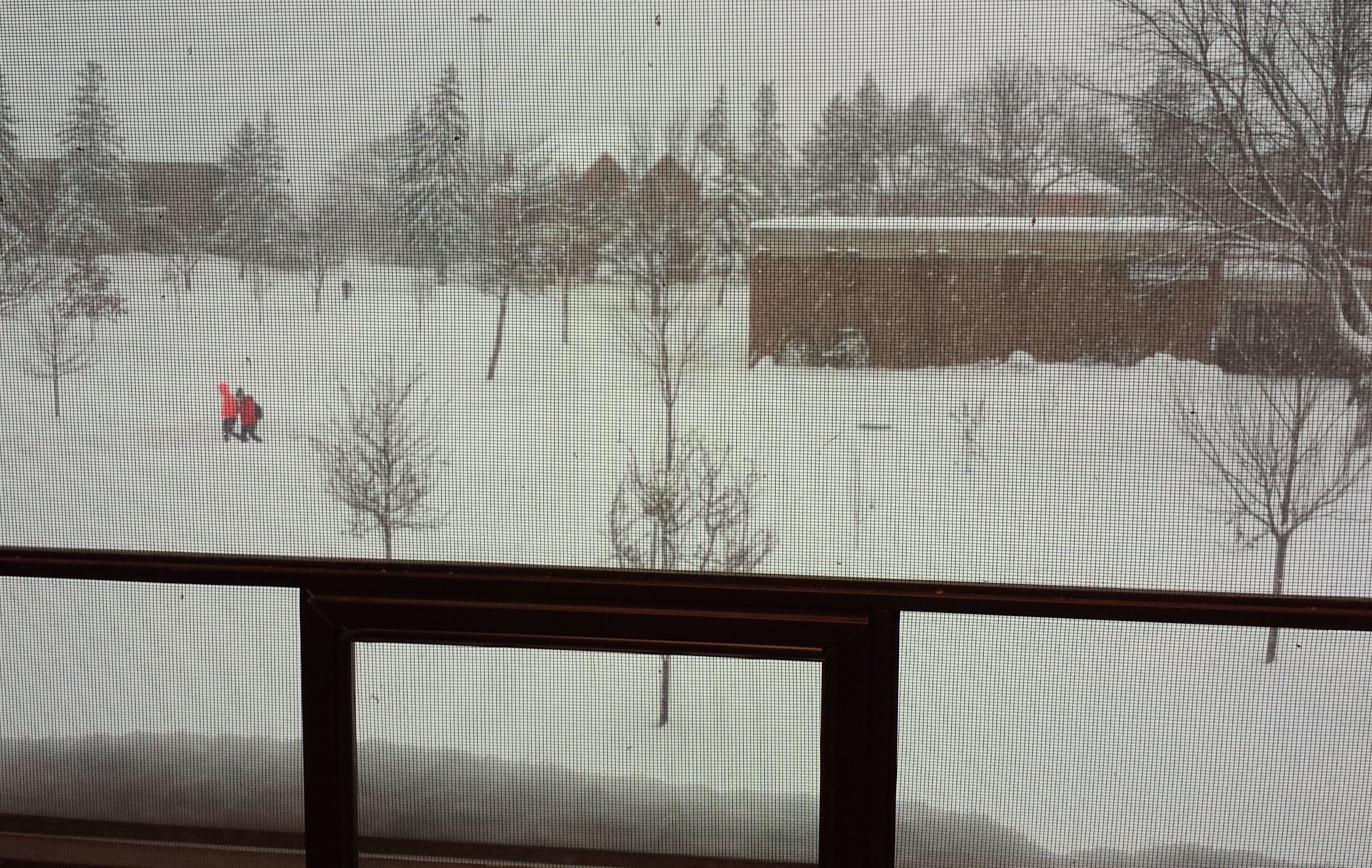
Sault Sainte Marie, Michigan, 12 pm
Sault Sainte Marie, Michigan, 12 pm
Claire Cain Miller flags a survey illustrating it:
People harbor equal distrust of advertisers and the government, Pew found. Eighty percent of users of social networks say they are concerned about advertisers or businesses gaining access to their information there, and 70 percent say they are at least somewhat concerned about the government doing so without their knowledge.
Yet highlighting the privacy paradox, 55 percent of people say they are willing to share information about themselves with web companies in order to use their services free, and 36 percent say they appreciate that these services are more efficient because they have access to this information.
The types of digital information that people consider to be most sensitive are their Social Security numbers, health information, the content of emails and phone calls and their location. They are least sensitive about their purchasing habits, media consumption, political and religious views, and the identities of their friends.
People with more education and higher incomes tend to be more sensitive about their online privacy, Pew found. And despite perceptions that young people care little about digital privacy, they often care more than older people.
Diamon Searls remarks that “when the penny eventually goes the inevitable way of the half cent and the Canadian penny (extinct as of 2012)” – and good riddance – we will lose “the last possible link between our language of money and the everyday physical world”:
[The etymology of penny] is uncertain, though the ending implies a Germanic origin—the
word used to be penning, with an -ing, like shilling and farthing, instead of a -y. The root may be Pfand, which turned into the English word pawn meaning “a pledge or token”: in that case, penny basically just means money. …
A quarter is a fourth of a dollar, a dime a tenth (Old French dîme, Latin decima), a cent a hundredth or one percent—all math. Anyway, a cent is not a piece of money: a U.S. penny is technically a cent or one-cent coin, but in spoken language, a cent is a value and a penny is a coin. We offer someone our two cents, not two pennies; pennies can clink in your pocket, cents can’t.
(Image by Flickr user yaybiscuits123)
Dean Karlan, “a believer in free range parenting,” flags research on the dangers of ignoring your young child because you can’t get off your damn iPhone:
Craig Palsson, a graduate student in the Yale economics department, argues in a new paper that the expansion of the 3G cellphone network led to more widespread adoption of the iPhone, which led to parents who discovered new apps and continual email on their cellphone; which led to parents who paid attention to their new toys at playgrounds and not necessarily to their small children; which led to 10 percent more accidents for those children from 2005 to 2012, including broken bones and concussions. The paper assembled data from the National Electronic Injury Surveillance System, run by the Consumer Product Safety Commission. The government does not collect any information from the phone, but instead relies on a sample of hospital emergency room visits involving consumer products.
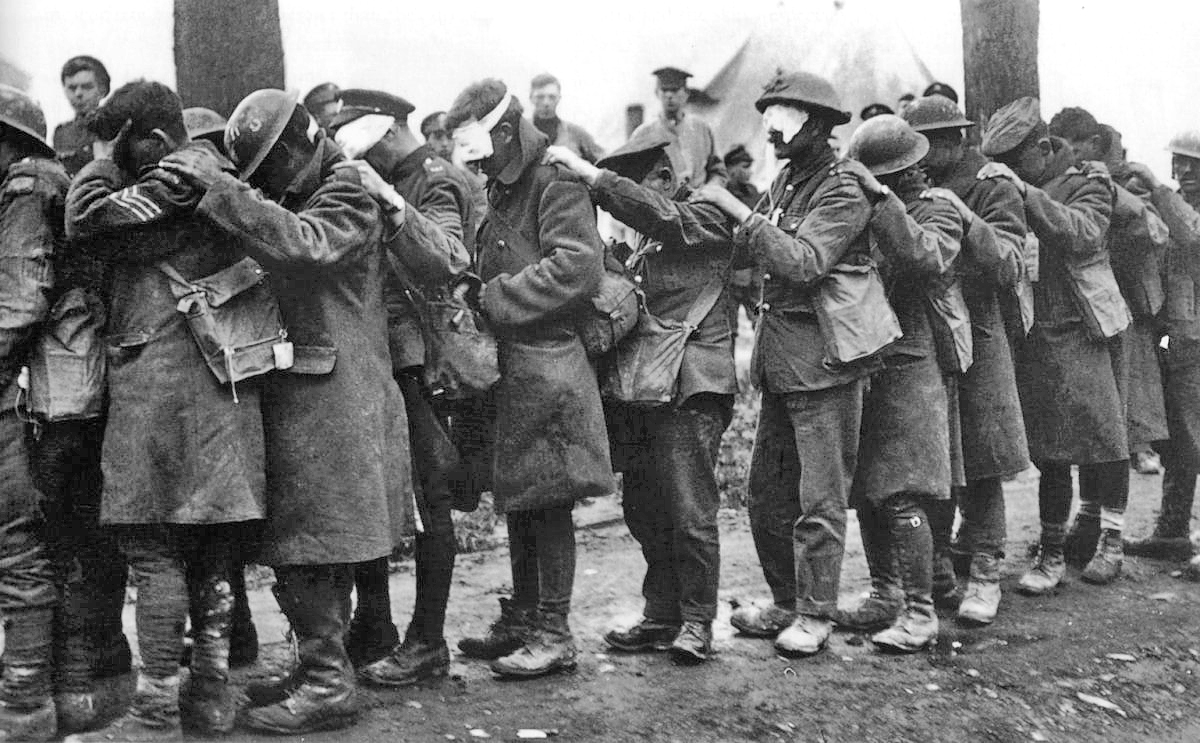
Wilfred McClay interrogates the common notion that “the Great War’s chief accomplishment was its wanton destruction of an entire political and social order and, with it of a certain blithe European optimism about the future.” Not so fast, he argues – it’s more complicated than that:
[O]ne of its lasting consequences has been to make us uneasy with the very concept of progress. We are not prepared to give up that concept entirely. That would be nearly inconceivable. … [O]ur culture is borne along by the flow of enormous progressive inertia. It does not necessarily have to affirm its earlier commitments, or even be aware of them, in order to be propelled or guided by them for a very long time. We teach our children that it is good, nay imperative, that they should want “to make a difference.” But there is no doubt that we do not feel quite as ready as we once were to endorse explicitly the idea of progress, without always employing the protective mechanisms of qualifiers or quotation marks. We live with a certain split-mindedness in that regard.
To further explain his point, McClay describes going to an academic conference on moral progress in history – timed to coincide with the 200th anniversary of the abolition of the slave trade. He was surprised to find himself the only participant overtly defending progress, though upon closer inspection he noticed even his colleagues hadn’t quite let go of the concept:
That said, the opposition to the idea of progress that I saw in my colleagues did not seem to me to go very deep. It seemed almost entirely professional and notional, without any echo in the conduct of their busy, well-organized, ambitious, and purposeful lives. No such thing as progress? Seriously? Who actually lives with such an assumption? Even our occasional efforts to sound fatalistic in our speech betray all the things that such speech silently presumes: that, as free and purposeful beings, we cannot help projecting certain ideals or goals, if even only short-range or proximate ones, into the inchoate future. This is particularly so in the United States, where every lamentation has a way of turning into a jeremiad, and thereby into a form of moral exhortation and a call to improvement, and thus to become the polar opposite of fatalism. The language of true fatalism would be stony and resigned silence, and that is not what we see or hear. There is a difference between what we think, and what we think we think.
(Image: British 55th Infantry Division soldiers, blinded by tear gas during the Battle of Estaires, 10 April 1918, via Wikimedia Commons)
Adam Kirsch reviews a collection of novellas by Nobel winner Patrick Modiano now available in an English translation:
The first to arrive is Suspended Sentences, which Yale University Press was already scheduled to publish, but is now rushing into print thanks to the Nobel announcement. For almost all American readers curious about Modiano, it will be their first introduction to his work. What sort of writer does it reveal?
First of all, a dedicated Parisian. Of the three novellas that make up this short volume, two take place in Paris and one in the suburbs; and Modiano writes about the French capital with a possessive affection that feels almost erotic. The narrator—who is always a version of the author—thinks back to the Paris of his teenage years, in the 1960s (Modiano was born in 1945), as to a shadowy paradise lost. He dwells on the changes time has brought to the city—the destruction of a neighborhood to make way for a highway, the disappearance of old haunts and old friends. Like Walter Benjamin, who believed that a whole civilization could be conjured from scraps of the Parisian past, Modiano seizes on even the smallest scraps of history. …
These novellas were originally published separately, but the decision to group them together makes perfect sense. In mood and often in subject matter, they read like variations on a theme: the missing man, the absent parents, the ravages of time, keeping coming back under different names. In each tale, the narrator remains bewildered by history, his own and his family’s, trying to make a coherent narrative out of the fragments he inherited.
Jonathan Gibbs recommends the collection, calling the author “as accessible as he is engrossing”. He gives a more detailed overview of the three novellas:
In “Afterimage” we have the narrator’s memories of lapsed photographer Francis Jensen, whom he knew as a young man, and whose personal archive he undertook to catalogue, while trying to work out why he had turned so resolutely away from life. The other two stories, “Suspended Sentences” and “Flowers of Ruin”, circle around “the Rue Lauriston gang”, a set of criminals whose black market dealings, during the Occupation, bled into dirtier work on behalf of the Gestapo.
“Suspended Sentences” is the liveliest offering, a childhood memoir in which young Patoche is palmed off by his parents onto a surrogate family of loveable freaks in a town outside Paris. Life there is immeasurably enlivened by the strange “friends of the family” who swing by in expensive American cars for clandestine meetings, or to whisk them all off for suspicious jaunts around Paris.
“Flowers of Ruin” is darker, and starts from an anecdote about a young married couple, living in Paris, who committed suicide “for no apparent reason” in 1933, after an evening partying with two other, more dubious couples. The narrator, thinking back to his own teenage years in Paris in the 1960s, wonders if the people he knew then might offer some connection back to that “tragic orgy”.
Sam Sacks provides a broader context:
Each of these sketches is framed as the narrator’s search through his imperfect recollections for telling clues that might somehow illuminate periods of time “whose very reality I sometimes doubted.” A strange and affecting feeling of guilt pervades the narrator’s investigations, drawing obscurely from the unknowns surrounding his estranged Jewish father, “who had weathered all the contradictions of the Occupation period, and who had told me practically nothing about it before we parted forever.” In all three novellas the author-narrator explains that his father was a black-market profiteer who may have been saved from deportation by his connection to the Rue Lauriston gang, the French branch of the Gestapo. Mr. Modiano was born in 1945 (“a product of the dunghill of the Occupation,” in his words), and he portrays the taint of collaboration as an inherited trait, oppressing a postwar generation who never fully understood the nature of their parents’ crimes.
Such themes give this autobiographical fiction a broader national significance. But Mr. Modiano is also profoundly regionalist. For all his stories’ ambiguities, Paris’s streets and sights are transcribed with emphatic specificity: “That Sunday evening in November, I was on Rue de l’Abbé-de-l’Epée. I was skirting the high wall around the Institut des Sourds-Muets. To the left rises the bell tower of the church of Saint-Jacques-du-Haut-Pas. I could still recall a café at the corner of Rue Saint-Jacques” and on.
Senator Elizabeth Warren, a Democrat from Massachusetts, looks on as Senate Majority Leader Harry Reid speaks during a news conference following a private meeting at the U.S. Capitol Building on November 13, 2014. Senate Democrats plan to elevate first-term Massachusetts Senator Elizabeth Warren to their leadership ranks on an expanded communications and policy committee led by third-ranking Democrat Charles Schumer. By Andrew Harrer/Bloomberg via Getty Images.
The US government’s response to the Ebola crisis in West Africa has relied primarily on the Pentagon, whose resources and logistical capabilities would seem to make it a good choice to lead such an operation. Alex de Waal, however, argues that military-run relief projects are less efficient and more costly than civilian efforts led by humanitarian professionals:
When Air Force planes carry out airdrops of emergency relief, they are invariably much more expensive and less effective than their humanitarian counterparts. Army engineers have the equipment to construct flood defenses or temporary accommodation for people displaced by fire or water, but there is invariably much wastage and learning on the job (by definition, too late). Experienced relief professionals can list many of the downsides of bringing in the military:
they utilize vast amounts of oversized equipment, clogging up scarce airport facilities, docks and roads; their heavy machinery damages local infrastructure; they use more equipment and personnel in building their own bases and protecting themselves than in doing the job; their militarized attitudes offend local sensibilities and generate resentment; and they override the decision-making of people who actually know what they are doing.
In the days after the Haitian earthquake in January 2010, the U.S. Army was efficient at clearing debris, setting up an air traffic control system, and getting Haiti’s ports and airport functional. One third of the emergency spending in Haiti was costs incurred by the military. (The costing includes only additional or marginal costs for the deployment.) When the army moved into other relief activities, such as general health and relief programs, even those marginal costs were disproportionately high. Trained for battlefield injuries, army surgeons weren’t skilled at treating the crush injuries common in an earthquake zone. In West Africa today, militaries are providing an important air bridge, given that commercial airlines have stopped flying. But the United Nations could do the job more cheaply and efficiently—if it had the resources.
Continuing our discussion, a reader submits the following exchange from Dan Jenkins’s Life Its Ownself:
“How do you feel?”
“Like I’ve been et by a coyote and shit off a cliff.”
Another reader: “I would nominate Vera Charles in Mame, who stumbles down the stairs around, pulls aside a drape at the window and moans, ‘My God, that moon is bright.'” Many more below:
The following bit from Cheever’s Bullet Park isn’t written as well as Amis’s famous hangover description. But it’s more terrifying:
When the alarm rings he mistakes it for the telephone. Their children are away at school and he concludes that one of them is sick or in trouble. When he understands that it is the alarm and not the telephone he puts his feet onto the floor. He groans. He swears. He stands. He feels himself to be a hollow man but one who has only recently been eviscerated and who can recall what it felt like to have a skinful of lively lights and vitals. She whimpers in pain and covers her face with a pillow. Feeling himself to be a painful cavity he goes down the hall to the bathroom. Looking at himself in the mirror he gives a loud cry of terror and revulsion. His eyes are red, his face is scored with lines, his light hair seems clumsily dyed. He possesses for a moment the curious power of being able to frighten himself.
He soaks his face with water and shaves his beard. This exhausts his energies and he comes back down the hall to the bedroom, says that he will take a later train, returns to bed and pulls the blankets over his face to shut out the morning. She whimpers and cries. She then leaves the bed, her nightgown hooked up over her comely backside. She goes to the bathroom but she shuts her eyes as she passes the mirror. Back in bed she covers her face with a pillow and they both lie there, groaning loudly. He then joins her on her side of the bed and they engage in a back-breaking labor of love that occupies them for twenty minutes and leaves them both with a grueling headache.
He has already missed the 8:11, the 8:22, and the 8:30. “Coffee” he mutters, and gets out of bed once more. He goes downstairs to the kitchen. Stepping into the kitchen he lets out another cry of pain when he sees the empties on the shelf by the sink. They are ranged there like the gods in some pantheon of remorse. Their intent seems to be to force him to his knees and to wring from him some prayer. “Empties, oh empties, most merciful empties have mercy upon me for the sake of Jack Daniels and Seagram Distillers.” Their immutable emptiness gives them a look that is cruel and censorious. Their labels—scotch, gin and bourbon-have the ferocity of Chinese demons, but he definitely has the feeling that if he tried to placate them with a genuflection they would be merciless. He drops them into a wastebasket, but this does not dispose of their force.
He puts some water on to boil and feeling for the wall like a blind man makes his way back to the bedroom where he can hear his wife’s cries of pain. “Oh I wish I were dead,” she cries, “I wish I were dead.” “There, there, dear,” he says thickly. “There, there.” He sets out a clean suit, a shirt, a tie and some shoes and then gets back into bed again and pulls the blankets over his face. It is now close to nine and the garden is filled with light. They hear the schoolbus at the corner, sounding its horn for the Marsden boy. The week has begun its splendid procession of days. The kettle begins to whistle.
He gets out of bed for the third time, returns to the kitchen and makes some coffee. He brings a cup for them both. She gets out of bed, washes her face without examining it and then returns to bed. He puts on some underwear and then returns to bed himself. For the next hour they are up and down, in and out, struggling to rejoin the stream of things, and finally he dresses and racked by vertigo, melancholy, nausea and fitful erections he boards his Gethsemane—the Monday-morning 10:48.
Another good one:
I am a little slow on the trigger for this, but Kerouac’s descriptions in Big Sur should be on any short list of hangovers in fiction. The following is taken from portions of chapters one and two:
The church is blowing a sad windblown “Kathleen” on the bells in the skid row slums as I wake up all woebegone and goopy, groaning from another drinking bout and groaning most of all because I’d ruined my “secret return” to San Francisco by getting silly drunk [….] instead of going thru smooth and easy I wake up drunk, sick, disgusted, frightened, in fact terrified by that sad song across the roofs mingling with the lachrymose cries of a Salvation Army meeting on the corner below “Satan is the cause of your alcoholism, Satan is the cause of your immorality, Satan is everywhere workin to destroy you unless you repent now” and worse than that the sound of old drunks throwing up in rooms next to mine, the creak of hall steps, the moans everywhere Including the moan that had awakened me, my own moan in the lumpy bed, a moan caused by a big roaring Whoo Whoo in my head that had shot me out of my pillow like a ghost.
And I look around the dismal cell [….] the rucksack sits hopefully in a strewn mess of bottles all empty, empty poor boys of white port, butts, junk, horror… “One fast move or I’m gone, ” I realize, gone the way of the last three years of drunken hopelessness which is a physical and spiritual and metaphysical hopelessness you cant learn in school no matter how many books on existentialism or pessimism you read, or how many jugs of vision producing Ayahuasca you drink, or Mescaline take, or Peyote goop up with — That feeling when you wake up with the delirium tremens with the fear of eerie death dripping from your ears like those special heavy cobwebs spiders weave in the hot countries, the feeling of being a bent back mudman monster groaning underground in hot steaming mud pulling a long hot burden nowhere, the feeling of standing ankledeep in hot boiled pork blood, ugh, of being up to your waist in a giant pan of greasy brown dishwater not a trace of suds left in it… The face of yourself you see in the mirror with its expression of unbearable anguish so haggard and awful with sorrow you cant even cry for a thing so ugly, so lost, no connection whatever with early perfection and therefore nothing to connect with tears or anything: it’s like William Seward Burroughs’ “Stranger” suddenly appearing in your place in the mirror — Enough! “One fast move or I’m gone.”
Another:
I think my favorite hangover description in fiction must be from Sir Henry at Rawlinson End by the late, great Vivian Stanshall. Sir Henry embodied all that was reactionary in the English aristocracy, taken to absurd extremes. Stanshall, a fascinating and sadly underappreciated character who died in 1995 and was perhaps the purest example of a Genuine English Eccentric, created the character and his equally odd extended family (including his loyal manservant “Scrotum, the wrinkled retainer”) for John Peel’s radio show. After a number of broadcasts and an LP or two, Sir Henry was immortalized on film by Trevor Howard. Stanshall’s mastery of numerous English dialects was put to good use here, as well as his wonderful Edward Lear-like facility with words. His work inspired Stephen Fry, among many others. Here’s a taste (transcribed from a broadcast):
“Filth Hounds of Hades!” Sir Henry Rawlinson surfaced from the blackness hot and fidgety. Fuss, bother, and itch. Conscious mind coming up too fast with the bends – through pack‑ice throbbing seas. Boom – sounders – blow‑holes – harsh croak – Blind Pews tip‑tap‑tocking for escape from his pressing skull. With a gaseous grunt he rolled away from the needle-cruel light acupuncturing his pickle-onion eyes, and with key-bending will slit-peered at the cold trench Florrie had left on her side of the bed. Baffling? At the base of his stomach – great swaddled hillock – was pitched a perky throbbing tent. This was so unusual he at first feared rigor mortis, but Madame Memory’s five lovely daughters jerked him to boggling attention. With grim‑mouthed incredulity he snatched for a riding crop and thrashed his impertinent member into limp submission. Bah! To Henry’s way of thinking, waking up was not the best way to start the day.
Another reader takes the thread in a new direction:
Screw the discussion about the best hangover in fiction. What about the best word for hangover in any language? The Latin for it is hard to beat: it’s crapula. Because, hey, that’s how you feel!
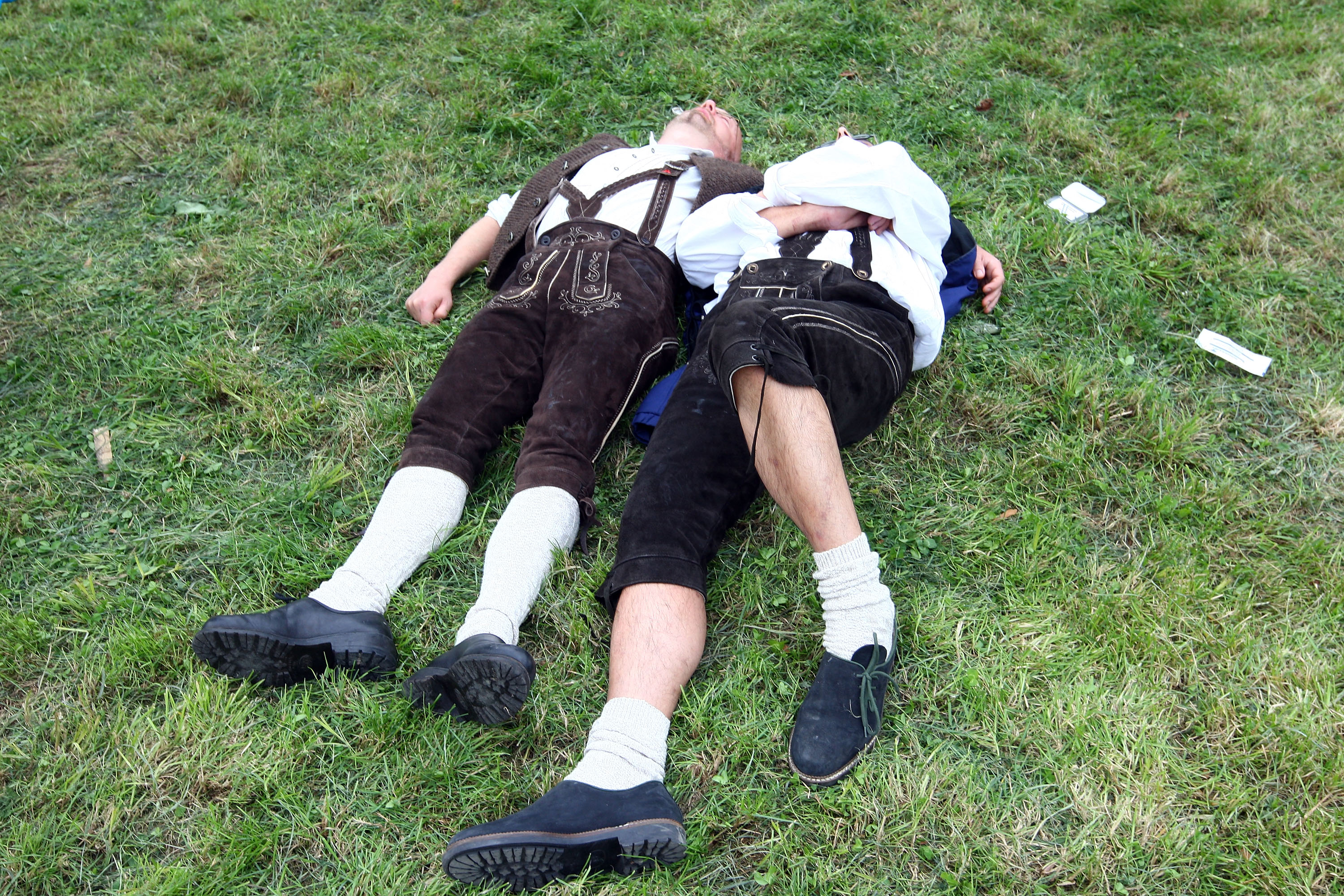
(Photo: Day 2 of the Oktoberfest beer festival on September 21, 2008 in Munich, Germany. By Johannes Simon/Getty Images)
Richard Skinner scratches his chin:
Ultimately, Barack Obama’s approval rating just doesn’t move around that much. It is striking, not for its lows, since most presidents have had periods in the 40s, but for its lack of highs. He hasn’t experienced a rally, as was experienced by George W. Bush after 9/11 and George H. W. Bush during the Iraq War. Nor has he presided over an economic boom, as Bill Clinton and Ronald Reagan did in their second terms. Obama’s job approval hasn’t exceeded 60 percent since April 2009, or 55 percent since that July.
What does this mean for 2016? I’m not sure.
I think it could be challenging for a Democratic presidential candidate to win under these circumstances, especially since the party has already controlled the White House for two terms. Could Obama’s job approval increase? The wave of good economic news suggests that it could happen; presumably, at some point, Americans will start feeling the improvements in their own lives. Perhaps the international scene will calm down as well. Maybe his approval rating will rise into the mid-40s or even the high 40s. But is it too late? All things being equal, presidents tend to see their approval ratings fall as their administrations age. And Obama’s approval rating has shown a certain imperturbability. Much like attitudes toward his most distinctive accomplishment, the public’s views of Obama may be built more on the rock of partisanship and ideology than on the sands of events.
Jonathan Bernstein is more optimistic:
It isn’t a common path for two-term presidents to improve after the last midterm. Then again most didn’t have an opportunity to have their best economic performance be in the final two years of their second terms. One advantage for Obama and the Democrats: Just as voters in 2010 blamed Democrats for hard times that began under Bush, people could have short memories again if good times return.
A lot of analysts are diving into the demographic data to figure out exactly how much of an advantage, if any, Democrats have in presidential elections because of the growing diversity of the electorate. My guess? Events over the next two years, and how they change the way people feel about Barack Obama, will matter a lot more than anything else.

 The Dish
