Love’s Labor Win?

Tyler Cowen highlights a paper that suggests union membership is a boon to marriage. From the paper’s abstract:

Over the past five decades, marriage has changed dramatically, as young people began marrying later or never getting married at all. Scholars have shown how this decline is less a result of changing cultural definitions of marriage, and more a result of men’s changing access to social and economic prerequisites for marriage. Specifically, men’s current economic standing and men’s future economic security have been shown to affect their marriageability. Traditionally, labor unions provided economic standing and security to male workers. Yet during the same period that marriage has declined among young people, membership in labor unions has declined precipitously, particularly for men.

In this article … union membership is positively and significantly associated with marriage. We show then that this relationship is largely explained by the increased income, regularity and stability of employment, and fringe benefits that come with union membership.

One In Twenty Arrests Are For Pot

Marijuana Arrests

Ingraham reviews new FBI data:

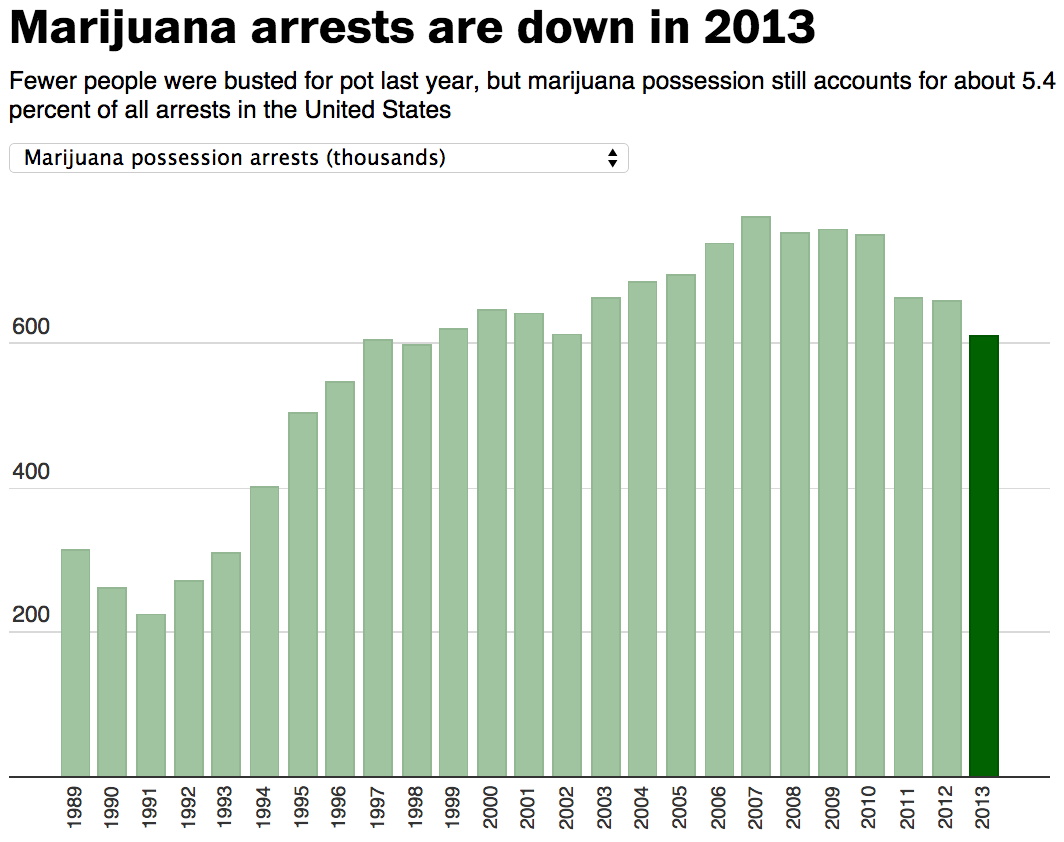
The total number of arrests for all offenses continues to drop sharply, from a high of 15.3 million in 1997 to 11.3 million in 2013. But marijuana possession arrests have not declined at the same rate – these arrests accounted for 1.6 percent of all arrests in 1990, but make up 5.4 percent of all arrests today. Moreover, arrests for all drug offenses made up a record share – 13.3 percent – of total arrests this year. Drug violations represent the single largest category of arrests tracked by the FBI. As NORML notes, if we assume ACLU’s conservative estimate of a cost of $750 for each marijuana possession arrest, it means that states spent more than $450 million on these arrests in 2013 alone.

Sullum examines the big picture:

The peak year for marijuana arrests was 2007, when there were about 873,000, three times as many as in 1991. The number fell to 848,000 in 2008, rebounded to 858,000 in 2009, and has been declining since then. Contributing to that trend, Colorado and Washington last year stopped arresting people for possessing less than an ounce of marijuana, as required by legalization measures that voters approved in 2012. Prior to that change, Colorado police were arresting about 10,000 people for marijuana possession each year. The annual number in Washington was about 6,000. Marijuana possession arrests in New York City, which peaked at more than 50,000 in 2011, also fell last year, from 39,218 to 28,644.

The downward national trend should continue. Washington, D.C., decriminalizedmarijuana possession last spring, and [yesterday] the NYPD announced that it will further reduce arrests of cannabis consumers, beginning later this month.

Matt Taylor explains the forthcoming NYC policy:

Starting next Wednesday, November 19, possession of 25 grams or less of pot—even in public view—will no longer get you cuffed and brought downtown by the cops. Instead, police will begin issuing criminal court summons, or desk appearance tickets, requiring guilty parties show up in front of a judge at a future date. The bad news for pot lovers is that smoking the stuff in public will still be sufficient to earn you a night or two in jail. And since many New Yorkers—especially young men of color—fail to show up when issued desk appearance tickets, this isn’t exactly a game-changer when it comes to the war on drugs in America’s largest city.

Matt Schiavenza hears from skeptical drug policy experts:

“It’s not decriminalization,” said Joanne Naughton, a former NYPD officer and member of Law Enforcement Against Prohibition, or LEAP. “People will be summoned into a criminal court to answer to criminal charges.” If those summoned fail to appear in court, judges could issue arrest warrants.

Kenneth P. Thompson, the Brooklyn District Attorney, is another skeptic. Thompson, who stopped prosecuting marijuana possession charges earlier this year, argued that a ticket and court summons would cause additional complications. Because summons without an arrest warrant don’t receive prosecutorial review, violators may not have access to full legal oversight and won’t automatically be appointed a lawyer. “These cases will move forward even when due process violations might have occurred,” Thompson said.

The GOP’s Firewall In The House

Nate Cohn measures it. Democrats now need 32 seats to retake the House:

The Republicans hold only 28 seats in districts that were carried by Mr. Obama. Many of these seats would fall to the Democrats in an anti-Republican year. The 12 newly elected Republicans who won seats in districts carried by Mr. Obama in 2012 are particularly vulnerable; many of these freshman Republicans could lose re-election in 2016.

Yet Democrats will have a struggle to win all of the seats held by Republicans that voted for Mr. Obama in 2012. The benefits of incumbency will allow many of these Republicans to defy even the most inhospitable conditions. And some of these Republicans, like Dave Reichert of Washington or Frank LoBiondo of New Jersey, are survivors of the 2006 and 2008 waves.

He concludes that “a Republican president is probably a prerequisite to a Democratic House.” 

Cohn, whose polling and demographic analyses are usually top notch, might be right this time, assuming that Republicans make no mistakes and Democrats keep shooting themselves in the foot. The last round of redistricting certainly gave Republicans a boost, and their expanded control of state legislatures may give them a head start on the redistricting that will take place after the 2020 census by boosting their likelihood of retaining control of those chambers. The expanded control at the state level also means that Republicans will produce more experienced candidates for the House and Senate over the next few years, which is one reason why some Democrats pointed to that outcome as the worst news from Election Night.

Still, history cautions against Republican optimism and Democratic despair. As we have seen over the last 20 years, it’s usually folly to assume that parties can avoid overreach and scandal for very long. Turnout in this wave election was historically low, which argues against learning any significant lessons on demography and sustainability. Unlike 1994, Republicans did not run on a unifying national platform; they relied instead on deep dissatisfaction with President Obama and Democratic leadership in the Senate that refused to check his perceived abuses. That parallels 2006 most closely, which means that the one mandate Republicans can claim would be to force Obama to work with the GOP on their terms, as voters either turned out to oppose Obama or didn’t bother to turn out in his support. That mandate could mean an even higher risk of overreach, although the lack of electoral consequences for last fall’s government shutdown suggests voters are very fed up with the White House.

A Pro-Life Election? Ctd

Olga Khazan discusses what the failure of “personhood” ballot initiatives in last week’s election – in contrast to Tennessee’s successful constitutional amendment paving the way for more restrictions on abortion – reveals about the split between the “incrementalist” and “absolutist” wings of the pro-life movement. While voters can’t stomach the radical changes the absolutists are demanding, that’s cold comfort to Kat Stoeffel, who argues that the incrementalists are in some ways a greater threat to abortion rights:

Rather than offering sweeping amendments for a hypothetical post-Roe future, [Target Regulation of Abortion Providers laws] revoke abortion access piecemeal, starting now. … Part of the insidiousness of TRAP laws is that they are so tedious they fly under the radar of all but the most dedicated pro-choice advocates. But another part of the problem is that TRAP laws don’t frighten the voter who is indifferent to abortion but also has the resources to navigate restrictions. She’s free to think, But I’d still be able to get one if I needed to and skip voting this year, as young people (who are traditionally pro-choice Democrats) disproportionately opted to do this year.

How does this play out? Based on the belief that he had an obligation to give a fetus a chance for life, a judge in Washington, D.C., ordered a critically ill 27-year-old woman who was 26 weeks pregnant to undergo a cesarean section, which he understood might kill her. Neither the woman nor her baby survived. In Iowa, a pregnant woman who fell down a flight of stairs was reported to the police after seeking help at a hospital. She was arrested for “attempted fetal homicide.” In Utah, a woman gave birth to twins; one was stillborn. Health care providers believed that the stillbirth was the result of the woman’s decision to delay having a cesarean. She was arrested on charges of fetal homicide. In Louisiana, a woman who went to the hospital for unexplained vaginal bleeding was locked up for over a year on charges of second-degree murder before medical records revealed she had suffered a miscarriage at 11 to 15 weeks of pregnancy.

Jessica Grose, meanwhile, pleads with her fellow left-feminists to stop describing the midterms as “bad for women”, as it’s a bit condescending to the millions of women who voted for Republicans like “combat veteran and hog castrator Joni Ernst in Iowa, black Mormon Mia Love in Utah, and youngest woman to ever be elected to Congress Elise Stefanik in New York”:

It’s not just candidates that women disagree on. It’s the issues themselves. Let’s take access to abortion, which is seen as a pivotal “women’s issue.” According to the Washington Post, polling over the years has shown that there’s actually not that much difference between men and women’s views on abortion. And women may be more supportive of restrictions on late-term abortions than men are. Particularly in this election, issues like the economy and security have outweighed social issues among all voters. Which is to say, though the right to choose is incredibly important to people like me and Ann Friedman, it’s not as important to a good portion of the female electorate.

The Gerrymandering In Michigan

Rigging the geography of districts does not fully explain the GOP’s grip on the House, but in Michigan, at least, it definitely had an impact:

State House: 1,536,711 (51.2%) total votes cast for state House Democratic candidates that resulted in 47 Democratic House seats (43%)

1,464,983 (48.8%) total votes for state House Republican candidates result in 63 Republican House seats (57%)

State Senate: 1,483,938 (49.3%) total votes for state Senate Democratic candidates result in 11 Democratic Senate seats (29%)

1,528,393 (50.7%) total votes for state Senate Republican candidates result in 27 Republican Senate seats (71%)

U.S. Congress: 1,506,455 (49.1%) total votes for Democratic congressional candidates result in 5 Democratic congressional seats (36%)

1,458,264 (47.6%) total votes for Republican congressional candidates result in 9 Republican congressional seats (64%)

That last one is a little jaw-dropping, innit?

The View From Your Window Contest: Winner #230

VFYWC-230

A reader writes:

A quick glance at the photo immediately brought Haifa to mind, particularly the curved bay stretching north to Akko and the hint of date palms in the foreground. On closer inspection I found nothing major to persuade me otherwise, although I seem to remember the coastline to be slightly more built up than it appears in the photo. In any case, finding the actual building has proved beyond me, so I’ll guess this was taken from a house somewhere along Henrietta Szold Street.

Another hedges his bets:

This is obviously Richmond, California; Cape Town, South Africa; Perth, Australia; Almeria, Spain; or Valparaiso, Chile. (I think that covers all of the Mediterranean-climate bases.)

Another looks very closely:

Surgery this week meant a short window of time to search, but during that time I searched every port identified by worldportsource.com as a port of call for Mediterranean Shipping Company, the MSC seen on the container ship. However, it seems to be about 60 short of the number of ports actually serviced by MSC. So, I’m left waiting to hear where it is. Judging from the picture, I see what could be Japanese architecture, arid mountains, and modern homes and street lights. I think Hawaii and Japan are too lush and, and so I’m guessing a shot in the dark that it’s in California. I thought maybe Palo Alto, but it doesn’t match.

The next reader might be wrong, but at least we learn something:

Holy crap! I think I’m starting to get into this, as I have been at least getting the right city. I think you’re showing some British Imperial nostalgia, as this is almost certainly the city of Valapraiso, Chile! What has this got to do with Britain? Well it was port city that held commemorative events for the Battle of Coronel, where a naval force under the German von Spee destroyed an antiquated British force under Rear Admiral Cradock, the first naval loss by the Royal Navy in World War I (and a humiliating one at that, as all casualties were British). However, this victory sowed the seeds for the defeat of von Spee and his men, since he had expended over half his ammunition in the battle and had no means of re-supply. The British were eager for revenge, which they got shortly thereafter at the Battle of the Falkland Islands.

The 100th anniversary was just this month. And the skyline looks just like the many pictures that the BBC posted on the anniversary of the battle.  I’ll leave the specific window to someone else …

Another emailer gets us on the right continent with this tantalizing offer:

Hi Dear, compliments of the season. I know that you do not know me, i do not know you in person but i got your contact from a business consultant in Dakar – Senegal. I have a proposal for you,please get back to me if you are interested in a business related issues..

A real reader takes us to the right city in Africa:

I thought it might be Marseille from looking around during other contests, but nope. (That’s the story for most of these contests for me, “Know nope.”) So please let it be Cape Town, South Africa. I’m guessing somewhere in the Oranjezicht neighborhood.

A former resident confirms:

I’m an American who spent 4 years (’92-’95) teaching high school at Zonnebloem on the edge of the old District Six in Cape Town (near this exquisite perch); now principal of a school in Gaborone, Botswana (landlocked), and miss the mountains and sea in the world’s most beautiful city. Yup, even better than San Francisco. Actually, the best view from this spot in the “city bowl” is of Table Mountain which you’d see if you turned 180 degrees.

Table Mountain has been made a few appearances on the Dish, including Contest #69, which led to one of our favorite coincidences of the contest series. Meanwhile, a former winner nails this week’s hotel and window with yet another greatly informed entry:

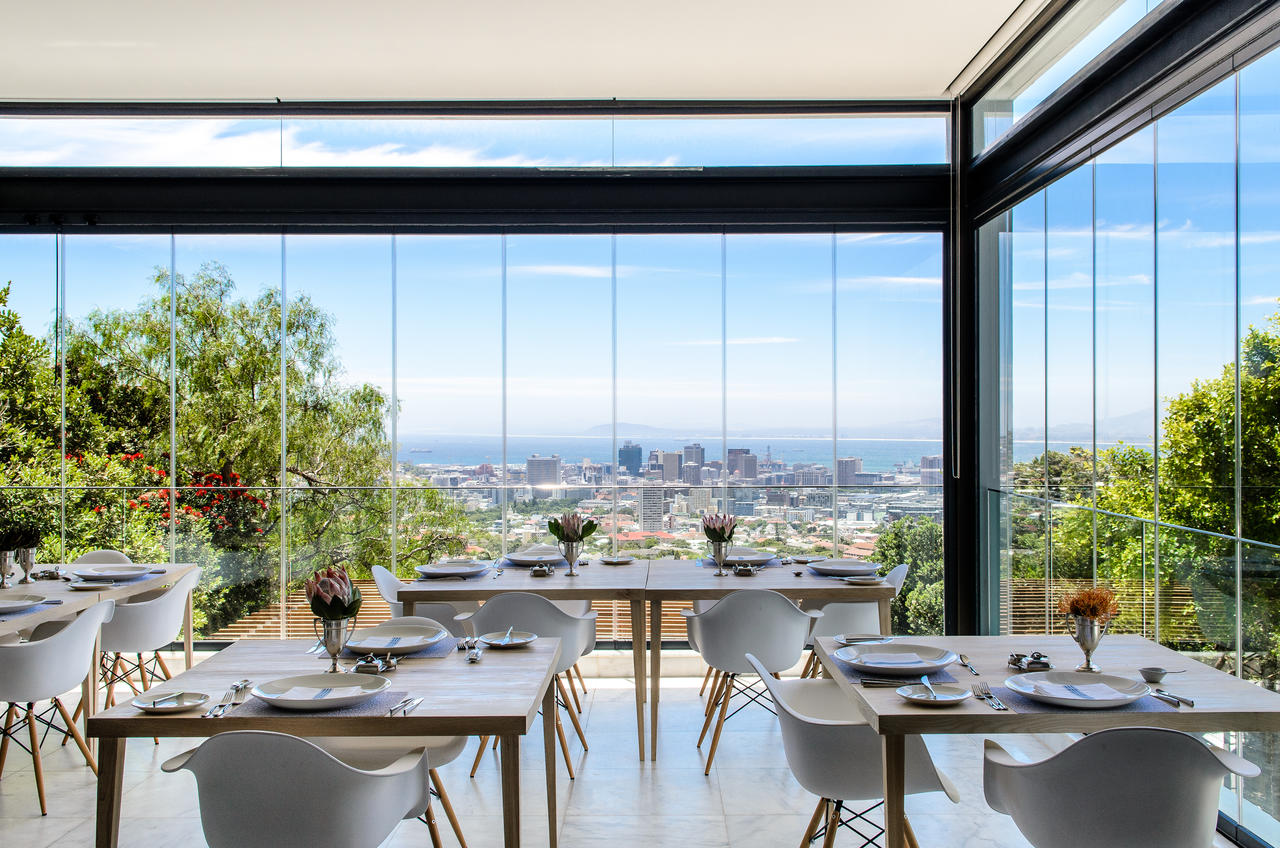
This week, we are all jealous of the submitter who enjoyed a meal in the dining room of the MannaBay Boutique Hotel admiring the views across Cape Town, Western Cape, South Africa out towards Table Bay.  The address is 8 Bridle Road, Oranjezicht, Cape Town, 8001, South Africa and it sits below Table Mountain.  At first, the foliage, mountains across the water, and my mistaken believe that there was a mixture of forks and chopsticks on the table caused me to start my search in Australia and New Zealand. I searched for container ports where the opening of the bay faces north in the southern hemisphere, but few ports fit.  Finally giving up on Oceania, I randomly searched ports in Chile and South Africa and quickly landed in Cape Town.

The window is the large glass wall of the MannaBay’s dining room facing north.  There are many wonderful pictures of the room and the window online, including this one.  The angle and stone wall along the left edge of the contest photo means the photographer was standing above the table against the left (western) wall of the room:
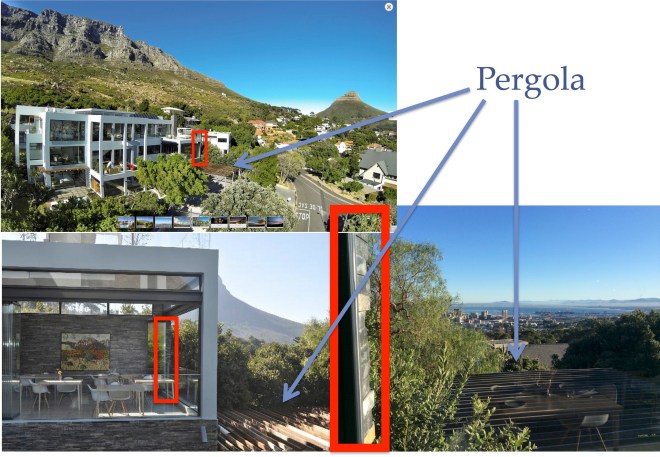
Window

Although a wonderful painting, the hotel’s decorator placed the portrait of Lord Byron wearing Albanian dress in the Persian room.  It was painted in 1813 after Byron returned from his Grand Tour of the Mediterranean but prior to his more famous foreign travels that culminated in his death during the Greek War of Independence.  Byron, and this famous painting, would influence generations of future travel writers.  As seen in this portion of a BBC documentary, Patrick Leigh Fermor looked to Byron for literary inspiration as well as how to pose when wearing traditional Cretan pants.  The horse statutes in the Persian room also seem out of place.  They appear to resemble Chinese terracotta horse statutes (here or here) rather than Persian ones.  Nonetheless, the room – like the others – looks amazing.

This week is really going to haunt this player:

I woke up this morning from a bad dream where I had put the wrong address on my entry. And I had!  The house I indicated in my earlier email is 4 Bridle Rd, not 6 Bridle Rd as I had stated previously. So 4 Bridle Rd.  Final answer. And now you know the contest gives some of us bad dreams.

As noted above, it’s 8 Bridle Road. Here’s this week’s collage of your guesses:
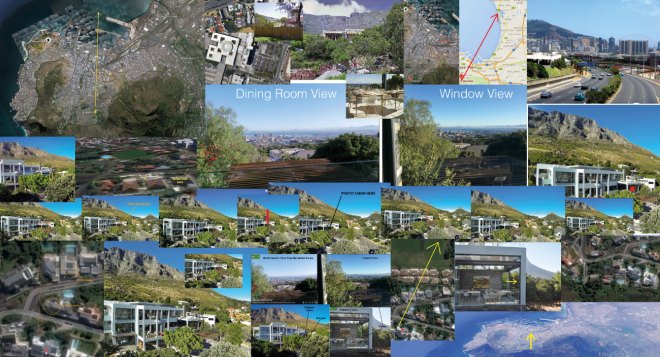
VFYWC-230-Guess_Collage_sm

A long-time reader, first-time player:

We had a dinner party tonight and I showed a South African friend who knew immediately that it was Cape Town. His dad, now a US citizen, grew up in a neighborhood in the picture. After five pounds of steak and a lot of wine, we started our investigation in earnest. I relied on Google Earth and clicked on B&B’s, restaurants and hotels in the vicinity. For a while I got sidetracked and looked for establishments with Eames chairs – since they’re trendy – but came back to Google and methodically checked until I found MannaBay. It’s 1 AM!

Also, I’m a huge fan. The Dish kept me sane my ten years as a stay-at-home mom. Between breastfeeding, spit-up, laundry, cooking, baths, play dates, errands, etc. I religiously visited The Dish. I’m back to work so I don’t get it as often, but when I do, it’s one of my favorite parts of the day.

Another correct guesser gets rightfully sentimental:

Since the birth of my second daughter in mid-October, I haven’t participated in the contest, finding the views too difficult to solve from only a mobile phone and in the limited time available.  This week, with the baby sleeping more soundly, and a view that instantly evoked a reaction in me, I had to solve it.

While sitting with my new daughter sleeping next to me, I was brought back to a thrilling time a few months into my relationship with her mother (and my wife).  My wife and I met in the summer of 2001 during a summer job, and instantly hit it off.  While we almost instantly knew we were soulmates, she was taking the fall of 2001 to study abroad in South Africa, first in Venda, and then Cape Town.  Before smart phones and ubiquitous internet accessibility or Skype, this was a real challenge to our relationship.  Feeling like I needed a personal connection, I decided to visit her once she got to Cape Town.  I flew half way around the world in October, 2001, shortly after 9/11.  After a nervous transfer through Johannesburg and having my luggage lost, I was unsure if I had made a wise choice.  But the moment I saw my wife, it was clear why I had to come.  Her classmates quickly accepted me, (perhaps mockingly) calling me “The One,” and I proceeded to have an amazing experience with the woman I was madly in love with, who I’m now lucky enough to call my wife and mother of our children.

Another reader shares a less happy memory:

It took me a very long time to identify this as Cape Town even though I’d spent a few nights with some friends in this general area several years ago. It was 1994 and my first time to Cape Town. I’d been staying in Botswana for a few years and was doing some hitchhiking to see a few places before I headed back home to the States. I left Cape Town on 10 May.  Nelson Mandela took the oath of office in Cape Town that same day.  I could tell you all the reasons why I left when I did, but they all seem rather lame now. I was standing by the paved road on the edge of Cape Town looking for a ride to Namibia when I saw the flyover.  I took out my camera, took a picture, and instantly knew that I was going to regret that moment for the rest of my life:
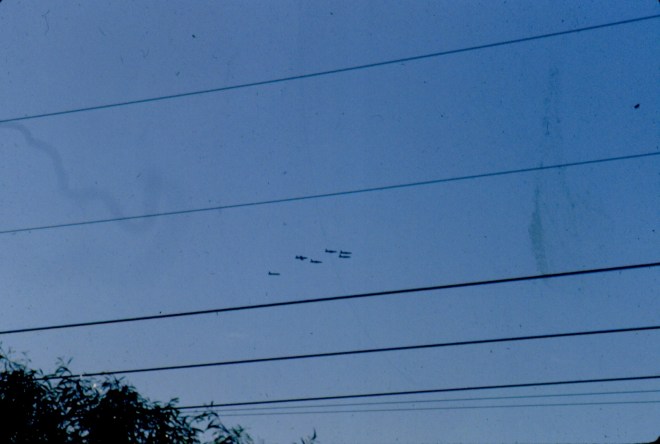
mandela flyover

Also, our contest poet from last week returns:

This one took longer than I had predicted
My wife suspects that I am addicted.

Again with the seaside ports you go,
MSC has 2-7-0.

Search shots of “succulents”, where’s this one found?
Eureka, the MSC port of Cape Town!

Next, a feat of long distance alignment,
Oh, I spy three! What alignment refinement:
That hill in Cape Farms, the Civ-Centre Tower,
And solar arrays … now I feel the power!

(As everyone knows, solar panels face north,
As long as you live way down south, of corth.)

Plotting scotch tape across PC screen,
I head for the view, with points in between,
To T-Mountain Park, I wiggle and squirm,
Manna Bay Cafe: Reflections confirm!

Left window panel, floor two, final tally,
Now for an optional tasteless finale:

Who, me? Addicted? What kind of a man,
Reads maps on his iPad while warming the can?
Please do not laugh, I may be a stinker,
But you can’t go wrong emulating The Thinker!

But emulators be warned, our Grand Champion has become a household name:

“I bet Doug Chini is happy,” said my 10-year-old daughter when she saw this one …

We’re not so sure:

The “Pom Pom” room. Yep, that’s actually the name of one of the rooms at the hotel where this week’s view was shot. The pic itself was only middling in terms of difficulty, but the hotel may very well be the most disgustingly posh lodgings ever featured in the contest. Which is my way of saying that I’d give my right arm to be there instead of being stuck up here staring into the teeth of the oncoming New York winter.
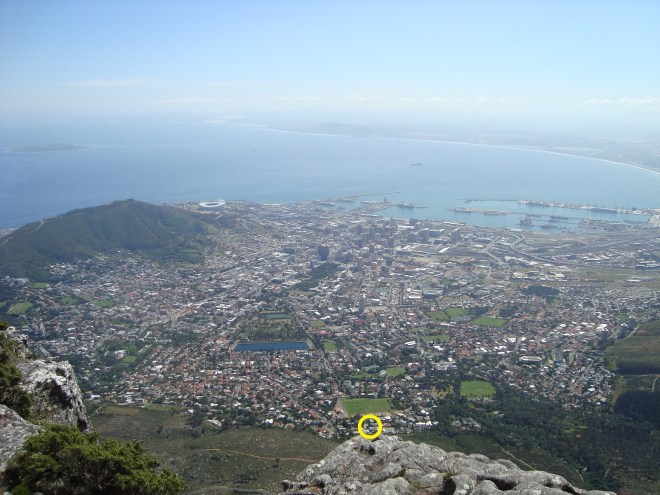
VFYW Cape Town Aerial Marked - Copy

This week’s view comes from a hotel on the lower slopes of Table Mountain and looks out over Cape Town, South Africa along a heading of 25.58 degrees. The picture was taken at approximately 7:02 AM local time on the morning of November 6th from the front left side of the Cafe at the MannaBay Hotel.

On to this week’s winner. This contest was the 18th time this veteran player has nailed at least the right building. His prize-winning entry this week:

This VFYW was taken from the Manna Bay hotel in Cape Town, bordering Table Mountain at 8 Bridle Rd.

The photographer sees a bay, with substantial development on both opposing shores.  The architecture is Western European or American; there are no hints of East Asian, South Asian, or classic Mediterranean building details.  The flora suggests a climate that is temperate, but somewhat arid.  I’m familiar enough with California to rule its cities out.  My inclination was that we are looking at western or southern Australia, Chile or Argentina, South Africa, or possibly Mexico.  The two long piers in the harbor provided a useful litmus test when looking at maps of harbors. Having first ruled out the harbors of Perth and Adelaide, I hit paydirt with the long piers at Cape Town:

 image001

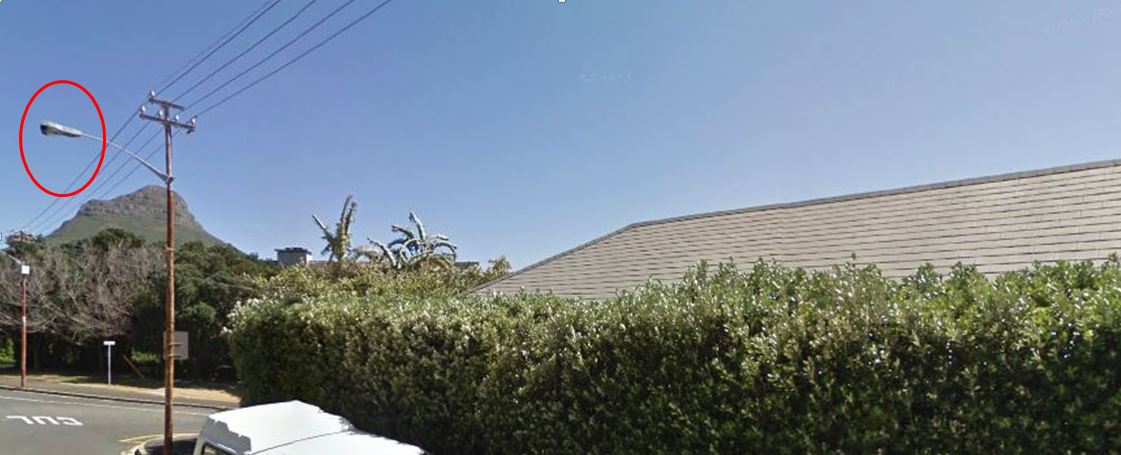
Using Google Maps, I knew I was close when I found the street lamp by a house with the appropriate shingle roof.
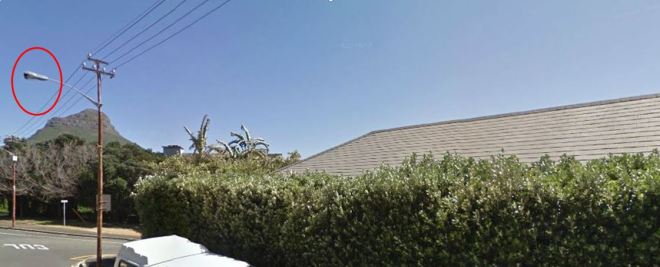
image002

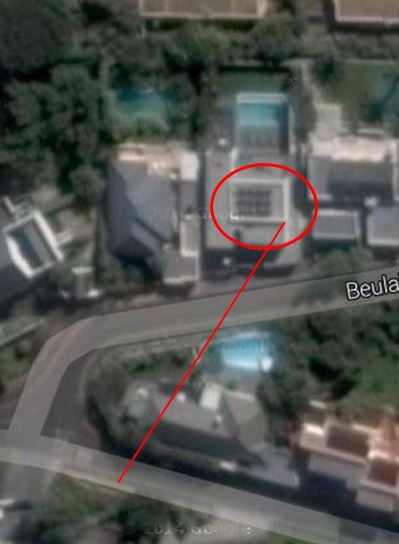
Then I found the solar panels, and considered the alignment of the corner of their platform and the peak of the shingle roof:

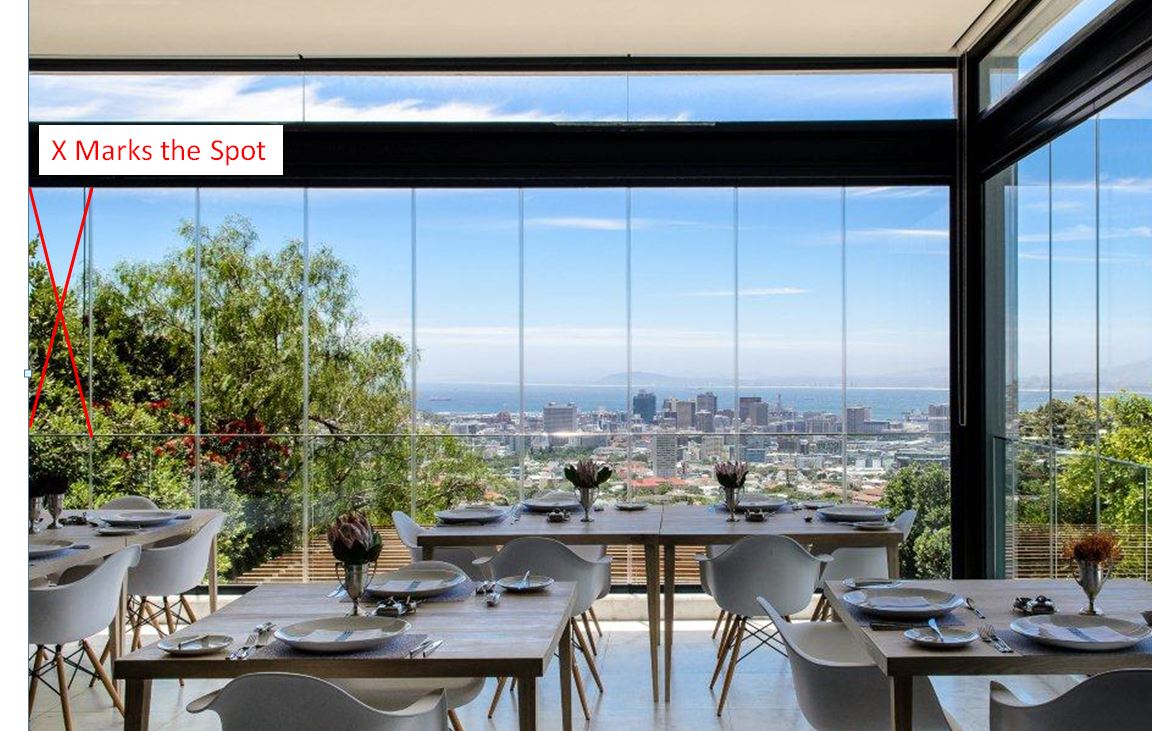
image003That pointed me to the Manna Bay, and the solution. X marks the spot:
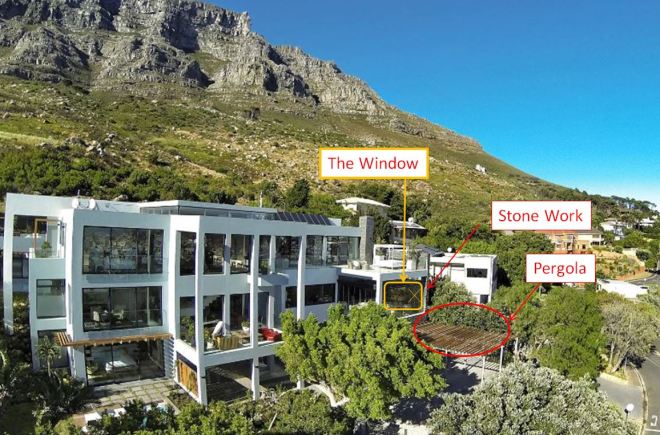
image004

… which we can see from the inside, too, along with the table and chairs reflected in the glass of the VFYW:
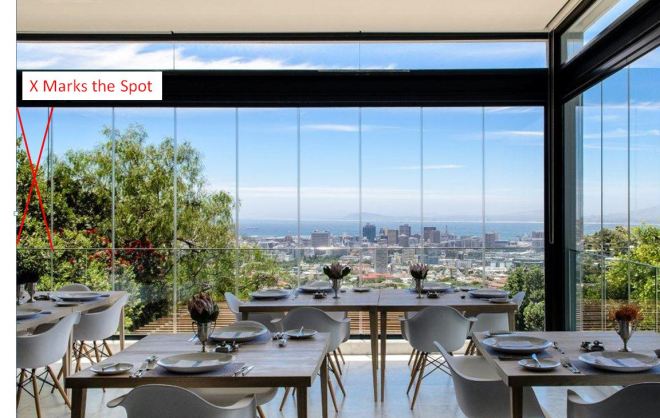
image006

By the way, our winner was also the reader the submitted the photo for Contest #197. Speaking of submitters, this week’s photo was the first this reader had ever sent in:

I was in Cape Town as part of a trip to South Africa to attend the wedding of the daughter of very close friends of mine from Washington DC (glad Andrew finally came to his senses and moved back!).  She is an American and yesterday married a South African man from Hermanus, a spectacularly beautiful resort town on the Atlantic about 90 minutes drive from Cape Town.  Hermanus is famous for having the best land-based whale watching in the world.  A large population of Southern Right whales spends July to December in Walker Bay.

Cape Town, and the Western Cape part of South Africa, is stunningly beautiful. The core part of the city as you no doubt know is nestled between Table Mountain and the Atlantic Ocean (Table Bay). The climate is Mediterranean, and it is late spring now. Spectacular sunny warm days with very low humidity, and chilly nights. A little like the weather in Santa Barbara California. The city is an amazing melting pot of people of indigenous tribal, Afrikaans, British and a little bit of everything else.  For example there is a section of the city that originally housed a large Malaysian population. Little known fact at least to me – when the Dutch first colonized South Africa they brought Malaysians as slaves.  The people are extremely friendly, the food and wine are delicious, and the cost is relatively low, at least that is the sense of American tourists like me.

I will follow the results of the photo contest with great interest. My guess is that a lot of people will quickly figure out it is Cape Town but they may have more trouble identifying the MannaBay hotel. We shall see.

Thanks and keep up the great work. I read The Dish every day, including here in South Africa.

Lastly, reader alerts us to some new competition from The Paris Review:

For the past few years, readers of the Daily have enjoyed an occasional series called “Windows on the World,” featuring Matteo Pericoli’s intricate pen-and-ink drawings of the views from writers’ windows around the world. Now those drawings are available in a book—Windows on the World: Fifty Writers, Fifty Views—and we’re celebrating with a contest. You can have your view illustrated by Pericoli, too. Starting today, submit a photograph of the view through your window—including the window frame—along with three hundred words about what you see…

The reader adds, “But I guess plagiarism is the sincerest form of flattery, right?”

You can browse a gallery of all our previous contests here.
Obama Revives The Net Neutrality Fight

Yesterday, the president threw his full support behind the principle of net neutrality, urging the FCC to reclassify broadband Internet services as a public utility:

Obama’s argument explicitly rejects proposed rules that FCC considered earlier this year to allow paid prioritization, a plan by which content providers can make deals with ISPs to get faster service to their websites. (Those rules are still under consideration and have not been finalized.) The White House proposal calls for no paid prioritization, no blocking of any content that is not illegal, and no throttling of Internet services, where some customers have their Internet speeds artificially slowed down. The proposal also asks that any new rules include mobile broadband, which is already the primary access point for many users.

As the president himself reminds us, the FCC does not answer to him, and does not have to listen to (or even consider) his suggestions. So there are no guarantees that any of these rules will even come to pass. However, an endorsement by the White House would be the strongest push yet toward an FCC that treats all Internet traffic as equal.

Phillip Bump calls this politically smart:

[S]iding with people against Comcast (which actually is subject to a higher standard on neutrality than other companies for now) and other cable providers is hardly a political misstep. (Do you love your cable company? Right. Thought so.)

It also helps repair relationships with the tech community that were splintered in the wake of the National Security Agency’s spying revelations.

When leaks from Edward Snowden revealed the extent to which the agency was infiltrating social networks, it put firms like Facebook and Google in an awkward commercial position. The administration reached out to the companies as it planned revisions. But an embrace of net neutrality —backed by big companies that don’t want to have to pay more to push out their content — is a big win for for tech. It could use one; its marquee midterm race went poorly.

Jason Koebler weighs the reaction from net neutrality proponents:

At first blush, it looks like  many of the most net neutrality supporters are happy with Obama’s announcement. Tim Karr, senior director of strategy at Free Press, who has organized many of the net neutrality protests called it “huge.” Tim Wu, who invented the idea of net neutrality, called it “100 percent on target.” The Electronic Frontier Foundation also backed Obama’s statement.

Of course, in the end, this is the FCC’s decision, and chairman Tom Wheeler has already proposed a  mostly maligned “hybrid” proposal that is apparently already being thrown out because of the backlash it received when its existence leaked more than a week ago. In that proposal, paid prioritization could occur between content providers and ISPs: Netflix, for instance, could pay to have its content delivered faster to consumers. In his statement, Obama said that’s no good.

David Dayen detects a message here about what kind of lame-duck president Obama plans to be:

As for the president, this maneuver signals that he’s not looking to be a caretaker in his final two years, at least on discrete issues. Net neutrality activists correctly reasoned that getting Obama involved would provide the surge of support they needed for reclassification, and they targeted him as much as the FCC over the past several months. Obama showed that he listened, and it should give some solace to other groups wanting him to use his executive authority. In other words, Obama’s action on net neutrality is very good news for those who want him to move on immigration.

Nick Gillespie remains staunchly opposed to what he calls a dumb policy:

The most likely outcome is that regulators will freeze in place today’s business models, thereby slowing innovation and change. That’s never a good idea, especially in an area where new ways of bundling and delivering content are constantly being tried. It’s a historical accident that cable companies, who back in the day benefited from monopoly contracts with local governments, have morphed into ISPs. That will not always be the case, as the rise of Verizon (originally a phone company) and Google’s rollout of its own fiber system, attest. Just a few years ago, the FCC frowned on the cell-phone company MetroPCS’s discount plan that allowed access to the World Wide Web but denied users multimedia streaming. The FCC and Net Neutrality proponents thought that was a bad thing. Customers on a budget had a different opinion.

James Pethokoukis also opposes Obama’s proposal:

Keep in mind that the Obama plan would give the FCC, according to R Street’s Steven Titich, “the widest range of alternatives for economic and technological regulation of broadband.” And, of course, make the agency an even more attractive target for the lobbying class. …

All this, then, just to lock in “net neutrality” – a situation that does not exist and never existed — despite the risk of limiting new investment and innovation, Obama wants the FCC to treat the internet like a public utility. But the Obama proposal is based on flawed model of how the internet operates. Half of the internet’s traffic comes from just 30 content providers such as Google and Facebook.  And they’ve already made special arrangements by plugging directly into the ISPs. “Fast lanes” already exist. Again, R Street’s Titch: “There’s nothing about network neutrality to “preserve.” A regulation that pretends there is would serve to remove an economic incentive needed to ensure that broadband infrastructure is sufficiently robust to support the demands contemporary applications have placed on it.”

But Adam Clark Estes argues that opponents are overstating the level and nature of regulation Obama is proposing here:

If the idea of using an 80-year-old law to regulate a super futuristic communications technology worries you, you’ll be very glad to know that the president’s got your back. In his statement, there is this brief but very important line: “I believe the FCC should reclassify consumer broadband service under Title II of the Telecommunications Act—while at the same time forbearing from rate regulation and other provisions less relevant to broadband services.” (Emphasis mine.)

So the first part of it is the big reveal. Obama wants the FCC to treat broadband companies as common carriers. Telephone companies are also a common carriers regulated under Title II of the Telecommunications Act. However, this does not mean that Obama wants the FCC to apply all of the same regulations for telephones to broadband internet.

Meanwhile, here’s Ted Cruz’s response:

Yglesias tries to translate:

What, if anything, that phrase means is difficult to say. But its political significance is easy to grasp. All true conservatives hate Obamacare, so if net neutrality is Obamacare for the internet, all true conservatives should rally against it.

The asinine analogy prompted Matthew “The Oatmeal” Inman to create this explainer cartoon.

Yglesias Award Nominee

“There is an animal-welfare bill on New Jersey governor Chris Christie’s desk right now, S998, which pigspassed both the Senate and the Assembly with strong bipartisan support. The bill would ban the use in New Jersey of so-called gestation crates, the metal stalls, 2 feet wide by 7 feet long, that confine more than 80 percent of pregnant pigs in the United States. The National Pork Producers Council opposes S998, because it opposes any legislation that might constrain animal agriculture. The group’s communications director belittled animal-welfare concerns, telling a journalist, “So our animals can’t turn around for the 2.5 years that they are in the stalls producing piglets. . . . I don’t know who asked the sow if she wanted to turn around.”

Most of us are not so dismissive where cruelty to animals is at issue, which is why the bill is supported by 93 percent of New Jersey voters, including 94 percent of Democrats and 92 percent of Republicans. It’s hard to imagine a more popular piece of legislation … It’s not just animal science that is offended by the crates — so is basic morality. In short, forcing pigs to spend their lives in such conditions violates elementary principles of decency, compassion, and mercy … The bill on Governor Christie’s desk right now is a common-sense measure that merely requires that pigs in New Jersey be able to lie down when they wish and turn around comfortably. Surely, that’s the least we as a society can provide them,” – Bruce Friedrich, National Review.

For a glossary of the Dish Awards, see here.

“The Great Political Reality Of Our Time”

Compensation

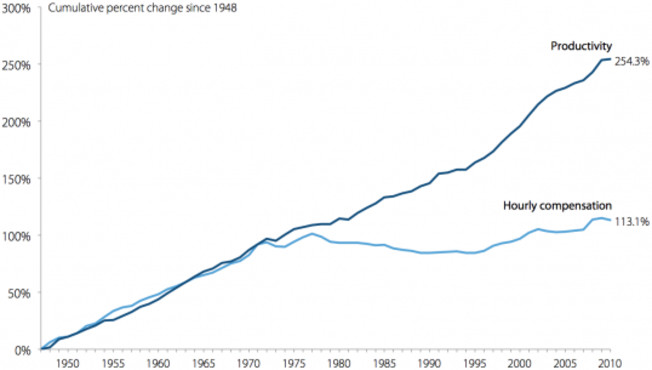
Josh Marshall declares it’s “that Democrats don’t know (and nobody else does either) how to get wage growth and productivity growth or economic growth lines back into sync”:

Democrats have toyed (and I use that term advisedly) with the issue of rising inequality for the last two elections. But let me suggest that as a political matter inequality is a loser. What is driving the politics of the country to a mammoth degree is that the vast majority of people in the country no longer have a rising standard of living. And Democrats don’t have a policy prescription to make that change.

Here is a chart we’ve probably all seen some version of. The gist is that while productivity growth has been relatively consistent through the post-war period, productivity became unchained from wages in the early 1970s. Despite a modest bump up in the 90s and another small one in the aughts it’s really never come back.

He admits that populism isn’t going to fix this problem:

Fundamentally, most people don’t care particularly how astronomically wealthy people are living their lives. It is a distant reality on many levels. They care a great deal about their own economic circumstances. And if you are not doing any better than you were 5 years ago or a decade ago or – at least in the sense of the hypothetical median wage earner – 40 years ago, that’s going to really have your attention and shape a great deal of your worldview and political outlook. …

But what are the policies that would change this corrosive trend? And how do you run on them as a party if you don’t know what they are? Minimum wage increases help those at the very bottom of the income scale and they have a lifting effect up the wage scale as the floor gets pushed up. But it is at best a small part of the puzzle. Clamping down on tax dodges by the extremely wealthy claws back some resources for the treasury and sends an important message, as might some restrictions on ridiculously high CEO pay. But again, these are important changes at the margins that do not fundamentally change the equation. Economic populism or another comparable politics with a different tonality won’t get you very far if you can get beyond beating up on the winners to providing concrete improvements to those losing out in today’s economy.

Relatedly, McArdle contends that the “lack of a clear and stable career path is … a worse problem than the wages paid by firms that employ large amounts of low-skilled labor”:

You can do anything for a short period of time, including slave away for very low wages.  But for this to be true, your labors have to lead somewhere other than more slavery at very low wages.  … Consumer confidence remains depressed, and it will not get un-depressed just by raising the hourly wage.  Most people don’t want better unemployment benefits; they want to be able to stop worrying so much about losing their jobs. Nor do they want to spend the rest of their life working at McDonald’s for a better wage; they want to leave the hot kitchen for a better job.  That’s still what’s missing.

Will Roberts Vote Against Obamacare?

Barry Friedman and Dahlia Lithwick aren’t so sure:

[I]t is possible everyone has their political calculus wrong with regards to the Chief Justice, just as we did the first time the Supreme Court looked at the ACA. Roberts, according to all accounts, did a last-minute 180 on Obamacare in 2012. We may never know why, but it seems likely it had something to do with preventing a backlash against the court. While such a backlash is less likely now—especially given the just-completed midterms that gave Republicans control of the whole Congress—Roberts is savvy enough to know how a ruling against the federal government in this case could be perceived. In a recent speech to the University of Nebraska College of Law, Roberts said that he didn’t want Americans to start to view the Supreme Court as a “political entity.” “I worry about people having that perception, because it’s not an accurate one about how we do our work. It’s important for us to make that as clear as we can to the public.” A 5-4 anti-Obamacare vote in King v. Burwell would accomplish the exact opposite: Eliminating the federal government’s subsidies, when there is such widespread agreement that Congress never, ever intended such a thing, would look like nothing but a political swipe.

I’m staggered that the Justices took the case. I tend to agree with Simon Malloy that a partisan SCOTUS ruling that struck down the heart of the Affordable Care Act on a technicality/typo would invite the greatest mobilization of liberal voters since 2008. But that might not stop the Court anyway. Noah Feldman suspects that, if SCOTUS “announces a fundamental constitutional right to marry, its liberal legacy will be so prominent that Roberts may have reason that he can kill Obamacare without tarnishing the court’s reputation too much”:

Imagine that, in the space of a few days at the end of June, the court decides a landmark case in favor of gay rights and then says that the IRS can’t give subsidies to citizens of states that have created their own health-insurance exchanges: What liberal critic would be able to say with a straight face that this was the most conservative activist court in history? The court would be activist, all right, but it would appear almost evenhandedly so.

Beutler lists off reasons Roberts may side with the government. Among them:

Chief Justice John Roberts himself is a business friendly justice. The Chamber of Commerce basically bats 1.000 with him. An adverse ruling would cause immense harm to powerful corporate interests like private insurance companies, hospitals, and other stakeholders, all of whom oppose the challenge.

Bill Gardner, on the other hand, bets that Roberts will agree with the challengers:

The constitutional outcome of a victory for the King plaintiffs would be a radically decentralized federalism. It would mean that increasing access to health care through the ACA would require political validation at the state as well as the federal level. This outcome would be consistent with the constitutional philosophy that Roberts and many other conservatives espouse. For this reason, if no other, I expect Roberts to vote for the King plaintiffs.

Earlier Dish on the case here and here. Update from a reader:

If it were based on a “typo”, why would Jonathan Gruber publicly state that the intention of that language was to force states to establish exchanges? Clearly there is more to this than your flippant dismissal indicates.

Another:

He made a mistake. Simple as that.