Why It Still Doesn’t Feel Like A Recovery

Underemployed

Derek Thompson fingers “invisible unemployment”:

What is “invisible unemployment”? It’s discouraged workers and part-timers who want more hours. The official unemployment rate doesn’t consider them unemployed. So when we talk about the official unemployment rate—now at a lowish 5.8 percent—we’re ignoring these workers. They’re statistically invisible. Here’s a picture of invisible unemployment (in blue) vs. official unemployment (in red). Since early 2010, the number of unemployed Americans has declined by twice as fast as the number of discouraged/part-timers (42 percent vs. 21 percent).

In 2002, official unemployment swamped invisible unemployment. The official unemployment rate was an accurate description of the labor force. But the spread between invisible and official unemployment is shrinking. In the last 20 years, the six months with the smallest gaps between official and invisible unemployment were all in 2014. That means the official unemployment rate is getting worse and worse at describing the real conditions facing American workers.

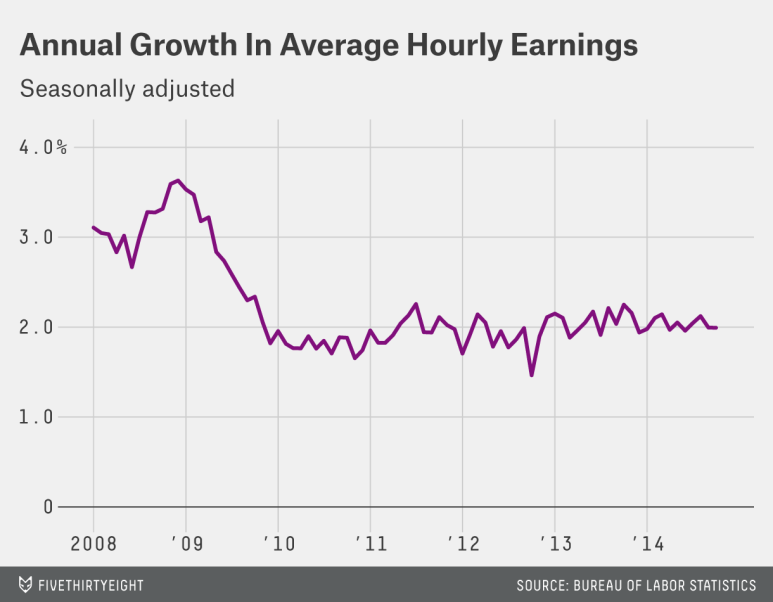
Ben Casselman focuses on our weak wage growth:

The average worker earned $24.57 an hour in October, up 2 percent from a year earlier. Even as hiring has picked up and unemployment has fallen, wages growth has remained decidedly anemic.

wages

From an economics perspective, modest wage growth isn’t an entirely bad thing. It suggests that employers aren’t struggling to find workers to fill the available jobs, which means employment growth can continue without the economy overheating. For policymakers at the Federal Reserve, it means they can keep trying to boost the economy with low interest rates without worrying too much about inflation.

But for workers, the earnings figures mean that they aren’t seeing the economic recovery reflected in their paychecks. Until that changes, they’re unlikely to take much comfort in jobs-day headlines, no matter how positive.
Greg Ip adds that “productivity is up only 0.9% in the last year, lower than the 1.3% average recorded since the recession, itself none too impressive”:

Both weak pay and productivity might be related to the sorts of jobs growing the most; Steve Blitz of ITG reckons almost 70% of this month’s private sector job growth were in temporary work, health care and restaurants. Manufacturing and construction both rose, but by slim numbers.

But Weissmann remarks that “some, like Moody’s Analytics economist Mark Zandi, are convinced wage spikes are just around the corner”:

Even though the overall unemployment rate is still high by long-term standards, some analysts believe that the millions of the long-term jobless are essentially unhireable—meaning that employers are actually looking at a much smaller labor pool. The short-term unemployment rate is already almost back to normal, and to them, that indicates pay raises are on the way. If they are, we can only hope that the Fed doesn’t overreact and throw cold water on the economy before it ever really gets hot.


The Philosophy Of Nay-Sayers

A reader points us to Massimo Pigliucci’s fascinating recap of an academic conference on denialism, or “the willful disregard of factual evidence by ideologically motivated groups or individuals.” One noteworthy takeaway:

Denialists have learned to use the vocabulary of critical thinking against their opponents. To begin with, of course, they think of themselves as “skeptics,” thus attempting to appropriate a word with a venerable philosophical pedigree and which is supposed to indicate a cautiously rational approach to a given problem. As David Hume put it, a wise person (i.e., a proper skeptic) will proportion her beliefs to the evidence. But there is nothing of the Humean attitude in people who are “skeptical” of evolution, climate change, vaccines, and so forth.

Denialists have even begun to appropriate the technical language of informal logic: when told that a majority of climate scientists agree that the planet is warming up, they are all too happy to yell “argument from authority!” When they are told that they should distrust statements coming from the oil industry and from “think tanks” in their pockets they retort “genetic fallacy!” And so on. Never mind that informal fallacies are such only against certain background information, and that it is eminently sensible and rational to trust certain authorities (at the least provisionally), as well as to be suspicious of large organizations with deep pockets and an obvious degree of self-interest.

Feds Play Whack-A-Mole On The Deep Web

Last Thursday, the FBI announced that it had shut down the second incarnation of the infamous black market site Silk Road and arrested its founder:

Investigators claim that Blake Benthall, 26, co-created Silk Road 2.0 in November 2013 after the man accused of founding the original Silk Road — Ross Ulbricht, known as “Dread Pirate Roberts” — was arrested and had his site shut down the month earlier. Operating under the name “Defcon,” the officials allege, Benthall owned and operated “one of the most extensive, sophisticated, and widely used criminal marketplaces on the Internet today.” The marketplace, which shielded its some 150,000 active users with Tor technology and appears to have been seized by federal authorities, was apparently generating sales of about $8 million each month, primarily in illicit drugs.

Two smaller “Darknet” sites were reportedly also seized. Chris Ingraham contends that these shutdowns actually make the drug market more dangerous, and in any case, as soon as one site goes down, another goes up:

I’ll note that there’s a strong argument to be made that the darknet economy makes the world a safer place overall. By taking drug transactions off the street and putting them online, you eliminate a significant link in the chain of violence between drug suppliers and end users. Drugs purchased online are typically less adulterated with dangerous contaminants than street drugs are, and a system of reviews rewards sellers who provide high-quality product. … Regardless of how many of these sites the FBI has seized today, it’s a near certainty that dozens more will spring up to take their place tomorrow.

In a follow-up, he adds that the FBI is returning to old-school drug war tactics that we know don’t work:

In essence, this is nothing more than a promise of an endless arms race between the FBI and Darknet administrators. It’s understandable that the FBI is going to pursue to biggest facilitators of drug sales — which are still illegal at the federal level — but it’ stills a throwback to the darkest days of the drug war, when law enforcement’s relentless focus on “supply reduction,”  shutting down drug sellers and manufacturers, fueled a surge in crime and had, studies showed, no impact on overall drug use trends.

Much of the rhetoric coming out of the federal government recently, on the other hand, has been focused on the flip side of that coin: demand reduction, including drug use prevention and treatment measures. These measures largely embrace the notion that drug use is a fact of modern life, and that the best way to address it is to focus on eliminating the harms associated with it.

Natural-Born Copycats

In an essay arguing that innovation “has been fueled and sustained by imitation,” Kat McGowan notes that “only humans ‘overimitate,’ copying an action with precision even when it’s obviously a poor technique”:

We overimitate even when told not to – it seems to be part of the way we think. In experiments conducted in 2007 by the psychologist Derek Lyons when he was a graduate student at Yale, children were shown a jar with a toy dinosaur inside.

An experimenter then demonstrated a ridiculous way to open the jar: first tapping it with a feather, then unscrewing the lid. In a video of this experiment, the psychologist emphasises how useless his actions were: ‘Josh, did I have to tap on the jar with this feather to get the dinosaur out?’ he asks. The little boy shakes his head: ‘NO!’ Then the researcher asks Josh to name the gestures that were ‘silly’ and ‘extra,’ and praises him when he answers correctly.

Clearly, Josh gets the point. So when the psychologist tells him to take the toy out however he wants, and then leaves the room, what does Josh do? He picks up the feather, taps the jar, and then unscrews the lid.

In variations of this experiment, children were explicitly forbidden to make any of the ‘silly extra’ gestures that researchers used; even so, between 75 and 94 per cent of the time, they copied the precise sequence of motions. Lyons argues that this is a perfectly rational way to behave, especially for children: puzzling out how something works through casual reasoning requires time, energy and knowledge about the world that they don’t yet have. Copying is heuristic – a smart shortcut that, outside of a psychologist’s lab, usually yields the right answer. ‘Imitation is a remarkably potent learning strategy,’ writes Lyons.

The Productivity Of Not Having A Job

Charles Murray celebrates the contributions of stay-at-home wives:

[M]any of the important forms of social capital take more time than a person holding a full-time job can afford. Who has been the primary engine for creating America’s social capital throughout its history, making our civil society one of the sociological wonders of the world? People without full-time jobs. The overwhelming majority of those people have been wives.

Every aspect of family and community life gets an infusion of vitality and depth from wives who are not working full time. If you live in a place that you cherish because “it’s a great community,” think of the things you have in mind that make it a great community (scenery and restaurants don’t count), and then think about who bears the brunt of the load in making those things happen. If you live in a place that is not a community—it’s just a collection of unrelated people, living anonymously, without social capital—think of the reasons why it is not a community. One of the answers will be that no one has spare time for that kind of thing.

I’m not knocking the importance of stay-at-home moms for raising children. I just want us to realize that stay-at-home wives are one of the resources that have made America America. It is entirely understandable that some wives work full time, either for the fulfillment of a vocation or to make money–the same reasons men work full time. But when either partner in a marriage—and it will usually be the wife—chooses to devote full time to being a parent and neighbor instead, that choice should not just be accepted, but celebrated.

And stay-at-home husbands as well. The division of labor within marriage is important, but it doesn’t have to follow traditional gender lines. Catherine Rampell responds to Murray:

Among fathers, 16 percent say they’d ideally stay at home, if money were no object. Just 7 percent of them are actually abstaining from the labor force. Now look at mothers: 22 percent say they would ideally like to stay at home and not work, while 30 percent actually do so. …

[W]hat accounts for the divergence between stated work preferences and actual work arrangements? Let’s start with the barriers to taking part-time work: Some jobs are just not easy to divvy into part-time hours, either because of the nature of the work or the costs to the employer associated with hiring and managing more staff. Part-time jobs also tend to pay less on an hourly basis than their full-time equivalents and may not be remunerative enough to justify paying for child care. So, many parents who would ideally like to work part time instead choose full-time jobs that pay a little better. Or — more often for mothers than for fathers — they stay out of the workforce altogether, which means they can provide child care themselves.

Fathers may feel relatively reluctant to drop out of the labor force — even when that is their preference, or when they prefer a part-time job but can’t find one – for two main reasons: A) They are still more likely to be in higher-paying careers than their children’s mothers are (a trend that may change as women obtain more education, as Tankersley suggested); and B) compared with women, men may feel greater social pressure to be breadwinners rather than homemakers, part of the so-called “masculine mystique.”

Update from a reader:

Rampell’s response to Murray’s piece only gets at part of the problem with his celebration of wives. Yes, the gendering of those who chose to stay-at-home is near-sighted and problematic. But Mr. Murray is not talking about “wives” here; he’s talking about the noblesse oblige of women of a certain class who are freed from domestic labor and then in turn pursue civic pursuits. While Mrs. Murray’s social commitments are commendable (she’s no Real Housewife of Chevy Chase), where does she get the time to take on “half a dozen civic obligations” if she isn’t relying on the (most likely) underpaid work of domestic laborers who keep up her house? Not that I would want her or anyone chained to what was once called drudge work, but her free time seems to be displaced onto the back of someone that Mr. Murray is not mentioning.  That someone cleans the Murray household (presumably a woman, since that is who typically performs paid domestic labor) is clearly not able to stay home and be a wife according to Mr. Murray’s definition.

Another:

I am not crazy about the “stay at home wife” terminology. It does ignore fathers who would like to stay home but do not, as well as the parents who need to work for financial reasons. However, as a “stay at home wife”, I disagree with the reader who said the civic participation occurs on the backs of hired help. Yes, that happens in some cases, but even the most cash-strapped “stay at home wives” volunteer their time in ways that benefit their community. I usually have 3-5 volunteer pursuits going at a time and I have no hired help to manage my home. We are wealthy enough to hire help but not wealthy enough for it not to be a trade off. Also, a number of women do not return to work when their kids go to college; they have a lot of time for civic pursuits.

In my experience, my volunteer civic pursuits are often treated as “cute” by men and women with careers, even if they require the same management skills as my former career did. Maybe what we need is less about celebrating “stay at homes wives” and more about respecting and valuing the contributions people make even when a paycheck is not involved.

The Best Of The Dish This Weekend

My own equivalent of the above is when I switch off my CPAP machine in the morning. Within a few seconds, a small, three legged beagle will be headed to my face for a frenzy of licking. It’s the best way to wake up ever. Well, almost.

Readers flocked to this wonderful quote from Aleksandr Solzhenitsyn this weekend – it’s what Ben Smith would call “sharable:”

If your back isn’t broken, if your feet can walk, if both arms can bend, if both eyes can see, if both ears hear, then whom should you envy? And why?

Other diversions: the beauty of short sentences; the joy of watching people having sex from a great height (a must-watch video called Drone Boning); the pain of having a really small penis; the study that found that 27 percent of men have fantasized about giving head; Boris Johnson on the best hangover in fiction (Kingsley Amis, natch); the acoustic warfare of bats; Borges on theodicy; Marilynne Robinson on Jonathan Edwards; and the powerful influence of Flannery O’Connor on Bruce Springsteen.

The most popular post of the weekend was Where Did Obama Go Wrong? – followed by What Exactly Is An Unusual Sexual Fantasy?

19 more readers became subscribers this weekend. You can join them here – and get access to all the readons and Deep Dish – for a little as $1.99 month. Gift subscriptions are available here. Dish t-shirts are for sale here, including our “Know Dope” shirts, which are detailed here. A final email for the weekend:

I just listened to your amazing podcast with Christian Wiman. As a struggling Catholic, it was wonderfully life-affirming for me to listen to you, Christian, and Matthew discuss faith.  You ended the podcast by thanking Chris and telling him “you make it a less lonely place for a lot of us.” That is very much how I have viewed The Dish for some time now, especially your Sunday installments.  I don’t have much faith in anything transcendent, but there is still something spiritual in my heart that keeps beating. The Dish is a big reason for that (along with Pope Francis!).  So thanks for making the world a less lonely place for a lot of us, especially me.

See you in the morning.

The Royalist Roots Of The American Presidency?

640px-George_III_(by_Allan_Ramsay)

Jack N. Rakove ponders Eric Nelson’s new book The Royalist Revolution: Monarchy and the American Founding, in which the political theorist advances a contrarian take on how American colonists viewed the British monarch. Nelson argues that “[r]esistance leaders and the Continental Congress repeatedly urged George III to take their side in the struggle against Parliament’s assertion that it possessed unlimited authority to enact laws governing the colonies” – in short, a number of American leaders had become “patriot royalists.” How this sympathy impacted the presidential office they’d construct after the revolution:

[I]t is important to say “executive” rather than “royal,” because none of the authors of the U.S. Constitution—not even that purported quasi-crypto-monarchist Alexander Hamilton—seriously imagined an American king or hereditary ruler. But the same “patriot royalists” who wanted the king to nullify Parliament in 1774-76 remained advocates of a republican executive armed with independent prerogatives (such as the presidential veto) that hardly conformed to the weak models of executive leadership that Americans had once favored.

Here again, Nelson brilliantly uses 17th-century English sources largely neglected by American scholars to illuminate another critical debate. American ideas of political representation, it is often argued, rested on a belief that election by the people in constituencies mapping the real distribution of the population formed a sufficient basis of political legitimacy. Architects of the revolutionary constitutions conceived of a representative assembly as a “miniature,” “mirror,” “portrait,” or “transcript” of the larger society. If these images were accurate, the demand for active consent was adequately satisfied.

But arguments like that had also appeared during the English civil war of the 1640s, to be countered by the idea that the king also embodied the national interest. If the executive was adequately authorized to serve that function, advocates for this claim held, the theory of exclusive legislative supremacy grew weaker. A space might be cleared in which the claims for executive prerogative—for an independent capacity to recognize and pursue the public interest—would complement, or even counter, the republican orthodoxy of 1776.

Andrew O’Shaughnessy further explains Nelson’s case:

Following the repeal of the Stamp Act in 1766, colonial authorities, in Mr. Nelson’s telling, began to contemplate the idea of a more powerful and independent monarch at the helm of a re-configured imperial government. The doctor and future spy Edward Bancroft was at the forefront of this movement with a 1769 pamphlet arguing that “Though the King’s Prerogative extends, indiscriminately, to all States owing him Allegiance, yet the Legislative Power of each State, if the People have any Share therein, is necessarily confined within the State itself.” Alexander Hamilton wrote a more expansive version, “The Farmer Refuted,” in 1775, and other important proponents of this royalist ideology included John Adams and two future Supreme Court justices, James Wilson and James Iredell.

Mr. Nelson acknowledges that such ideas about prerogative were for a time overshadowed by Tom Paine ’s assault on the mythology of monarchy in “Common Sense” (1776). But they were revived in the Massachusetts Constitution of 1780 (drafted by Adams), and a broad resurgence of monarchial enthusiasm thereafter culminated in 1787 with the creation of the strong presidency in the “recognizably Royalist constitution for the new United States.” Mr. Nelson concedes that the presidency could never possess all the pomp and trappings of kingship but notes that the Constitution assigned “its rechristened chief magistrate far more power than any English monarch had wielded since William of Orange landed at Torbay in 1688.” He quotes the historian Mercy Otis Warren complaining in 1788 that the new constitution created a “Republican form of government, founded on the principles of monarchy.”

(Image: Allan Ramsey’s portrait of King George III, 1762, via Wikimedia Commons)

Books For The Boss

It turns out Bruce Springsteen has very Dish-y taste in literature. Here’s how he recently answered an interviewer’s question about the one book that made him who he is today:

One would be difficult, but the short stories of Flannery O’Connor landed hard on me. You could feel within them the unknowability of God, the intangible mysteries of life that confounded her characters, and which I find by my side every day. They contained the dark Gothicness of my childhood and yet made me feel fortunate to sit at the center of this swirling black puzzle, stars reeling overhead, the earth barely beneath us.

More of his favorites:

I like the Russians, the Chekhov short stories, Tolstoy and Dostoyevsky. I never read any of them until the past four years, and found them to be thoroughly psychologically modern. Personal favorites: “The Brothers Karamazov” and, of course, “Anna Karenina.”

Current favorites: Philip Roth, Cormac McCarthy and Richard Ford. It’s hard to beat “American Pastoral,” “I Married a Communist” and “Sabbath’s Theater.” Cormac McCarthy’s “Blood Meridian” remains a watermark in my reading. It’s the combination of Faulkner and Sergio Leone’s spaghetti westerns that gives the book its spark for me. I love the way Richard Ford writes about New Jersey. “The Sportswriter,” “Independence Day” and “The Lay of the Land” are all set on my stomping grounds and, besides being poignant and hilarious, nail the Jersey Shore perfectly.

Paul Elie offers more on Springsteen’s connection to O’Connor:

Little-known fact: In the last months of his life Walker Percy, prompted by his nephew Will, wrote what he called a “fan letter of sorts” to Springsteen – whom he called “one of the few sane guys in your field.”  He asked the Boss about “your spiritual journey,” and in particular about “your admiration for Flannery O’Connor. She was a dear friend of mine,” he told Springsteen, “though a more heroic Catholic than I.”

In a 1997 interview in DoubleTake (it figures into The Life You Save May Be Your OwnSpringsteen told the nephew what O’Connor meant to him in the voice familiar from his long on-mike introductions to songs like “The Promised Land”:

There was something in those stories of hers that I felt captured a certain part of the American character that I was interested in writing about. They were a big, big revelation … There was some dark thing – a component of spirituality – that I sensed in her stories, and that sent me off exploring on my own.

And me on mine. And you on yours – as with Whitman’s Leaves of Grass, which Springsteen likes to read on a summer’s day on the front porch.

Soothed By Sadness

Tom Jacobs flags a new study that explains why we take solace in sad songs:

The results reveal that sad music brings up “a wide range of complex and partially positive emotions, such as nostalgia, peacefulness, tenderness, transcendence, and wonder,” the researchers report. Nostalgia was the most frequently reported emotion evoked by sad music (although it came in number two among Asians, behind peacefulness).

“The average number of emotions that participants reported to have experienced in response to sad music was above three,” they write. “This suggests that a multifaceted emotional experience elicited by sad music enhances its aesthetic appeal.”

In terms of timing, “our data suggest that people choose to listen to sad music especially when experiencing emotional distress or when feeling lonely,” the researchers report. “For most of the people, the engagement with sad music in everyday life is correlated with its potential to regulate negative moods and emotions, as well as to provide consolation.” In other words, sad music is “a means for improving well-being,” they write.