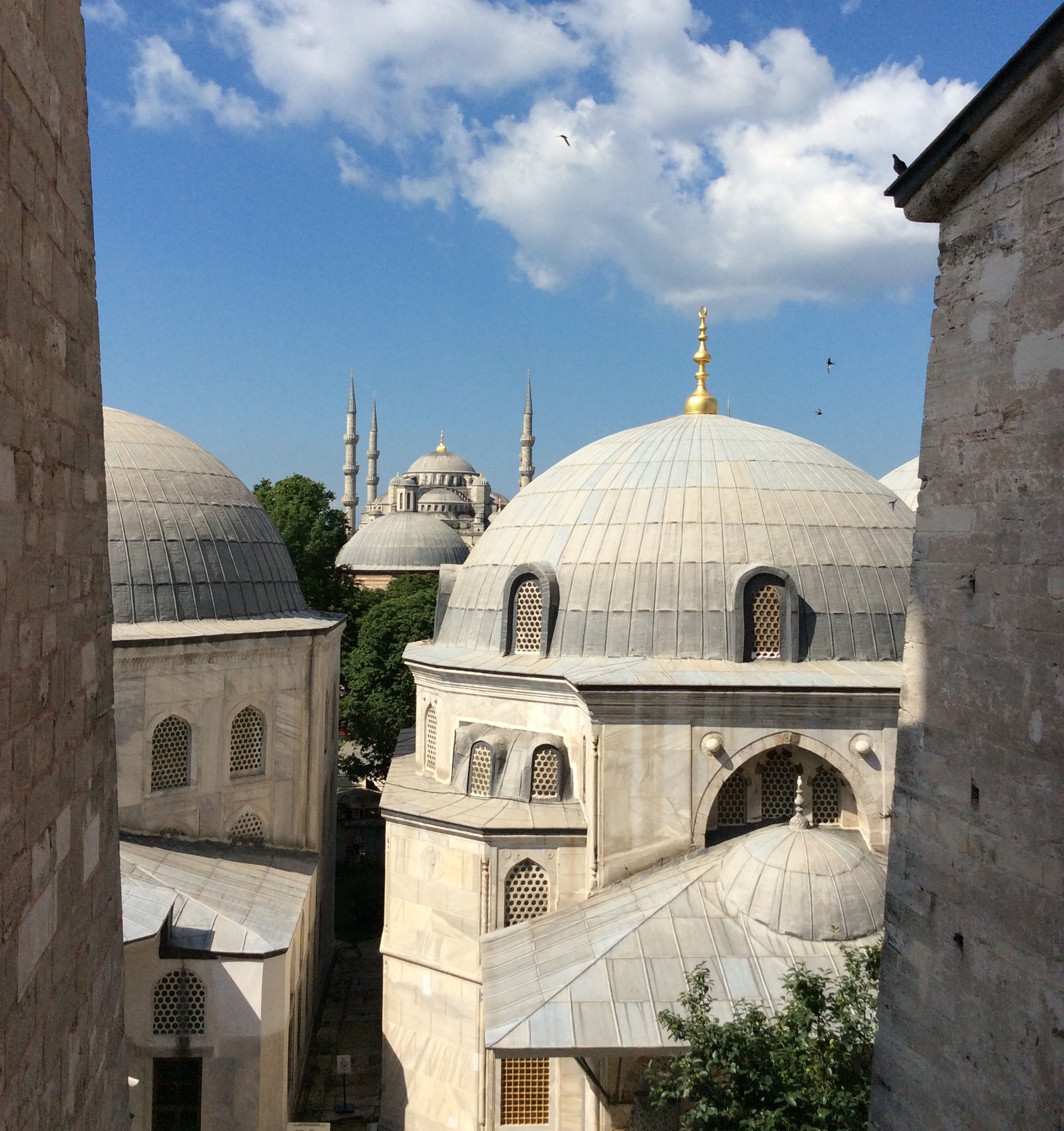
Istanbul, Turkey, 10 am
Istanbul, Turkey, 10 am
“What about the main thing in life, all its riddles? If you want, I’ll spell it out for you right now. Do not pursue what is illusionary — property and position: all that is gained at the expense of your nerves decade after decade, and is confiscated in one fell night. Live with a steady superiority over life — don’t be afraid of misfortune, and do not yearn for happiness; it is, after all, all the same: the bitter doesn’t last forever, and the sweet never fills the cup to overflowing. It is enough if you don’t freeze in the cold and if thirst and hunger don’t claw at your insides. If your back isn’t broken, if your feet can walk, if both arms can bend, if both eyes can see, if both ears hear, then whom should you envy? And why? Our envy of others devours us most of all. Rub your eyes and purify your heart — and prize above all else in the world those who love you and who wish you well. Do not hurt them or scold them, and never part from any of them in anger; after all, you simply do not know: it may be your last act before your arrest, and that will be how you are imprinted on their memory,” – Aleksander Solzhenitsyn, The Gulag Archipelago, 1918-1956: An Experiment in Literary Investigation.
(Hat tip: John Benjamin)

Emma Green ponders a new Pew study (pdf) on religion and electronic media that found “only 20 percent [of respondents] said they had ‘shared something about [their] religious faith on social networking websites/apps’ in the past week.” That’s only about half as many who claimed they did so in person:
[The] relationship between on- and offline sharing was roughly the same across Christian denominations and the religiously unaffiliated: Twice as many people talked about their religious beliefs offline vs. online. Perhaps the most interesting thing about this is that there’s hardly any variation among age groups: People younger and older than 50 were nearly equally likely to say they’d talked about their faith on social media within the last week. That’s remarkable for two reasons: In general, younger Americans are less religious than older Americans, and they’re also much heavier users of social media. Across two demographics who think about both faith and the Internet very differently, the mores of talking about God online seem to be similar.
This survey doesn’t say much what those mores are. But it does suggest that people like talking about their religious beliefs face-to-face more than they do online—or, perhaps, they’re more willing.
Cathy Lynn Grossman reminds us, however, that there’s still plenty of God-talk online:
Megachurch pastors have mega-followings online. Joel Osteen of Lakewood Church streams his Houston services online. Rick Warren of Saddleback Church has 1.8 million likes on his Facebook page. And Pope Francis has more than 4.6 million English-language followers, chiefly American, for his @Pontifex Twitter feed.
Not only do religious people find faith online; so do 50 percent of the “nones” — people who claim no denominational identity, from atheists to the vaguely spiritual. … David Silverman of American Atheists, tweeting @MrAtheistPants, has more than 29,000 followers.
I have also begun to notice that many college students could improve their writing dramatically merely by setting their sights on shorter sentences. Many students have somehow got the assumption that scholarly writing requires a certain tone of voice. I don’t know where this assumption comes from. I am inclined to blame it on the rhetorical posturing of well-meaning but fundamentally inept high school English teachers – the kind of teacher who promotes “critique” and “decoding” of “texts” instead of explanation and clarity of ideas. I do not blame these teachers. I hope they will still be allowed into heaven. I know they are only doing what they’re told. At any rate, whatever the source of this malaise, the symptoms are evident in the tendency of students to obfuscate simple ideas through a complexification of syntax, a multiplication of imprecise verbs instead of the selection of the one strong verb, and a deliberate substitution of polysyllabic words whose meanings are often vague and slippery for smaller ones whose meanings are plain and solid. It is all very anti-working-class. The student’s shame of his uneducated parents and their drab suburban home is transferred to a (deeper and more scandalous) shame of plain speech. Nothing good will come of this.
So I have been encouraging students to aim for shorter sentences that say exactly what you want to say, not for longer sentences that sound the way you would like to sound. And – physician, heal thyself – I’ve been trying to do it too.
NSFW, because porn:
Allison P. Davis raves about Drone Boning, above:
A commentary on civil-liberties issues and surveillance in modern society? No, says one of the filmmakers, the agenda of Drone Boning (poetry) was simpler: “The plan was to take beautiful landscapes and just put people fucking in them.”
Mission accomplished, sir. The groundbreaking video features straight, gay, and lesbian couples having sex alfresco on the beach, in the mountains, nestled in the mossy bed of a regal forest, amid the blossoming crops of an apple farm, and on the side of a highway against a vintage-looking royal-blue car. It’s like if a Google Maps camera caught you humping unawares amidst a Kinfolk photo shoot. Or perhaps the uncensored, unrated cut of Planet Earth. Simply stunning.
Jason Koebler agrees that the film “skews way more artsy and thought provoking than your average entrant into the genre”:
“We wanted to see the artistic value of this perspective,” John Carlucci, [filmmaker Brandon]LaGanke’s partner, said. “It’s an omniscient point of view, really. We did these shots in places where you couldn’t see much from the ground, but then you put a drone in the air and you can see what’s happening.”
So, even though the two used hired actors in mostly isolated places outside of San Francisco, there’s a certain amount of voyeurism that goes into actually watching the video. Carlucci calls it a “Where’s Waldo” sort of thing: You see these amazing, beautiful landscapes, and you quickly want to see where, exactly, people are getting it on.
A parody of ’80s sitcoms with a sinister twist:
Alexa Tsoulis-Reay tracked down members of it:
While a precise number is open to scientific debate, it’s commonly accepted that the average size of an adult male penis is five and a quarter inches, erect. Generally speaking, measure in under about three inches erect, and you have what’s called a micropenis — the least common of the conditions falling under the banner of an “inconspicuous penis,” which includes a webbed penis, where it is difficult to decipher exactly where the scrotum ends and the penis begins; or a buried penis, where the shaft of the penis is hidden by skin and fat.
One man she interviewed, “a 51-year-old English teacher from the U.K., gave an in-depth account of his life with a micropenis”:
[Q.] Do you think about your penis size every day?
[A.] I can tell just by the way people walk and the way they look and the way they relate to other people that they have a big penis. You go into a meeting and the guys are swaggering around with their legs akimbo as if they’ve been riding a horse because they’ve got such an enormous package they can’t really walk straight and it’s just crazy. I have got to a point where I am quite amused by it and I’m fascinated by all this sex stereotyping and gender stereotyping. I’ve got strong heterosexual instincts and if I see a woman I feel strongly towards, even if I just glimpse somebody, the next thing I think is, No, don’t! You know what will happen … Well, nothing will happen, but if something did happen, you know how it will end up. It will be that terrible scene again; it will be that thing with the regrets and the apologies. And there’s nothing worse than that.
After a while, you just accept that you can’t ever do it properly. You can try all the textbook stuff and advice column stuff about positions, but thinking about that kills things. You want it to be more natural and you just start thrusting away and it’s popping out all the time. It just doesn’t stay in because it’s just too small. That’s what it comes down to, I’m afraid.
I’m laughing, not crying, by the way. But I might cry as well.
This week saw the release of a 6-CD set from Bob Dylan, The Basement Tapes Complete, which features 138 songs that he recorded with members of The Band in the late 1960s, some which have been circulating in bootlegged form for decades, and Dylanologists are rejoicing. Sasha Frere-Jones provides the context for these remarkable, freewheeling sessions – Dylan’s famous 1966 motorcycle accident, which spurred a relatively reclusive period of his career:
There is no official documentation of the accident, and it’s not clear what injuries Dylan incurred, though he said that he suffered a concussion and “busted” some “neck vertebrae.” It is also unclear how many people witnessed the accident—Dylan said that his wife, Sara Lowndes, was behind him, in a car. “It happened one morning, after I’d been up for three days,” he said. He told one interviewer, “I probably would have died, if I had kept on going the way I had been.”
After a short convalescence, Dylan tinkered with a tour documentary he was making, called “Eat the Document.” (It has never been commercially released, but bootleg copies have circulated for years.) In the spring of 1967, he began making music again. He worked in his house and in the basement of a house outside Saugerties, near Woodstock, with his touring band, a mostly Canadian group originally called the Hawks and later renamed The Band. He performed no live dates in 1967, made a single appearance in 1968, and played only three shows in 1969. He removed himself from public view for all of 1970, and then, in 1971, he appeared at the Concert for Bangladesh, a benefit in New York organized by George Harrison. That year, he told Shelton, “Until the accident, I was living music twenty-four hours a day.” In the summer of 1967, he was recording music without living it, or living it differently from before. The recordings he made in Woodstock are a document of Dylan determining where he and his songs and his audience and his country and his past overlapped, or didn’t.
Tom Moon offers advice on how to approach these recordings:
It’s best appreciated not as a collection of songs, but as a kind of audio documentary, a painstaking account of the daily song-chasing that went on for nearly seven months at Dylan’s house and then Big Pink.
It catches Dylan in a fertile writing period, and offers telling glimpses into his process — his use of absurd placeholder words (“You Ain’t Goin’ Nowhere”) and nonsense syllables that would eventually become lyrics in subsequent versions. At the same time, it shows how resourceful his collaborators were as they cobbled together, often on the fly, a rustic and rarified textural landscape that could complement and enhance his images.
By all accounts, very little premeditation was involved: Hudson once noted that they were doing anywhere from seven to 15 songs in a day. Dylan worked constantly on lyrics, banging them out on an Olivetti typewriter sometimes right before tape rolled. He’d bring a page downstairs, and in a matter of minutes, a song would take shape. Not just any song, either: These sessions yielded “I Shall Be Released,” “Tears Of Rage (co-written with Richard Manuel), “Quinn The Eskimo,” “Northern Claim,” “This Wheel’s On Fire” (co-written with Rick Danko) and others.
Clinton Heylin adds:
[T]his banquet really needs to be savoured entire. After all, seeing the stack of reels that sat in a Toronto studio awaiting transfer to digital, one can’t help but be reminded the boys at Big Pink took their time. The Basement Tapes, which for years were seen as the work of a few summer days, turn out to be nine months in the life of a former boy wonder and a family man, at a time when he could still make music in the most idyllic of settings and count his blessings.
Even Dylan allowed himself to wax lyrical about those times when prompted to remember them by a young Wenner: “You know, that’s really the way to do a recording – in a peaceful, relaxed setting, in somebody’s basement, with the windows open and a dog lying on the floor.” No expectations, no commitments. Just for the love of it. Expect to spend a lifetime unravelling the mystery that is Big Pink. Dylan has.
A Dish reader flags the above video, in which Boris Johnson nominates Kingsley Amis’ famous account from Lucky Jim. Here’s the passage in question:
Dixon was alive again. Consciousness was upon him before he could get out of the way; not for him the slow, gracious wandering from the halls of sleep, but a summary, forcible ejection. He lay sprawled, too wicked to move, spewed up like a broken spider-crab on the tarry shingle of the morning. The light did him harm, but not as much as looking at things did; he resolved, having done it once, never to move his eyeballs again. A dusty thudding in his head made the scene before him beat like a pulse. His mouth has been used as a latrine by some small creature of the night, and then as its mausoleum. During the night, too, he’d somehow been on a cross-country run and then been expertly beaten up by a secret police. He felt bad.
Do readers have a better suggestion? For those unfamiliar with Amis’s novel, there might be no better introduction than this essay from Hitch, which particularly emphasizes what makes the book so funny:
I happened to be in Sarajevo when Kingsley Amis died, in 1995. I was to have lunch the following day with a very clever but rather solemn Slovenian dissident. She knew that I had known Amis a little, and she expressed the proper condolences as soon as we met. Feeling this to be not quite sufficient, however, she added that the genre of “academic comedy” had enjoyed quite a vogue among Balkan writers. “In our region zere are many such satires. But none I sink so amusing as ze Lucky Jim.”
This, delivered with perfect gravity in the lugubrious context of the Milosevic war, made me grin with inappropriate delight. How the old buzzard would have gagged, with mingled pride and disdain, at the thought of being so appreciated by a load of Continentals—nay, foreigners. And what the hell can his masterpiece be like when rendered into the Serbo-Croat tongue?
Just try to suggest a more hilarious novel from the past half century. Something by Joseph Heller? Terry Southern? David Lodge or Malcolm Bradbury? Yes, the Americans can be grotesque and noir; and the Englishmen have their mite of irony. (In fact, the academic comedy is now a sub-genre of Anglo-Americanism.) But even so. The late Peter de Vries—much admired by Amis for his Mackerel Plaza—depended too much on the farcical. No, the plain fact is that Amis managed in Lucky Jim (1954) to synthesize the comic achievements of Evelyn Waugh and P. G. Wodehouse. Just as a joke is not really a joke if it has to be clarified, I risk immersion in a bog of embarrassment if I overdo this; but if you can picture Bertie or Jeeves being capable of actual malice, and simultaneously imagine Evelyn Waugh forgetting about original sin, you have the combination of innocence and experience that makes this short romp so imperishable.

Lori Zimmer captions the work of Nick Gentry:
With the age of technology advancing faster than we can possibly keep up with, we are left with obsolete media. Film cameras have been replaced with digital capture and USB drives render floppy disks useless. As an artist, Gentry finds beauty in these forgotten remnants, like the rolls of exposed 35 mm film he finds in abundance in thrift stores and secondhand sales, or receives from donors.
His effort to give new life to the media that are now obsolete has created inspiration for a beautiful body of work, which is given greater depth than if simply painted on canvas. Gentry paints many of his portraits with a direct gaze, which almost summons to viewer to look deeper into the work.
 The Dish