It Means The World

Adam Frank suggests we should all be grateful for “this corner of the universe as embodied in the unlikely blue world we call home”:

A quick review of our solar system makes it clear that good planets are hard to find. The sun hosts eight worlds, at least six large moons, countless asteroids and countless comets. Of all those bodies there is only one place with warm oceans and blue skies and cool breezes and rainfall. And, of all the sun’s children, there is only one place where life has run riot.

It’s easy to take the Earth — and its ceaseless buzzing of wings and legs and fins — for granted. It’s easy to forget its staggering beauty or its almost incomprehensible strangeness in the near vacuum of interstellar space. But in its subtle coupling of air, ice, water and rock, our planet is nothing short of a miracle.

There are, likely, much worse places in the cosmos to try and eek out a lifetime. Places with less color, less majesty, less warmth, less coolness, less joy, less wonder. So, no matter what your year has been like — no matter what you may have lost — there is always the Earth.

A Poem For Thanksgiving

6251005476_9cf91ae003_b

“First Thanksgiving” by Sharon Olds:

When she comes back, from college, I will see
the skin of her upper arms, cool,
matte, glossy. She will hug me, my old
soupy chest against her breasts,
I will smell her hair! She will sleep in this apartment,
her sleep like an untamed, good object, like a
soul in a body. She came into my life the
second great arrival, fresh
from the other world—which lay, from within him,
within me. Those nights, I fed her to sleep,
week after week, the moon rising,
and setting, and waxing—whirling, over the months,
in a steady blur, around our planet.
Now she doesn’t need love like that, she has
had it. She will walk in glowing, we will talk,
and then, when she’s fast asleep, I’ll exult
to have her in that room again,
behind that door! As a child, I caught
bees, by the wings, and held them, some seconds,
looked into their wild faces,
listened to them sing, then tossed them back
into the air—I remember the moment the
arc of my toss swerved, and they entered
the corrected curve of their departure.

(From Blood, Tin, Straw: Poems by Sharon Olds © 1999 by Sharon Olds. Used by permission of Alfred A. Knopf, an imprint of the Knopf Doubleday Publishing Group, a division of Random House LLC. All rights reserved. Photo by Tom Wachtel)

High From A Holiday Spice?

Deborah Blum separates fact from fiction when it comes to having fun with nutmeg:

In the 1965 book, “The Autobiography of Malcolm X,” the activist describes purchasing it from inmates in a South Carolina prison, concealed in matchboxes, and stirring it into water. “A penny matchbox full of nutmeg had the kick of three or four reefers,” he wrote.

Toxicologists say that description is somewhat misleading, an overly romantic account of nutmeg’s generally unpleasant effects. It takes a fair amount of nutmeg — two tablespoons or more — before people start exhibiting symptoms. These can include an out-of-body sensation, but the most common are intense nausea, dizziness, extreme dry mouth, and a lingering slowdown of normal brain function. Dr. Gussow said nutmeg experimenters have compared it to a two-day hangover.

“People have told me that it feels like you are encased in mud,” said Dr. Edward Boyer, professor of emergency medicine and chief of the division of medical toxicology at the University of Massachusetts Medical School. “You’re not exactly comatose, but you feel really sluggish. And your remembrance of events during this time period is incomplete at best.”

Dreher actually tried it:

Teenage Home Experiment here. Let’s say you are a 17-year-old boy living in a residential high school in Natchitoches, Louisiana, and you and your friends are bored out of your minds.

And let’s say that one of your friends has a copy of The Anarchist Cookbook, which has a few paragraphs in it about how you can get high on nutmeg. You and your buddy might be the kind of people who say, “Dude, you can buy that stuff at the supermarket.” And you might even be the kind of people who will ride their bikes through the rain to the Brookshire’s store after dinner, buy a box of McCormick’s ground nutmeg, and take it back to the dorm to eat.

If you’re me, you mix it with Equal to make it slightly more palatable. It tastes like spicy dirt. We must have eaten two or three teaspoons each, then sat around waiting to get high.

And waiting.

You’ll want to read the rest here.

Thank God, Or Not

Emma Green contemplates why “secular, Thanksgiving-flavored gratitude seems so fuzzy”:

Religions from Christianity to Hinduism to Wicca all emphasize the importance of thankfulness, especially as a form of prayer. This is because they rely on the premise of an other, some sort of non-human being that has some sort of control or influence in the world who you can thank for the world and the good things in it.

“One of the things that’s really interesting about the human mind is that we seem to want to see agency in the world, almost intuitively,” said Michael McCullough, a psychologist at the University of Miami. “The mind really craves an explanation for the good and the bad, in terms of agency.” By “agency,” McCullough means something along the lines of “a force that can act in the world and cause events to happen.” In crude sociological terms, people give thanks to the forces that act in the universe—God, or god, or gods—as a bid for cosmic benevolence, whether that means making it rain or preserving a loved one’s health or bringing a baby into the world. But these thanks are also an implicit metaphysical claim: Humans owe their existence, their longevity, and perhaps even their daily fortunes to a being beyond ourselves.

While expressing gratitude for the good in her life, Kate Cohen confesses that “as an atheist, I don’t ever ascribe these gracious gifts to God; I never believed a supernatural being to be the source of the bounties that I enjoy”:

And yet, like any other lucky soul, I am still “prone to forget” my many blessings and “habitually insensible” to my own good fortune. I can use a day set aside now and then to make myself remember.

I could — with apologies to the Puritans — keep Thanksgiving, but leave God and prayer out of it. Just because it began as a day of prayer doesn’t mean mine has to be. Atheists don’t have to thank God: they can thank their hosts (or welcome their guests), toast the cooks, and enjoy the food.

Maybe that would be enough for me if I didn’t have kids. But even though I don’t want my children to believe in God, I still want them to believe in blessings. Beauty. Wonder. Good fortune. Grace.

Map Of The Day

This embed is invalid


Megan Gambino unearths the first map to bear the name “New England,” published by Captain John Smith in 1616:

In his new book, A Man Most Driven: Captain John Smith, Pocahontas and the Founding of America, [Peter] Firstbrook argues that historians have largely underestimated Smith’s contribution to New England. While scholars focus on his saving Jamestown in its first two harsh winters and being saved by Pocahontas, they perhaps haven’t given him the credit he deserves for passionately promoting the settlement of the northeast. After establishing and leading the Virginia Colony from 1607 to 1609, Smith returned to London, where he gathered notes from his exploration of the Chesapeake Bay and published his 1612 map of Virginia. He yearned for another adventure in America and finally returned in 1614.

When Smith was mapping New England, the English, French, Spanish and Dutch had settled in North America. Each of these European powers could have expanded, ultimately making the continent a conglomerate of similarly sized colonies. But, by the 1630s, after Plymouth and the Massachusetts Bay Colony were established, the English dominated the East Coast—in large part, Firstbrook claims, because of Smith’s map, book and his ardent endorsement of New England back in Britain. “Were it not for his authentic representation of what the region was like, I don’t think it would be anywhere near as popular,” says Firstbrook. “He was the most important person in terms of making North America part of the English speaking world.”

So, Friendsgiving Is A Thing

Kay Steiger explains that she and her pals inaugurated a tradition of non-family get-togethers “because we all thought we could make better versions of Thanksgiving food and it’s more fun to get drunk with your friends anyway”:

[F]or all the cleverer recipes and the fancier food, what actually matters is getting everyone together for another year – which was the point of the family Thanksgivings we all either couldn’t or didn’t want to go back to our hometowns for. We aren’t related by blood, but we’re still a family.

The idea of Friendsgiving isn’t particularly unique to us, but it is quietly radical in its way …. The conservative view is that your second family starts with a marriage between one man and one woman, preferably long before the ages we all our now – and, until then, your original family Thanksgiving should take top priority. But creating – and celebrating – families with the people you like rather than the people you might feel stuck with provides a lot of people more reason to give thanks.

But not everyone is so Friendsgiving-friendly. Foster Kamer insists it’s “the ne plus ultra of dumb, idiotic, made-up, fake holidays created exclusively for the most middlebrow human beings intent on perpetuating middlebrow, capital-b Basic culture”:

[T]his is where Friendsgiving is supremely annoying: The core idea here is the implication that, as opposed to Friendsgiving, a regular Thanksgiving must be spent with family, and not friends; should be stogy at best; and if not boring, then at least tense and uncomfortable. Friendsgiving hinges on the idea that Thanksgiving is mediocre.

I resent that implication. I resent the idea that I should have two meals, because one of them just isn’t supposed to be fun. Why else would you need an ostensibly unconventional, wacky and neat alternative?

Melia Robinson differs, reflecting fondly on the Friendsgiving she held last year:

Friendsgiving isn’t perfect. There were hiccups. One roommate scratched her eye after slicing an onion and experienced such searing pain, we thought we were going to have to take her to the hospital. (She’s fine now.) We kept realizing we forgot to pick up needed ingredients; so by the second unplanned trip to the grocery store, I invested in a six-pack of Woodchuck to preserve our sanity.

But there was no screaming, no awkward interactions with relatives you see twice a year, and no tears (besides the onion incident). Just old jokes rehashed and new memories made between people who love each other.

If you’re going to spend Thanksgiving with your relatives, have a Friendsgiving, too. Celebrate both your families, no matter how weird one is.

Ellen McCarthy is on the same page. Meanwhile, in McSweeney’s, Chris Brotzman narrates “The First Friendsgiving.” It all began, he says, with a group of Millennials in 2008:

With the Thanksgiving holiday soon approaching, decisions needed to be made. Plans needed to be laid out. And so they began to wonder.

“Welp. I can’t afford a plane ticket home for Thanksgiving,” said one Millennial to another.

“Me either,” she replied.

A third chimed in. “Fuck it. Let’s have Thanksgiving here [in LA]. It’s way warmer than in the Midwest anyway.”

They began texting other Millennials of their remarkable idea! A feast just for them! No adults! No annoying family members! What a celebration!

Like a miracle, one of the Millennials had a friend in graphic design who was pretty badass at Photoshop and willing to design a logo for the eVites and the Facebook page. It’s even been told that the name “Friendsgiving” was coined by one of these Millennials who worked as an advertising copywriter, but that’s yet to be confirmed by Wikipedia.

“The more the merrier!” it said right there on the Facebook event page. But they all knew it. “Merrier” was just a façade. They knew this whole thing was merely a coping mechanism for their own, deep-seeded unhappiness: lost in a strange place, much like the Pilgrims of the first Thanksgiving, starving for acceptance from strangers. The main difference, of course, is that the original Pilgrims were also literally starving. Like, for food and medicine and stuff.

But do not be fooled. The Millennials had it rough, alright. For it is no easy thing to come to grips with the idea that life isn’t easy and can’t be handed to you.
The Upside Of Being A Downer

Though ’tis the season to give thanks, Mariana Alessandri maintains that voicing dissatisfaction isn’t all bad:

The 20th-century Spanish philosopher Miguel de Unamuno didn’t recommend banishing the negative emotions or “keeping on the sunny side of life.” In “The Tragic Sense of Life” he described his anxiety over the prospect that there might be no afterlife, adding that he failed to understand people who had not once been similarly tormented by this or by the certainty of their own death.

Unamuno believed that a life worth living consists in communing with others, and that this happens most genuinely through negativity. In “My Religion,” Unamuno wrote: “Whenever I have felt a pain I have shouted and I have done it publicly” in order to “start the grieving chords of others’ hearts playing.” For Unamuno, authentic love is found in suffering with others, and negativity is necessary for compassion and understanding. If we try to deny, hide or eradicate the negative from our lives, we will be ill-equipped to deal with people who are suffering.

Captioning The Canon

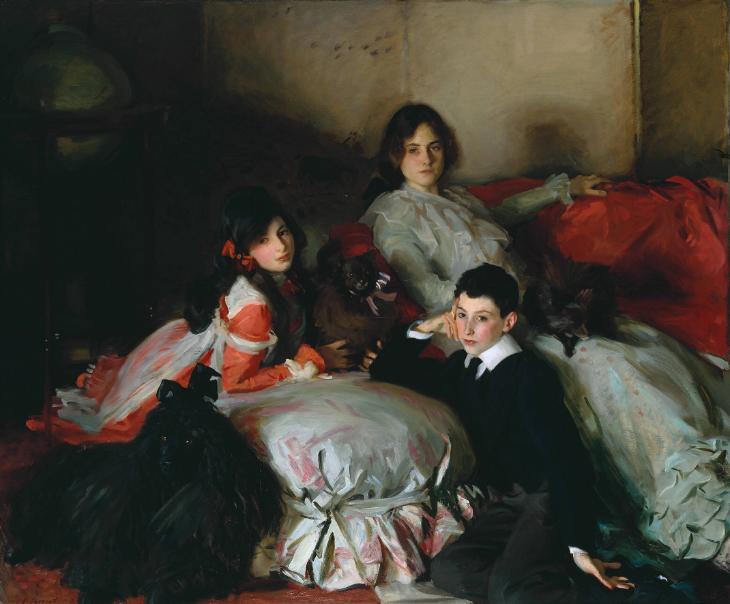
Essie, Ruby and Ferdinand, Children of Asher Wertheimer 1902 by John Singer Sargent 1856-1925

Just in time for the holidays, Mallory Ortberg presents “Families Who Hate Each Other In Western Art History”. Sample dialogue:

shouldn’t we all be smiling, Mother?

for the portrait?

thats a good idea

why dont you tell me what i have to fucking smile about

and i’ll try to work up the muscles to do it

(Painting: John Singer Sargent’s Essie, Ruby and Ferdinand, Children of Asher Wertheimer, 1902, via Wiki Art)