Down And Dirty On Broadway

by Dish Staff

Laurence Maslon looks back to musical theater’s lurid past:

Coded references to risqué and sexual matters were catnip to the lyricists Lorenz Hart and Cole Porter. In the case of Pal Joey, Hart found a soulmate (and drinking buddy) in the book’s writer, the equally louche John O’Hara. Within the first 15 lines of the show, during which an aspiring nightclub singer is quizzed by a prospective manager, there are references to cocaine, alcohol, pederasty, and one-night stands. In this show, which Richard Rodgers wrote was the first musical “to deal with the facts of life,” the eponymous nightclub singer becomes the kept man of a wealthy socialite, while cheating on his more innocent girlfriend. The singer and the socialite rhapsodize about their affair in a song called “Den of Iniquity,” where they brag about the power of a radio broadcast of Tschaikovsky’s “1812 Overture” to heighten their sexual activity.

When Porter came to Kiss Me, Kate in 1948, the newer brand of musical, with its stricter narrative form, gave fewer opportunities for the naughty one-off numbers that made his reputation in the late 1920s, but with songs such as “Brush Up Your Shakespeare,” he gets away with murder (or “murther,” if you are Shakespearean purist): “When your baby is pleading for pleasure/Let her sample your Measure for Measure” and “If she says your behavior is heinous/Kick her right in theCoriolanus. (Shockingly, this last couplet made it into the 1953 film version; someone was napping over at MGM.)

Rose Petals

by Phoebe Maltz Bovy

If Dan Savage gets to repeat his claim that women fantasize about rose petals, I’ll allow myself to reiterate my bafflement. From that recent interview:

PLAYBOY: What if someone asks what their partner wants and doesn’t like the answer?

SAVAGE: It happens all the time. Young women write me dish_rosepetals that they pressed and pressed their boyfriends to share their secret fantasies with them and then were terrified when they found out what those fantasies were—when it’s not “I want to fill the bed with rose petals and light a thousand tea candles in the bedroom.” That’s not a male fantasy. Girls tell me about Mr. Darcy from Pride and Prejudice and romantic comedies and all that bullshit. I always tell my female young-adult readers, “Careful. If you press him about his fantasy, you’re much likelier to hear ‘a three-way with you and your sister’ than ‘a trip to Paris.’ ” Male sexuality is crazy, perverse. Men are testosterone-pickled dick monsters. We just are.

Now, I don’t have access to the skewed but substantial data set that is Dan Savage’s inbox. I do, however, have access to a sum total of one female brain, as well as female friends, as well as the sitcom-tame but getting-somewhere take on female sexuality that is “The Mindy Project.”

And I continue to have trouble believing that a significant number of young women would even consider sex amidst rose petals sexual fantasy, let alone the wildest one they could imagine. As for “a trip to Paris,” such a thing probably is more interesting to women than to men (see: Paris study-abroad participation), but is it anyone’s erotic fantasy? Are there really women who’d imagine that a man’s secret hope was to – budget and schedule permitting – travel with her to the French capital? Why would he have kept that a secret?

Later in the interview, Savage talks perfect sense: “Female sexuality is different, whether you believe sexual reserve and caution are biological or cultural or some combo of the two, which is what I believe.” Indeed. It’s hard to dispute that whichever mix of cultural expectation and hormonal wiring leads to men expressing more out-there desires. What I just can’t accept is the centrality of rose petals to female fantasy life. Something about that just doesn’t ring true.

(Photo by Flickr user -Reji)

Blaspheming Dorothy Parker

by Michelle Dean

I was checking out The Millions’ Year in Reading again this morning and came across the entry of one William Giraldi. Giraldi is a critic I’ve run into a few times before. He once wrote a weirdly angry review of two books by an acquaintance of mine. This got him pilloried all over the internet. It was really more of a reap-what-you-sow moment than an outrage moment. I think if you write something angry, you should probably be prepared for people to respond in kind.

What I am about to describe is not something angry he wrote though. It’s just something that made me stop short, before I’d even looked at the byline in my RSS feeder:

Imagine the irredeemably WASPish, cloistered Connecticut world of John Cheever if rendered by James Thurber, or John Updike’s suburban New England strivers and cheaters delivered by Oscar Wilde, or, better yet, imagine if you could make an alloy of H.L. Mencken’s irreligious perceptions and Dorothy Parker’s cagey sapience, and you might come close to beholding the vibrant abilities of Peter De Vries.

I’ve never read Peter De Vries. Let’s stipulate that he’s probably wonderful in all the ways described. I Young_Dorothy_Parkersuspect, though, that this sentence would have benefited from about four fewer names included in it. The adjectives could have left too. I am no stranger to long, looping, complicated sentences, and in fact it annoys me that in my own work I have to use the shorter ones so often. The windup here simply goes on too long.

None of these are what bother me, though. What bothers me is this reference to Dorothy Parker’s “cagey sapience.” It’s so totally wrong it took my breath away. An insane overreaction, I know. This is the problem with writing a book about dead writers: you sometimes find yourself with highly developed opinions about other people’s tossed-off remarks about them.

So, caveat emptor, this is a nitpick. But I’m going to unpack it anyway in the interest of intellectualism and all that.

Which, by the way, Parker was never very much for. It wasn’t that she couldn’t be serious. She had a strong interest in politics, which you can see in the fact that she left the rights to her work to Martin Luther King, Jr. and the NAACP, thereby forever incurring the wrath of her friend Lillian Hellman, who had hoped to inherit that herself.

But “sapience”? That word implies that Parker believed herself to hold wisdom. For all her meanness, for all her pose of authority in her Constant Reader column in the New Yorker, her style does not present itself as wise. Parker did think of herself as funny, but as we know, there’s often a hollow core to humor. There’s often a punishing self inside. This was certainly true of Parker, and not because of the caricatures that posit her as perenially suicidal (she wasn’t always) nor falling-down drunk (more like “tipsy,” most of the time, people said).

Besides, all her work was founded on doubt. Doubt that people were as wise or as talented or even as important as they said they were. And putting yourself out there as a doubter and a ridiculer is not the same as wisdom. If anything I feel like half of Parker’s problems with herself came from her keen awareness of the gulf between “funny” and “wise.” So forget “sapience.”

Second, this matter of “cagey.” How was she withholding or careful or secretive in her work? Reading the better half of it she is in confessional mode. Her stories and poems often correspond closely to events in her own life. That’s not the same thing as saying they’re purely autobiographical, of course. But Parker wasn’t hiding, not remotely, in her poems and fiction. If anything I think she thought they were too honest, too close to what she perceived as her own weaknesses. She’d often plead to write as something other than herself: “Dear God, please make me stop writing like a woman.” Which is very sad to think about, especially given that so many people found her “self,” that Dorothy Parker persona, pleasant enough to buy her books in droves.

My point, I guess, is if you going to lard Parker up with adjectives you should at least use ones that indicate more than surface familiarity with her work. Pick up the Dorothy Parker Reader instead of the thesaurus. Or else risk offending Parker pedants like me.

(Photo via Wiki)

A Short Story For Saturday

by Dish Staff

This weekend’s short story is Tim Parks’ “Reverend,” just published in The New Yorker. You can surmise the subject matter from its title, which has autobiographical significance for Parks. In an interview, he had this to say about the story’s relationship to his own life:

Reams could be written about the autobiographical links, of one kind or another, in pretty much all of the fiction I have written. If anyone were interested, that is. Let’s say that the distance fiction allows—talking in the third person, declaring from the start, “This is not me, these are not people I know”—enables me to meditate on experiences close to home, on characters like myself, like my father, without being swept away by them. There is also a constant and, I hope, exciting tension between memory and invention, an awareness that, even when you try to say exactly how something was, it is still largely reconstructed through memory and language; it is still a “creative” act.

How the story begins:

After his mother died, Thomas started thinking about his father. All too frequently, while she was dying, there had been talk of her going to meet him in Paradise, returning to the arms of her husband of thirty-two years, who had died thirty-two years before she did. This would be bliss.

Thomas did not believe in such things, of course, though it was hard not to try to imagine them, if only to savor the impossibility of the idea: the two insubstantial souls greeting each other in the ether, the airy embrace. She had been ninety at death, he sixty. There would be some adjustment for that, presumably, in Heaven. The madness of it confirmed one’s skepticism.

Keep reading here. Read the rest of the interview with Parks about the story here, and peruse previous SSFSs here.

Face Of The Day

by Dish Staff

01_Carrie

Michael Zhang captions:

Photographer Shelley Calton grew up in Houston, Texas and was raised by a father who owned guns for both hunting and self-defense. She and her two sisters all learned to shoot firearms from a young age.

This background is something Calton shares with the subjects of her project “Concealed.” It’s a series of portraits that looks into the lives of women who arm themselves. Calton writes that, in doing this project from 2011 through 2014, she “sought to more deeply understand [the women’s] collective experiences as concealed carriers.”

Craig Hlavaty has more:

Most of these women grew up with guns, Calton says, so they didn’t have an aversion to them. Some women had a traumatic incident in their past that lead them to always have a handgun nearby. One was briefly kidnapped. Others were sick of feeling vulnerable and threatened. Some carry now because their significant others wanted them to be able to protect themselves and their children if needed.

“Some carry on their bodies everywhere they go, some in their purses, and some just in their cars and homes,” says Calton. One woman carries her concealed piece in a small Coach purse, with the pistol taking up most of the space.

The View From Your Window Contest

by Chas Danner

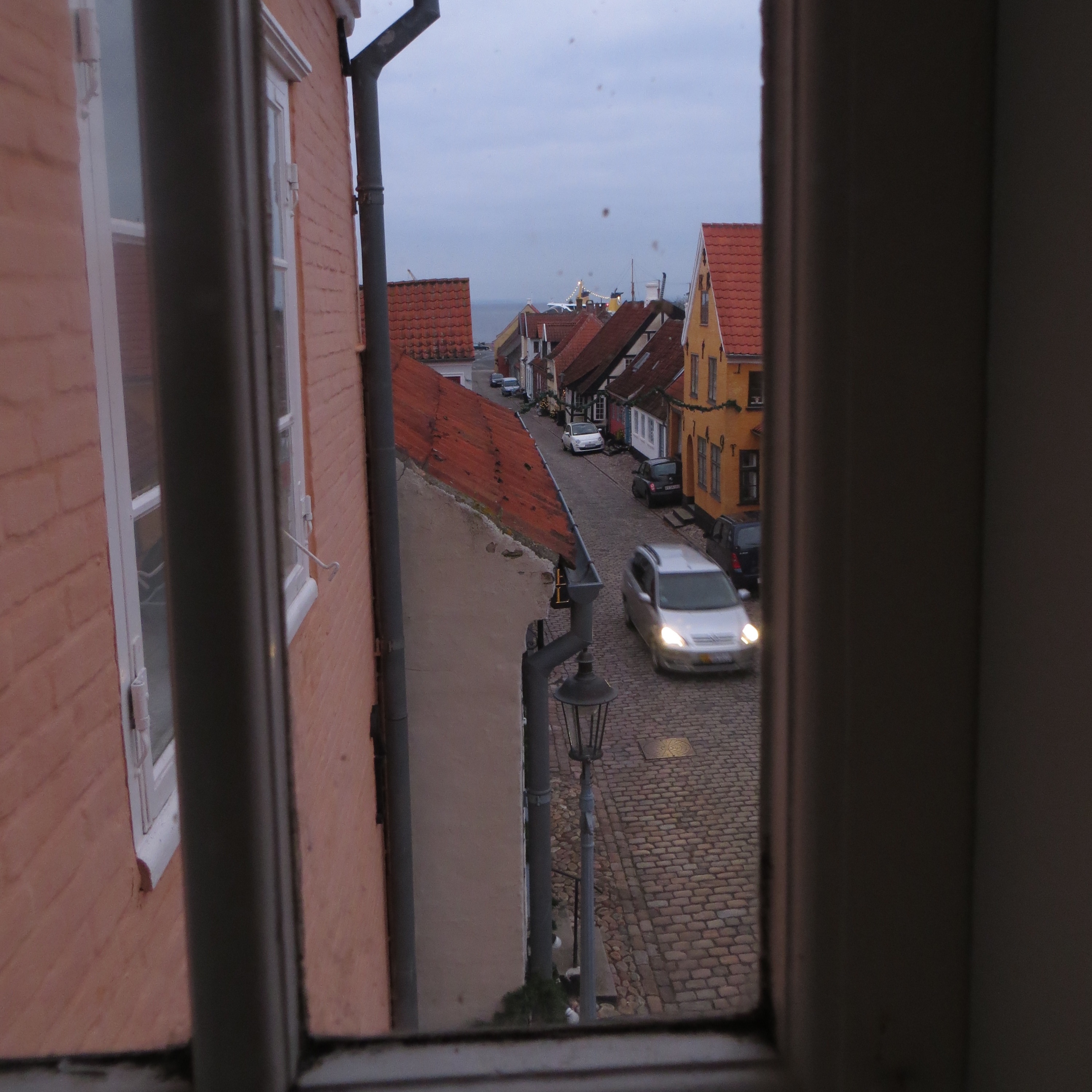
VFYWC__236

You have until noon on Tuesday to guess it. City and/or state first, then country. Please put the location in the subject heading, along with any description within the email. If no one guesses the exact location, proximity counts.  Be sure to email entries to contest@andrewsullivan.com. Winner gets a free The View From Your Window book, a new Dish mug,  or two free gift subscriptions to the Dish. Have at it.

Last week’s contest results are here. Browse a gallery of all our previous contests here.

Outrage And Privacy

by Phoebe Maltz Bovy

I want to second Michelle’s endorsement of the outrage year-in-review over at Slate. The item there that jumped out at me was Jordan Weissmann’s account of having played a large part in sparking a “cycle of viral outrage” against a Harvard professor who had “raged [in email] at a local Chinese restaurant that had overcharged him a mere $4 on a takeout order.”

Weissmann cops to a history of producing clickbait outrage journalism, but explains, “It’s something I feel ambivalent about as a writer.” He makes the case for what is, after all, his livelihood. Shaming bad behavior is maybe a good deed? Plus, these pieces apparently function for a place like Slate the way lose-weight-and-get-a-man ones do for women’s mags – they pay for the serious but tough-to-monetize pieces. He also insists that, in this case at least, his target is unlikely to suffer financially. (“And I doubt his $800-per-hour corporate consulting business is going anywhere.”) These are all fair points. But I came away from the essay unsure whether Weissmann had succeeded in convincing himself that viral outrage – that is, of the sort sparked by the ostensibly private slip-up of someone who isn’t in the public eye – is defensible.

The problem with the current media climate is that all outrage-bait is, in a sense, equal. The impact of a celebrity’s gaffe and of an ordinary person’s off day are both measured in traffic. And all such moments are becoming equally accessible. As Adrienne LaFrance notes, commenting on a Pew report, “While privacy once generally meant, ‘I assume no one is looking,’ as one respondent put it, the public is beginning to accept the opposite: that someone usually is.” Once content is out there, it all just sort of feels equivalent – the virally-famous maybe shouldn’t have become public figures, but once they are, no one thinks twice before commenting on them as if they were.

I suppose the Apple Store Lady is the example I keep coming back to because a few unpleasant-looking seconds of this random woman’s life made her the face, as the headline would have it, of “The First-World Problem to End All First-World Problems.” To go viral as the face of unchecked privilege, you don’t have to pass terrible legislation, or even to write an oblivious essay for Thought Catalog. All you need to do is live in a place where people have smartphones and be someone who isn’t entirely delightful every moment of every day. Or you can be a complete and utter saint and have your actions altered or taken out of context. In her installment in Slate’s outrage coverage, Amanda Hess writes, “With a few assumptions and a quick Photoshop job, even a black woman complaining about a white dude on the bongos can be framed as an emblem of white entitlement.”