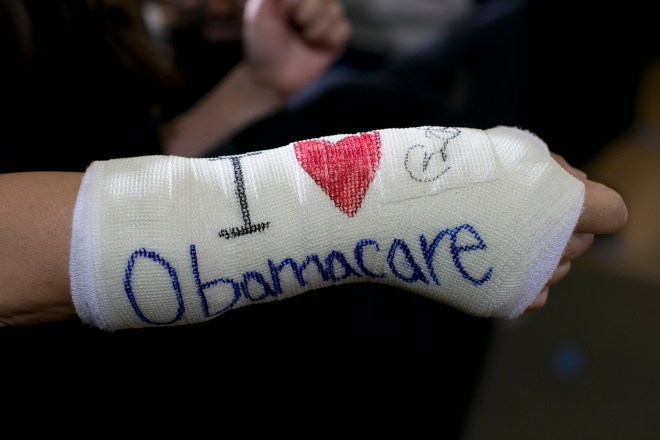
The latest reader thread we want to highlight centers on your personal experiences with the ACA – mostly good, some just okay, a few terrible. Read the whole collection here. Several more of your stories are below, aired for the first time:
I’m 43 and was laid off last year from one of the major banks. I fell off a ladder about five years ago and ended up having four surgeries to get it all straight. Besides that, I’ve got ADD and generic meds, but no other major health issues. I was pretty surprised to be denied coverage by a few companies when trying to get it myself last year. When Obamacare activated, I was surprised that I got subsidies as a member of the upper-middle class and able to get affordable coverage while looking for a job. When I did get a contract job, I looked into health coverage. What the contract company was offering was over twice what I was paying on my own! The benefits weren’t even that different. I kept my plan through healthcare.gov and am very happy for it. For an income around $100k, I figured I’d make sacrifices for the greater good, but I’m actually seeing benefits.
Another reader:
My extended family’s Obamacare success stories come with a huge helping of Republican epistemic closure.
First, the successes. My 52-year-old brother retired early from working in a manufacturing plant for 30 years and started his own small business. His house is paid for and he is extremely frugal, so his business provides a comfortable yet modest living. However, he could not afford to purchase insurance just for himself before Obamacare, so he went uninsured. Now he pays $53 a month for a plan that is very similar to what his girlfriend has through her employer. Success!
My niece was able to stay on her parents insurance while she went to grad school for nursing. Success!
My cousin has a 24-year-old son with spina bifida. With that preexisting condition, it would have been almost impossible (and unaffordable) to find insurance to cover him once he was off his parents’ policy. Now with the law restricting insurance companies from denying coverage for preexisting conditions, he will be able to enter the workforce with no worries about his coverage. Success!
Now the epistemic closure part. Even with all of these personal examples, my extremely Republican parents have been brainwashed by Fox and still think Obamacare is the worst thing ever to happen to this country. They are convinced that their Medicare will be taken away and they won’t be able to find any doctors. They are convinced that President Obama just wants to take all of their money and give it to poor people. I have stopped trying to educate them with facts and real examples because it is no fun beating my head against a brick wall!
Another:
I am a surgical specialist. My politics would be RINO, but in this day and age, I vote “not Republican”, as I do not believe the party can be trusted with power nor to govern.
ACA is basically a Rorschach test for partisans. I’m personally for it as a first step towards a better system, so maybe I’m biased. I see someone every week who now has healthcare who didn’t before. Unfortunately, these are often neglected issues that would have been better managed in the past, but at least they have a way now to get care. I also may be unique because I am uninsurable outside of a group plan due to a personal history of blood clots. I was turned down by every single insurer despite being fit, no other health issues, and a lifetime risk of clotting again of 8% with no medications or 3% with Coumadin, 10.00/3 month supply.
I practice in a blue-collar area with plenty of uninsured and I’ve watched my income plummet with the economic downturn. I found that about 1/2 of my head-and-neck cancer patients were uninsured and I had to eat the cost of their treatment – no more; this year so far everyone has had insurance. Medicaid doesn’t pay much, but it is better than nothing. The homeless guy I operated on last week came in with his tongue cancer small enough that it hasn’t spread to the neck and his surgery should be all he needs. That saves the cost and morbidity of radiation therapy. Sure, he is being paid for by the state, but the cost was much less than what it would have been had he hit the ER in a few months with metastatic disease.
I also had a guy follow up today who is no longer insured since losing his job recently. My right-wing office manager of course blames Obamacare. I had a gentleman last year who was in the union but for some reason hadn’t been working. He had refused working a certain job since it would have been on a concrete floor, which is hard on his back. I don’t know the other details, but he had opted to not get his Cobra, and being a 62-year-old smoker and drinker, he has some risks. He tried to buy Cobra, but he was 20 months out – and of course, he blamed Obamacare for his inability to get Cobra. I don’t bring politics into the mix, but the only reasons he’ll ever get insurance again is because of government programs. Good luck finding a private insurer who would touch him.
Those who love purely private medicine should ask how would a 78-year-old diabetic with heart disease gets insurance, and what would be the cost? How does someone with MS get health insurance on the private market if they are single and unable to work? Look at dental care. (This is healthcare, but that’s another argument.) A sizable percentage of the population has untreated dental disease. One-half of my on-call weekends are spent dealing with neck abscesses related to dental infections. Many of these people are uninsured. And the classic story is they had dental work done, had to pay a bunch of money in cash, developed an abscess, were treated with oral penicillin, got worse and were sent to the ER, where the rest of us treat for free.
I see at least one case a week where the ACA has helped someone get insurance and I have yet to see a case where it hurt. I am sure there are 25-year-olds who didn’t have insurance and who didn’t have a healthcare issue who are financially hurt, but the fact is, statistically, some of them do get sick, injured, etc … and not having coverage is not acceptable to society who has to eat the cost. Believe me, I’ve fixed dozens of facial fractures on young men with motorcycles, fast cars, or big mouths who didn’t have insurance.
I also do not understand the greed of many. I have colleagues who makes 3X what I make yet they feel they are being screwed. I make a very good living and it bothers me that I see people who are poor and have to do without basic care. I do not think that everyone should make the same amount of money, and I feel my work is worth more than most, but I also grew up lower middle-class and I can’t fathom not caring that hard working people or children unfortunate to be born to bad parents suffer needlessly.
But another dissents from the others, quoting me:
I’m not sure that “Obamacare is as big a liability for Obama this fall as the Iraq War was for Bush in 2006″, but I do think it will potentially be used as a HUGE negative, even for many who voted for him and other Dems in the past few elections. And I believe that if the Democrats do not quickly grab hold of the reins and prepare well and cleverly and early on to counter what will be the number one issue to beat about the head and shoulders of our candidates, we will most definitely lose the Senate and eventually the presidency. Why? Because many of those hardest hit by the worst unintended effects of Obamacare are middle-class independent and Democratic voters. And they are feeling betrayed and pissed and afraid for their financial safety.
Most of us who supported health care reform did so out of a sense of empathy and fairness; we were tired of seeing so many people going without decent health care, were angry hearing the nightmare insurance stories in which children were denied cancer treatment, in which the mentally disabled and chronically ill and employed but uninsured got all their care through emergency room visits. We wanted our kids covered longer because college is costlier and taking more time to complete, much less find employment after graduation. We were tired of having our local communities and hospitals and ERs having to foot the bill for the low-income uninsured, for being forced to absorb the costs of long-neglected conditions that ended up being hundreds, thousand and even hundreds of thousands of dollars when decent primary care could have prevented the illness. We thought it was not only stupid financially; it was morally wrong and wanted to find a way to fix it, smartly.
What we all really wanted, whether we knew it or not, was a single-payer/public option that was affordable and spread out the risk nationwide to make all of our out of pocket costs go down. Instead we got the worst possible “free market” solution they could dream up in DC.
Far too many of us in the middle class – those of us with one or two job incomes and employer provided health insurance – have been financially REAMED by Obamacare – by the tax changes; by the way this law has been manipulated by our employers and insurance companies to pass on their costs to the individual; by the increase in costs and reduction in benefits in an economy that is stagnant and in which most of us haven’t had a raise in years. Too many people who supported reform, who voted D, who out here are making moderate incomes and dealing with the competing financial demands of raising families, paying for college costs, helping their elderly parents and now desperately trying to save for their retirements (there are no pensions anymore, don’t forget) are being hurt financially by this law, and unfairly so. And – whether I agree with this or not – it’s all being blamed on Obama and the ACA.
Example: I work as an RN at a medium-sized corporate hospital that offers our employees a really shitty BCBS plan. We staff nurses averaging about $50-60K/yr in earnings and many of them are single parents. I am blessed to be able to opt out due to my spouse having coverage (excellent coverage) as a federal employee, but my friends do not. Over the past two years, they have seen their deductibles jump to $6000K/yr or more, with co-insurance of 20-30% or more pharmaceutical “co-pays” have jumped to ridiculous levels.
This winter several of my co-workers had to pay almost $60 for a generic albuterol inhaler during their recovery from the various flu-bugs we all got. My coworker’s 12 year-old daughter has juvenile diabetes and she pays hundreds out of pocket monthly for her insulin and supplies. Remember that $5000/family tax-free flexible health savings account we all could sign up for in the past? You know, the one where you set an annual amount to divide up like a loan and put into an account that will advance you the money up to your elective limit for health costs? Well, “Thanks to Obamacare” it’s been cut to $2500, and believe me that goes fast. One of my coworkers had to take both her small children in for abscessed tonsillectomies and it cost her $3500 dollars, out of pocket, on our hospital’s wonderful BCBS plan.
I’ve seen more formerly uninsured people get covered, which is fantastic, but now my hardworking peers approaching middle adulthood with diabetes, hypertension, chronic autoimmune disorders like lupus, funny moles on their skin, obstructive sleep apnea, depression and a whole host of health issue are JUST NOT GOING TO THE DOCTOR ANYMORE. If it’s not free or catastrophic, they’re crossing their fingers and hoping a trip to the health food store or some meditation will fix their problem.
Yes, they get the low-cost, required “essentials and annual freebies”, but in general, too many of us had better out-of-pocket costs before Obamacare (and even then we were sometimes stretched to pay those). Since we’re insured by our employers, we don’t meet the stringent numbers to qualify for subsidies on the exchanges, so even if we wanted to opt out and buy there, we’d pay even more in premiums than we do now. I am exuberant that my kids can stay on our health insurance until they’re 26, and that my 29-year-old son would have insurance right now after not having any for four years if he had not finally found a job with it as a benefit.
And I won’t even tell you ALL the ways business is blaming Obamacare so that they can ruthlessly make cutes, refuse raises, and generally squeeze out profit and then dump the hurt on their employees. At our hospital, ACA is blamed SPECIFICALLY for the layoffs and cost cuts that are hurting the quality of care and safety we offer our patients. They have forced on us increased nurse-to-patient ratios and cuts to CNA caregivers, which has resulted in poor outcomes and even a few serious harms to patients.
Physicians at our hospital are miserable, and spend less time on patients and more time trying to learn and use our electronic medical system . It’s clunky, out-of-date and creates serious errors, but because corporate is cashing in on CMS bonuses in reimbursements by implementing electronic medical records now, they are more concerned about their bottom line than doing it well. So they refuse to purchase better software and the doctors yell and insult and dodge putting in orders (which means WE have to step away from the bedside to do it for them. Worse, they take their business elsewhere down the road, which in turn results in days off for us due to fewer patients in our unit.
Patients are unhappy and give us poor “Patient Satisfaction Scores” because no one answers their call lights fast enough, so they wet their pants, their food sucks and their rooms are dirty longer than they used to be and the equipment looks like something donated to a Third World hospital in Africa, so they don’t trust it. My CCU is an oasis of relative safety, mostly due to Medicare reimbursement rules about ratio’s and standards of care, but we are struggling every day and stretched way too thin, and we all worry about the looming “sentinel incident” around the corner that hurts or kills a patient and costs us our license. Would YOU like your nurse to be distracted from your open-heart surgery recovery because she has to leave your bedside to answer the phone, buzz in visitors, deliver food trays, enter medical orders for cranky doctors, answer call lights for water for other patients, and cant get your emergency cardiac iv’s because her computer system has crashed once again? I don’t think so.
Anyway, this is just a long, frustrated, but hopefully insightful, rant about the day-to-day NEGATIVE impact of ACA has been, and why it will be a big challenge to overcome in the next two election cycles. I really wish we had more focus on THESE kinds of issues and how they will be remedied, and fast because it scares the SHIT out of me that we’ll end up getting an entirely radical Republican national government if we don’t. And there’s no Meep Meep if that happens.
Update from a reader:
Your allegedly sympathetic but frustrated RN asserted that “because of Obamacare,” Health Savings Account minimums have been “cut” to $2,500, and folks can’t sign up for robust HSA accounts anymore. Well, I knew that was bull as soon as I read it because I have an HSA for my kids and me, to which I contribute $4,000 annually. So I Googled the issue. The IRS issues the annual HSA minimums and maximums, which I don’t see has anything to do with “Obamacare” – have a look.
So this RN is using the HSA minimum and representing that as the maximum that “Obamacare” appears to allow. The truth is, anyone with dependents could sign up for as much as $6,550 in HSA contributions in 2014! (That figure is verified here.) And it’s going up another $100 for 2015.
Another:
The respondent discussing HSA limits as quoted by the IRS is discussing a health savings account, which has different limits and is continuable through successive years, as opposed to the Flexible Spending Account as discussed by the RN. The FSA is a tax-differed method to pay for out-of-pocket expenses for health plans without high deductibles. FSAs expire at the end of each year, with any unspent money evaporating. So, in a sense, they are both right, but talking about different beasts.
(Photo by Yoon S. Byun/The Boston Globe via Getty Images)




 The Dish