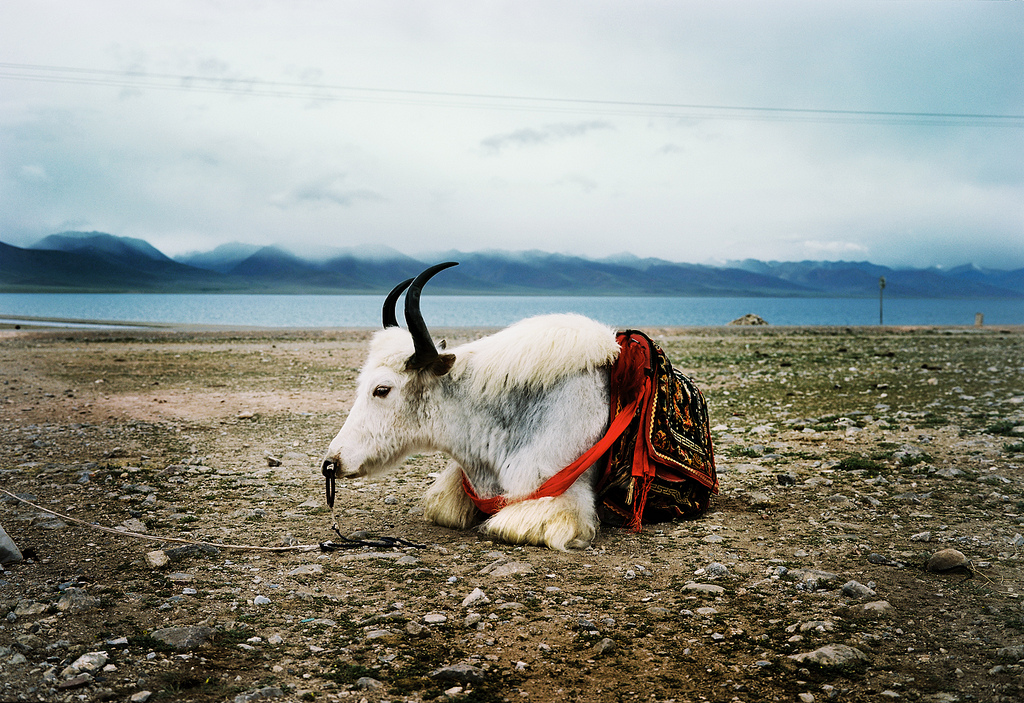
Yak dung, when used as fuel, is arguably dirtier than coal but is definitely much cheaper. Particulate pollution from burning animal dung greatly increases the risk of lung cancer and other respiratory ailments, the occurrence of which can be slowed by switching to cleaner ways of heating homes. …
A new paper accepted for publication in the journal Atmospheric Environment provides some of the first quantitative data on both black carbon and indoor air pollution during the cool season in Tibet. Via air samples and a survey of households in the Nam Co region of Tibet—the name means “heavenly lake”—researcher Eri Saikawa and her team learned things were even worse than they suspected. Her survey admittedly had a small sample—just 23 households responded—but is nevertheless illuminating.
A majority of residents had access to improved cookstoves, even solar power, but yet every single respondent still used yak dung for heating. Saikawa explains this by noting that average annual income per household is just $890 a year. Yak dung is simply the cheapest fuel available.
As hashtag memes go, #YouHadOneJob (see also) seems like a lighthearted bit of fun. For the uninitiated: The hashtag is meant to collect instances of hilarious on-the-job fails:
Yes, I laughed. Then again, my sense of humor is such that an out-of-context roll of toilet paper on its own could also have that effect.
But the hashtag often gets used for more run-of-the-mill customer-service gripes, of the they-got-my-order-wrong variety. (I don’t wish to start a shaming cycle, so no specific links to those tweets. A glance at the hashtag will provide copious examples.) While these are indeed among the less clever uses of the meme, they’re not exactly out-of-place. After all, the butt of the joke is someone with a low-skilled job. More than that: Part of the joke is the job itself.
It’s supposed to be hilarious that someone’s honest-to-goodness jobis lining up tiles properly or spelling a sign correctly; the ineptitude at the simple task is just icing. The “you” of the meme doesn’t refer to a readily identifiable worker (and thank goodness), but the implied worker would probably be – or perhaps was – fired for the mistake. On the rare occasions when it’s used to refer to a failure at a complex task, the joke falls flat, because clearly making a flu vaccine is not just “one job” in the sense the meme requires.
The question is, why this mean-spirited (if sometimes quite funny) meme, and why now? Aren’t we supposed to be living in an era of hypersensitivity? Why hasn’t the privilege of users of this hashtag been called out? (According to a few minutes of Googling, it has not.) Does #YouHaveOneJob tap into employment anxieties of those who are or have been un- or underemployed? Or is it just yet another example of the online quest for affirmation?
Elizabeth Nolan Brown highlights a case of political correctness gone awry at the University of Iowa, where a sculpture of a Ku Klux Klansman was labeled “hate speech” and taken down because apparently the very shape of a racist symbol, even when used to make an anti-racist statement, is now deemed too offensive for college students to handle:
Created by Serhat Tanyolacar, a UI visiting professor and printmaking fellow, the klansman sculpture was decoupaged in newspaper coverage of racial tension and violence throughout the past 100 years. The piece was meant to highlight how America’s history of race-based violence isn’t really history and “facilitate a dialogue,” as Tanyolacar told university paper The Gazette. But no matter: After several hours, UI officials decided that the display was “deeply offensive” and needed to be removed. …
To me, this case provides a good reference point for why we shouldn’t curtail freedom of expression even when it comes from despicable groups like the Klu Klux Klan. When you start casting for exceptions to the First Amendment, you never know what kind of other speech—perhaps speech designed to address the very problems you’re fighting against—will get caught up in the net. Unfortunately, the kids and faculty at UI seem to have learned a different lesson: reacting to the statue as art or as a political statement was a reflection of cluelessness, insensitivity, and white privilege.
Tiffany Jenkins picks up on a similar trend of art censorship in Europe:
The travelling Exhibit B, by the white South African artist Brett Bailey, is a recreation of a human zoo from the 19th century that features 12-14 African performers from the host city and a choir of Namibian singers exhibited as artifacts. It’s meant to provoke a conversation about slavery, colonization, and present-day racism, but many protesters accuse it of being racist itself. In London in September, the Barbican pulled the entire run of Exhibit B after a petition calling on the arts center “not to display” the work achieved 22,988 signatories and criticized Exhibit B as “simply an exercise in white racial privilege.” …
Such debates aren’t new, of course, but there are important differences between the demands for censorship of the past and those of the present. Historically, those calling for censorship were often concerned that an artwork—perhaps of a sexual nature—would have a coarsening effect and a negative moral impact. Today’s activists have a different rationale. They argue that they are the only ones who have the right to speak about the experience depicted—and thus, have the right to silence those who have no comparable experience. So those protesting Exhibit B suggest they, as members of the black community, are the only ones who can create an artwork exploring slavery and colonization.
Previous examples of illiberalism in the art world here and here.
Andrew is off the blog for the week, but he may pop on to write a post or two on the torture report (his parting takedown of Cheney is here if you missed it). To help in his absence are guest-bloggers Michelle Dean and Will Wilkinson, whose introductory posts are here and here, respectively. Michelle today invoked her time as a corporate litigator to scrutinize the Sony hacking story and then commented on a few drunken Santas harassing a Garner/Brown protest. Will, meanwhile, tackled the SCOTUS ruling that just gave cops even more discretion to detain, search, and arrest people.
The most popular posts of the day remained Andrew’s takedowns of Dick Cheney on Meet the Press and Fox News. A reader’s take:
Dick Cheney is not a psychopathic evil “sith lord”; he is a moral relativist, which is actually much worse. If he were the former, it would be far easier for him to be sidelined by the press and all people of good conscience the way serial killers are. The right is so quick to claim their moral authority based on the Founding Fathers and their interpretation of the Constitution. In this context, it’s important to remember that George Washington was no moral relativist, when speaking about how the Continental Army should respond to rumors of British bayonetings at the Battle of Paoli:
Treat them with humanity, and let them have no reason to complain of our copying the brutal example of the British Army in their treatment of our unfortunate brethren who have fallen into their hand.
Many recent posts were updated with your emails – read them all here. You can always leave your unfiltered comments at our Facebook page and @dishfeed. Gift subscriptions are available here (you purchase one today and have it auto-delivered on Christmas Day). Dish t-shirts are for sale here and our new mugs here. 25 more readers became subscribers today. You can join them here – and get access to all the readons and Deep Dish – for a little as $1.99 month. A new subscriber writes:
Although a Northern CA lefty, I began reading the Dish before Obama’s first election. I was impressed by your dedicated adherence to “balanced” discussions and the willingness to expose epistemic closure. I have felt guilty for not subscribing before, but signed up to quantify my support of your stance on the historically significant damages this dark episode of torture has done to our nation.
Although an Obama supporter, I have, from the start of his administration – to the revulsion of my friends – decided that his unwillingness to even consider bringing to trial those responsible for this horror will far out weigh his accomplishments. My perspective on this comes from my 27 years as part of a nonprofit aiding veterans and their families from the generational impact of service to this country. The craven destruction of America’s code of honor regarding the treatment of our enemies has removed the shield that may protect our military personnel from comparable base and depraved actions when captured.
For that alone, even if they never face the justice they deserve, Cheney and all of the architects deserve, and, I believe, will be remembered as the true traitors to this country. Keep up the great work.
With an eye toward recent history, Geoffrey Wheatcroft assails the usual distinctions made between the First and Second World Wars, asserting that “we have returned to fighting a kind of war grimly prefigured not by the supposedly evil Great War but instead by the seemingly noble Good War”:
The myth of the Bad War and the Good War has become very dangerous, insofar as it has conditioned our attitude to war as a whole. The notion that the second world war was finer and nobler than the first is highly dubious in itself, since it sanitises so much, from the slaughter of civilians by Allied bombing to the gang rape of millions of women by our Russian allies at the moment of victory.
And it may be that the sanctification of the later war has had more pernicious consequences than the anathematisation of the former. Any argument that the Great War was uniquely wicked and wasteful is plainly false in statistical terms, and the idea that the Good War was uniquely noble is absurd in view of its moral ambiguities.
Worse than that, the glorification of the second world war has had practical and baleful consequences. It has led us to an easier acceptance of “liberal interventionism”, founded on the assumption that we in the west are alone virtuous and qualified to distinguish political right from wrong – and the conviction that our self-evidently virtuous ends must justify whatever means we employ, lighting up a bomber flare path from Dresden to Baghdad to Tripoli.
(Photo of a pile of bodies awaiting cremation in Dresden, Germany, after Allied bombing in 1945, via Wikimedia Commons)
Ben Schiller runs down the research of Stephan Goetz, who tracked “the number of days people said they were in a negative mood” on a county-by-county basis:
Goetz says suburban counties tend to be happier than urban or rural ones, and that non-white counties tend to be happier than whiter ones. People were also happier when they commuted less, moved homes less often, and lived in places deemed to have more closely-knit communities (higher levels of “social capital”).
For example, a 1% increase in the share of non-whites in a county reduced the average number of poor mental health days by 0.08%—which is actually a larger number than it might seem, when you consider the whole country. “After controlling for other factors including income, educational attainment, place of residence, commuting time, social capital, there is still a residual, unexplained factor that leaves whites a little bit less happy than non-whites,” Goetz says via email. “One possible factor that may explain this difference could be religious adherence, to the extent that it varies between whites and non-whites.”
(Image: the results of Goetz’s study plotted on a map of the United States, with the highest number of “poor mental health days” in red and the lowest in green.)
Michael Lewis created an amusing one. Near the top of it:
No person under the age of 35 will be allowed to work on Wall Street.
Upon leaving school, young people, no matter how persuasively dimwitted, will be required to earn their living in the so-called real economy. Any job will do: fracker, street performer, chief of marketing for a medical marijuana dispensary. If and when Americans turn 35, and still wish to work in finance, they will carry with them memories of ordinary market forces, and perhaps be grateful to our society for having created an industry that is not subjected to them. At the very least, they will know that some huge number of people — their former fellow street performers, say — will be seriously pissed off at them if they do risky things on Wall Street to undermine the real economy. No one wants a bunch of pissed-off street performers coming after them.
Reviewing the new documentary, Regarding Susan Sontag, J. Bryan Lowder argues that it demonstrates how much of her swagger was a “carefully (and wisely, for a woman in a man’s trade) crafted façade, behind which lived and wrote a person who, despite the kind of career most writers can only dream about, felt as inadequate as the rest of us”:
That Sontag harbored such self-doubt can almost feel offensive—such as when a confidant reveals to the director that, after publishing the remarkable book On Photography, Sontag could only worry that it wasn’t as good as Walter Benjamin’s work.
But if you can get past that initial bristling response, Kates’ documentary offers fascinating and crucial insight into the psychology and motivations of one of the previous century’s greatest, and most mercurial, thinkers. Indeed, the film is so attentive to Sontag’s personal life, so committed to pushing past her decades-long PR campaign, that at moments it felt like a violation. But then, there’s something important about placing the kind of person who is more-than-willing to pronounce upon everyone and everything else under a similar scrutiny, something irresistible in regarding the critic, the figure whose job description is to regard the rest of the world.
And what does Kates see when she looks at Sontag? For one thing, she discovers a woman whose sexuality clearly informed her orientation to culture and who yet declined to directly come out as queer (some oblique textual gestures aside). Though the film is not exactly angry about this omission, it refuses to respect it, dedicating a considerable portion of the run-time to interviews with Sontag’s many female partners and lovers.
The Economist‘s Y.F. has more on Sontag’s sexuality:
While on a fellowship at Oxford in her early 20s, Sontag made her first trip to Paris, where in the 1950s so much of America’s avant garde seemed to find a natural home. Harriet Sohmers Zwerling, the writer’s first lover, accompanied her to France and recounts that the day before they were due to host an expat party she punched Sontag in a jealous rage. At the party, noticing Sontag’s bruise, Allen Ginsberg asked Zwerling, “Why’d you hit her, she’s younger and prettier than you.” Zwerling replied, “That’s why.” Sontag possessed a magnetism that even in their moments of greatest candour the film and the people in it—some of them deeply hurt by her—seem unable to withstand.
While much has been made of Sontag’s desire to remain private about her sexuality, she also wrote about it often and gave it an enshrined place in her life and intellectual development. Wayne Koestenbaum, a writer, wryly sums the situation in the film: “Does the author of ‘Notes on Camp’ have to come out?” The film takes us through her experiences as a very young undergraduate in Berkeley and San Francisco in the late 1940s, discovering the area’s underground queer culture and her own place within it. “Everything begins from now…I am reborn,” she writes, “I have been given permission to live…” Of its connection to her writing she observed, “My desire to write is connected to my homosexuality. I need the identity as a weapon to match the weapon that society has against me. I am just becoming aware of how guilty I feel being queer.”
Several estimates are now in circulation, and Robert Samuels’s 2013 book Why Public Higher Education Should Be Free presents the most detailed proposal. According to the most-recent calculations of Strike Debt, the debt-resistance group I work with, the cost would be relatively modest. The federal loan program is propped up by a motley assortment of subsidies and tax exemptions that amount to tens of billions of dollars. Strip these away, along with some other unjustifiable subsidies (GI Bill benefits and Pell Grants that are gobbled up by fraudulent for-profit colleges) and the cost to the government of public college would be as low as $15 billion in additional annual spending. That is little more than a line item in the defense budget, and a small price to pay for meeting the challenge of the 21st-century knowledge economy.



 The Dish
