Lawyers for Gitmo detainees, especially for the recently released Abu Wa’el Dhiab, argue the method used for force-feeding hunger-strikers amounts to to torture. Given the apparent use of force-feeding as torture in the past, that claim should receive renewed attention.
Brian Merchant discovers that rectal feeding is “a century-old technique that rose to prominence during World War I”:
It was invented by an American surgeon named John Benjamin Murphy (the apparatus is called the Murphy Drip to this day), and was used to both deliver drugs and to keep patients hydrated when they lost use of their mouth.
Over the course of the century, as physicians became more skilled at administering intravenous therapy, the Murphy Drip fell out of regular use. In a 2010 article in the journal Emergency Nurse, the author notes that while rectal rehydration is still occasionally used in Chinese medicine to administer herbal remedies, “With the widespread use of intravenous infusions in contemporary emergency nursing, some might question whether there is a place for proctoclysis.”
Even if one accepts the highly dubious notion that anyone believed “rectal feedings” were a legitimate means of nourishing someone, there was no reason to consider such extreme measures in the first place. The rule of thumb in medicine is “if the guts works, use it,” meaning that it’s best to use the stomach to hydrate a patient if it’s functioning properly. There is no indication that these detainees couldn’t have had tubes inserted into their stomachs through their noses for the purposes of feeding them, assuming that respecting their right to refuse food had already been thrown out the window. For hydration, an IV would have been effective, as CIA medical officers conceded.
What those same medical officers acknowledge is that using the rectum to hydrate prisoners (which would, in contrast to feeding, at least work) was an effective means of behavior modification. These procedures weren’t undertaken because they were necessary. They were done to give a thin patina of ersatz legitimacy to what is otherwise flagrant sexual assault. The details differ but the intent is the same as in a high-profile case of police brutality.
A reader imagines the response to this news:
The phrase “rectal feeding”, which I for one have never heard before (has anyone?), is what will ensure the viral power of the Senate Committee report. Whatever it takes I guess.
Based on the hinges of the window: Time Square Hilton. Room 420.
Or a remote island?
I’ve never been to Cape Verde, but this is definitely it.
A more qualified shot-in-the-dark:
You’re like a cat with prey – one week you give me a window that practically shouts its location from the rooftops, then today you give us this. No signs, no cars, no recognizable buildings. What are the clues? Desert-y mountains, a woman on a roof, a satellite dish (maybe?), the grate on the shutters. I was going to guess the Elqui Valley in Chile, only because I’ve been there and the mountains look a lot like the ones in the photo. But Chile is too prosperous, I think, to still have mud buildings. So I’m going with Huarpa, Peru, because the landscape is similar.
Bastards.
Or somewhere in Asia?
Unfortunately, I suspect it’s actually nearby to Jalalabad, but the relative paucity of photos means that’s about as close as I’m going to get. The mountainside combined with the lack of trees and the mud brick construction puts it somewhere around the Himalayas. The mud brick construction plus the funky window bars puts it square in Afghanistan somewhere. (Pakistan and Tajikistan tend to more modern construction.) For a largish city, Jalabad looks like the closet match to an area which has water (from a river), and enough moisture to grow trees on the hillsides and allow mud brick construction, but otherwise so dry that the high parts of the hills are just rock and sand.
Kabul is likely too flat and probably has better construction. And there’s an FOB in Jalalabad …
Another from that country:
Just a guess, but this feels like the Panjshir Valley to me. The topography screams Afghanistan (as I’m sure many of your military readers will agree). Given the condition of the road and the absence of any concertina wire or security barriers, I would assume the image comes from a relatively peaceful province. Moreover, the fertile valley in the background looks like somewhere in the eastern part of the country. It could also be Kunar, but my gut says Panjshir.
Or India?
OK, high mountains, south flank of the Himalayas, that is a pretty wide area. Not Muslim, judging by the colorful clothing, so scratch Srinagar and points West in the Karakoram and Hindu Kush. Probably taken by a Westerner in a small guest house or such, more likely to be found on Lonely Planet than TripAdvisor, so maybe an intrepid traveler or and MSFer on R&R. Plenty of such types in Ladakh, so should be close. Road looks paved and there are hints of large electricity pylons, so could be on the road to a hydro dam. So without checking every hydro plant from Srinagar to Thimphu I will settle on Alchi, Jammu and Kashmir, India.
Another is sure it’s Yemen:
I suppose it’s unfair that I immediately recognized this the moment I saw it, since I lived there for several years in the 1960s. This looks like Taizz used to look, before it exploded as a city. Since I see no terraced gardens in this picture, I assume it’s from the northern part of the country, not too far from the capital Sanaa, where the Houthis reign. This poor country has been devastated by the US’s drone strikes, along with so many other things reign.
Another nails the right country as well as the mountain range:
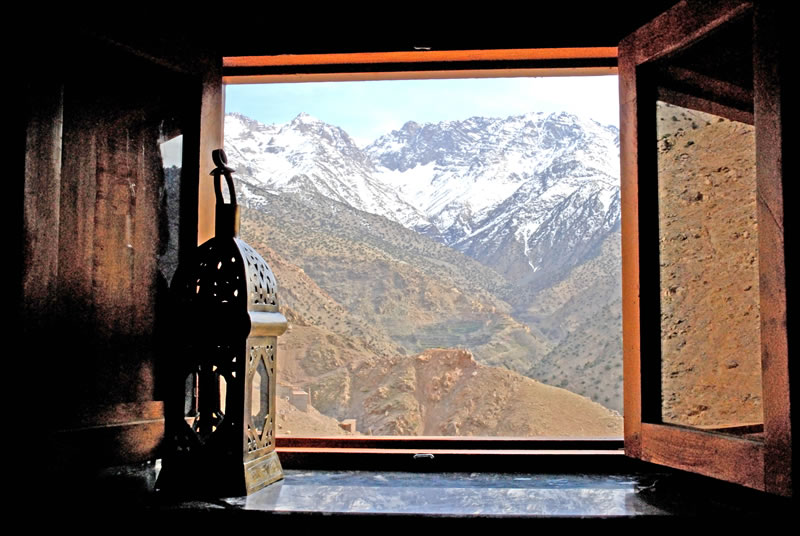
I’ll eat my shoe if this isn’t the Central High Atlas region of Morocco, near/in the Toubkal National Park (Jebel Toubkal is the highest mountain in north Africa). From the valley vantage point looking up into the snow-capped peaks, I’m going to guess the Berber village of Ouirgane, with many lovely old riads where one can stay while hiking in the mountains. This could be a view from the Dar Tassa, but I wouldn’t stake my life on it. I spent several wonderful years as a Peace Corps volunteer in Morocco, though my site was in the more heartbreakingly desolate Anti-Atlas mountains seen here.
Guesses were all over the map this week:
This embed is invalid
And a surprising number of readers knew the right country right away:
When I saw the photo I instantly knew it was Morocco. I visited Marrakech almost 15 years ago and I still have fond memories of that lovely country. I was traveling solo and spent a few days traveling in the Atlas mountains in a Land Rover full of Belgian women. We had an amazing time, seeing several casbahs, Ait Ben Haddou and bouncing down the high Atlas road to Ouarzazate (still my favorite place name ever). I need a good couscous and tagine now!
Another:
I was a Peace Corps volunteer in Morocco, and this looks like the High Atlas region of that country. I’d say the photo was taken near Mount Toubqal, the highest peak in Morocco. It looks like there is a small village between the window and the peak, and after poking around Google Maps for a little while, I’d say the photo was taken in Imlil, Morocco. I’m going to go one further and say that the patch of green in the foreground is Aroumd, Morocco. I’m not sure about this “Aroumd” place… In Google Maps, you will note that although the English says, “Aroumd,” the Arabic still says “Imlil.” Anyway, I’d say the best chance at capturing the view in the photo is on the West side of town, looking in the same direction as this Google Maps image:
I’ve been following your contest for a long time – too long to have any confidence of winning. Maybe I will at least make into your blog post as an “also-ran.” My parents would be so proud!
Another narrowed it down using a key clue:
The landscape screams one of four places – the Moroccan Atlas, the Zagros Mountains of western Iran, northern Yemen, or the Af-Pak borderlands. The seemingly unveiled woman is typical of the Berber people of the Atlas, so I’m going with Tafraoute, Morocco, a wonderful collection of villages south of Marrakesh. Where exactly amongst those villages this picture was taken, I have no idea – no doubt others will be more precise.
Bad luck found this guesser of Tacheddirt:
Sadists. You wait until I move house, to a diabolical cable modem that doesn’t work so I’m hopping around the attic trying to get 3G. That’s when you transport me to a place I think I know: hiking the wondrous trail to Tacheddirt, whose Wikitravel entry baldly states “The only way is by foot, no roads exist. The village isn’t very big anyway.” Whoever wrote that has no soul. Like me, moaning about modems instead of the disastrous floods that occasionally hit the High Atlas.
Well, I did find similar windows in the Gîte Iabassene further east of Tacheddirt (h/t salimr at summitpost.org) But instead of hurling my now-wheezing phone against the wall, I will leave it to your army of fenestrophiles to DNA the laundry on the nearby rooftop. Still, thanks for the memories of a magical place and the last time I had no internet for a week, though then it was willingly.
Incorrect guesses don’t get more specific than this one:
Aaack! One of those photos that you can probably only solve by having been there, but I’m taking a stab at it anyway.The window grill screams Morocco. The wide white window trim on the visible buildings plus the mud brick construction of the nearest building backs this up. The mountains, most likely the High Atlas chain. Currently very popular with the trekking set.
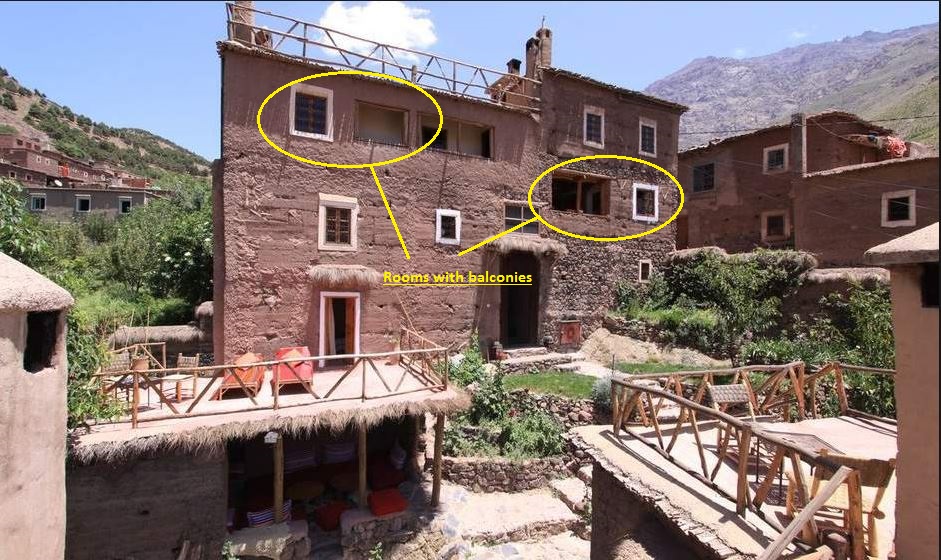
After a couple hours looking through the different hotel guest photos of the guesthouses and hotels in the valleys leading to the High Atlas from Marrakesh, I finally decided that this was taken from the Yan Room of the Douar Samra guesthouse. Why? Based entirely on the photo to the right, whose window grill matches the grill in the photo you posted. According to their website, this room is in the main house and has a balcony.
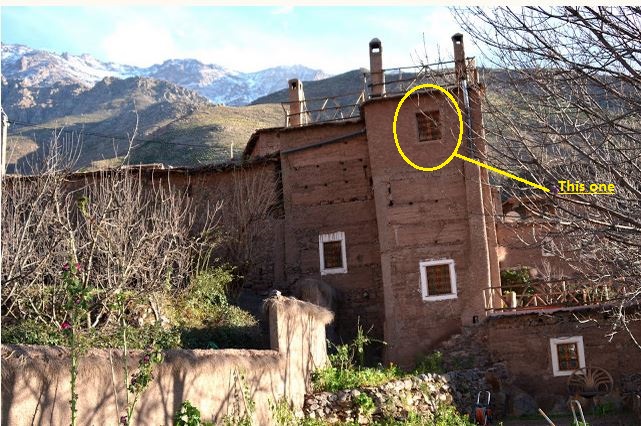
But it doesn’t seem to be taken from either of these, since the terraces below don’t show up, so it is probably taken from a side window. I’m guessing it is this window right here:
Looking forward to seeing how close (or far off) I was.
Not far at all. A former winner nails the village and lodge:
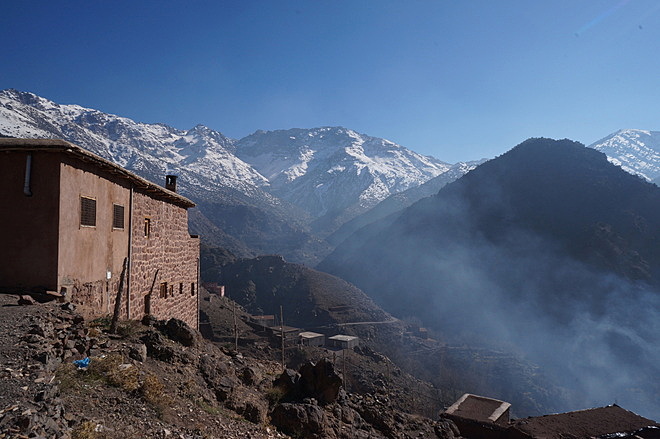
It looks rather tough, doesn’t it? But if you get a rough idea of where to look (a mountain region near the Sahara desert), and search for some distinctive feature (for me it was the peculiar power-line), it isn’t that hard to find, after all. This week’s picture was taken from the south side of the Azzaden Trekking Lodge, in the village of Aït Aïssa, Azzaden Valley, some 50 kilometers south of Marrakesh, Morocco. Here it is:
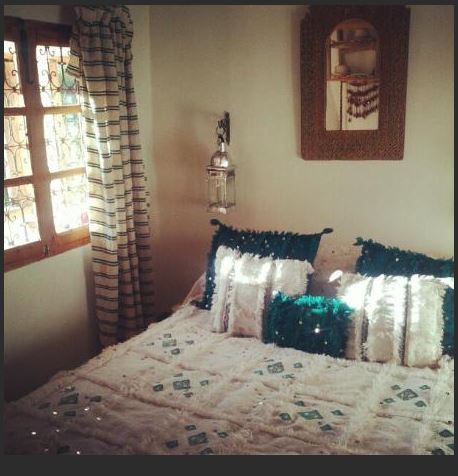
And here is the view from one of the rooms (maybe the same as this week’s picture?):
These more difficult contests really demonstrate how truly gifted some of our veterans have become. This one has been playing at Grand Champion level for a long time:
The contest view is from the southern façade of Azzaden Trekking Lodge (aka Toubkal Lodge) in the valley of Azzaden, Toubkal National Park, Morocco, and faces the Toubkal Massif of the Atlas Mountains. The lodge is affiliated with the Kasbah du Toubkal Hotel in Imili which is located in a neighboring valley and is more widely known. The scenery, villages, and wheat terraces of the area are ridiculously stunning.
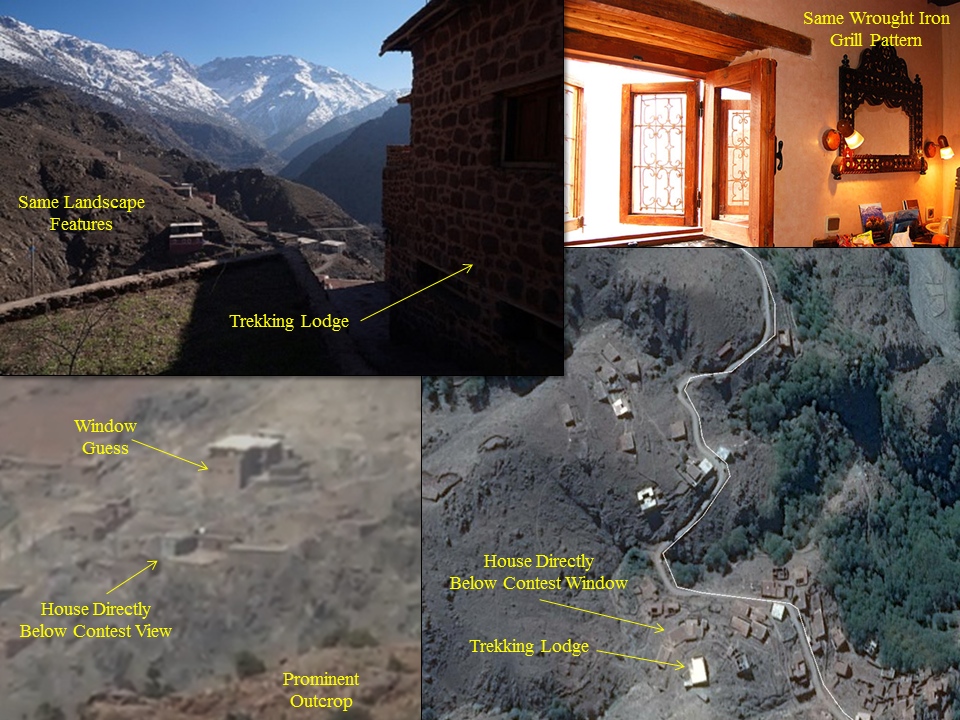
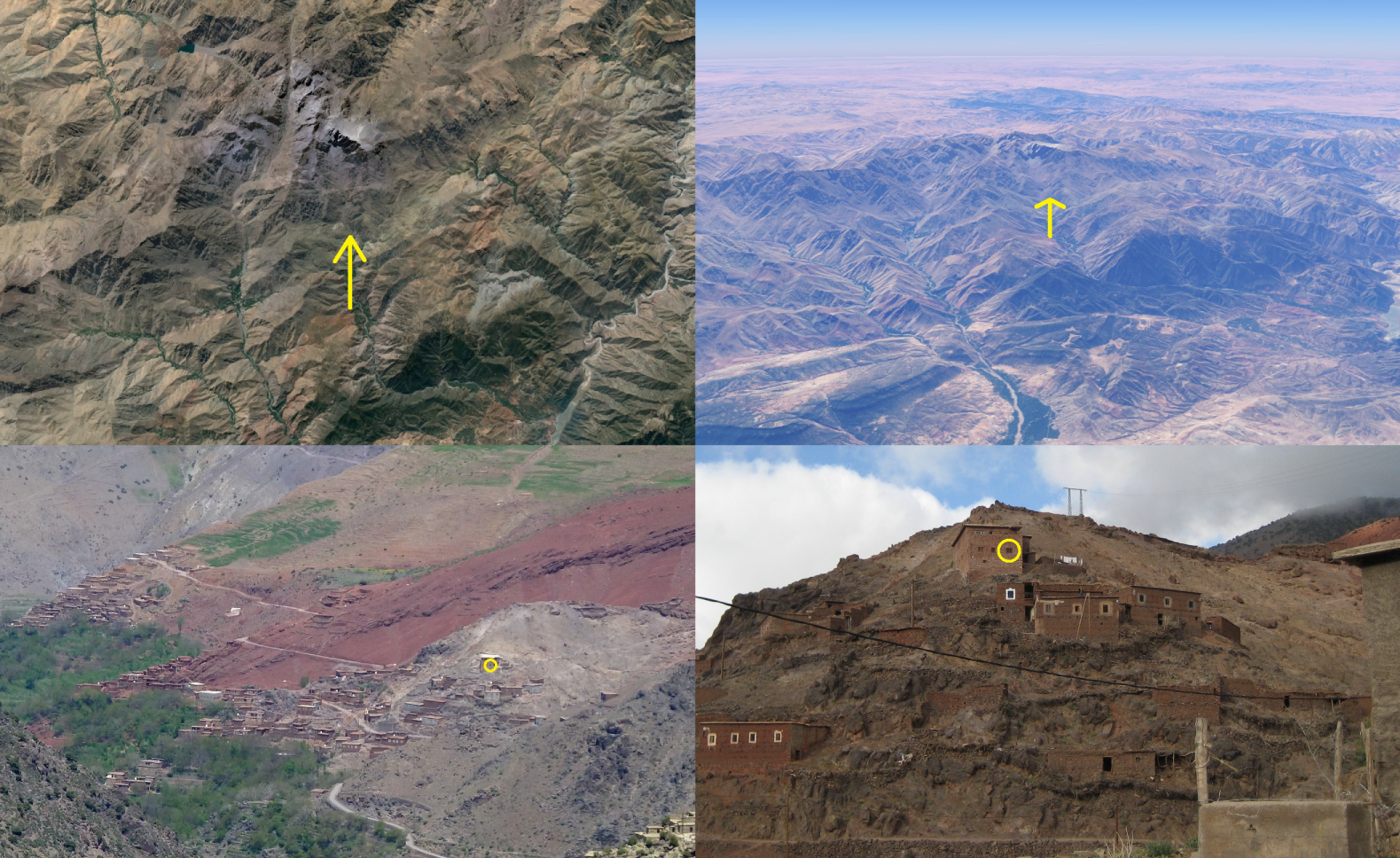
The construction and architecture of the earthen, stone, wooden, and grass house in the foreground of the contest view are fortunately quite distinct. Searches for earthen structures in Africa narrowed the possibilities to the higher altitude regions of Morocco and the northern Sahara and, from there, to the Toubkal National Park region. The prominent ridge outcrop in the contest window proved to be the clinching clue when I recognized it in an older photograph taken from the lodge’s terrace. Finding the lodge on Google Earth took longer given the scarcity of place names available for the area, but eventually the relative locations of the valleys, the mountain peaks, roads, and various structures fell into place.
I am guessing that the contest window is one of three windows on the first (lower) floor of the lodge because the view appears lower than those in photographs taken from the second-story terrace (which is most of them). I decided to go with the western-most of the three because it seemed the one most likely to capture the contest photograph’s view of the western side of sprawling house directly below the lodge.
This search was a treat. Thank you.
Another:
Great contest this week. The contest view comes comes from the Azzaden Trekking Lodge in the Azzaden Valley. The lodge is in the village of Aït Aïssa, Al Haouz Province, Morocco. No street address this week. Best guess on location is 31°08’02.3″N 7°58’28.7″W at 5950 ft in elevation. Jebel Toubkal, the highest peak in the Atlas Mountains, dominates the view out the window.
Online maps do not offer enough detail to determine the village’s name. The closest village they identify is Tizi Ouseem to the south of Aït Aïssa. A tour company offers this map that made it possible to discern the name by comparing the distances to, and following the valley paths from, Tizi Ouseem and Imlil.
With Aït Aïssa pinpointed, it was time to find the gite or lodge with the contest window. The distinctive metal work on the windows (example here), the angle of the view towards Jebel Toubkal and the road below each offered great clues leading to the Azzaden Trekking Lodge. Attached is a comparison of the overhead view with the contest picture.
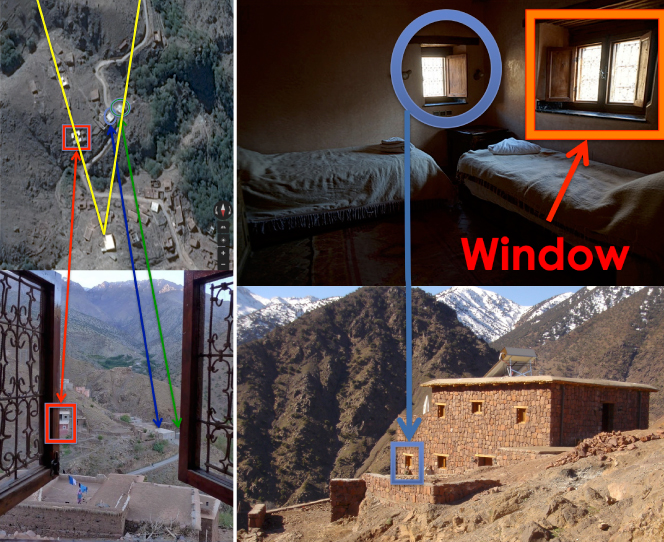
Once at the lodge, however, the exact window was hard to find. First, the window is on the south wall but I could only find exterior photos showing the east and north walls and the west wall. Second, the interior shots are difficult to make out and three sets of windows did not match. This window is too narrow and has the metalwork’s pattern on left and right panes reversed. This photograph shows almost the same view of the mountain but the window lacks metalwork. And these windows in the lodge’s southwest corner are also slightly off.
But this window looks just right. It is in the southeast corner below the top level terrace. Attached is a picture highlighting the contest window. It shows the room’s interior and where in the lodge it is based on a photo of the east wall:
Wow. Meanwhile, Chini tries to play coy:
I give up. I can’t find it. I’m resigned. Defeated. Shattered. I’ve looked everywhere, from one end of the internet to the other. Just when I thought I’d tracked an answer down, poof, it turns out to be something else. Think this image shows the building? No dice, Chini. That look like a good angle? Figured wrong, Butch. Sigh.
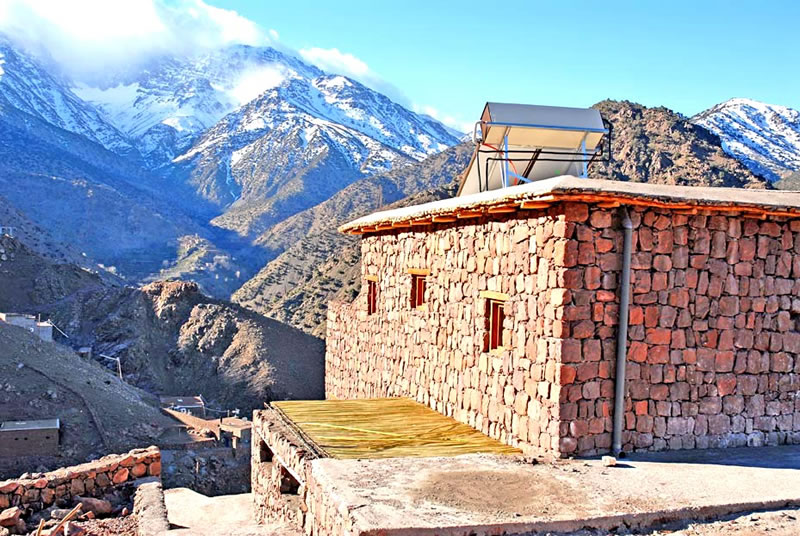
So I have to leave things where they are; I simply can’t find a good, close up image of the southern face of the Kasbah de Toubkal Trekking Lodge in Morocco’s Azzaden Valley where this week’s view was shot. The exact coordinates of 31° 8’2.47″N, 7°58’29.03″W in the village of Ait Aissa and these overhead and exterior views will have to suffice:
This week’s winners are a relatively new husband-and-wife team:
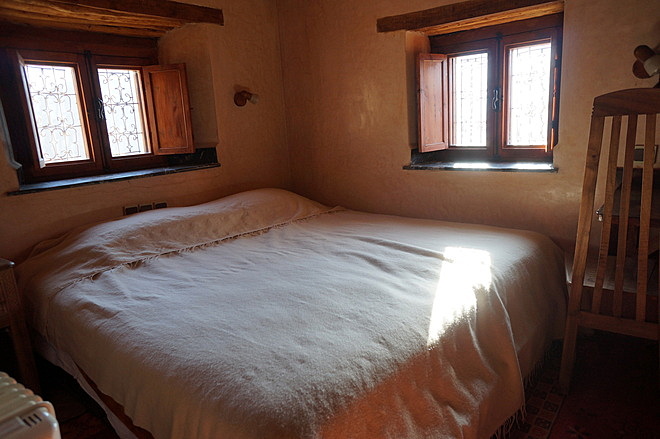
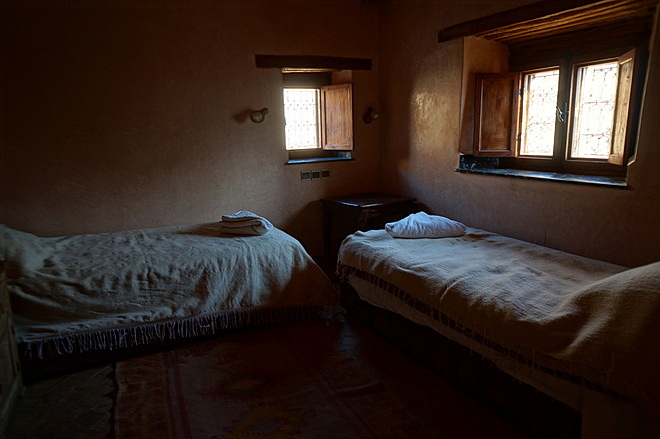
So my wife and I have come up with the location the past two weeks, and we were looking forward to this week’s View. And from the first moment I knew it just had to be Morocco, near the Atlas Mountains. So then I spent the next 3 or 4 hours looking at countless hotel websites, especially in and around Imlil. And then, finally, my wife found the shutters! At the Azzaden Trekking Lodge in the village of Aït Aïssa in the Azzaden Valle, a five or six hour trek from Imlil. The lodge is owned by – or associated with – the famous Kasbah du Toubkal in Imlil. The Lodge has three rooms, all of which appear to have similar shutters. I’ve decided that this room picture is the room with the View’s shutters:
Anyway, after four hours of searching – and as much as I enjoy it – it’s now way too late to continue this. Also, Obama is about to appear on the Colbert Report and I’m not going to miss that! So no more pretty pictures or Google maps with circles and arrows, But I did love this tour video of the trekking lodge:
Fantastic job. It was a honeymoon view:
As a frequent enjoyer of VFYW in contest and non-contest form, I thought I’d take a minute to submit this recent, especially fortunate view that I had from the Azzaden Trekking Lodge in the village of Ait Aissa, Morocco, in the Atlas Mountains near Mount Toubkal, the tallest mountain in North Africa. My wife and I spent our honeymoon in October travelling around Morocco, and we hiked from the town of Imlil, where many of the backpacking routes start and end, to Ait Aissa to get even more away from it all. We were there during the Feast of the Sacrifice, Eid al-Adha, where many people were back home for the holidays from Marrakesh and other cities and at night the sounds of singing and games echoed around the valley.
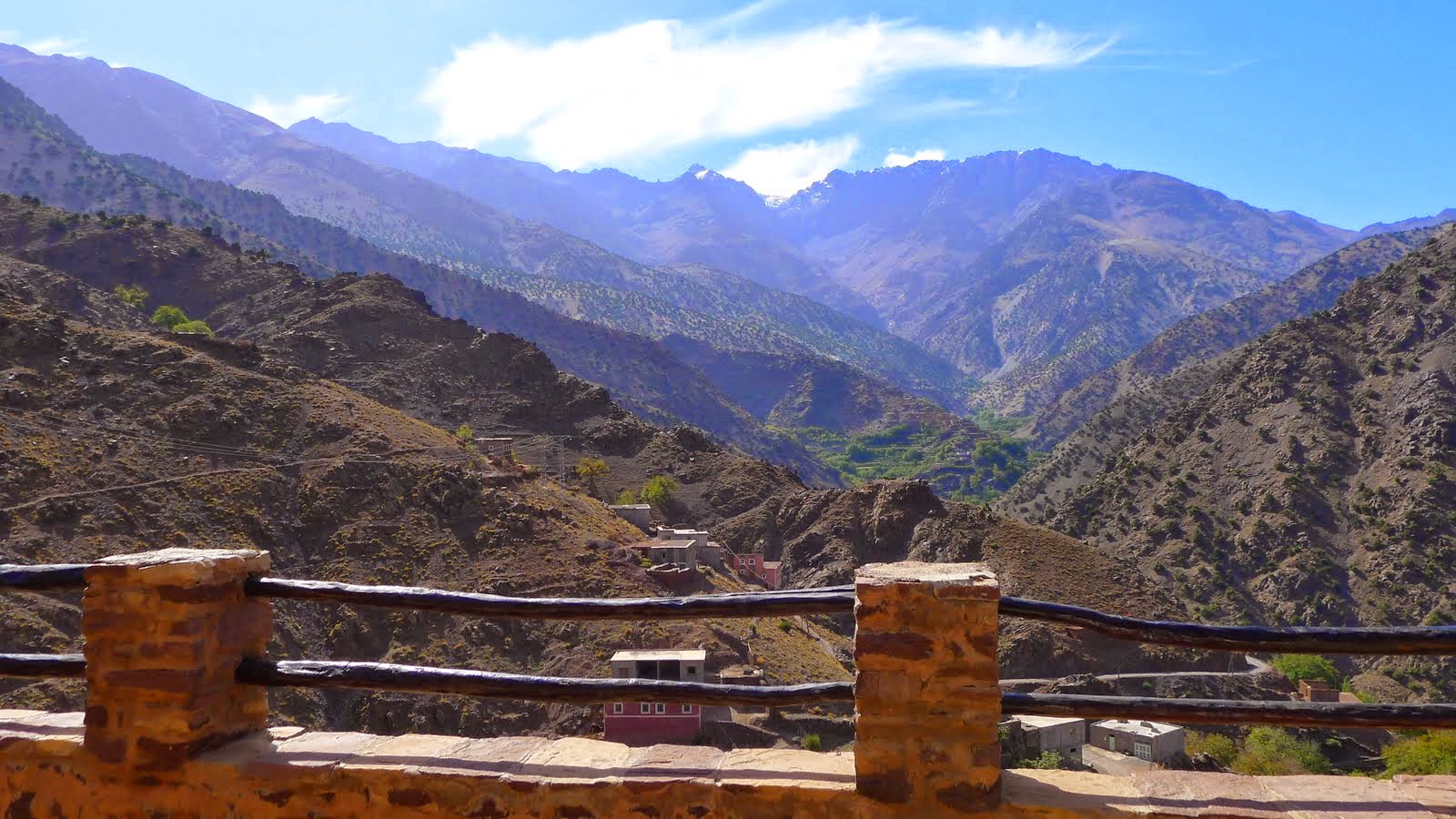
Here are a couple more shots, one from the terrace of the Azzaden lodge looking roughly in the same direction as the lodge, “up” the valley:
And another from the terrace looking across the valley to the village on the other side (sorry, don’t know the name of it):
Also, I would be remiss if I didn’t mention the friendliness and hospitality of all of the Berber people we came across during our stay in the Atlas mountains, in particular our trekking guide Ibrahim. His father and brother are also guides and so maybe someone reading the Dish will come across them one day! It was a real pleasure being there and I’d definitely recommend a visit.
For a Conde Nast Traveller write-up of the lodge, check out this PDF.
The spectacle of the president’s granting pardons to torturers still makes my stomach turn. But doing so may be the only way to ensure that the American government never tortures again. Pardons would make clear that crimes were committed; that the individuals who authorized and committed torture were indeed criminals; and that future architects and perpetrators of torture should beware. Prosecutions would be preferable, but pardons may be the only viable and lasting way to close the Pandora’s box of torture once and for all.
The logic is faulty; interrogators who use torture in the future will expect to be pardoned just like their predecessors.
Whether you call non-prosecution a “pardon” or not, it amounts to the same thing. But what is most odd is that a civil libertarian believes that the president should tar people as criminals without giving them the benefit of a trial. Romero, like the supporters of torture, do what people always do when Congress or the courts can’t, or won’t, do what they want. They turn to the president and demand executive action.
Jonathan Bernstein, on the other hand, advocates for pardons:
This step is critical to keep the issue from becoming partisan, with Democrats being against torture and Republicans allowing it. If torture is to remain banned, it’s going to take reviving the consensus of the elite against it that was broken in the Bush administration. Pardons take care of the legal jeopardy part for the officials; generous pardons might lessen their reputations as bad guys.
A final step has to be a truth and reconciliation commission to detail what happened and how counterproductive it was.
Julia Azari puts such pardons in historical context:
Like Ford’s pardon of Nixon, the act of pardoning would also acknowledge the wrongdoing, even while closing off the possibility of punishment. At the same time, it would depart from the logic that has informed many other politically visible pardons: while breaking from the past, it would acknowledge his opponent’s – not his own party’s – legitimate role in the polity despite serious transgressions. In the current political climate, that might actually be a radical move.
My core problem with this is that a pardon should only be given if the recipient has expressed remorse. Not only have Bush and Cheney and Tenet and Rumsfeld and Hayden expressed no remorse, they have aggressively defended their record, embraced the value of torture, lied about its effectiveness and refused even to acknowledge its appalling amateurism, gross miscarriages of justice and even deaths. There is no way such unrepentant war criminals can be pardoned against their will.
We have a rogue party in this country – a rogue party unlike any other in the West. There isn’t a single political party in the Western world that supports torture, except the GOP. There has never been a political party in American history that has openly supported torture. You cannot and must not appease this tendency. It is a deep threat to our democracy and to our way of life. By allowing the executive branch to do anything it wants, outside of any reasonable interpretation of the law, beyond any moral concerns, and to contract out torture sessions to amateurs is so egregious attack on the rule of law and the West that it cannot be tolerated, let alone pardoned.
Obama’s record in all this is a disgrace – a moral, political act of sustained cowardice and co-optation. It would be compounded by any attempt to formally pardon the guilty for crimes for which there is no statute of limitations and which place the US outside the norms of civilization. It would, moreover, destroy what’s left of the Geneva Conventions, turning their imperative for prosecuting war criminals into an actual pardoning of them. I’m ashamed of living in a country where this is even considered as an option.
Hillary Clinton – surprise! – has said not a word about the torture report since yesterday. She’s on record supporting publication of the report and against prosecuting anyone for war crimes, but hasn’t uttered a peep since the damning evidence was laid out for all to see:
In her memoir about her time helming State, “Hard Choices,” Clinton adds: “There was no denying that our country’s approach to human rights had gotten somewhat out of balance” after the Bush administration. She also praised Obama’s order “prohibiting the use of torture or official cruelty,” using the term the Bush administration refused to use for the harsh interrogation tactics.
Then there is Rand Paul, famous libertarian. We have just read a report that shows that the US government tortured 26 innocent people – about as deep an attack on human liberty as can be conceived. And, so far, he has nothing to say. These individuals are almost as cowardly as our sad, defensive, equivocating excuse for a president at a moment when we need clarity and courage.
As he strolled to his Senate office, Paul declined to characterize the report as an attack on Bush like so many of his colleagues.
Instead the Kentucky senator, who’s attempting to chart a less interventionist course for the GOP as he mulls a presidential run, expressed mixed feelings on the report’s release and what it says about the United States — a sharp break from his Kentucky colleague McConnell, who blasted Democrats’ work as “ideologically motivated.”
“It’s important that people take a stand and representatives take a stand on whether they believe torture should be allowed. I think we should not have torture,” Paul said. “Transparency is mostly good for government. The only thing I would question is whether or not the actual details, the gruesomeness of the details, will be beneficial or inflammatory.”
Update from a reader:
It has been 24 hours since publication of the Senate’s report. Your visceral reaction to publications and politicians not responding to the report on your time line is unfair and obnoxious. This is an important document which requires a thoughtful, sober response. Everyone should be thankful that, for example, two prime candidates for president aren’t running their mouth without thinking, which is what a 24 hour turnaround would be in this situation. Not everyone runs on a blogger schedule.
Steven Taylor makes a simple but essential observation:
So far the only critique of the Senate report has been that the techniques deployed by the CIA did, in fact, produce good and useful intelligence. Setting aside whether that is true or not, keep in mind that such an argument is a defense of torture. I have not seen anyone disputing the actual content of the report. If you are going to be upset about the report, keep in mind what you are defending.
Data shows that popular opinion on the use of torture by the U.S. government has subtly shifted since 2004, when Pew Research Center began polling Americans on the subject. Pew asked whether torture used against suspected terrorists to gain important information is justified, finding a majority of respondents (53 percent) said torture could never or only rarely be justified. But over the next five years, public opinion slowly reversed.
By November 2009, a slight majority of Americans said for the first time that torture could sometimes be justified. In Pew’s 2011 report — its most recent — 53 percent said the U.S. government’s use of torture against suspected terrorists to gain important information can often (19 percent) or sometimes (34 percent) be justified, marking a turnaround from 2004.
But Aaron Blake finds that not all polling is in agreement:
Pew in 2011 showed 24 percent of Americans said torture should “never” be used — little-changed from the 25 percent who said that same in 2009. But also in 2009, a Washington Post-ABC News poll showed Americans were actually about evenly split on torture, with 48 percent saying it could be used “in some cases” and 49 percent saying “never.”
The reason for the even split? Probably because people were given just two options rather than four. And so people who might otherwise say torture should “rarely” be used are temped to say “never,” because they really don’t like the idea of it. … So in sum, depending on how you ask the question, support for using torture in at least some cases — even rare ones — has polled at 70 percent-plus, around 50 percent, and also at just 38 percent.
James Antle III calls out torture apologists who complain about government overreach:
[T]he case for limited government is weakened when those making it ignore or defend torture, testicle-crushing, and waterboarding, complaining only about big government when someone proposes spending taxpayer dollars to help people. And I say that as someone who has written a book arguing that seemingly benign and compassionate government spending can curtail individual freedom.
It is difficult to take someone seriously who thinks the imprisonment of human beings in cages and the behavior of government agents with guns have less impact on personal freedom than the capital-gains tax rate. That is one reason it is so easy for many to dismiss arguments against programs like Obamacare as being motivated purely by economic self-interest.
First, thanks for the live blogging yesterday. It was exhausting to read and I’m sure much more so for those on the Dish team slogging through what is a very depressing report. Days like this make my subscription worth it.
Last night, Congress finally agreed on a spending bill to fund the government for the next year. Digging into the bill I found this on pg. 1353:
10 PROHIBITION ON THE USE OF TORTURE
11 Sec. 7066. (a) None of the funds made available in
12 this act may be used to support or justify the use of tor-
13 ture, cruel, or inhumane treatment by any official or con-
14 tract employee of the United States Government.
It is utterly depressing that we need to include this in a law dictating how taxpayer funds will be used, but as the torture report release makes clear, it is absolutely necessary.
Another is bewildered:
I’m trying to understand why Obama won’t own the report now, and why his administration has resisted its release. Did he want to keep all tools available to current and future executive administrations? Is his administration being held hostage by the CIA? Does he want to stand back and let Congress and the American people work through this without his entering the debate and unleashing Republican rage even more?
I think Obama is a great president and human being, so I am really trying to understand why he seems to be choosing the wrong side of history here. I hope there’s an explanation, but it’s an increasingly small hope.
Another has had enough:
I am disgusted after reading about how Obama is a shill of the CIA and refuses to follow through on transparency in government. He should give the Nobel Peace Prize back. He truly does not deserve it.
Another gives props to Obama’s former presidential rival:
Unfortunately, so far most of the response on the right has been how political the report is, and that it’s just Democrats being mad at losing the Senate (as if this report hadn’t been in the works for a long time), and how torturing people was OK, because, you know, terrorists! I am pleasantly surprised to find myself in agreement with John McCain, something that hasn’t happened in a long time. If he has credibility on anything, it is this, and at least thank god he is speaking up in defense of the report.
Will this cause problems for the US? Perhaps. But, when you’ve done something wrong (and this has all been so very wrong), it’s better to ‘fess up, take your licks, and try to move on. Burying this longer will not make it go away and undo damage that, IMHO, has already been done. Exposing this will allow us to move on, and hopefully, eventually, regain some moral high ground that we have sadly lost.
Another is more pessimistic:
I wish I had some insightful analysis that I could offer, but all I thought as I read of these atrocities was, “It won’t matter. It won’t matter. It won’t matter.”
The report won’t even cause a ripple in this country’s view of torture. If anything, it’s liable to strengthen the position that any and everything is justified, because look at what they did and continue to do to us. To feel outraged, you must view the torture in a vacuum, free of its associations with September 11. And I guarantee you that will NEVER happen. The apologists won’t let it happen, and certainly those who conducted and authorized it will never let it happen.
Add to that the political view that it was released by Democrats in their waning days of Senate power, on the day the Republicans had hoped to grab headlines by humiliating Gruber in front of Congress, and there you have it. The report is at once groundbreaking and astounding – and completely irrelevant if not outright damaging to its own intents and purposes.
I have a feeling we’re about to see, over the next few days (if the story even lasts that long, which in itself is telling), just how far we’ve fallen from our lofty heights. Osama bin Laden must be smiling from his watery grave.
More despair from a reader:
I never truly had my heart broken. Until today.
My father was born here in the States but grew up in Eastern Europe. He lived his childhood on the wrong side of the lines in World War II. The Nazis kicked him out of his bed and made him sleep in the barn with the animals. The Russians came in after the war and eventually turned his village into an artillery range.
He and his brother came back to the States as foreigners in their own land. He got a job, raised his brothers, found a girl and had a family of his own. He was a union man, a Democrat and a fierce anti-communist. He used to wear my brother and me out with stories of his childhood and coming back to America.
He would talk about the Nazis and the Partisans and the Russians. He was a young boy, so he was often insulated from what was happening around him, but not always. In his experience, the Nazis were terrible and the Russians were worse, but America was different. The stories often ended the same way. “What a country!” he’d say as we rolled our eyes and turned back to the TV.
I just can’t reconcile that his America is capable of such barbarism. To annex the tactics of the Nazis is inconceivable.
Perhaps if the masterminds had spent any time in an actual war zone instead of hiding behind a plum Air National Guard assignment or multiple college draft-deferrals. Perhaps then, they would have understood how gravely they betrayed the very America they claimed to defend.
It feels like the America my father loved so dearly died today. And I am heartbroken.
Another anguished reader zooms out:
I’m having trouble recalling a more depressing month. There’s something about the grand jury decision in Ferguson, the grand jury decision in Staten Island, and the release of the torture memo today that feel weighty – and for me, connected. Obviously the events in Ferguson and Staten Island have brought us to a critical moment, one that begs our attention to racial injustice, police brutality, the militarization of our police forces, and the profound inequities of our criminal justice system. There’s been – rightly – much ink spilled these issues in the last several weeks, and hopefully more in the weeks to come.
But with the release of the torture report, I can’t help but think (and hope) that we might be reaching an even broader convergence – one that shines light on the cost of American “security,” at home and abroad. The cost of the wars on drugs and terror – and the unchecked expansion of police powers that have come with – have wrought havoc on our budget, our laws, our moral credibility, our international standing, and of course the lives of people like Eric Garner, Mike Brown, and Gul Rahman.
I don’t have any hope that the incoming Republican Congress is going to do anything about it, of course. We will all be lucky if they don’t make it worse. But what a wasted opportunity for true conservative reform if they don’t. It’s time we shortened the leash, lest the dogs run away from us. Maybe they already have.
“Torture is the polar opposite of freedom. It is the banishment of all freedom from a human body and soul, insofar as that is possible. As human beings, we all inhabit bodies and have minds, souls, and reflexes that are designed in part to protect those bodies: to resist or flinch from pain, to protect the psyche from disintegration, and to maintain a sense of selfhood that is the basis for the concept of personal liberty. What torture does is use these involuntary, self-protective, self-defining resources of human beings against the integrity of the human being himself. It takes what is most involuntary in a person and uses it to break that person’s will. It takes what is animal in us and deploys it against what makes us human. As an American commander wrote in an August 2003 e-mail about his instructions to torture prisoners at Abu Ghraib, “The gloves are coming off gentlemen regarding these detainees, Col. Boltz has made it clear that we want these individuals broken.”
What does it mean to “break” an individual?
As the French essayist Michel de Montaigne once commented, and Shakespeare echoed, even the greatest philosophers have difficulty thinking clearly when they have a toothache. These wise men were describing the inescapable frailty of the human experience, mocking the claims of some seers to be above basic human feelings and bodily needs. If that frailty is exposed by a toothache, it is beyond dispute in the case of torture. The infliction of physical pain on a person with no means of defending himself is designed to render that person completely subservient to his torturers. It is designed to extirpate his autonomy as a human being, to render his control as an individual beyond his own reach. That is why the term “break” is instructive. Something broken can be put back together, but it will never regain the status of being unbroken–of having integrity. When you break a human being, you turn him into something subhuman. You enslave him. This is why the Romans reserved torture for slaves, not citizens, and why slavery and torture were inextricably linked in the antebellum South,” – yours truly, TNR, December 2005.
Pitting two roosters against one another may seem barbaric and arcane, but it may be why the bird became so ubiquitous. Biological evidence suggests that thousands of years ago in South Asia, its ancestral home, the chicken existed only in small numbers. In other words, chickens weren’t kept for producing meat and eggs; there weren’t enough of them for that purpose. They must have had a specialized use, and some scholars believe that use was cockfighting.
It may have begun, like bull fighting, as a religious ritual. A clan or village may have pitted its sacred rooster against another group’s bird. In northern Thailand, for example, the faun phi ceremony honoring ancestral spirits entails cockfighting of a religious nature that may reflect ancient practices. And in Indonesia’s Bali, few religious rituals take place without a cockfight that spills blood into the soil, satiating earth demons.
As the chicken spread, so did its use in ritual and gambling. One of the earliest recorded cockfights took place in China in 517 B.C. The match was held in Confucius’ home province of Lu during the philosopher’s lifetime. The earliest unequivocal evidence of cockfighting in the West comes from this same era. In a tomb just outside Jerusalem, excavators found a small seal that shows a rooster in a fighting stance. The seal was owned by Jaazaniah, who is called “the servant of the king.”



 The Dish