Leaving The Farm

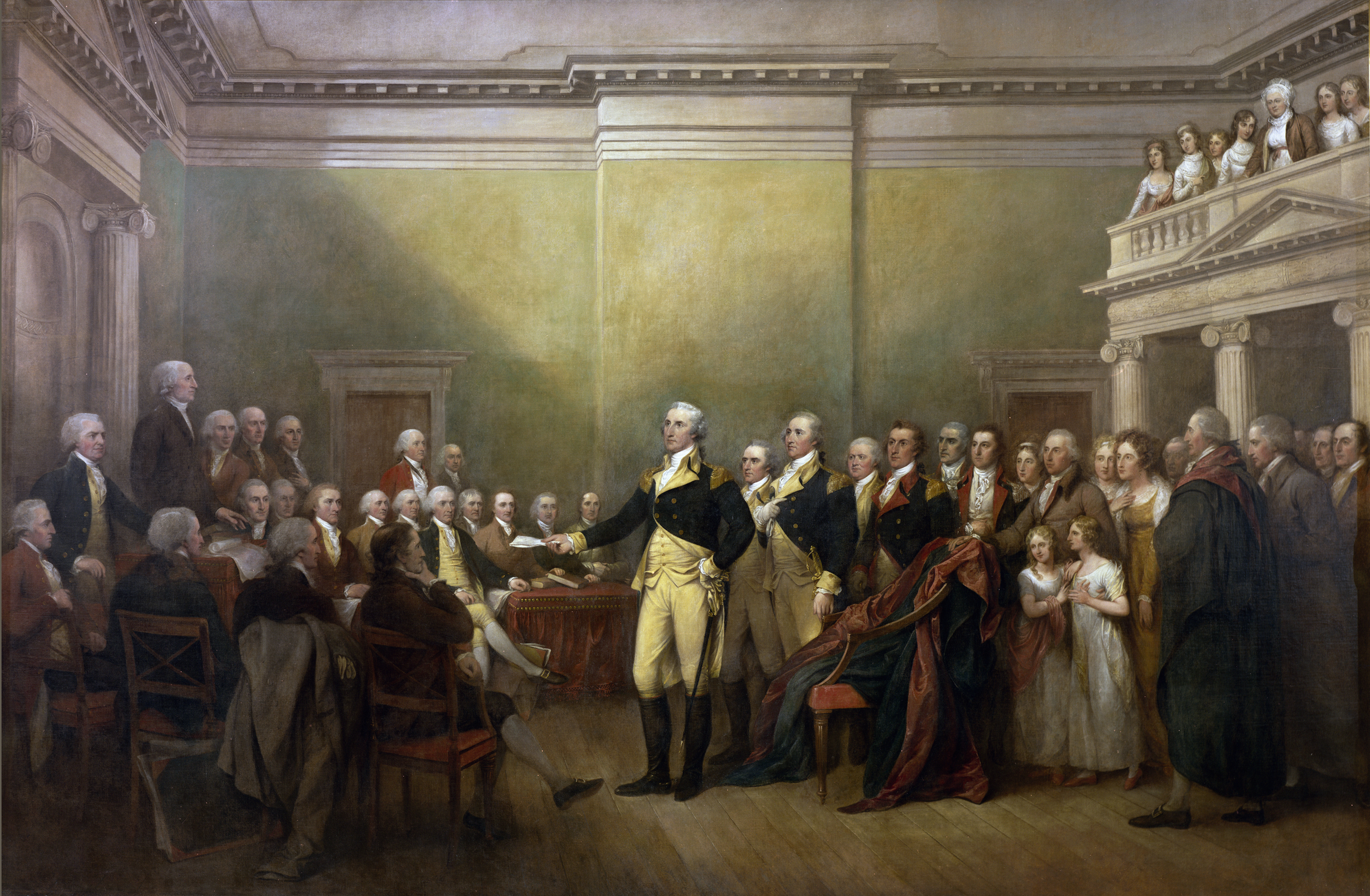
General_George_Washington_Resigning_his_Commission

Alec D. Rogers reviews Edward Larson’s The Return of George Washington: 1783-1789, a portrait of our first president from the end of the Revolutionary War until he took office. Unlike many accounts that portray “a Washington who emerges from Mount Vernon only with the greatest reluctance to play out a script written by James Madison,” Larson gives us “a much more active and politically engaged Washington, who did as much as anyone during these years to bring the new republic into being”:

[Larson] shows us how Washington’s political savvy helped ensure that the Constitution would gain acceptance. The result was a product that closely resembled what, for years, Washington had been advocating in private.

At the crux of the story, though, is Larson’s explanation for why Washington ultimately abandoned a retirement from political life that he earnestly desired.

Larson makes the case that the political class of the time was sold on the need for reform of the Articles of Confederation, and that all agreed Washington’s active support was essential. But the key connective element is Washington’s own political thought and understanding of republican duty. As Glenn Phelps has noted in his study of Washington’s constitutional thought, Washington’s concept of republicanism was that of Greece and Rome: “Republican hagiography demanded that its heroes always be willing to defend the republic against corruption and decay. As much to confirm his own virtue as to attain specific reforms, Washington determined to end his public ‘retirement.’”

In an earlier review of the book, Steve Donaghue expressed regret regarding Larson’s “unwillingness to pin down this less-than-selfless side of his hero”:

His Washington is generally a Washington of whom Washington would have approved, with the man’s baser motivations kept discreetly in the background. This extends even to the choosing of the site for the seat of the national government; Washington and Madison worked hard to make sure the location of that new capital city was on the banks of the Potomac River, near Mount Vernon. As Larson somewhat innocently reports: “It lay at the midpoint of the country’s north-south axis and, if Washington’s company could open the upper Potomac for commercial navigation, at the terminus of the main route west.” It’s about as neutrally phrased as it could be.

Rather than being motivated by grubby financial concerns, Larson’s Washington is always the dispassionate and far-sighted statesman. He refuses to comment publicly during the new constitution’s lengthy ratification process, for instance, not because his personal vanity outweighed his respect for its republican virtues, but because “the Cincinnatus ideal demanded that he not seek power and taking sides now might limit his ability to serve as a unifying leader later”.

(Image: General George Washington Resigning His Commission by John Trumbull, via Wikimedia Commons)

Keeping Excessive Punishment In Check

Reihan sketches out a plan to do so:

What government routinely fails to do is account for the costs the criminal justice system imposes on the civilians who get caught in its web. Mark A.R. Kleiman, a public policy professor at UCLA and author of When Brute Force Fails, made this point vividly in a Democracy Journal essay published last spring. Instead of fixating on the dollar costs of running the criminal justice system, he asks that we also account for “the suffering inflicted by arrest, prosecution, conviction, and incarceration, including all of the residual disabilities that go with the label ‘ex-convict,’ and the fear created by overaggressive policing.”

Imagine if, as Cardozo Law School professor Richard A. Bierschbach has suggested, we had in place a “punishment budget.”

Given such a budget, we would accept that the criminal justice system would cause some degree of suffering. At the same time, we’d insist that if you pass some measures that increase suffering in some way—say, by making more arrests—you’d have to reduce the sum total of suffering in some other way, for instance by reducing prison sentences for nonviolent offenders. This would impose a useful check on the creep of new laws, rules, and regulations that steadily increase the government’s coercive powers, as if on autopilot.

He also recommends getting “better, more reliable data on policing so that communities have a clear sense of what local law enforcement agencies are doing in their name.” Along the same lines, Josh Voorhees wants the president to “call for all law enforcement agencies to keep an accurate count of how many people the police kill each year”:

Without a formal and comprehensive reporting system, the president, lawmakers, and everyone else have no way of knowing the true scope of the problem. Even if the government is willing to believe that police officers are almost always justified when they kill suspects in the line of duty, Washington still owes the nation a full accounting of those killings that it has implicitly sanctioned. How can the president hope to limit the number of lives lost if he has no way of knowing how many lives are actually lost? How will Congress evaluate whether policies aimed at curbing police shootings are successful if it has no way of tracking the success or failure of those policies?

Buried In Berries

dish_berries

Josh Barro registers a shift in Americans’ eating habits:

According to statistics published by the United States Department of Agriculture, per capita consumption of fresh raspberries grew 475 percent from 2000 to 2012, the most recent year for which data are available. Blueberry consumption is up 411 percent, and strawberries are up 60 percent.

He notes, to his surprise, that “the main factors changing what fruits we eat are on the supply side”:

If people are eating more of some kind of fruit, it’s probably because farmers have figured out how to deliver more of it, at higher quality, throughout the year. Of course, there is the “superfood” factor:

Both raspberries and blueberries have been praised for their nutrient value. But Chris Romano, who leads global produce procurement for Whole Foods, attributes the boom in berries largely to taste and availability. “Techniques in growing raspberries, blueberries and blackberries have gotten much better over the last 15 years,” he said. Growers are planting better breeds of berry, with higher sugar content; they’re using pruning and growing techniques that extend the season, including growing berries inside greenhouse-like structures called tunnels that retain heat; and most important, they’re growing berries in places they didn’t used to, where production is possible at different times of year.

Update from a reader:

I don’t know why Josh Barro is so surprised by this. I lived in Ithaca, NY, when the farmers market got started. There were already several farms in the area where people could pick strawberries and other crops. After a few years in the 1970s, we went to one farm that had more than a one-week strawberry season. When we asked, it turned out that they were starting some berry plants earlier using protection from the weather and Canadian varieties more accustomed to cooler weather. I think they experimented with Southern varieties to extend the season later.

Over the years, vendors selling in the farmers market pushed to extend their seasons or get two seasons out of cool weather crops, including some greens, broccoli, and peas. There were probably more crops that I can’t remember or that came after we got transferred out of town. I miss the Ithaca farmers market a great deal. I was delighted to buy fresh produce that was locally grown “out of season”.

Where I live now in Pennsylvania, I see the season for fresh corn being extended through early and later planting and some careful management. But it’s also getting harder to get fresh corn right out of the field at some farm markets, which have added refrigeration facilities to hold the corn. The supersweet varieties do have pretty good quality when they’re refrigerated right away, but the ones grown locally are not candy-sweet. Frozen corn in bulk packages at grocery stores is now so sugary I can’t stand the brands I’ve tried. I’ve gone back to home freezing and otherwise avoiding corn.

The downside of all this sugaring up is that with corn and also with winter squash – at least for me – is that I don’t like eating them as much. I don’t want to eat corn that is as sweet as a banana. I want to be able to add a little brown sugar to the squash to perk up the flavor but add that molasses overtone – and acorn squash has gotten so much sweeter adding brown sugar makes it cloying. In addition, some of the squashes I used to buy seem to be unavailable. In Ithaca when I was first married, I’d bake a mixture of acorn and buttercup squash because the buttercup was drier and the combination could be run through a food mill and frozen, and the result reheated nicely and wasn’t watery. Buttercup squash, confusingly, looked more like acorns with the big cap and protruding cup-shaped base. I haven’t seen it in a farmers market or store in years.

One thing I’d like to know about the increased sale of raspberries is what the rate of waste is. I am very cautious about buying berries and inspect carefully. A fair number of packages of blueberries show a bit of white mold or squashed berries on the bottom, and blueberries are fairly sturdy compared to raspberries. Raspberries spoil really easily, so I wonder if more are discarded at the store and if more are discarded at home because of mold or other deterioration. I do appreciate getting the berries in clear plastic containers, because I can visually inspect them, but berry sales, unlike banana sales, depend on a lot of plastic – which also gives me pause.

(Photo by Flickr user swong95765)

The Distinctiveness Of DFW

Adam Kirsch finds it in his Americanness – especially the writer’s conviction that his unhappiness was “a specifically American condition”:

Like many classic American writers but few contemporary ones, he genuinely experienced The_best_people_you_will_ever_knowbeing American as a bitter, significant fate, a problem that the writer had to unravel for the benefit of his fellow sufferers. In a late story, “The Suffering Channel,” Wallace theorizes about “the single great informing conflict of the American psyche,” which is “the conflict between the subjective centrality of our own lives versus our awareness of its objective insignificance.” All of “Infinite Jest” can be seen as a demonstration of the thesis Wallace advances early in the novel: “American experience seems to suggest that people are virtually unlimited in their need to give themselves away, on various levels.”

When Wallace wrote about how difficult it was to be an American, he specifically meant an American of his own generation—the post-sixties cohort known as “Generation X.” “Like most North Americans of his generation,” Wallace writes about the teenage hero of ”Infinite Jest,” “Hal tends to know way less about why he feels certain ways about the objects and pursuits he’s devoted to than he does about the objects and pursuits themselves.” Likewise, in “Westward,” he writes, “Like many Americans of his generation in this awkwardest of post-Imperial decades . . . Sternberg is deeply ambivalent about being embodied.” It is no wonder that readers born between 1965 and 1980 responded to this kind of solicitude, with its implication that they were unique, and uniquely burdened.

Recent Dish love for David Foster Wallace here and here.

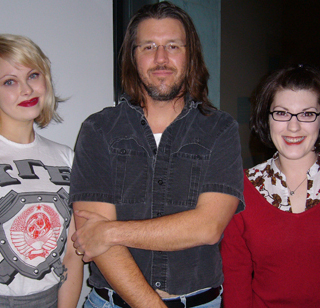
(Photo via Wiki: “David Foster Wallace at the Hammer Museum in Los Angeles, standing for a photo with fans Claudia Sherman and Amanda Barnes, in January 2006.”)

The Best Of The Dish This Weekend

IMG_3002

Ross made a crucial point about TNR today:

The New Republic as-it-was, the magazine I and others grew up reading, was emphatically not just a “policy magazine.” It was, instead, a publication that deliberately integrated its policy writing with often-extraordinary coverage of literature, philosophy, history, religion, music, fine art. It wasn’t just a liberal magazine, in other words; it was a liberal-arts magazine, which unlike many of today’s online ventures never left its readers with the delusion that literary style or intellectual ambition were of secondary importance, or that today’s fashions represented permanent truths.

That’s why the Dish’s coverage of the world every day includes philosophy, theology, art, photography, literature, film and poetry alongside our bread and butter political and policy analysis. If you want to know why we don’t take the weekends off – but try to curate and aggregate some of the more thoughtful essays and reviews and posts on what might be called “the eternal things”, this is why. Because we’re trying in our inevitably limited bloggy way to keep the worldview of the now-disappearing literary and political magazines alive in a new medium and a new form. If we had the resources, we would do more – finding ways to add many more original essays and reviews to Deep Dish, for example. We’re brainstorming the future of our little experiment all the time – but the demise of places where high and low culture, politics and poetry, human life and abstract argument can jostle for space and inform each other makes me particularly aware of the need to fill this cultural void, while some of us still retain the institutional memory to replicate it. Culture needs stewards, and they can come in all sorts of shapes and sizes.

I struggle with blogging all the time – it’s a very intense and public way of being a writer, it’s extremely Howler Beagle (tr)strenuous, and doing it for fifteen years every day can get you exhausted by exhaustion. Part of me wants to drop off the planet all the time and just grab a book or ten, or debate something in the news without anyone but my friends to tell me I’m full of shit, or just not go online for a few weeks on end. Part of me would like to go a week without being called a racist, a sexist, a homophobe, an anti-Semite or a misogynist (I guess that was Burning Man). But I’m not delusional, and when I see the little lifeboat that we, with your help, have managed to create over a decade and a half, it seems a vital thing to figure out a way for it to survive and thrive. As more old-school magazines become shipwrecks, or unrecognizable, we have to keep that boat buoyant until the seas calm … or this metaphor completely runs out of steam.

This weekend, we discovered aspects of Kafka’s life that were straight from a sit-com; explored Pope Francis’ view of sexual complementarity; worried about the decline of male friendship and love (see Martin Amis talk about Hitch here); celebrated the art of toilet graffiti; and revealed the video-photo-shopping of movie-stars in movies – to make them flawless, of course.

Some other quotes:

Bad sex writing: “The universe was in her and with each movement it unfolded to her. Somewhere in the night a stray rocket went off.”

Faith: “The yearning for an afterlife is the opposite of selfish: it is love and praise for the world that we are privileged, in this complex interval of light, to witness and experience.”

Good luck: “Updike’s literary setbacks were those of a lottery winner who stubs his toe on the way to the bank and then has to wait in line before he can cash his check”

Jed Perl on Picasso: “A product of modernism, Picasso trumped modernism. By rejecting the idea of art as having a past or a future, he has somehow managed to stay with us in the present.”

And Mark Strand on his own death, and on life:

The weather, like tomorrow, like your life,
is partially here, partially up in the air.
There is nothing you can do.

The most popular post of the weekend was TNR RIP – my reflections on the implosion of an institution. Next up: A Smaller Screen For Sex.

If you want to help keep this blog alive, and haven’t yet subscribed, please do here. It matters for all the reasons above. If you have, thank you – and you can help some more by buying a Christmas gift subscription for a friend or family member, or by buying our new coffee mug. Some Dishheads’ pets – here, here and here – are more excited than others:

cat-mug

Mug just arrived! Gorgeous!

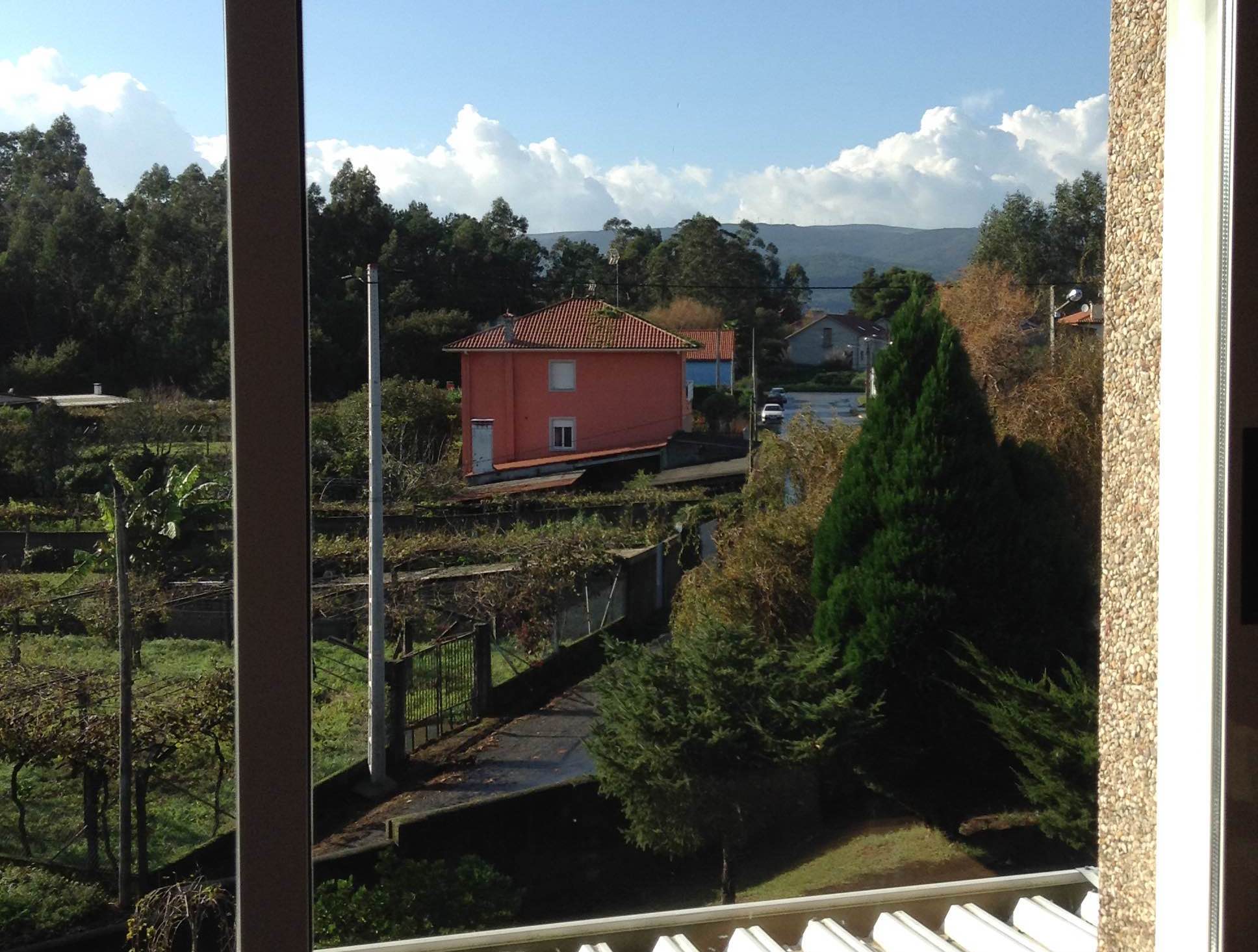
One more email for the weekend, from the reader who sent the window view above:

Because I’m a recent first-time subscriber, I don’t know the unspoken decorum to go about submitting a Window View for the daily shots or the weekly contest, but here it is: a shot from the elementary school I work at in Boiro, Spain, taken at 3:33pm. I’ve been reading since around March or so and subscribed in July and am happy to contribute even a small amount to support such a high quality curation of links and articles from across the ‘net as well as the rich discussion that is hosted here. Keep it up.

We will in the morning; see you then.

Liberalism, Conservatism, Skepticism

Thanks to the Washington Post, Tom Maguire and Hanna Rosin, we have a glimpse of what might have actually happened to UVA’s “Jackie”:

A group of Jackie’s close friends, who are advocates at U-Va. for sex-assault awareness, said they believe that something traumatic happened to her, but they also have come to doubt her account. A student who came to Jackie’s aid the night of the alleged attack said in an interview late Friday night that she did not appear physically injured at the time but was visibly shaken and told him and two other friends that she had been at a fraternity party and had been forced to have oral sex with a group of men. They offered to get her help and she said she just wanted to return to her dorm, said the student, who spoke on the condition of anonymity because of the sensitivity of the subject.

That’s a horrific story, if it pans out. The failure of the school to investigate more assiduously remains salient. The climate for young women on a campus where many readily believed the gang-rape-broken-glass-“grab it by its leg” version does not cease to be a pressing issue. The truth could be damning enough.

So why did an inflammatory, lurid, and apparently fallacious story get into print – with only one source and no corroboration – breaking most basic journalistic rules in a serious publication? Rich Bradley is surely right: it was a too-good-to-check story that echoed what many truly wanted to hear. It managed to suggest that the “rape culture” we are now told is endemic is even worse than you could possibly imagine, and ignored in plain sight. It implicated individuals in various stigmatized groups (among many journalists and activists) – i.e. the dreaded evil trifecta of “white”, “men” and “Southern”. Its details – from the shattered glass and the beer bottle sodomy – had an irresistible allure. Questioning it was like questioning whether Saddam Hussein actually did have WMDs – it seems as if you are excusing an evil figure, or being terminally naïve, or minimizing the danger. We believe what we want to believe – and, in our public debates, we also keep searching for the perfect anecdote or fact or story to refute our opponents for good and all.

Both sides do this. Republicans couldn’t accept the already-damning and uncontested facts about Benghazi – that the danger to the consulate was under-estimated, security was lax, and people died as a consequence. They had to make the story fit a bigger narrative – of treachery and betrayal at the highest levels, a story that could dispatch Obama and Clinton in one news cycle swoop. And so they have made an ass of themselves as much as Rolling Stone has. I’ve done this too – in 2002 and 2003, when I simply did not see what was in front of my nose on Iraq. So I don’t think that the lesson of this latest embarrassment is that we do not have a grave problem of campus rape; or that anything more than a tiny fraction of those claiming rape are fraudulent. I think the lesson is to be more skeptical of things you want to believe than of almost anything else.

This is difficult, especially when you believe you are in the vanguard of social justice – and the ends can justify the means. It is much easier, for example, to believe that the vicious murder of Matthew Shepard vindicates a worldview where every straight man is a gay-basher until proven otherwise, and that the hatred of gays is close-to-pathological in its fury. It is much harder to absorb a still-terrible but much more complicated story of a horrible mixture of homophobia, the meth subculture and petty criminality.

This is why liberalism matters as much as progressivism, which is on my mind a little as the demise of TNR has sunk in. For many, TNR’s legacy of airing internal dissent, its controversial questioning of progressive shibboleths, its inclusion of some conservatives in its ranks, its constant sallies against liberals as well as conservatives, and its airing of taboo subjects, make it a risibly racist/sexist/homophobic/classist institution that deserves to die. I dissent. What it long represented was the spirit of liberalism in the American tradition – a spirit of fearless inquiry, serious argument, and a concern for the truth. That TNR failed in some of these attempts does not damn it. Not to try to confront feelings with reason, or ideology with fact is a far worse inclination. In fact, as so many instant hysterical and self-serving stories flicker across our screens and phones, we need TNR’s beleaguered liberal spirit as badly as we always did. We need it among publications on the right as well as the left. In these polarized, self-cocooning days of Facebook “likes” and doxxing, of intensifying groupthink and moral posturing, of Twitter lynch-mobs and instant fads, we need  more voices willing to question their own “side”, more turds in more punchbowls, more writers willing to be open to facts that undermine their own ideology, to express skepticism precisely in those areas where dogmatism is creeping in.

We try to do that every day here at the Dish – because, in part, I was trained and influenced and formed by some of the best minds in this great liberal tradition in American letters, and because I have tried to learn from my own errors. It isn’t easy and it isn’t fool-proof. But that tradition must not die; or, sooner rather than later, our democracy will.

(Thumbnail image cropped from a photo by Bob Mical)

God, Aliens, And Us

7309213060_d585413262_b

If intelligent life was discovered elsewhere in the universe, could monotheistic faiths successfully adapt? Damon Linker is pessimistic:

Think of it as a theological Copernican Revolution. Just as the scientific Copernican Revolution destabilized and downgraded humanity’s place in the cosmos by substituting heliocentrism for a geocentric view that placed the Earth and its inhabitants at the center of creation, so the discovery of advanced life on other planets would imply that human beings are just one of any number of intelligent creatures in the universe. And that, in turn, would seem to imply either that God created many equally special beings throughout the universe, or that God cares for us more than he does for those other intelligent beings.

How the latter view could be rendered compatible with basic tenets of monotheism (including divine omnipresence, omnipotence, and omnibenevolence) is beyond me. Did God create those other intelligent creatures, too, but without an interest in revealing himself to them? Or did they, unlike human beings, evolve all on their own without divine origins and guidance?

How believers answer those questions will be a product, in part, of what the extraterrestrials look like. If the aliens have symmetrical body structures — two legs, two arms, two eyes, two ears, two nostrils — then it may be plausible to assume that they were created in the image and likeness of the same God as we were. But if they look nothing like us at all, the case for separation between “our” God and these alien intelligences would grow much stronger.

Noah Millman, however, offers a more sanguine take:

Religions do not grow and shrink in response to reasoned analysis. Their origins are mysterious and their subsequent trajectories are the function of too many variables to be easily teased out. Why did Mohammed’s conquests lead to the formation of a new world religion, while Genghis Khan’s did not? Why did Jesus beat out Mithra in the contest to succeed Roman paganism? Why was there any such contest in the first place? What, for that matter, do the Abrahamic religions offer that is so appealing that they continue to grow at the expense of non-Abrahamic traditions that, objectively speaking, require much less of a leap of faith, much less suspension of disbelief in the objectively absurd?

I don’t know the answer to these questions. But they have more bearing on the prospective future of Christianity – and what that future will look like – than the possibility that Christianity will seem absurd in the face of this or that scientific development. Even so revolutionary a development as the encounter with extraterrestrial intelligence.

(NASA’s Hubble shows the Milky Way is destined for head-on collision)

The Science Of Sibling Rivalry

Peter Toohey mulls it over:

[Animal behaviorist Scott] Forbes describes how herpetologists, ornithologists, and mammalogists found that “infanticide – including siblicide – was a routine feature of family life in many species,” most commonly seen in birds. Some birds lay two eggs “to insure against failure of the first egg to hatch. If both hatch, the second chick is redundant to the parents, and a potentially lethal competitor to the first-hatched progeny.” The healthy older chick often kills the younger to eliminate the competition, and some parents actually encourage siblicide when the death of the nest-mate doesn’t naturally occur.

After all, if resources are scarce, it’s better that the strongest offspring survive and that their potential efforts go to ensuring that happens. (It’s the old story of genetic replication again: Surviving offspring are more likely to have the strongest genes, and they are the ones that have the best chance of reproducing later and passing those genes on.) Forbes thinks that such extreme jealous reactions are not common in the human species, but “the more modest forms of sibling rivalry that are ubiquitous in species with extensive parental care – the scrambles for food and begging competitions – resemble more closely the dynamics that occur in human families.”

Update from a few readers:

That Youtube video of the two kids just sent me back about 30 years.

My older daughter and her brother had been fighting a lot one day and my husband made them sit on the couch and hold hands for five minutes. Somehow holding hands didn’t seem quite as hard to get done as hugging, but after about two minutes the giggles started and by the time the timer went off, they became again the power of two against the power of parents and ran off to play … not nearly as dramatic but just as successful. The two of them still talk about it once in a while. I have to admit my husband was much more creative in making certain that our kids suffered the consequences of their actions much better than I did.

Another is dismayed:

That gruesome Youtube of children forced to hug each other made me ill.  The boy was obviously overtaxed and needed rest.  The daughter has obviously learned her parents’ game well enough to work the problem.  But there is no love here. Neither child cares about the other; in the end, they only want to make it stop.  And the parents are nasty control freaks who have no empathy for either child.  That was billed on Youtube as “funniest punishment ever.”  It was actually one of the most manipulative and unkind representations of parenting I have ever seen.  I wonder what messes these children will become as adults, but I can guess.  The daughter will be able to game any situation and be a master of manipulation and control, having learned well from her parents.  The boy will finally catch on to how to work it, especially when he gets some testosterone and becomes aggressive, but he will always be a needy, dependent mess underneath.

When a hug is punishment, then black is white and up is down.

Painting In The Present

2777734591_df45247676_b

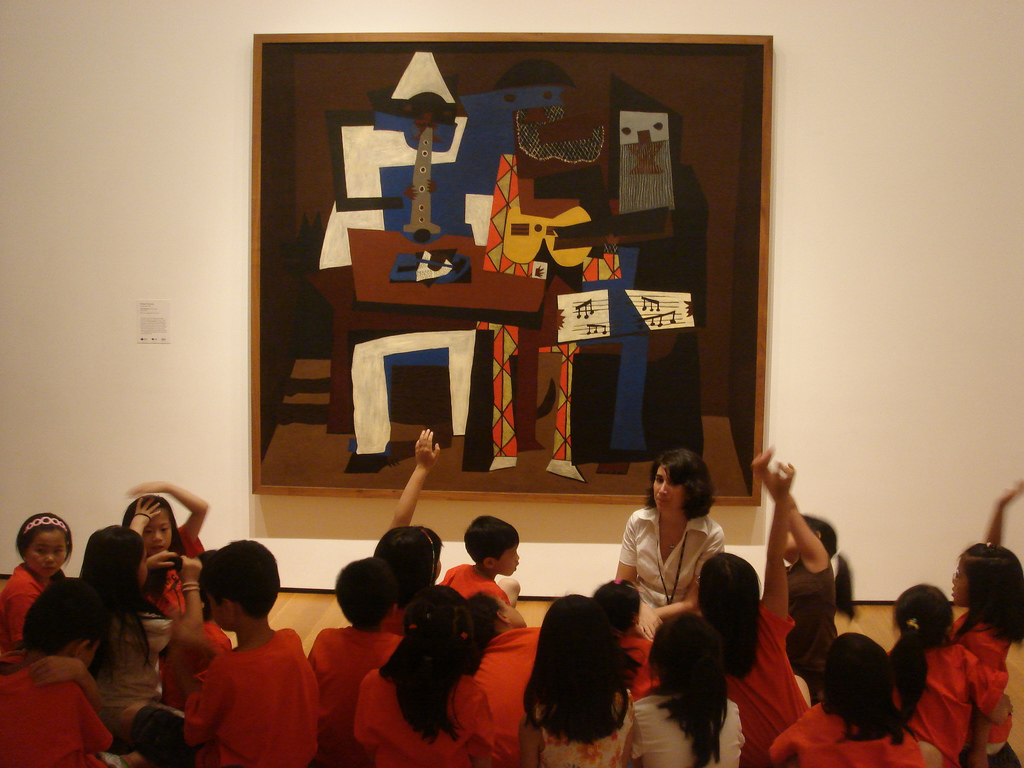
Jed Perl recently visited two exhibitions of Picasso’s work – one in Paris, one in New York City – leading him to consider why the artist still resonates so powerfully:

Progress, at least in modern art, has often been related to ideas of purification, simplification, and reduction. Picasso was never committed to any of that, at least not for long. Sometimes he simplified, but as frequently he complicated. For Picasso, Cubism was as much complication as simplification, as much a matter of feeling as of form, the world comically and tragically disassembled and reassembled. Neoclassicism’s porcelain-perfect verisimilitude was as natural an outcome as the abstract web of the 1928 design for a monument to Apollinaire. If Picasso’s work strikes with particular urgency now, it is because his skepticism about the promise of progress and his heartfelt and disorderly humanism accord with our moment, when we often feel that the best we can do is to take things as they come, the tragic and the comic bewilderingly mixed. Like Picasso, we do not see catharsis in the old modern dream of progress.

A product of modernism, Picasso trumped modernism. By rejecting the idea of art as having a past or a future, he has somehow managed to stay with us in the present. Going through the rooms full of Picassos in New York and Paris, confronting at every turn the faces and figures of his lovers and friends and mythological imaginings, we find ourselves happily besieged by humanity in all its crazy, wonderful, awful profusion. For those who had imagined that Picasso would recede with the modern century, there is quite a shock in finding that he is right here beside us as we stand blinking in the harsh light of the day after modernism died.

(Photo by Antonio Rubio)

“Beginning In Damnation, Bound For Deliverance”

Kathryn Schulz profiles Cheryl Strayed, author of the memoir Wild (recently made into a motion picture, seen above), which recounts her experience living alone in the woods for three months. Schulz connects Strayed to a tradition of religious pilgrimage – “the Muslim walking to Mecca, the Buddhist to Bodh Gaya, the Hindu to Puri, the Catholic to Lourdes”:

Religious pilgrims walk outdoors, but their fundamental journey is inward, undertaken to improve the state of their soul. So, too, with Strayed. The subtitle of Bill Bryson’s book is Rediscovering America on the Appalachian Trail. The subtitle of hers is From Lost to Found on the Pacific Crest Trail.

Like Dante, then, Strayed is on a spiritual journey, beginning in damnation, bound for deliverance. That makes Wild a redemption narrative — and that, in turn, helps explain its popularity, because redemption narratives are some of the oldest, most compelling, and most ubiquitous stories we have. We enshrine nature writing in the canon — you were probably assigned Thoreau and Emerson et al. in high school — but it is redemption narratives that dominate our culture. Among other things, you can hear them in religious services all across the land and in AA meetings every day of the week.

Wild embodies this ancient story. Or, more precisely, it embodies the contemporary American version thereof, where the course is not from sin to salvation but from trauma to transformation: I was abject, dysfunctional, and emotionally shattered, but now I see. This version has more train-wreck allure than the traditional one (being a mess is generally more spectacular than merely being an unbeliever), and it is also more inclusive. Identifying with it requires no particular faith, beyond the faith that a bad life can get better.