Thoughts On Affirmative Action, Ctd

A reader pushes back a bit:

I feel like you’re talking out of both sides of your mouth here. On the one hand, you say that use oppose affirmative action in the way that it explicitly uses race as a factor in determining admissions as being unfairly discriminatory towards qualified students. Yet, at the same time, you favor California’s 10% policy as a substitute, even though the only reason this works is because it draws on our country’s structural and institutional racism. So you’re against affirmative action if it happens explicitly, but you’re all for it if it’s an implicit part of the system? How do you see those two things as being meaningfully different?

Because one is explicit, racially discriminatory and clearly undermines the principle of equality of opportunity; and the other, while not ignoring racism, is implicit, race-neutral, and geared toward advancing equality of opportunity. From an Asian-American reader and Harvard grad with a JD and MPH:

First, I can’t help but notice that many liberals like Freddie who are quick to say things like “there is no such thing as a meritocracy” are credentialed in squishy academic studies (see his Ph.D. in “Rhetoric and Composition.”) The sad fact is that much of Academia, especially the humanities, has abandoned traditional notions of intellectual rigor in favor of jargon and happy-talk in which nothing you say can ever be wrong so long as you come out on the right side (“microaggressions,” “structural racism,” “patriarchy,” and so on). If this is your academic background, then it really is true that there is no such thing as meritocracy. But anyone who has struggled through calculus-based physics or Bayesian Statistics knows the truth:

not everyone can handle truly trough academic material, and it’s not merely a matter of being privileged. You note that Cal Tech doesn’t use affirmative action and now has a class that is 40% Asian. But the interesting question is why doesn’t Cal Tech practice affirmative action? The answer: because they bloody well can’t. The required core curriculum in Cal Tech includes quantum mechanics for everyone! Cal Tech can’t admit unprepared kids and then shunt them off into African-American Studies or Sociology.

This is a big problem with the illiberal left that isn’t properly acknowledged: they are truly anti-intellectual. There is still a strain of Marxist thought in the liberal humanities that treats science itself as fundamentally Western, patriarchal, and racist. The crowning jewels of humanity (calculus, relativity, quantum mechanics, evolutionary biology) are treated as just another “way of knowing” the world. Although we aren’t there yet, this all reminds of me of the scene in Zhang Yimou’s Ju Dou, where a woman bleeds to death during childbirth in China during Mao’s great leap forward, because the doctors in the hospital were all sent to be “re-educated” and have been replaced with seventeen-year-olds who can spout revolutionary dogma but are completely ignorant of medicine.

Liberals can talk a pretty game, but I wonder how many of them, if their child needed risky brain surgery, would hasten to a hospital whose motto is “We Put Diversity First,” or “We Don’t Believe in Merit?”

Another Harvard grad provides a solid assessment of the overall situation there:

I’ve been fascinated by your thread on the lawsuit alleging anti-Asian discrimination at Harvard. I believe the often-ignored but key issue in these kinds of discussions (flagged by Richard Posner, the eminent judge and author, here) is that Harvard, like all universities, runs itself as a business, and that business is based on maintaining and increasing the scale, power and influence of Harvard, as well as its brand as the gold standard of world universities.  The admissions policies of Harvard College should be understood in that light.

To support its academic bona fides, Harvard lavishes unmatched riches on its graduate and professional schools with the aim of ensuring that they’re world-renowned centers of academic and research excellence educating students with the highest potential in their disciplines (I imagine you saw evidence of this when you were a graduate student there).

The role of Harvard College in Harvard’s business is somewhat different.  In parceling out the 1,600 or so places for entering undergraduates each year, Harvard College has to assemble a mix of students who, collectively, do the most to satisfy the sometimes-competing business objectives of (i) maintaining Harvard’s academic bona fides; (ii) ensuring that future world leaders in a range of areas – not exclusively academic – choose to attend Harvard College; and (iii) satisfying other institutional priorities critical to the broader business of Harvard.

The first objective is met by admitting a certain number of truly academically superior candidates, as measured by standardized test scores, grades, class rank and other signifiers of academic achievement.  Harvard needs to fill a large chunk of the class with candidates of this kind, not only to support Harvard’s academic brand but to avoid damaging it by lowering the range of standardized test scores of admitted students, which is published every year.  Accordingly, Harvard makes as many places available for these kinds of candidates as it thinks it can, consistent with meeting objectives (ii) and (iii) above.

The second objective is met by trying to recruit candidates who may be exceptional in other than entirely academic areas (e.g., music, studio art, drama, creative writing, political activism, journalism and athletics) while being academically acceptable.  Harvard College alumni who go on to positions of leadership in areas outside academia are powerful assets to Harvard’s brand, implicitly sending a message that attending Harvard College helped them achieve their success, and broadening Harvard’s reach in our society.

The third objective – satisfying other institutional priorities – leads to a variety of admissions behaviors.  Historically underrepresented minorities are recruited and offered admission under affirmative action because this is seen to be the right thing to do and, perhaps as importantly, it would tarnish Harvard’s brand with important constituencies if Harvard were seen to be a laggard in this area.  Harvard recruits athletes because, rightly or wrongly, sports are an important part of the American university experience (and Harvard’s history) and increase student and alumni loyalty to Harvard while enhancing Harvard’s brand and visibility (in my experience, incidentally, some of the most successful businesspeople are former Ivy League athletes, which suggests that some favoritism in admission to qualified athletes may have merit).  Giving some advantage to legacy applicants increases alumni engagement and, implicitly, donations (by the way, legacy applicants tend to compare favorably on academic qualifications to the overall applicant pool – undoubtedly owing in part to the advantages they’ve enjoyed as children of Harvard graduates – but most are rejected anyway).  Also, legacies are more likely to accept offers of admission, which also enhances Harvard’s brand (since yield is a well-publicized indicator of desirability, and Harvard’s yield is among the highest in the country).

So who loses in this system?  Asians, who are applying in growing numbers but have only a relatively fixed number of slots available to them, because (i) not all are academically exceptional or leaders in other areas; (ii) they are not generally viewed as underrepresented minorities; and (iii) for a variety of reasons, relatively few of them are institutional priorities such as athletes and legacies.  The disadvantaging of Asians is a logical (if unfortunate for the Asians) outcome of actions taken by Harvard in what it sees as its own interest.  Harvard has never made academic superiority the dispositive criterion for admission to Harvard College, because that would be bad for business.


The View From Your Window Contest: Winner #233

VFYWC-233

A reader snarks:

Saginaw, Michigan. Come on man, challenge us.

Another air-balls:

Ulcinj, Montenegro. Why not?  Could be any bit of rocky, pretty coastline, anywhere in the world. Don’t really have an F’ing clue.

Another sighs:

The picture is a needle in a haystack. The view seems to be an island. The colors seem to be a warm island close to the equator. The rocky coast suggest a volcanic beginning. The lighting seems to be late afternoon with a vantage point on the east coast of an island. The foliage seems more Mediterranean rather than Caribbean. All that leaves a lot of islands. I selected the Canary Islands based on the remote coast no boats. Gran Canaria. To pin down a city, my guess would be las Palmas or Santa Cruz. If I am within 1000 miles, I would consider it a win.

Another gets to the right coast:

Well, you picked a photo without my special helper trick: no satellite dishes in this photo! But the instant I saw this, I thought of southern CA, and my wife, who recognized Jefferson’s house, says San Diego, so we’re going with that.

Another is too far north:

Wow, I will tip my hat to the person who gets this without being a local or stayed here. My best guess is that this is the upper Mendocino County coast line, perhaps going further then that and might even be Oregon, but it’s all too familiar as I have traveled the coast often. There’s no frigging clue that would help me to pinpoint this location and I don’t have time to day to start searching the coast line using Google Earth to hunt for images for this building. I’m going for closeness points today: Elk, California. I imagine I’m within 30 miles.

In only 11 minutes after the contest was posted, our first entrant got the region just right: “Big Sur, CA”. Closer still:

I’ll be damned if that isn’t somewhere around the 17 Mile Drive in Carmel in coastal California.  The coastline and sunlight look like dead-ringers for it.  It looks like the window is facing south with some late afternoon sun.

This guy nails everything:

FINALLY!!!!

Long time Dish-head here.  I’ve entered the VFYW contest several times over the years, but never won (… never really even got close).  I’ve followed the contest closely since its inception. And I often have jealously read about those people who know a view instantly. Well – finally – that was me!!

The very moment I saw it I knew right away where it was. I live in Carmel-by-the-Sea and this is right next door – about 10 minutes away.  I knew immediately that it was shot somewhere in the Carmel Highlands, looking south into the glory that is Big Sur.  I assumed right away that it could only one of two places: either the Carmel Highlands Hyatt or the Tickle Pink Inn right next door. After looking around at a couple maps, I confirmed that it is definitely the Tickle Pink Inn:

tickle pink front

The view is looking south out over the stunning Yankee Point. It’s clearly overlooking the row of balcony’s on the top floor (down along the line of them, actually). The umbrella in the bottom of the pic below is on a “cliffside deck” they have that overlooks the Pacific, and further down on the terrace they have a hot tub. Needless to say, it’s an incredible property.

Figuring out exactly which window was somewhat tricky.  Actually: I take that back, it’s not tricky; I can point on the map which one it is, but I didn’t know the specific room number, etc.  (I live here – so I never stay in these incredible hotels we have!) But … I know VFYW and that I won’t win with just getting the Tickle Pink Inn right.  So I decided to take a trip. (Again, it’s about 10 minutes from my house.) After snooping around and bothering the Inn Keepers a bit, I figured it out. The room is at the very end of the building, on the top floor.  It is Room 28, also known as the “Crow’s Nest.”:

floorplan-and-window-with-arrows-

(I was informed that the December-March rates are: Sunday-Thursday is $327 + tax and Fridays and Saturdays are $469 + tax a night.) 

I can’t believe I finally got it right – and got it EXACTLY right – and got it almost instantly.  This is so exciting!

Nice job! Our window-guessing neuroscientist takes a less-local approach:

An easy one for this non-native Californian. The photo screams the CA coast: rough surf, cypress, headlands, breaking fog. There are surprisingly few stretches of the coast that accommodate lodging so close to the ocean yet aren’t in beachy SoCal. Thanks to dramatic coastal elevation but also thanks to successful conservation efforts from the Lost Coast in Humboldt/Mendocino counties to the protected Sonoma Marin county coast, and finally to protected Big Sur further south, most of the pacific coast between Oregon and Santa Barbara is more or less intact and free from development, and open to recreation. Without aggressive efforts to maintain these exceptional coastal areas in their relatively natural state, coastline like this photo would look like Atlantic City. Or southern CA.

In any event, the absence of palms and the coastal rockiness indicate this photo is from either the Sonoma coast or near Monterey Bay / Carmel. A quick scan on gmaps IDs Carmel as the source, specifically the Tickle Pink Inn:

fig1

Another gets misty:

I was fortunate enough to drive up the central California coast this past summer on a flawless, sunny day, and there are few places more beautiful when not covered by fog. Following the map up the coast and after a quick diversion at the Ragged Point Inn & Resort just south of Los Padres National Forest, I lit on the distinctive headland of Yankee Point, the subject of this week’s photo, located in Carmel Highlands, California. Ansel Adams moved here in 1962, drawn by its natural beauty and local real estate prices are some of the highest in the country, no doubt for the same reason.

Meanwhile, Chini is taken back in time:

The first view I found two years ago in Mendocino felt like a minor miracle. Now, finding a view like this, which is only a few hours away, feels almost routine. A few clicks here, a few clicks there and we’re done:

VFYW Carmel Overhead Marked - Copy

But one thing did stand out about this week’s location; it has to have the most unbearably cloying hotel name ever featured in the contest. This week’s view comes from room 28 of the, God-help-us-all, “Tickle Pink Inn” in Carmel, California. Yep, just writing it makes me wince.

Well this reader seemed to enjoy it:

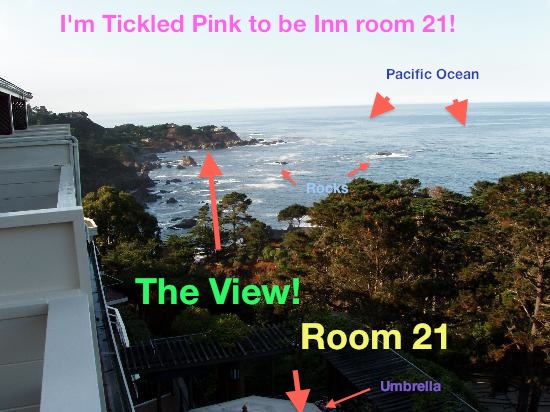
view from-the-room 21

But another keeps his distance:

It’s a very discreet place, so I won’t begin to guess the room number.

A former winner explains the perfectly reasonable story behind the inn’s name:

The suggestively named hotel was once owned by California State Senator Edward Tickle and his wife Bess, who loved pink flowers.  Originally from England, Senator Tickle represented California’s 25th district from 1933 to 1943 and chaired the state Republican party from 1942 to 1944.

Another reader laments:

Wish I could offer up graphic tales of a Champagned honeymoon or a wet weekend of teenaged debauchery, but the best I can offer is the weekend afternoon I indulged in a little lifestyle envy and followed an Open House sign on Highway 1 to a glass-and-concrete apparition on Spindrift Road, future home of some one-percenter, vertiginously anchored over the foam, almost visible from here. I thought of calling the Inn’s front desk, but I figured they had taken the phone off the hook and were watching in awe as their online bookings rocketed up once a million Dishers started checking out the photos online.

Many among those million sent visual entries:

VFYWC_233-Guess_Collage

A reader starts to share the stories:

My parents used to go here once a year starting in the late ’60s; they went here the night of their wedding in June 1968. It has always held a place in my mind as a paragon of ’60s fashion (a’la James Bond or the Pink Panther), at least from their descriptions – they never brought me along. Nonetheless, I have two strong memories of it; my folks made a point of the fact that there were no TVs in the rooms (this, sadly, appears to no longer be true), and the motto, in mock Latin “Restabit; fortis arare placeto restat”, which was on the matchboxes my dad would bring home. From the website, it appears to have been significantly gentrified since those days. It was considerably more humble 40 years ago.

Several have stayed there themselves, of course:

Gotta say it looked familiar, but then a lot of the California coast looks a lot like that, and I’ve visited a lot of it over the years.  Still it sure looked Big Surish (not the hauntingly gorgeous parts of Big Sur, to be sure, but Big Surish nonetheless).  And why would I imagine there aren’t any number of comparably alluring places in the world sharing similar qualities of not-quite-the-most-gorgeous-parts-of-Big-Sur-but-still-gorgeous-in-their-own-right-ness?

I started a Google Image search for “Big Sur” but, just before hitting return, thought better and went for “Carmel Highlands” because it’s the sort of view I remember from my birthday stay there three summers ago at the Tickle Pink Inn (the northern gateway to Big Sur but not Big Sur itself, gorgeous view but not haunting, if you want haunting continue south another hour or so and stay at Post Ranch Inn or the Esalen Institute, both deep in the heart of Henry Miller country).

Don’t bother to imagine my surprise, therefore, when one of the first image results that appeared was essentially the same view as that of the view window, taken from an ocean view room at the Tickle Pink Inn:

Tickle Pink Inn VFYW

Needless to say I was tickled rosy.  It turns out that our view photo was taken in room 28, an ocean view room just above the front office, the other end of the building from where my wife and I had shared room 9, a cove view room, with damn-it just about as fine a view.

Another former guest:

I was raised in Salinas which is about 30 miles from there (and as many income groups lower) and my mom had a friend who worked at the place, so as a kid she would show us around the place because god knows we could never afford to stay there.  My husband and I finally stayed there years ago and I considered is a great accomplishment – the “little lettuce seed” had finally made it.  (Salinas is the lettuce capital of the world).  Thank you for making my day.

A few readers have even honeymooned at the hotel:

I am a Dishhead.  My husband, on the other hand, is only an occasional reader.  Still, he recognised this one rather than me.  It is a view from the Tickle Pink Inn in Carmel, California. We stayed there for our honeymoon.

Last but not least, a two-year veteran picks up the win this week with his 15th correct entry (including last month’s difficult Portugal view):

I first looked at this view as a small image on my phone and groaned in anticipation of a long sojourn around rocky coasts. But when I finally got to sit down with my coffee and laptop, itching for a challenge, I was at the hotel in about 5 minutes.

20141129_Carmel_TicklePinkInn

We are in the Room 28 (the “Crow’s Nest”) of the Tickle Pink Inn. Normally I’d have more to add, but this week I’m not feeling that verbose. Tryptophan?

Nope.

This week’s photo came from the in-tray archives, circa 2012:

Carmel Highlands, 6:29 pm on Friday July 6th. View is from the “Crow’s Nest” room (#28) at the Tickle Pink Inn. Delightful place in every possible way (including the pretty absurd name).  My boyfriend and I came here for the first time last year and we’re hooked. There’s an awesome guest book in the room filled with entries from people on their honeymoons, anniversaries, and birthdays, many of whom have returned to the same hotel (and room) many times, or after 25 years of marriage. There’s also a seagull who sits on the railing outside and taps on the window looking for food.  It’s utterly charming.

She updates us with some fantastic news:

Wow! This is very exciting! My then-boyfriend in 2012 and I got married just a month ago! Somehow being selected for the VFYW contest at this time feels like a little wink from the universe. We’ve continued to go back to our beloved Tickle Pink Inn every year – so we’re on four years running now. That view never gets old and we hope to keep the tradition going for many (happily married!) years to come. Happy holidays to everyone at the Dish! And thank you!

PS: I finally subscribed to the Dish … I’ve been meaning to do so for a long time and the photo being featured got me to make it happen!

Congrats! We’ll be sending our newly wedded couple a brand new Dish mug as a belated wedding gift, which they will hopefully enjoy for many years to come. Bowie sure will:

DSC_0547

For the rest of you, our 234th opportunity for contest-related romance arrives at noon on Saturday. In the meantime, our contest poet returns:

Searchin’ U.S.A.

If everybody had the notion,
Across the USA,
Then everybody’d be searchin’,
On ev’ry Saturday,

You’d see ’em stuck in their pee jays,
Fuzzy sandals too,
Bushy bushy bed hairdo,
Searchin’ U. S. A.

You’d catch ’em searchin’ Point Lobos,
On down to Yankee Point,
Big Sur, Cabrillo,
Kim Novak’s old joint,
All over the Highlands,
Off Carmel coast highway,

Everybody’s gone searchin’
Searchin’ U.S.A.

We’ll all be planning that route,
We gotta ID that view,
We’re wearin’ down our mousepads,
Shit, it’s way past noon!
We’re outta touch for the weekend,
We’re on search-fari to stay,
Tell the preacher we’re searchin’,
Searchin’ U. S. A.

If I had plenty of money,
I could chuck this iPad,
And drive a woody with my honey,
Down to that state most rad,

Off the Number 1 Highway,
They’re havin’ Fun, Fun, Fun,
At the Tickle Pink Inn, babe,
Room Twenty One!

Yeah, that’s the Tickle Pink Inn, babe,
Searchin’ U. S. A.!

Thank You! ….. Thank You!

(Archive: Text|Gallery)

The Schumer Consensus

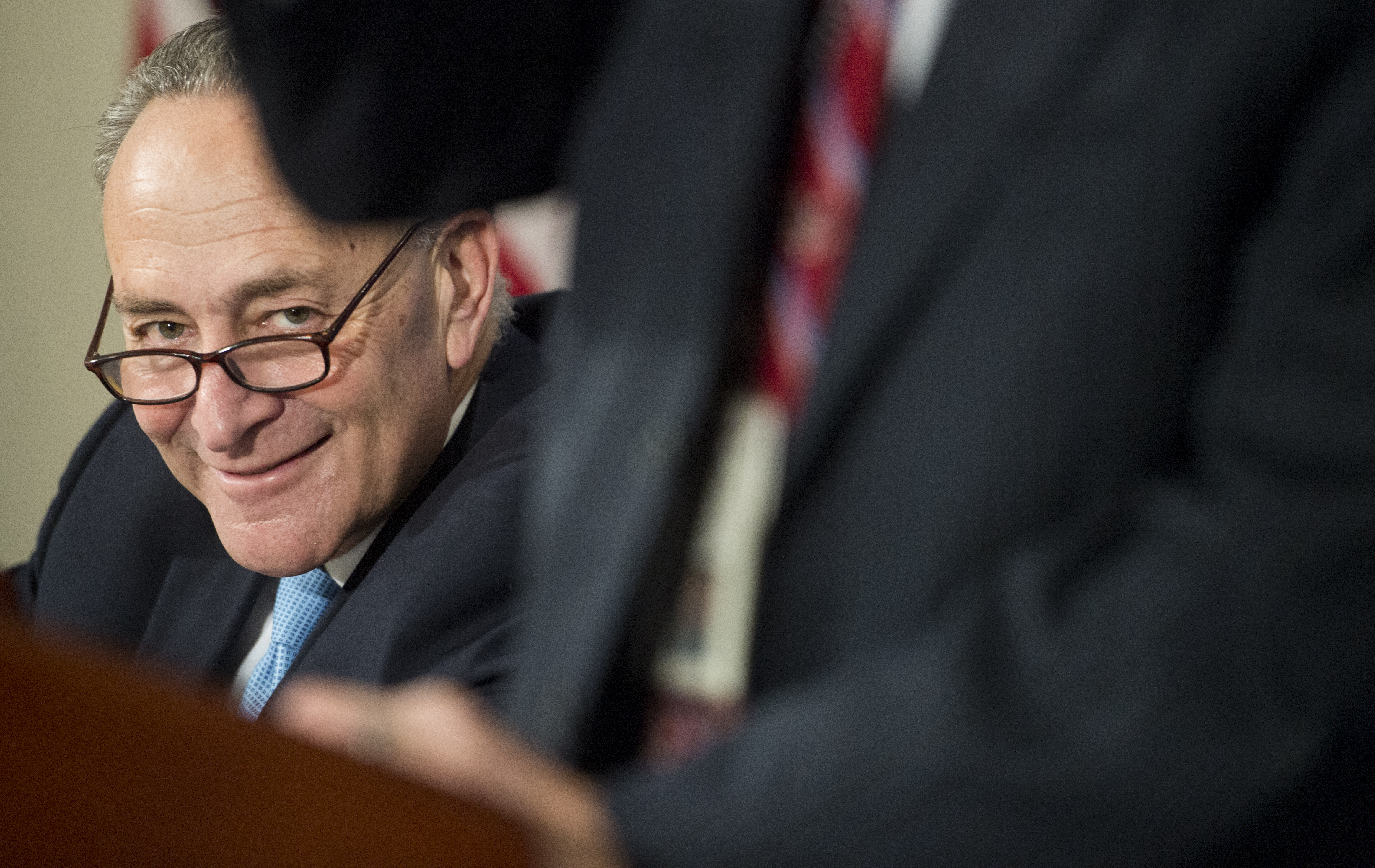
Sen. Chuck Schumer

You can barely click on a link these days without reading someone arguing that Obama’s decision to pursue healthcare reform in 2009 – 2010 was the fatal flaw of his administration. As Chuck Schumer put it, putting healthcare before economic recovery sent the wrong message to working-class whites, who have been fleeing the party in droves ever since. Today, Charlie Cook offers up the same message about white flight:

An argument can be made that it is because Democrats have subordinated their traditional focus on helping lower- and working-class Americans move up the economic ladder in favor of other noble priorities, such as health care, the environment, and civil rights.

I’ve heard this a million times now and I simply don’t understand it. In terms of chronology, Obama did put the economy first. With TARP and the stimulus and the auto-bailout, the key measures to shore up a flat-lining economy were taken in short order. You could plausibly argue, I think, that in retrospect, Obama should have gone bigger, and produced a much more ambitious stimulus. But, as someone who observed this close-up and in real time, the odds of that actually happening were close to zero. And if it had happened, the stimulus would have been even less popular – and more easily demagogued – than it actually was. The problem was not the timing or the seriousness of the response; it was the seriousness of the problem. When an economy has a near-death experience, on top of huge public and private debt, the recovery will tend to be exactly what this recovery was: long, sad at first, and later … well, we don’t know yet, do we?

More to the point, healthcare was itself a response to the wounded economy. Here’s why. It’s very hard to see how the white working classes can ever see the kind of income gains they enjoyed for much of the mid-twentieth century in the new global economy. Tax redistribution can only do so much to counteract the enormous forces depressing those wages. But one way in which the working poor can tangibly be helped is by providing access to health insurance, something everyone needs, and something that costs a huge amount for a struggling blue-collar worker. You could argue – and I would – that universal health insurance in America – is actually the most effective measure available to counteract soaring social and economic inequality. Far from being a distraction from the core Democratic task of helping the working family, it’s one of the most effective policies for that goal that’s available.

I suspect that what is really going on is a matter of perception – which, of course, does matter in politics.

The healthcare debate in 2009 and 2010 was more spirited and fierce than the debates over many other issues. The GOP decided to make it their first boogeyman of the Obama years, and organized the 2010 mid-terms around it. And politically, especially against a typically feeble Democratic messaging campaign, that made cynical sense. Even though Obama had put the economy first, the GOP could alter the debate to make it seem as if he had put healthcare before jobs. And since his healthcare proposal was successfully distorted by the right as a redistribution scheme from the white elderly to poor blacks and browns, you can see why this might lead to white flight.

My point is not that this didn’t happen in the public consciousness. My point is simply that this wasn’t because of Obama’s skewed priorities. And to blame Obama for the distortions and demagoguery of the ACA on the right is to cement the cynics’ victory twice over. But that’s what Democrats of Schumer’s era always tend to do. It’s the kind of defensive crouch that the Clintons perfected over the years. What Obama deserves criticism for is not the substance, but the inability to sell and explain and communicate the core principles and purposes of the ACA. He was so busy trying to get something through the Congress he took his eye off the ball in public opinion. And since there appears to be almost no one in Democratic ranks who can make the case except Obama, it turned into a political failure.

But that, again, is not a foregone conclusion. We are still in the very early stages of the ACA’s existence, the period when opposition is likely to be strongest, when glitches remain, when the benefits have yet to be fully or widely felt. Sure, the polling has been relentlessly negative since the ACA was passed – but that is not unusual for new and large government programs. If the economy continues to improve in the next two years, moreover, the impact might begin to reach those white working classes who increasingly view the Democrats as alien. And if the ACA brings tangible benefits to the struggling poor who are its primary beneficiaries,and as the minimum wage debate continues, the politics of class might shift again. When the debate is about removing health insurance from large numbers of the working poor – as the Republicans propose – the self-interest of the white working class might begin to work in the Democrats’ favor.

Well, we’ll see, won’t we?

(Photo: Senator Chuck Schumer waits to speak at the National Press Club on Tuesday, November 25, 2014, on what went wrong for Democrats in the 2014 midterm elections and what they must do to succeed in 2016. By Bill Clark/CQ Roll Call)

That Old Car Feel

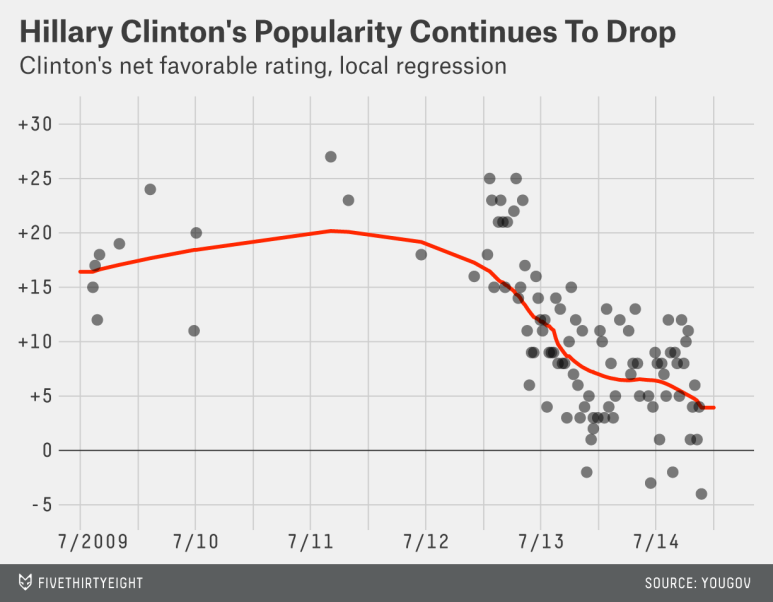
Clinton Numbers

Harry Enten spells out why Clinton “no longer looks quite so invincible, and early indicators point toward a Republican-leaning political environment”:

In four polls conducted over the past month, YouGov asked more than 2,500 registered voters whether they would vote for the Democratic or Republican candidate for president in 2016. The Republican candidate led, on average, 39.2 percent to 36.7 percent. …The current environment suggests Clinton would need to be stronger than a generic Democratic candidate to be considered the favorite. Instead, her standing has deteriorated.

Furthermore, he finds that any “lead Clinton does have is almost entirely attributable to being better known”

Among the seven Republican candidates listed by Quinnipiac, the correlation between Clinton’s lead (or lack thereof) over each Republican and that Republican’s name recognition was 0.94. In other words, other Republicans should gain ground as they become better known. In fact, a simple regression between name recognition and a Republican’s standing against Clinton in the Quinnipiac poll suggests that she isn’t performing much better than a generic Democrat.

I don’t think you can measure how well or poorly Clinton will do without knowing what on earth she is proposing to address the country’s problems. And there’s an obvious likelihood that she could easily run without ever feeling the need to spell that out in detail, as is her wont. Or that her 1990s-style triangulating neo-liberalism simply won’t cut it in the Democratic party of 2015. Vinik puts his hope in a better economy to improve Clinton’s chances:

Economic forecasters are expecting those green shoots to lead to stronger growth over the next two years. The Congressional Budget Office projects that the economy will grow nearly 4 percent in both 2015 and 2016. The Federal Reserve’s most recent forecast put growth a bit lower, at 2.6-3.0 percent over the next two years. For comparison, growth hovered around 2 percent in 2013 and 2012. …

“If the incumbent president isn’t running, the effect of the economy would be a little bit smaller, but it’s still important,” George Washington political scientist John Sides told me earlier this year. “The logic there being that a new candidate for the party would not get as much credit or blame as the actual president who was presiding over the economy.” In other words, an improving economy benefits the candidate of the incumbent party: The more the economy improves over the next 24 months, the better Clinton’s chances are of winning the presidency.

Sabato, meanwhile, worries about the impact of winning the White House on the president’s party:

The surest price the winning party will pay is defeat of hundreds of their most promising candidates and officeholders for Senate, House, governorships, and state legislative posts. Every eight-year presidency has emptied the benches for the triumphant party, and recently it has gotten even worse. (By the way, the two recent one-term presidents, Jimmy Carter and George H.W. Bush, also cost their parties many lower-level offices, but in both cases this didn’t happen until they were defeated for reelection.)

Since World War II there have been eight two-term presidencies: Dwight Eisenhower, Ronald Reagan, Bill Clinton, George W. Bush, and Barack Obama, plus the reasonable succession combos of Franklin Roosevelt-Harry Truman, John Kennedy-Lyndon Johnson, and Richard Nixon-Gerald Ford. Not a one has left his party in better shape that he found it, at least in terms of lower elected offices.

Which reminds me of that Enoch Powell quip that all successful political careers end in failure.

The Case Against Police Unions

Friedersdorf makes it by showing just how hard it is to fire bad cops:

If police officers were at-will employees (as I’ve been at every job I’ve ever held), none of the cops mentioned above would now be walking the streets with badges and loaded guns. Perhaps one or two of them deserved to be exonerated, despite how bad their cases look. Does the benefit of being scrupulously fair to those individuals justify the cost of having more abusive cops on the street?

I’d rather see 10 wrongful terminations than one person wrongfully shot and killed. Because good police officers and bad police officers pay the same union dues and are equally entitled to labor representation, police unions have pushed for arbitration procedures that skew in the opposite direction. Why have we let them? If at-will employment, the standard that would best protect the public, is not currently possible, arbitration proceedings should at a minimum be transparent and fully reviewable so that miscarriages of justice are known when they happen. With full facts, the public would favor at-will employment eventually.

Why Are There Fewer Abortions?

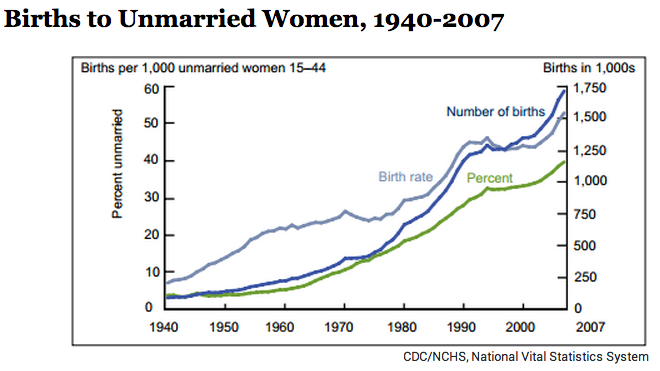
Birth Rate Single Women

This should be cause for major celebration on the pro-life side. Elizabeth Nolan Brown highlights a new CDC report finding that the abortion rate in the US fell steadily from 2002 to 2011, reaching its lowest level since Roe v. Wade was decided in 1973:

Overall, there were 13.9 abortions per 1,000 women in 2011, down 5 percent from 2010. There were 219 abortions performed per 1,000 births, down 4 percent from the previous year. Analysts say the decline has less to do with abortion restrictions passed in various states than with the recession and an overall decline in pregnancies and birthrates.

Pointing to the chart above, Frum advances a theory to explain this decline. The increasing acceptance of single parenthood, he argues, has encouraged more unmarried women who become pregnant to carry their pregnancies to term:

Women who already have one or two children outside marriage may continue to choose abortion as a way to avoid a third or fourth. As the Guttmacher Institute notes, 61 percent of women who have abortions are already mothers. But the urgency of having an abortion to terminate a first pregnancy has clearly faded, as single parenthood has become the norm for non-affluent Americans of all races.

This is the fascinating irony of the pro-life movement. The cause originated as a profoundly socially conservative movement. Yet as it grew, it became less sectarian. Women came to the fore as leaders. It found a new language of concern and compassion, rather than condemnation and control. Most radically and decisively, the movement made its peace with unwed parenthood as the inescapable real-world alternative to abortion.

Max Ehrenfreund agrees with Frum’s analysis, but isn’t sure the pro-lifers had that much to do with it:

That might be giving the conservative movement too much credit. Public attitudes about abortion have held steady in recent years, even as the rate of births to unmarried mothers has continued its steep climb. It looks as though unmarried women are making decisions about pregnancies more or less on their own. Whatever the explanation, Frum’s conclusion seems sensible: the best way to get people to create and stay in families is with policies that make raising a family genuinely easier.

A Less Deadly Form Of HIV?

There’s new evidence of it:

Rapid evolution of HIV, the human immunodeficiency virus, is slowing its ability to cause AIDS, according to a study of more than 2,000 women in Africa. Scientists said the research suggests a less virulent HIV could be one of several factors contributing to a turning of the deadly pandemic, eventually leading to the end of AIDS.

This has long been thought likely (I covered it on the Dish in 2005). Viruses do better the longer their hosts survive. But it’s fascinating to see it proven – and to marvel at the speed of natural selection. Of course, the usual suspects years ago – specifically the New York Times – were warning us that the virus was mutating into something much worse – remember super-AIDS? That merely goes to show that projecting morals onto viruses is a foolish game. Jason Koebler unpacks the study:

“Theory predicts, all other things being equal, that infections causing new epidemics will reduce in virulence over time because pathogens require host survival to transmit,” [Oxford University researcher Philip] Goulder wrote.

None of this is to say that HIV, left untreated, is going to be harmless anytime soon. But it does appear as though the virus is evolving in that direction—and more quickly than would be expected naturally, thanks to antiretroviral therapies. … Already, roughly 1 in 300 infected people are able to keep HIV in check, indefinitely, at undetectable levels, without any therapy at all. These people are called “​long-term nonprogressors.” In a few years, that number could go up to 5 or 10 percent, Goulder said. “Over tens of decades, maybe the majority of people will be able to control it without treatment,” he added.

Clare Wilson also reads through the research:

One reason for the change could be the growing use of HIV drugs, says Goulder. People with the most virulent form of the virus get sick sooner and start drug treatment. This reduces the level of the virus in their blood and sexual fluids almost to zero, so they are unlikely to pass it on. This means that a more aggressive virus is less likely to be transmitted.

“It’s a benefit of therapy that nobody thought of,” says Goulder. “That’s another reason to provide it.”

Which is yet another reason why the most important thing to do with HIV is to get as many people in the vulnerable populations onto PrEP, and as many infected people on serious meds. Jason Millman outlines how far we have to go on that:

[F]or the first time in the past year, the number of HIV patients who started receiving medication was greater than those newly infected with the virus, according to the ONE Campaign. … However, diagnoses attributable to male-to-male sexual contact saw increases for nearly every group, with those 13-24 years old recording the largest increase (133 percent) of any group. Of the 1.2 million Americans who had HIV in 2011, just 40 percent said they were seeing a medical professional for the virus and 37 percent had a prescription, the CDC revealed last week. Just 30 percent of those infected the virus under control.

That’s completely unacceptable. And we gay men need to find a way to reach the most vulnerable among us.

Walking While Black, Ctd

Readers add further nuance to the viral video we posted:

Thank you for updating your post with the sheriff’s comments.  (And since the person in question was originally identified as “light-skinned”, it’s not clear that being black was ever the issue.) Pontiac, Michigan is a city where the County sheriff patrols because there is no longer a local police force. A parent from our kid’s school was shot dead while minding his shop. For awhile, it was normal, driving through Pontiac, to have to sit in one’s car while the car in front of you executed drug deals with people on the street.  It is a place that was at one point, quite literally, lawless.

In that video, a shopkeeper, having been robbed more than once before, called the sheriff when something looked suspicious, and the sheriff came.  Once there, he was calm and respectful, and did his job responsibly.  In Pontiac, that is just absolutely awesome.

Another points to a 2009 incident in which Bob Dylan was similarly stopped by cops and asked for his ID:

Not all neighborhoods like people walking about.

It’s like there’s something wrong with you. Why don’t you have a car? Why are you walking? In the place I grew up – very blue-collar burbs – people simply did not walk. Then I moved to NYC, and since that time I never want to live in a neighborhood where you can’t walk. All people should feel comfortable to walk down the street, hand in pockets or whatever, but the guy in the video was right to note the absurdity of the person who made the call in the first place. At least the guy and the officer were able to discuss it without anything horrible happening.

Another notes a website we’ve featured before:

While I appreciate your sentiment that “more black men need to bring their cell-phones to these police interactions,” you should note that recording police puts the people with the recording devices at risk. There’s a great website called PhotographyIsNotACrime.com that has documented literally hundreds of incidents of police abusing, arresting or assaulting people who have tried to exercise their First Amendment rights to record or photograph the police. If black men started routinely recording interactions with the police, then that would escalate the risk to those black men.  Just to pick three stories from the last few days – here, here, and here. (Those are literally the top three non-Ferguson stories from the “recording the police” category as I type.)

Another pans out:

I think we’re missing a drama that accentuated part of the issue over the last few days. I’m a 60-year-old engineer visiting San Antonio on business. Last week, as you may know, a white guy shot up downtown Austin, targeting the Mexican consulate, the US courthouse and the Austin PD building before being killed by police. Today I was having lunch with a coworker who lives in Austin and had been visiting Philly last week. When I mentioned the shooting to him, he hadn’t heard of it, even though he LIVES in Austin.

In the last few years, over a dozen white, right-wing anti-government terrorists have targeted police officers resulting in the deaths of over 10 cops. Yet this is so invisible even people living in Austin don’t know about it. When I mentioned this to a buddy of mine, a white conservative cop, he waved it away saying criminals killed more cops than white terrorists have.

It’s obvious the blinkers are on, EVEN AMONG COPS. Yes, criminals kill cops, but can you imagine the outcry if a dozen cops had been killed by Muslims? The St Louis Police Officer’s Association demands an apology from football players for raising their hands in sympathy with the Brown family, but where is the outrage against the Republican officeholder who said she’d kill government officials who “tried to take away her rights”? Where is the outrage against the NRA that enables military weapons to be openly sold in the US (and they get around this by saying weapons like the AR15 aren’t “military”.)

Cops ARE being targeted by the right. Cliven Bundy was proof. He was a hero until his racism was too strident even for the right. Yet the cops still ignore the threat posed by right-wing terrorism and, instead, shake down black US citizens who walk with their hands in their pockets in the winter.

The President Backs Body Cams … And Not Much Else

New York City Public Advocate Displays Police Wearable Cameras

Zeke Miller details Obama’s planned executive orders:

President Barack Obama is preparing to issue an executive order to calling for additional oversight of various federal programs which provide military surplus equipment to local law enforcement agencies, senior administration officials said Monday, but will stop short of banning the transfer of heavy gear to police forces. …

Obama will also announce a three-year $263 million package to increase the use of police body-worn cameras and expand local law enforcement training. The program, modeled after a similar program for bullet-proof vests for officers, would provide $75 million over three years for the “Body Worn Camera Partnership Program.” Administration officials said it would provided a 50 percent match for body-camera purchases by state and local agencies, enough for 50,000 new cameras. Officials said they hope to secure about $70 million in funding for the effort as part of a government funding deal that must be reached in the coming two weeks.

George Condon Jr. views the announcement as yet another example of Obama’s “trademark caution”:

He was cautious about the use of surplus military equipment by domestic police forces, promising to make it more transparent so it can be studied. He was cautious on police behavior, promising to work with Congress to pay for more body cameras to be worn by cops on the street. He was cautious about the Justice Department’s role, announcing that the outgoing attorney general will “convene a series of these meetings all across the country.” And he was cautious in falling back on that most familiar of Washington responses—a task force to further study the situation.

Scott Shackford is skeptical that the president is really committed to de-militarizing the police:

The White House promised to study police militarization in the wake of how various law enforcement agencies in Ferguson, Missouri, responded to the peaceful protesters, not just the aggressive or criminal ones. What comes out of the report is a call for better documentation and transparency, and an easily supportable demand that local governments must actually review and authorize acquisition of the “controlled property” military equipment (guns and vehicles) by law enforcement agencies.

What the report doesn’t recommend is scaling back the programs in any notable or significant way. It appears as though the White House is trying to have it both ways on police militarization, calling for reforms without having to tackle the issues surrounding whether it’s actually necessary.

Trevor Timm is more blunt:

Obama said he wants to avoid building a “militarized culture” in police departments, yet his White House report claims all the militarization programs are “valuable” to law enforcement, without going into any detail of where that value has actually been shown. For example, when was the last time a local police officer drove over a fucking mine? Why would neighborhood cops ever need Mine Resistant Ambush Protected Vehicles (MRAPs) that were meant to protect soldiers against IEDs in Iraq? The White House’s four months of “research” into federal funding simply does not venture to explain. Nor does it explain any use for any of the Pentagon’s weaponry now in the hands of our local police.

Emily Badger argues along the same lines:

[B]y calling for local police to receive more training — including on civil rights and civil liberties — when they receive military-style equipment, the review leaves unasked the question Obama’s own earlier comments seemed to raise: Is it even a good idea to give it to them?

Joshua Brustein focuses instead on the body cams fund, which could “almost double the number of cameras in use in the country”:

The White House’s support of cameras isn’t a surprise. In the days after Brown was shot, a petition on WhiteHouse.gov in support of legislation requiring all state, county, and local police to wear cameras gathered nearly 155,000 signatures. Roy Austin of Obama’s Domestic Policy Council posted an official response that described years of work by the administration to advance the use of body-worn and dashboard cameras. Police departments have long been coming around on cameras, but progress is slow. Adopting police cameras requires thousands of independent agencies coming to terms with thorny privacy and accountability issues.

Jim Bueermann, president of the Police Foundation, says that the biggest barrier is cost. The White House will match the spending of local and state agencies who decide to buy cameras, mirroring a similar federal program that has led to the purchase of over 1.1 million vests for law enforcement agencies. The money won’t come without strings attached: Bueermann expects a requirement that every officer in participating departments wear a camera at all times while in the field.

Rich Lowry recommends a different reform:

The most needful reform in Ferguson and surrounding communities, per the excellent reporting of Radley Balko of the Washington Post, is the end of the obnoxious and parasitic practice of squeezing revenue out of residents with fines from traffic and other petty offenses. This creates an incentive for police to hassle motorists and is especially burdensome to poor residents. Because this issue is exceedingly local and dull, almost no one talks about it.

(Photo: New York City Public Advocate Letitia James displays a video camera that police officers could wear on patrol during a press conference on August 21, 2014 in New York City.  By Andrew Burton/Getty Images)