Was Selma Really Snubbed? Ctd

As we covered yesterday, the film’s low number of Oscar nods was probably more a victim of a screener scheduling than anything else. But Noah Millman, contra most film critics, “had the feeling that most people didn’t really love the film”:

Indeed, I suspect that the Best Picture nomination is itself a kind of consolation prize, that voters were reluctant to shut it out altogether from the major categories. I understand why some observers are troubled by the unbearable whiteness of this year’s awards. But it isn’t fair for a single film to shoulder so much expectation. If it’s a problem, the problem originated not in this year’s voters but in casting and financing decisions made years before.

Beutler doesn’t buy that consolation prize argument:

Nearly all of the Oscar trophies are meant to reward skill and stylistic judgment, but the best movie award is the most subjective and thus the most malleable.

It’s capacious enough to allow that a story can be inspired, and the decision to turn it into a film brilliant, even if the technical execution is ultimately flawed. Selma isn’t a best picture nominee because the Academy felt politically obligated to recognize it somehow, but because best picture is the one category that really fits.

Suderman is befuddled as to why the film didn’t as least get an additional nod for Best Director:

I haven’t seen the movie yet, so I’ll leave that argument alone except to note that it’s always a little bit weird to see a movie nominated in the Best Picture category but not in the Best Director category, as if a film could be the best movie of the year but not also the best directed. You can imagine a case for the distinction, of course, but the Academy’s voting and nomination patterns don’t make that case.

But since 2009, the number of Best Picture slots has been double the number of slots for Best Director, shattering that pattern. And again, Paramount didn’t have time to send out screener DVDs to the Directors Guild. A Dish reader puts it well:

While the term “Academy” may evoke visions of hallowed hallways filled with wizened old intellectuals who bestow honors on film artists, it’s actually Hollywood’s PR machine. A qualified film not receiving “enough” nominations is no reflection of the quality of the film. Instead, it’s simply a failure of the film’s PR hacks’ effectiveness at marketing directly to the Academy voters. It’s not the film’s fault, nor is it the Academy’s fault; it’s the film’s publicists’ fault. In the case of Selma, I’ve seen more publicity for Paddington!

David Sims zooms out from Selma:

It’s crucial to note [that] the Oscars’ “diversity” shouldn’t begin and end with more nominations for Selma, which, to repeat, is a particularly Oscar-friendly movie. Plenty more films starring people of color—Beyond the Lights, Dear White People, Top Five, Rosewater, Belle—got barely a sniff of Academy attention (Beyond the Lights did get a Best Original Song nomination).

A reader notes:

It seems to have escaped all these commentators that African Americans do NOT define diversity. Alejandro Friggin’ Iñarritu is the Mexican director of Birdman, nominated for Best Director. He is hardly white. In fact, here in Mexico, his apodo (nickname) is El Negro.

Moving past the “snub” debate, Aisha Harris highlights was makes Selma so deserving of its Best Picture nomination:

[Director Ava DuVernay] rightly and effectively puts the black community at the center of the change of that moment, revealing in dramatic form the many moving parts that it took to get an important bill passed. It is not merely an “MLK biopic,” as many (including me) dubbed it before seeing it—it’s about the many black people (John Lewis, Hosea Williams, Andrew Young) and support from progressive non-blacks (James Reeb, Archbishop Iakovos) that it took to push progress forward when Lyndon B. Johnson wanted to focus on other policy battles first.

And that, perhaps more than anything else, is what makes Selma such an ideal Oscar contender, and what makes its Best Picture nomination truly matter. It rises above other biopics—including its fellow nominees The Imitation Game and The Theory of Everything—because it doesn’t cling to the ingrained falsehood that one extraordinary, brilliant man can be solely, or almost entirely, responsible for a major societal breakthrough. Is King portrayed by DuVernay as the inspiring force that he was? Of course—she doesn’t deny history. But she also shows how King could never have gotten things done without the minds, the risk, the sweat, and the cooperation of many others. And in that sense, the academy has finally gotten this side of history right.


Obama’s Plan To Give Workers Time Off

Paid Leave

Earlier this week, Obama announced his support for the Healthy Families Act:

The legislation calls for businesses with 15 or more employees to let them accrue up to seven paid sick days a year to care for themselves or a family member who falls ill. On a call with press, adviser Valerie Jarrett said the White House estimates that it would give 43 million workers access to leave who don’t already have it. The leave could also be used by victims of domestic violence, sexual assault, or stalking to recover or seek assistance. Obama will also urge states and local governments to pass sick leave laws of their own.

The president will also sign a memorandum that will ensure federal employees get at least six weeks of paid sick leave for the arrival of a new child and propose that Congress pass legislation to give them six weeks of paid administrative leave.

Jared Bernstein sees this as part of a larger strategy:

So the forces of darkness and light will scrum over this stuff and hard to imagine it will get very far in DC, though part of the plan—and the WH is smart to go there—is providing states with some resources to explore the feasibility of introducing some of these measures on their own. But put this together with the Van Hollen tax plan … and you begin to see an interesting dynamic that I suspect we’ll hear more about in next week’s State of the Union speech: the economy is reliably growing, and yet too little of that growth is reaching the middle class. Therefore, policy makers must relentlessly work on the policy agenda that will reconnect growth and more broadly shared prosperity.

Ben Casselman reviews the statistics on paid leave. He finds that “61 percent of private-sector workers in the U.S. are offered at least some paid sick time by their employers, and just 12 percent are offered paid family leave”:

Nearly 25 percent of workers in the top 10 percent of private-sector earners get paid leave compared with just 4 percent of workers in the bottom 10 percent. There’s no significant group, however, where a majority of workers get paid family leave. That said, efforts to expand access to paid leave appear to be gaining momentum. A growing list of cities and states have approved measures to require some form of paid leave for many workers. Overall access to paid time off has expanded significantly since the early 1990s, when just 2 percent of workers got paid family leave.

 points out that the “business case for paid sick leave is a strong one”:

Paid sick leave is also, frankly, a public health issue. According to theAmerican Public Health Association, during the 2009 H1N1 pandemic “an estimated 7 million additional individuals were infected and 1,500 deaths occurred because contagious employees did not stay home from work to recover.” 1,500 deaths! 1,500 people died because a cadre of mucous troopers were unwilling or unable to stay home while infected with the flu. If a terrorist attack caused 1,500 deaths it would be a national crisis. But when those same deaths are caused by workplace sneezes we shrug.

Joan Walsh is disappointed that “so far [Obama is] not supporting the Family and Medical Insurance Leave Act DeLauro is co-sponsoring with Sen. Kirsten Gillibrand”:

De Lauro and Gillibrand’s bill is important, however, because it creates a funding mechanism for paid family leave, similar to disability insurance. Employers and employees would contribute two-tenths of one percent of salary – an average of $2 a week for most workers – that would fund leaves up to 12 weeks when an employee has a child or needs to care for a sick family member.

The funding mechanism means employers aren’t paying a full salary at a time when they’re losing a worker for up to three months, which could make it easier to get temporary help. Just as important, family leave becomes an earned benefit, not a top employee perk, not a welfare program, and not a benefit to be cut back in tough economic times.

In a long feature on maternity leave, Claire Suddath provides more background on the bill:

So why is the Family Act at a standstill? Gillibrand says Congress doesn’t think it’s important enough. “The issue isn’t being raised because too many of the members of Congress were never affected by it,” she says, pointing out that 80 percent of Congress is older and male. “They’re not primary caregivers. Most members of Congress are affluent and are able to afford help or able to support their [wives]. It’s not a problem for most of them.” Hillary Clinton has also admitted that while she supports paid leave, it’s a political battle the U.S. isn’t ready to fight. “I don’t think, politically, we could get it [passed] now,” she said in a CNN town hall meeting last June.

Washington won’t be able to ignore this forever. “You’re finally starting to see momentum on this issue,” says Debra Ness, president of the National Partnership for Women and Families. Over the past decade, Ness has noticed that young parents are becoming increasingly angry at the lack of employer support when they start to have children. “This will be part of the conversation during the next election,” she says. “The sleeping giant is waking up.”

Amazon Doesn’t Always Have The Best Deal

But the company tries hard to make you think it does:

“Amazon may not actually be the lowest-priced seller of a particular product in any given season,” the report reads, “but its consistently low prices on the highest-viewed and best-selling items drive a perception among consumers that Amazon has the best prices overall — even better than Walmart.” The study was part of a white paper Boomerang released on Tuesday to bring attention to the idea of price perception in e-commerce.

 provides more details:

What the authors find is that Amazon has carefully priced some items low, while leaving others more expensive – in some cases, much more expensive – to bolster its reputation as a place for deals.

For instance, items with high consumer ratings tend to be priced lower than what you’d find at Wal-Mart. … Also, stuff that’s highly visible — products that either customers rave about or Amazon itself promotes — also tend to be cheaper than at other places. But items that you wouldn’t naturally associate with online retail, such as tires for cars, aren’t cheap at all. And accessory items to highly promoted products — think cable connectors for your new flat-screen TV — aren’t always that cheap.

Doing The Right Thing At Rikers

John Surico relays some actual good news out of the Big Apple when it comes criminal justice:

New York City’s Rikers Island, the second-largest jail in America, has been making headlines for the worst possible reasons lately. Between the ritualized beating of teenage inmates and horrendous treatment of mentally ill prisoners, it’s no wonder the feds are suing NYC over civil rights violations at the sprawling complex.

So it came as something of a surprise when, on Tuesday morning, New York City officials announced that, starting next year, Rikers Island will no longer hold anyone in solitary confinement under the age of 21, making it the first jail of its kind to do so in the country. Furthermore, no one—regardless of age—will be allowed to suffer in solitary for more than 30 consecutive days, and a separate housing unit will be established for those inmates most prone to violence.

Suffice it to say this is a big deal: Rikers Island just went from being one of the most dysfunctional jails in America to tentatively claiming a spot at the vanguard of the emerging criminal justice reform movement.

Major props to Mayor de Blasio, who last March appointed a new jails commissioner who promised to “end the culture of excessive solitary confinement.”  But not all the news from Rikers was good this week:

A clean criminal record is not a requirement for a career as a Rikers correction officer, the Times reports. Got a gang affiliation and multiple arrests? No problem! Deep-seated psychological issues? Can’t hurt to apply! The Department of Investigation reviewed the Correction Department’s hiring process and discovered “profound dysfunction.” …

This administrative horrorshow does go a long way toward explaining why Rikers has found itself embroiled in so many awful situations, which include but are not limited to the inmate who was beaten and sodomized by a Correction Officer, the teen who died in solitary from a tear in his aorta, and the mentally ill man who died in solitary after guards declined to check on him.

Indeed, violence against prisoners has been at a record high:

Though the de Blasio administration promised reforms and a federal prosecutor’s report brought new attention to a “deep-seated culture of violence” at Rikers Island, in 2014 New York City correction officers set a record for the use of force against inmates. According to the Associated Press, guards reported using force 4,074 times last year, up from 3,285 times the previous year.

Back to the issue of solitary, it’s worth revisiting Jennifer Gonnerman’s great piece on Kalief Browder, who was sent to Rikers at 16 after being accused, but never convicted, of taking a backpack. He ended up spending three years there, most of it in solitary. A snapshot:

[Browder] recalls that he got sent [to solitary] initially after another fight. (Once an inmate is in solitary, further minor infractions can extend his stay.) When Browder first went to Rikers, his brother had advised him to get himself sent to solitary whenever he felt at risk from other inmates. “I told him, ‘When you get into a house and you don’t feel safe, do whatever you have to to get out,’ ” the brother said. “ ‘It’s better than coming home with a slice on your face.’ ”

Even in solitary, however, violence was a threat. Verbal spats with officers could escalate. At one point, Browder said, “I had words with a correction officer, and he told me he wanted to fight. That was his way of handling it.” He’d already seen the officer challenge other inmates to fights in the shower, where there are no surveillance cameras.

Browder later tried to commit suicide by slitting his wrists with shards of a broken bucket. Also from Gonnerman’s piece:

Between 2007 and mid-2013, the total number of solitary-confinement beds on Rikers increased by more than sixty per cent, and a report last fall found that nearly twenty-seven per cent of the adolescent inmates were in solitary. “I think the department became severely addicted to solitary confinement,” Daniel Selling, who served as the executive director of mental health for New York City’s jails, told me in April; he had quit his job two weeks earlier. “It’s a way to control an environment that feels out of control—lock people in their cell,” he said. “Adolescents can’t handle it. Nobody could handle that.”

Another story of a teen in solitary is seen in the above video. Previous Dish on the inhumane practice here.

To Protect And Bomb

This week ProPublica reported on law enforcement’s overuse of flashbang grenades:

Police argue that flashbangs save lives because they stun criminals who might otherwise shoot. But flashbangs have also severed hands and fingers, induced heart attacks, burned down homes and killed pets. A ProPublica investigation has found that at least 50 Americans, including police officers, have been seriously injured, maimed or killed by flashbangs since 2000. That is likely a fraction of the total since there are few records kept on flashbang deployment.

The U.S. Court of Appeals for the 7th Circuit wrote in 2000 that “police cannot automatically throw bombs into drug dealers’ houses, even if the bomb goes by the euphemism ‘flash-bang device.’” In practice, however, there are few checks on officers who want to use them. Once a police department registers its inventory with the Bureau of Alcohol, Tobacco, Firearms and Explosives, it is accountable only to itself for how it uses the stockpile. ProPublica’s review of flashbang injuries found no criminal convictions against police officers who injured citizens with the devices.

The article goes on to detail several incidents of flashbang misuse. Sullum comments on one of them:

One of those Little Rock raids involved a grandmother accused of illegally selling beer and food from her home—a misdemeanor that triggered the use of a battering ram and a flash-bang, which started a fire in a pile of clothing. “If she hadn’t been selling illegal items out of the home, no warrant would have been served,” the police spokesman told ProPublica. “What you call extreme, we call safe.”

To my mind, tossing explosive devices into the homes of nonviolent offenders is decidedly unsafe; in fact, it is inherently reckless, especially since there is always the possibility that innocent bystanders like Treneshia Dukes or Bou Bou Phonesavan will be injured or killed. Even if the police had found the drugs they were expecting in those cases, that would hardly justify their paramilitary assaults. Flash-bangs, like SWAT tactics generally, should be reserved for life-threatening situations involving hostages, barricaded shooters, and the like. They should not be casually tossed into the mix of techniques for busting unauthorized sellers of bud or beer.

Update from a reader:

To make matters worse in the case of Bou Bou, the county is refusing to pay the $1 million+ in medical bills that the family now has and will continue to have as Bou Bou will need at least 10 more reconstructive surgeries over the next 20 years. The county says that it would be illegal for them to pay the bills as state law grants them sovereign immunity from negligence claims, so any money they would pay the family would constitute an illegal “gratuity”. It’s unconscionable that the police can nearly kill this kid with their reckless and overzealous tactics and just walk away without having to pay a dime to the family they just financially destroyed.

The Best Of The Dish Today

And so we get a little warmer:

Central Intelligence Agency Director John Brennan consulted the White House before directing agency personnel to sift through a walled-off computer drive being used by the Senate Intelligence Committee to construct its investigation of the agency’s torture program, according to a recently released report by the CIA’s Office of the Inspector General. The Inspector General’s report, which was completed in July but only released by the agency on Wednesday, reveals that Brennan spoke with White House chief of staff Denis McDonough before ordering CIA employees to “use whatever means necessary” to determine how certain sensitive internal documents had wound up in Senate investigators’ hands.

So at the very least, the White House was aware of the CIA’s intent to spy on the Senate staffers, as part, one can only presume, of its campaign to shield the CIA from any accountability on torture and to undermine as much as possible the SSCI report. Then we have this blather from Josh Earnest today:

Reporter: Was it acceptable for the CIA to go into these computers and look at what, you know, at what the senate committee was doing? Senator Feinstein was very, very upset about this. Does the White House have a position about whether the CIA acted properly or not?

Josh Earnest: What is most important is we have a group of individuals within area of expertise who can sit down and take an impartial look at all the facts and determine exactly what happened to offer up some prescriptions for what can be changed to ensure that any sort of miscommunication or anything that would interfere with the ability of congress to conduct proper oversight of the CIA is avoided in the future. You can read the report. It’s been declassified and released. And they included a set of procedural reforms they believe will be helpful in avoiding any of these disagreements in the future. Fortunately, the director of the CIA said he’d implement these reforms. What’s most important is that there’s an effective relationship between the intelligence agencies and the committees that oversee them.

My favorite line in that pabulum is: “Fortunately, the director of the CIA said he’d implement these reforms.” Fortunately. It’s not as if the president could simply order him to do so. He must ask very, very politely; and if he’s very, very lucky, the CIA Director may occasionally agree.

Some posts today worth revisiting: why women cry more than men; watching Charlie self-censorship in Britain on live TV; the burgeoning Republican consensus that 11 million people need to be forcibly deported from the US; the miracle of the latest Google Translate app; and how Obama’s Gallup approval ratings at this point in his second term are identical to Reagan’s.

The most popular post of the day was Charlie, Blasphemer; followed by Quotes For The Day.

We’ve updated many recent posts with your emails – read them all here. You can always leave your unfiltered comments at our Facebook page and @dishfeed. 19 more readers became subscribers today. You can join them here – and get access to all the readons and Deep Dish – for a little as $1.99 month. Gift subscriptions are available here. Dish t-shirts are for sale here and our coffee mugs here. One happy recipient from the holidays:

A few weeks ago I wrote and said “fuggedaboudit!” because of the shipping and handling cost of the DishMugDish mug and I said I wouldn’t buy one.

On Christmas Day I was shocked, I tell you, shocked! When I opened a present from my thoughtful wife there was a Dish mug! She took it into her own hands to send for it and I am so tickled and happy to get it! They are great and it hasn’t left my hand since I took it out of the box. All Christmas Day it was filled with coffee, tea, eggnog, or wassail punch.

They are superb, and I say to everybody: just do it and GET ONE!

You can do so here – but soon, since there are only a small number of mugs remaining from our limited run (we opted for the higher-quality mugs over the print-on-demand ones).

See you in the morning.

Was Selma Really Snubbed?

Another year, another diversity headcount for the Oscars. But Linda Holmes does note a striking consistency among this year’s nominees:

Even for the Oscars — even for the Oscars — this is a really, really lot of white people. Every nominated actor in Lead and Supporting categories — 20 actors in all — is white.

Every nominated director is male. Every nominated screenwriter is male. Shall we look at story? Every Best Picture nominee here is predominantly about a man or a couple of men, and seven of the eight are about white men, several of whom have similar sort of “complicated genius” profiles, whether they’re real or fictional.

She wishes Selma director Ava DuVernay had been nominated:

[This] is a disappointment not only for those who admired the film and her careful work behind the camera, but also for those who see her as a figure of hope, considering how rare it is for even films about civil rights to have black directors, and how rare it is for any high-profile project at all to be directed by a woman. Scarcity of opportunity tends to breed much lower tolerance for the whimsical sense that nominations normally have, so that even people who know better than to take Oscar voting to heart feel the sting of what seems like a deliberate snub.

Selma did get two nominations, for Best Original Song and Best Picture. But that’s still a snub to many:

However, Joe Reid points out that Selma‘s production schedule greatly hindered the nomination process: “The film wasn’t completed until late November, which left it too late for distributor Paramount to send out screener DVDs to voters in most awards organizations, including the Screen Actors Guild, Producers Guild, and Directors Guild.” Tim Gray goes into greater detail:

[S]creeners were sent to BAFTA and [Academy] voters Dec. 18, after Par [Paramount] paid a premium for sped-up service, since it usually takes up to six weeks to prep DVDs for voters. … In theory, Par could have met final deadlines for some of the guilds, but instead it focused on in-person screenings in New York and Los Angeles, since the studio had already missed some guild deadlines.

Mark Harris also notes that less sexy factor of screener scheduling:

As I hope a lot of companies are realizing this morning, it is just about always a mistake to release a serious Oscar movie in the second half of December. Yes, American Sniper did very well today, with half a dozen nominations to take into its first weekend of national release. But it’s the only one of the eight Best Picture choices this year to open after December 1 besides Selma.

Joe Concha sighs:

So please, can we save the racist rhetoric for a more worthy discussion?

Selma — I would submit a better movie overall than 12 Years a Slave [which was nominated for 9 Oscars and won Best Picture, Supporting Actress, and Adapted Screenplay] — was still nominated for Best Picture. It may very well win (Vegas odds coming shortly). Sometimes (often) the Academy screws up with the nominations, and I’ve still never forgiven them for selecting Dances with Wolves over Goodfellas for Best Picture or Forrest Gump over Shawshank. But for credible newsmen and publications to call out the Academy’s skin color as the defining factor in what and who gets nominated is the kind of dialogue that cheapens the argument.

Freddie is frustrated as well:

Selma has already rapidly become one of those artistic objects that our chattering class will not allow to exist simply as art, and instead is used as a cudgel with which to beat each other over various petty ideological sins. … [O]ur media is filled with people who presume to speak for those who lack privilege but who enjoy it themselves, racial and economic privilege. The difference in stakes between those who suffer under racism and classism and most of those who just write about them distorts the conversation over and over again. Which leads to things like last year, where people preemptively complained about the racism inherent in 12 Years a Slave not winning, whining about American Hustle and white privilege, and then actually seemed disappointed when 12 Years did win. You know you’re a privileged person when the fun of complaining about injustice outweighs the pleasure of a just outcome.

Could there be a national conversation the various issues playing out here that was edifying, smart, and meaningful? Sure. Will there be? Hahahaha, no! There’s tons of important things to be said about the relationship between art and politics, about the continuing racism of Hollywood, about what it means to be universal in the way that Boyhood is frequently praised for (and largely black films usually aren’t), about what it means to be Oscar-bait in the 21st century…. But I can pretty much guarantee you that we won’t have an effective conversation about any of it, because lately our whole apparatus seems broken.

By the way, it’s worth recalling another big controversy over a critically acclaimed film getting “snubbed” at the Oscars, in 2006, because of perceived prejudice:

West Coast critics seemed to favor Crash, a movie about Los Angeles, whose characters spent a lot of their time in their cars. A massive ensemble piece that seemed to employ half the Screen Actors Guild (no wonder actors who were Academy members liked it), it purported to make a grand statement on the still-troubling issue of Racism: It infects everybody. East Coast critics, however, found Crash‘s racial politics simplistic and its plotting too full of programmatic twists and coincidences (nearly every character is revealed to be something other than the hero or heel he or she seems at first.)

Instead, they favored Brokeback Mountain, which deconstructed cherished Western archetypes about cowboys, machismo, and rugged individualism in order to tell mainstream Hollywood’s first gay love story. And while director Ang Lee won an Oscar for his sensitive handling of the material, its three principal actors were snubbed (a particularly galling omission in the case of Heath Ledger, whose breakthrough performance turned out to be the last opportunity to give him a trophy while he was alive, and whose posthumous prize for The Dark Knight is often considered a consolation prize for his being passed over here).

And the Angelenos who make up the bulk of the Academy gave Best Picture to Crash.

The Politics Of “Fertility Fog” Ctd

Several more women tell their stories:

Ugh, that last letter you published, which included this phrase “I, and many of my Ivy League, high-income friends” was HORRIBLE. Here’s what I have to say: Ladies, don’t be so selfish. If you choose to focus on yourself (and there is nothing wrong with that) for the first 20 years of your adult life, don’t COMPLAIN when you then have the a) money, and b) time to pursue IVF. Be HAPPY that you are so fortunate.

I’m 31, do not have children of my own. I am in a relationship with a man who has a 6 year old and an 8 year old. We live together and he has shared custody of his kids. I am there too, doing homework, helping out with dinner. Some might say I have a family – and in some ways, yes, I definitely do – but they are not my children and never really will be. He and I have discussed having one of our own someday, but honestly, I don’t know that it will happen. But that’s ok.

Because I made a CHOICE. Just like that Ivy-League educated, rich lady did. We make choices. These choices involve tradeoffs. She’s lucky to even be able to MAKE that choice. She had access to birth control to avoid pregnancy, and enough education and income to have a “pretty freaking awesome” life. So have I – but I am owning up to the fact that I prioritized awesomeness in my 20s over procreating, and perhaps that means I may not reproduce.

Don’t make a choice and then complain about the result of your choice.

Another is “really shocked and saddened to read these stories about doctors avoiding discussing fertility with their patients”:

It makes me even more grateful for my OB/GYN who, when I was 36 (and still single), directly addressed the subject at my annual appointment:

Her: “Do you want to have children?”
Me: “Hmm.  I haven’t really thought about it.  I guess so.  At some point.”
Her: “Well, if you do, here’s the name and address of a fertility clinic.  You shouldn’t wait any longer.”

And when I walked out of her office,  it hit me – yes, I did want to be a mother, and yes, it was about time to do that.  And thanks to her (and an anonymous sperm donor), I have spent the last sixteen years being a mother, and I can’t believe that I almost missed this experience and this life that I love were it not for the not-very-subtle prodding of my OB/GYN.

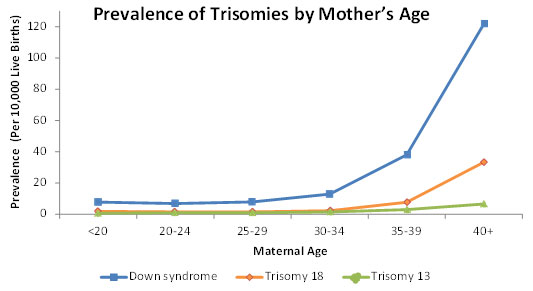
Another reader reminds us:

The risk of Downs’ syndrome and some kinds of birth defects increases with the age of the mother, others with the age of the father. The mother – from the CDC:

unnamed (8)

On the other hand, risk of gastroschisis (intestines outside the body) decreases with age of the mother. For fathers, their increased age is associated with increased risk of bipolar disorder, schizophrenia, and autism.

Another reader tells multiple stories:

I can tell you all about fertility fog. (Sorry this got really long.)

When I was about 34, in a serious relationship with a younger man, but not engaged, a friend told me she wanted to talk to me about something serious.  She told me that I shouldn’t wait to have a baby, that she’d had age-related fertility problems at 35 and didn’t want the same thing to happen to me.  It was upsetting, because I wasn’t in a position to go home and try and get pregnant that night. But I didn’t dismiss her.  I told my boyfriend (now husband) what she’d said, and that, while I wasn’t giving him an ultimatum, I couldn’t wait forever because I wanted a family.  When I started openly talking about adoption or donor sperm, he got the hint, and we got engaged. I was married just before turning 35.

Lo and behold, I had problems getting pregnant (which may not actually have been caused by my age, but being older didn’t help).  I learned a lot about infertility and was very quick to seek aggressive medical help when it didn’t happen right away.  With lots of medical help, I was able to have three children, including twins.  (By the way, my gynecologist acted like my age was a non-issue, and if I’d left it up to her, I would have waited a lot longer to seek help from a fertility specialist. I am very grateful to my friend for lighting a fire under me.)

I was quite open with my friends, all career women, about our struggles, and very clear about the perils of waiting. They were mostly skeptical that fertility really starts to decline in your late 20s, and falls off a cliff after 35.  They latched on to the stories that comforted them. They would read about celebrities seeming to get pregnant very easily in their mid to late-40s and assumed that they would also be able to do so.  They seemed to think I was just bitter when I assured them that the celebrities were almost certainly using donor eggs.  I can’t tell you how vindicated I felt when it was revealed in Cheryl Tiegs’ divorce that she had indeed used donor eggs to have her children at 52.  She had gone around on talk shows telling people that the twins had been conceived using her eggs and her husband’s sperm because she’d taken such good care of herself that her reproductive organs were “young.”  (I know for a fact that her doctor would be asked at infertility conferences to do for these regular women what he’d done for Tiegs.  He couldn’t tell the truth, of course, because of doctor/patient confidentiality, but he hinted.)

Anyway, two stories.  One friend seemingly took me seriously.  When she got engaged in her late 30s, she planned a short engagement, and we had a sit down where I told her everything I knew about how to up her odds of getting pregnant quickly.  She was quite worried.  Lucky for her, she got pregnant easily and had a healthy baby.  I think she probably felt I’d made her panic for nothing.  She also apparently thought that her pregnancy cured her of her age.  Instead of trying quickly for a second child (she wanted several), she decided it would be ideal to have at least two years between children, and although she was now in her 40s, decided to wait that long to start trying again.  I tried to gently hint that she might not want to wait, all the same issues applied, but, to my regret, I wasn’t pushy about it, and didn’t tell her she was an idiot for waiting (even though that’s what I thought).

Well, she did get pregnant again after a while and miscarried.  She miscarried several times. Her miscarriages were almost certainly as a result of her older eggs.  But she refused to believe it and refused any treatment that might increase her odds of success.  She even called me crying once to tell me that her new doctor had told her that her miscarriages were the result of her age, and that she should see a fertility doctor right away while there was still some hope.  I told her the doctor was being reasonable, but it was like she was deaf.  She switched doctors!  She never had another child and was sad about it for many years.  I always have felt badly that I did not push her harder not to wait.  But I don’t think she would have heard me.  If she wouldn’t hear a doctor, why would she hear me?

Second story.  A friend was having no luck meeting a guy, so decided to go the donor sperm route.  She got all set up, picked the clinic, the donors, the whole thing, and was ready to begin.  Then one day we were having lunch and she told me she’d decided to wait at least another year.  (She was in her late 30s.) I again tried to gently encourage her not to wait.  I remember asking her whether, if she knew that by waiting she wouldn’t be able to have a child would she still wait and she said yes. She also said she would never pursue treatment.  I left it at that.  She knew my story.

A year or so later, she finally tried to get pregnant and it didn’t work.  She had tests done and the results were not great, her likelihood of success not good, but she decided to do IVF (which she said she’d never do) anyway.  Her several attempts failed pretty miserably.  And she told me that I “should have told her that it was a mistake to wait”!!!   I felt awful, but also a little pissed.  I did tell her.  I just didn’t TELL her.  It was probably already too late anyway, to be honest.  She ended up adopting a child, eventually married, has stepchildren and is very happy.  I don’t think she has any regrets now, so it worked out for the best, but there was a lot of heartache in between.

Map Of The Day

[youtube https://www.youtube.com/watch?v=pJxrTzfG2bo&start=13]

History professor Claudio Saunt created the above time-lapse, as well as a corresponding interactive map, to emphasize “the fact that the United States is built on someone else’s land”:

By the time the Civil War came to an end in 1865, it had consumed the lives of 800,000 Americans, or 2.5 per cent of the population, according to recent estimates. If slavery was a moral failing, said Lincoln in his second inaugural address, then the war was ‘the woe due to those by whom the offense came’. The rupture between North and South forced white Americans to confront the nation’s deep investment in slavery and to emancipate and incorporate four million individuals. They did not do so willingly, and the reconstruction of the nation is in many ways still unfolding. By contrast, there has been no similar reckoning with the conquest of the continent, no serious reflection on its centrality to the rise of the United States, and no sustained engagement with the people who lost their homelands.

Update from a reader:

“The fact that the United States is built on someone else’s land”. Um, isn’t this true of every modern nation? Isn’t it true that the Native Americans fought and killed each other to take land from their neighbors?

(Hat tip: Nathan Yau)