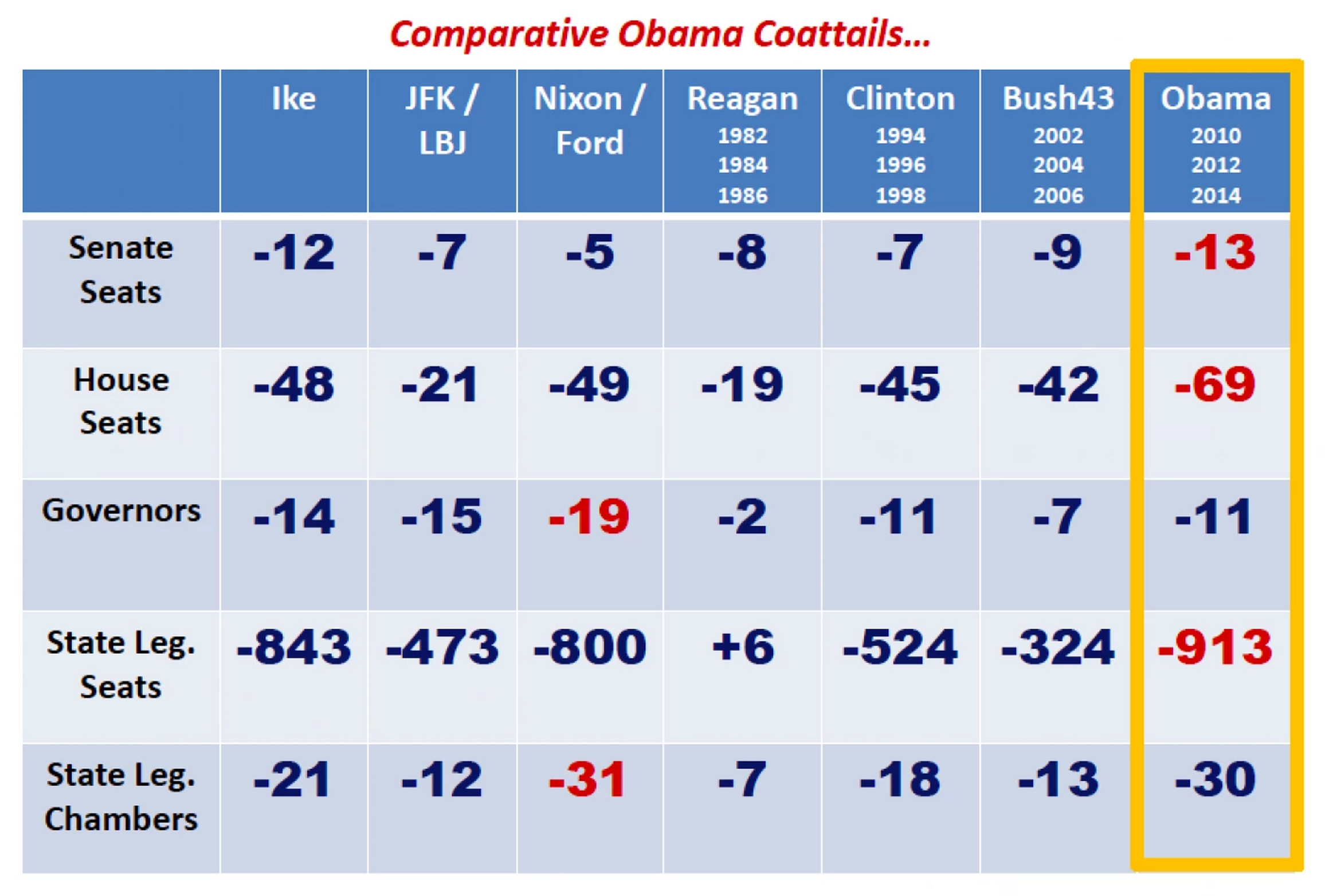
Based on Sabato’s calculations, Cilizza charts the Obama effect on Dems in state legislatures:
Now, there are more 7,000 state legislative seats in the country, according to the National Conference of State Legislatures, which makes that 913 number slightly less eye popping. Still, the Democratic losses between 2010 and 2014 amount to 12 percent of all state legislative seats nationwide. As NCSL notes, Republicans now control over 4,100 seats — their highest number since 1920. After taking over 11 legislative chambers from Democrats in 2014, Republicans now control 30 state legislatures completely — and have full control of state government (state legislature and governor) in 23 states.
He points out how it also gives the national GOP an advantage in prospective candidates:
State legislatures are the minor leagues. Most of the politicians — Barack Obama included — who have gone on to great things, politically speaking, honed their craft in the state legislature of their home (or adopted home) state.
Melissa Dahl, who admits she cries “embarrassingly easily,” investigates the question. One reason? Women seem to have shallower tear ducts:
“There are several studies over the years that have shown that men have larger tear ducts in their eyes, so that it is less likely for the tears to well up to the point of spilling over the eyelid onto the cheek,” said Dr. Geoffrey Goodfellow, an associate professor at the Illinois College of Optometry in Chicago. There’s also this paper from the 1960s, in which a physician from the University of Michigan reports how he used male and female skulls to measure the length and depth of tear ducts, finding that women’s were shorter and shallower.
Hormones may also play a role:
[Researcher Ad] Vingerhoets believes [testosterone] inhibits crying. Male prostate cancer patients, for example, tend to become more emotional when treated with medications that lower their testosterone levels.
But this isn’t just about testosterone: Back in the 1980s, biochemist William H. Frey and his team analyzed the chemical makeup of emotional tears and compared them to tears caused by irritants. They found, among other things, that emotional tears tend to contain prolactin, a hormone produced by the pituitary gland that is associated with emotion. … Lauren Bylsma, an associate professor in psychiatry at the University of Pittsburgh who has studied crying with Vingerhoets, said that this difference in prolactin levels “may help explain these differences in crying, as well as other differences in emotional expression and depression vulnerability between men and women.”
Speaking of such differences, Walt Hickey compares men and women when it comes to the movies that make them cry.
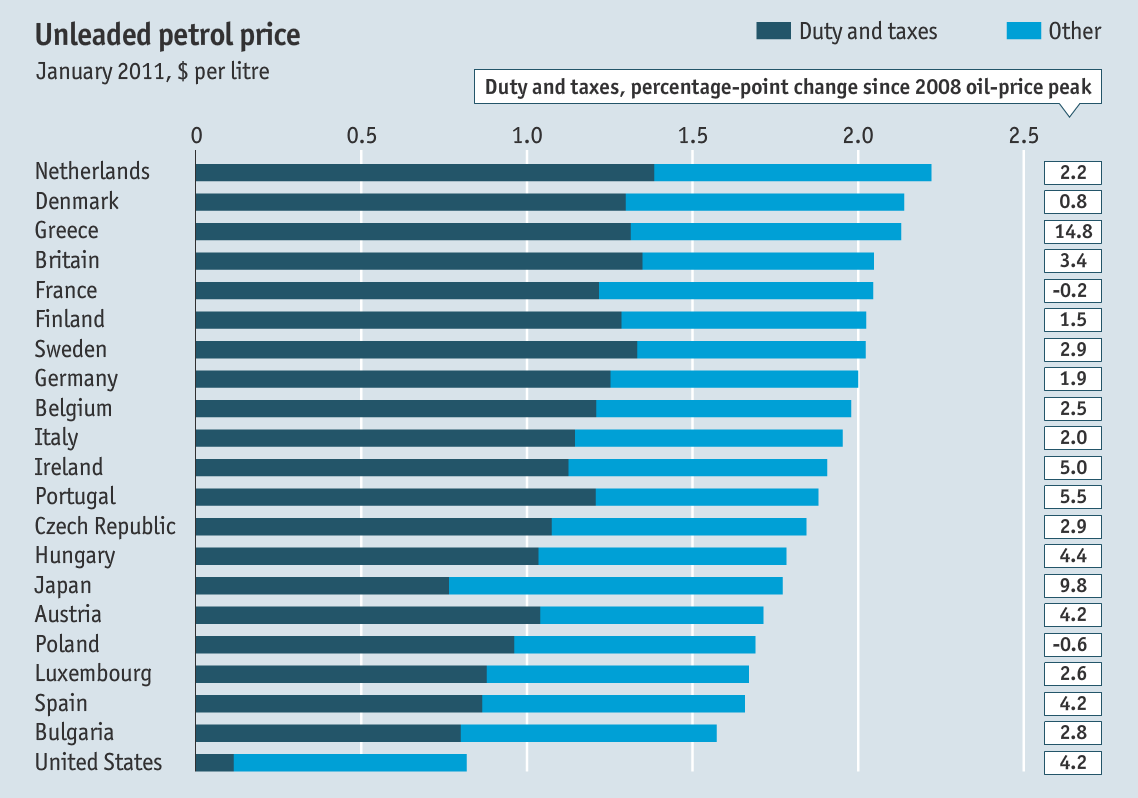
Yes, Mr. Edwards, the percentage increases in the gas tax between 1984 and 1992, seems rather large, but this a rather lazy argument and ignores almost all of the developed world. Take a look at this article in The Economist from 2011. My coworker – back when I used to work at the Energy Information Administration – used to have [the above] graph contained therein posted outside his door for a good reason. Developed countries’ gas taxes are almost all at least a $1 higher than ours!
Another also pounces on Edwards:
You know what else happened between 1982 and today? A wee bit of inflation. The 18.4¢ today is equal to just 7.5¢ when adjusted for inflation. That’s a slightly less meteoric rise. But what’s perhaps even more disingenuous – and this is from someone who apparently has a masters in economics – is where Edwards starts his chart and analysis.
There’s really no good reason for him to start that chart in 1982 that I can find. If you extend it backwards, the gas tax was unchanged at 4¢ from 1959 to 1982. The 4¢ gas tax in 1959, had it been adjusted for inflation, would stand at 32.5¢ today (about what the 18.4¢ 1993 figure would buy today if adjusted). In other words, thee gas tax that built the Interstate Highway system 50 years ago was nearly double what it is today. Of course, we now have to maintain that system, but no longer have the tax base to do so. The 1993 hike merely brought it up to where it had been originally, but it has slipped by nearly half that value in the past 20+ years.
Unlike most other taxes that are per dollar, gas taxes are per gallon (which makes some sense due to the volatility of gas prices), but unlike those taxes, they don’t rise with inflation. They should, but good luck getting that through Congress. So any time inflation ticks up, it’s a backdoor tax cut for drivers, with the only side effects being the condition of the roads they drive upon.
Ilana E. Strauss covers delayed sleep phase syndrome (DSPS) – “a disorder that affects one in 750 adults,” or about 400,000 Americans:
DSPS sufferers have internal clocks that run at least two hours slower than normal, giving them “social jet lag” which is pretty much what it sounds like: They’re out of sync with the rest of society. They struggle to keep their eyes open during morning business meetings because their bodies are convinced it’s the middle of the night.
Michael Lewis stands up for the nocturnal among us:
Lewis wrote his first book entirely after midnight, and he continues to write at night. “I can’t get the best stuff out of me any other way,” Lewis said. “I used to write until five in the morning. I think my books would be better if I could still do that.”
I don’t know about you, but I thought a word from Hitch at this moment might well be appropriate. Have you not missed him these past couple of weeks?
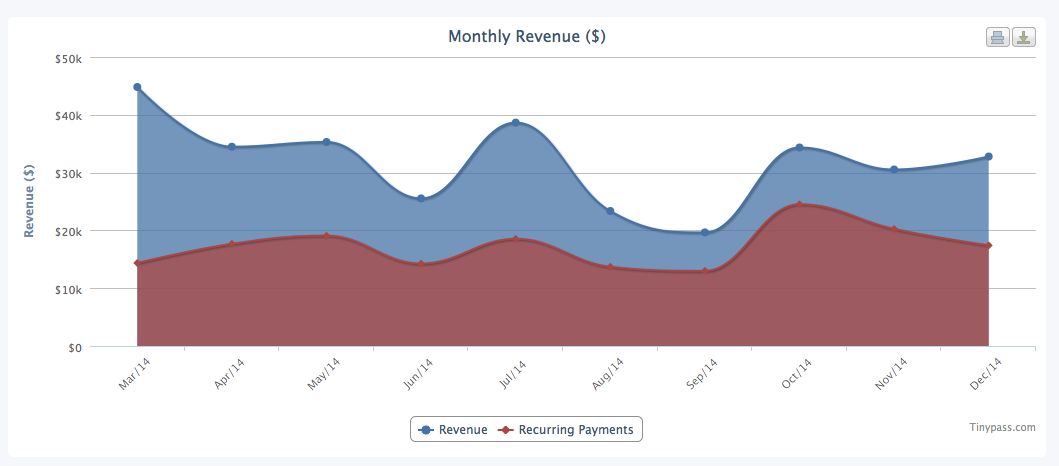
I’m two weeks late for my monthly report on the State of the Dish because of, well, not being able to get out of bed, but here goes. December was a strong month for us: we brought in $33K in revenue. Here’s the gross revenue chart since last March:
The red is from last year’s subscribers and the blue from new ones this year. Our total gross revenue from subs in 2014 came to $967K. In 2013, it was $851K. That’s a 14 percent increase, year on year. It wasn’t our only source of income, because we also got some Amazon affiliate money and some merchandise profits – about $51K total. So that bit of revenue added to our subs makes the Dish a million dollar company in 2014. Traffic also came in at over a million unique visitors in December and 5.8 million pageviews.
A massive thanks to all of our 30,478 subscribers. I had no idea if we’d make it to Year 3, but we have. Your commitment to this little platform for open debate and conversation is, mercifully, rock-solid. I’ve been at other magazines. You guys are different and special. If you haven’t yet, please join us. If you’d like to introduce a friend to the Dish, gift subscriptions are here. A reader writes:
I’ve followed your website for some time now, a time during which my wife was in a six-year battle with breast cancer. I always hesitated to subscribe out of the need to ensure all my resources, both financially or other, were directed toward her care. I lost her last July after 32 years of marriage and have been struggling to come to terms with the aftermath. Believe it or not, your site and its diverse content has helped me, and I have been intending to subscribe … but was stuck for some reason.
One of Sunday’s posts, “The Way Time Heals“, struck a cord that has finally moved me to subscribe. One quote from Mantel’s article:
Recovery can seem like a betrayal. Passionately, you desire a way back to the lost object, but the only possible road, the road to life, leads away.
It’s a perfect description of the feelings one has in grief. Every step I take, changing names on bank accounts and titles, buying groceries for one, and the things I do for myself – like finally subscribing to The Dish – are painstaking steps away from my former life. And each decision and change can feel like you’re erasing a former life, so the finality of each action can be heartbreaking.
So as strange as it might seem, this is a big, difficult, and heartbreaking decision, but one that is part of moving forward instead of remaining in stasis. You need to know that your site is a beacon and godsend of intelligent and thoughtful content, and it can help people in ways you might not fully understand.
I subscribed at twice the requested rate, half for me, and half in memory of my beautiful wife. Thanks again for all the amazing everything you and your cohorts do each day.
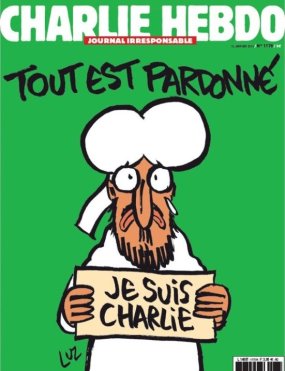
You can probably tell I’ve been really sick because I couldn’t manage to write about the Charlie Hebdo Jihadist mass murder. Now that the immediate crisis is past and my fevers are back under some control, some thoughts.
I was actually surprised and gladdened by the response to the slaughter – an overwhelming wave of revulsion and disgust, expressed with great dignity and courage (and yes, it was an absolute disgrace that Obama sent no one of a higher rank than the ambassador). I had begun to think that a defense of free speech was no longer a pillar of the American right or left, but for a while, at least, I was wrong. People do draw the line at the murder of blasphemous cartoonists in the name of God. It seems we have at least achieved a consensus on that. Two cheers!
Was it enough to prompt the New York Times to be a newspaper, instead of a quivering pile of bullshit fearful of offending people? Nah. Baquet is a man worthy to succeed Bill Keller, the editor who refused to use the word torture because it would offend the American government, which was trying to conceal war crimes (and has gotten away with all of it). The NYT is a fantastic paper in so many ways. But it is run by those educated in the view that anything that might offend any non-white minority is the worst human sin imaginable. The brutal truth is: Charlie Hebdo employees would last a week at most at the NYT before being fired. A liberal church like that will not tolerate blasphemy either. And can you imagine Charlie being allowed to be published on any US campus? For merely its depictions of Jews and Christians, it would never survive. It is, after all, a “macro-aggression”, right? Students would need counseling for years to recover from such images. Still, hypocrisy is the compliment vice pays to virtue, and in an America dedicated to rooting out “hate speech”, this is probably as good as we’re likely to get.
Then the deeper disappointment. Even now, many will not concede that religion was the root cause of the attack, and that the name of that religion is Islam. Reading the cartoonishly liberal Nick Kristof was like watching a Monty Python Piranha Brothers sketch (see above). Yeah, they have murdered thousands of Westerners and far larger numbers of Middle Eastern and Nigerian and Pakistani Muslims. Yeah, they did that. They also declared at every one of their slaughters that their motivation is Islam. They have beheaded people, mass murdered school children, flown planes into buildings, cut women’s genitals, employ sex slaves, commit mass rape, and on and on. They have taken over a large part of the Iraqi and Syrian deserts to advance their desire for religious purity.
But Islam has nothing to do with this. There are just a few loonies who are suffering from false consciousness, and their real motivations are economic or personal or secular or just purely violent. You can believe that, if you want. Or you can pretend to believe it because it might be more pragmatic to do so. Or you can open your eyes. This is not to say that most Muslims support this kind of mass murder – and the global Muslim response was particularly encouraging. But it is to say that it is not a coincidence that so much terror and violence all over the world is currently being committed in the name of Islam. Some core parts of it are, quite simply, incompatible with post-Enlightenment thought and practice. And those parts have all the energy right now.
And the core issue here is blasphemy. For almost all of human history, rooting out blasphemy has been the norm. Many Western countries still have moribund blasphemy laws and the Muslim world is crammed with them. The death penalty is common. Prison time is expected. Mob mass murder is another phenomenon. Today, the NYT dutifully cites some verses from the Koran that instruct Muslims to simply “not sit with” blasphemers. There are others:
Those who annoy Allah and His Messenger – Allah has cursed them in this World and in the Hereafter, and has prepared for them a humiliating Punishment. Truly, if the Hypocrites, and those in whose hearts is a disease, and those who stir up sedition in the City, desist not, We shall certainly stir thee up against them: Then will they not be able to stay in it as thy neighbours for any length of time: They shall have a curse on them: whenever they are found, they shall be seized and slain (without mercy).
Or the prophet himself:
The Prophet said, “Who is ready to kill Ka’b ibn al-Ashraf who has really hurt Allah and His Apostle?” Muhammad bin Maslama said, “O Allah’s Apostle! Do you like me to kill him?” He replied in the affirmative.
You can get thrown in jail and have mobs calling for your execution by teaching kids about a teddy bear in Sudan, to give a simple 2007 case. In Pakistan, 50 people arrested for blasphemy over the last three decades have been murdered before they got to trial. In Saudi Arabia, an ally, blasphemy is on the same level as apostasy: it’s punishable by death.
The map above from the Pew Foundation shows where blasphemy laws are on the books. See a pattern here? Pew notes that 64 percent of the world’s populations still live under blasphemy laws and they are marginally more common than the other deeply anti-Enlightenment prohibition on apostasy.
Again, it’s vital to point out that Islam is the norm for most religions on planet earth since the beginning of time – except for a brief period in the modern West. It is not so much that they have gone backward so much as we have gone forward so rapidly on the question of religious liberty and free speech that some core elements of Islam cannot tolerate it. It’s too great a cultural gulf. I have tentative hope that this vast gap on a fundamental question may take as long for Islam to arrive at as Christianity did. But that means a century at least of more bloodletting – and given the presence of so many disaffected young Muslims in Europe, a series of slaughters to come, and the possible erosion of support for free speech outside these rare moments of cherished unity. I see no other way of getting through this: surveillance, vigilance, an end to invasion, occupation and torture, and patience. And to give not an inch to any infringement on free speech.
A group of people stage a demonstration on January 14, 2015 during the celebration of the 4th anniversary of the beginning of the “Arab Spring” revolution at Avenue Habib Bourguiba in Tunis, the capital of Tunisia. Four years ago today, longtime president Zine El Abidine Ben Ali was deposed. By Yassine Gaidi/Anadolu Agency/Getty Images.
Cassandra is being called immature simply because she believes in quality over quantity of life, which is a concept that is pretty alien to most First Worlders who believe that science can/should keep us alive (and young) for as close to forever as possibly. In a very death-fearing culture, anyone who questions it is usually written off as crazy – when they are an adult – and “immature” when they are a teen.
By the way, the recent Canadian case where the Aboriginal girl was allowed to stop chemo because a judge found it violated her freedom of religion came to mind when I read about Cassandra. I followed that case in the news a bit. The interesting thing that came up in comment sections was not so much about how the girl and her parents were wrong to pursue alternative medicine (some did think this) but how lucky they were that they were Aboriginal and could therefore use their Charter rights to do so.
And that girl was 11 years old. Another reader:
There is one aspect I haven’t seen discussed about the right to refuse medical treatment, and I think it is a pretty big elephant in the room: Cost.
Who is going to pay for all that chemo? I am assuming Cassandra is covered by some sort of insurance policy, but what if she wasn’t? This decision might often be more than just the self-centered struggle about whether a patient wants to endure much pain in exchange for survival. It can also be decision about whether to allow one’s family to spend their life savings and face bankruptcy. College funds, retirement plans, homes, farms, and just about everything money can secure are often lost in the struggle to keep a family member alive longer than nature would allow.
Health care in the U.S. is still a privately financed affair. Can or should the state be able to force a family to purchase expensive medical services that they may not have the capital for? Shouldn’t the state pick up the tab if they are the ones ordering the services?
Another circles back to the age question:
I’m not going to get into the merits of Cassandra’s case, except to point out that regardless of the outcome, this case should point out the confusion and continued absurdity of how we deal with the question of “At what point are you considered an adult?” The general consensus (and legal definition in most cases) is that 18 is the point when you are considered an adult. Many of the things that are considered the hallmark of reaching adulthood occur at 18. You’re allowed to vote, join the military, take on credit, live independently, and do things without requiring parental consent.
Yet, the same consensus also dictates that there are certain things 18 year olds are not mature enough to act rationally on, the most obvious regarding the consumption of alcohol. It’s the old argument that comes up when discussing alcohol: the state feels you are mature enough at 18 to join the military and kill someone if needed, but God forbid you need a drink to unwind after a long day. Furthermore, in many states, the age of sexual consent is dependent on what state you live in. In some cases, it can be as young as 14 or 15. It would seem to me that nothing would require the highest level of maturity than engaging in a sexual act, but then all hell breaks loose if the subject of handing out condoms or discussing birth control is even broached.
I know it’s not as black and white as this, but either have a consistent point where you say that under 18, your child and the law will treat you as such, or have all laws apply equally regardless of the person’s age.
Another turns the conversation to alternative treatments:
I must tell you about our experience with a serious disease. It is the kind of experience that supports Cassandra’s decision. My husband was diagnosed with Aplastic Anemia, at the age of 55, in 2005. With AA, the bone marrow stops making adequate blood. The prognosis was poor. He was given transfusions to keep him alive and chemo to treat the AA. After the IV chemo, he was put on powerful oral medication. It was strongly suggested that a bone marrow transplant might be in his future.
The chemo helped lift his blood counts, but because the longterm prognosis was so poor, we started researching. We tried to avoid quackery, and it’s definitely out there. And when you’re desperate, you’re certainly vulnerable. But we also found thoughtful testimony from people who had nothing to sell, nothing to gain, but simply wanted to tell their story. We also found links to medical research that contradicted some of the doctor’s advice.
As a result of this research, my husband discontinued the oral medication. He also began to refuse platelet transfusions. The reaction of his nurse was angry: we will discontinue you as a patient if you do not do as we say. It became clear that her motivation was not healing, but power.
Because the truth is: my husband was not doing nothing instead of the medication. He changed his diet completely. He went to an acupuncturist and learned and practiced Qi Gong. He did a lot of soul-searching.
And his blood counts began to rise. Sadly, none of his doctors seemed interested in this phenomena. He stopped going in for blood tests.
In a similar situation I was following online, the end was much sadder. The patient, 10 years younger than my husband, followed doctor’s orders – and died, leaving behind two teenage daughter.
My husband is alive and well. We have a four-year-old granddaughter who is the joy of our lives, and another on the way. Chances are good that he would have missed this joy if he had followed doctor’s orders.
So: please don’t dismiss all questioning of cancer treatment as foolishness and quackery. Sometimes saying “no” can save a life. And is it really appropriate to drag the family to court, to ridicule them in such a public way? To post guards outside her door? Could the doctors consider a heart-to-heart talk, and be open to her ideas about healing? Could they possibly take the time to listen, instead of just scolding and insisting? Could a compromise be found?
Another relays the details of a famous case of refusing chemo for alternative treatments:
Concerning what your reader said about folks buying into myths to avoid chemotherapy, let’s not forget about what Steve Jobs did to himself. From the Wikipedia page on him:
Barrie R. Cassileth, the chief of Memorial Sloan–Kettering Cancer Center’s integrative medicine department, said “Jobs’s faith in alternative medicine likely cost him his life…. He had the only kind of pancreatic cancer that is treatable and curable…. He essentially committed suicide.”
According to Jobs’s biographer, Walter Isaacson, “for nine months he refused to undergo surgery for his pancreatic cancer – a decision he later regretted as his health declined. Instead, he tried a vegan diet, acupuncture, herbal remedies, and other treatments he found online, and even consulted a psychic. He was also influenced by a doctor who ran a clinic that advised juice fasts, bowel cleansings and other unproven approaches, before finally having surgery in July 2004.” He eventually underwent a pancreaticoduodenectomy (or “Whipple procedure”) in July 2004, that appeared to successfully remove the tumor. Jobs apparently did not receive chemotherapy or radiation therapy.”
 educated in the view that anything that might offend any non-white minority is the worst human sin imaginable. The brutal truth is: Charlie Hebdo employees would last a week at most at the NYT before being fired. A liberal church like that will not tolerate blasphemy either. And can you imagine Charlie being allowed to be published on any US campus? For merely its depictions of Jews and Christians, it would never survive. It is, after all, a “macro-aggression”, right? Students would need counseling for years to recover from such images. Still, hypocrisy is the compliment vice pays to virtue, and in an America dedicated to rooting out “hate speech”, this is probably as good as we’re likely to get.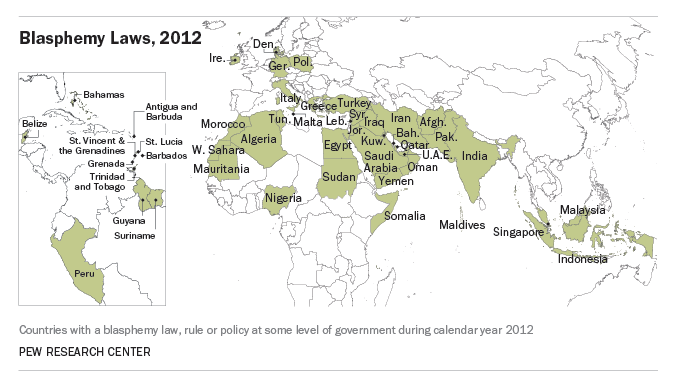


 The Dish