Diet Another Day

Carrie Arnold suggests that weight-based New Year’s resolutions are a lost cause:

With fears about obesity ever present, as well as the West’s intense societal stigma against fat, it makes sense to want to lose weight. What people need to stop and ask, however, is whether it’s realistic to diet and lose weight long term, and whether that will improve health. The answer to both questions, [Body of Truth: How Science, History, and Culture Drive Our Obsession With Weight—and What We Can Do About It author Harriet] Brown says, is no.

“If you look at the studies, most of them stop after six months, one year, two years,” Brown says. She wanted to know what happened over five years, or even 10, but the scientific literature had little to offer.

The longest study Brown dug up was the Look Ahead Study, which randomized 5,145 adults with diabetes to either an “intensive lifestyle intervention focusing on weight loss” or a control group and then followed them for 13.5 years. After 9.5 years, however, the study was halted. Although the intervention group did lose more weight than the control group (6.0 percent versus 3.5 percent of starting body weight), the researchers found no significant difference in cardiovascular events like heart attack and angina, or in premature death.

Sarah Kliff adds:

[T]here’s actually a tangible risk to failure:

research has shown that people who don’t meet their goals in dieting, for example, become less likely to succeed in future attempts. They seem to build up a narrative in their head that the thing they want to do is impossible. They have, after all, screwed it up before. “Every time we fail, we damage our own self-esteem,” says Janet Polivy, a psychologist at the University of Toronto in Mississauga. “We make ourselves less able to bounce back the next time. One thing we see is that, when people fail, they don’t blame the diet. They blame themselves. And that makes it hard to start again.”

Meanwhile, Lindsey Averill reflects on the success of her 2012 resolution to find clothes that fit rather than lose weight:

I was a clothes-that-fit badass. And while resolving to buy clothes might seem superficial and ridiculous, it wasn’t. It was amazing. As soon as I tossed my too-tight favorites, I started to forget to be self-conscious in private spaces. In other words, when my jeans were too tight, I could sit alone in my car at a red light – feel the tightness – and be reminded that I thought my body was wrong. Once my clothes fit, the “wrongness” I felt with regards to my body was rarely present unless other people or media made me feel that way.

I’m not trying to oversell this idea – all my problems with my body weren’t magically solved by clothes that fit, but I was loving myself more and I was treating my body like it deserved nice clothes, like it was okay to live and be happy and enjoy fashion at my size. So yeah – a resolution that was about accepting my body was way healthier for me than starting another new diet.

Reality Check

YouGov has a few charts that could qualify:

Assessments of both the economy and of the President continue to have a partisan basis.  Republican approval of the way the President is handling his job barely reaches double digits (12% this week), although in many recent Economist/YouGov Polls, is was below 10%.  And only 35% of independents approve.  But 80% of Democrats do, one of the President’s highest ratings in recent months from his own party’s identifiers.

A similar pattern holds when assessing the state of the economy.  Although 44% of Republicans believe the economy is getting worse, that is much lower than most previous numbers.  A majority of Democrats are optimistic.  Independents are divided.

Palestine Ups The Pressure

Noah Gordon sums up the big news this week:

The Palestinian Authority’s President Mahmoud Abbas signed the papers to join the International Criminal Court a day after it was denied statehood by the UN’s Security Council. The provocative move could draw sanctions from Israel and the United States, as well as expose the Palestinian territories and Israel to an international investigation of war crimes.

Jessica Schulberg’s take on the implications:

Precedent suggests that Palestine’s ascension to the ICC will amount to little more than a symbolic display of sovereignty.

As The Washington Post editorial board noted, the ICC accused Sudanese President Omar al-Bashir of genocide, crimes against humanity, and war crimes in 2009. Yet, he continues to rule the country and travel freely. Since its inception in 2002, the ICC has brought a total of 21 cases in eight countries, resulting in only two convictions. Even if the ICC does decide to indict specific Israelis for war crimes, Israel is not party to the Rome Statute and could refuse to surrender its citizens or evidence for trials.

At this point, Palestine had little to lose by joining the court. It comes at a time when international support for Palestinian sovereignty is expanding, as is disillusionment with Israel’s continued occupation. While this decision is in direct defiance of the U.S. (the biggest donor to the United Nations Palestinian Relief Agency), the Americans are unlikely to pull funding.

Keating notes how close the vote was for Palestinian statehood:

This latest Security Council vote was hardly an unambiguous victory for Israel. The U.S. and Australia were the only countries to vote against the resolution. (Australia abstained on the 2012 Assembly vote, but has been more vocally pro-Israel since the election of Prime Minister Tony Abbott last year.) Three of the five permanent members—Russia, China, and France—voted for it. Britain, whose parliament passed a non-binding resolution in support of Palestinian statehood in October, abstained. None of the four EU countries on the council supported Israel’s position (Luxembourg voted for the resolution, and Lithuania abstained), reflecting growing impatience in Europe with Netanyahu’s government. …

Going forward, if the composition of the council is slightly different or the U.S. is slightly less enthusiastic about lobbying on Israel’s behalf, things could easily go very differently and Israel and its primary backer could find themselves even more isolated.

Bernard Avishai thinks Secretary Kerry is misreading the situation over there:

It turned out that Kerry did not have to veto the first resolution, though Abbas may try to reintroduce it in January, when the composition of the Security Council will change to his advantage. Kerry is trying to avoid “doing stupid stuff,” as Obama has often put it. If the nuclear negotiations with Iran finally produce an agreement this winter—even one that opens the country to permanent inspections and greater economic integration—Netanyahu and the Republican Congress can be expected to attack it. Why provide them with more reasons to accuse the Obama Administration of being unfriendly to Israel?

At the same time, Kerry knows that doing nothing to quell the conflict between Israelis and Palestinians may not be shrewd. Jerusalem witnessed escalating acts of violence this year, some with religious overtones, and Kerry saw how the collapse of his mediation effort last spring contributed to the eruption of war in Gaza. So Kerry is asking for a three-month grace period on the second, more significant resolution, in which all sides sweat out the Israeli election results with him.

Gershon Baskin supports the PA’s resolution, for the most part:

My sense is that the Palestinians put down a draft to place a benchmark of their baseline positions – look at what we are demanding. We (the Palestinians) want the world to know that our demands are such and such and that they are reasonable. That is a kind of starting point for the Palestinians, and if their international diplomatic strategy continues, members of the Security Council sympathetic to the Palestinian side may now push for some amendments to that resolution.

For the most part, the resolution is quite good and I see it as a call to the international community to preserve the viability of the two-state solution. I see this as a call to save the State of Israel from the occupation and to enable Israel to break free from its hold over millions of Palestinians. It is most unfortunate that the Palestinians did not wait to bring the draft to a vote, at least until after Israeli elections.

Leelah Alcorn’s Last Words

Heartbreaking in so many ways:

If you are reading this, it means that I have committed suicide and obviously failed to delete this post from my queue.

Please don’t be sad, it’s for the better. The life I would’ve lived isn’t worth living in… because tumblr_nh42atfkcv1tddhzxo2_500I’m transgender. I could go into detail explaining why I feel that way, but this note is probably going to be lengthy enough as it is. To put it simply, I feel like a girl trapped in a boy’s body, and I’ve felt that way ever since I was 4. I never knew there was a word for that feeling, nor was it possible for a boy to become a girl, so I never told anyone and I just continued to do traditionally “boyish” things to try to fit in.

When I was 14, I learned what transgender meant and cried of happiness. After 10 years of confusion I finally understood who I was. I immediately told my mom, and she reacted extremely negatively, telling me that it was a phase, that I would never truly be a girl, that God doesn’t make mistakes, that I am wrong. If you are reading this, parents, please don’t tell this to your kids. Even if you are Christian or are against transgender people don’t ever say that to someone, especially your kid. That won’t do anything but make them hate them self. That’s exactly what it did to me.

My mom started taking me to a therapist, but would only take me to christian therapists, (who were all very biased) so I never actually got the therapy I needed to cure me of my depression. I only got more christians telling me that I was selfish and wrong and that I should look to God for help.

When I was 16 I realized that my parents would never come around, and that I would have to wait until I was 18 to start any sort of transitioning treatment, which absolutely broke my heart. The longer you wait, the harder it is to transition. I felt hopeless, that I was just going to look like a man in drag for the rest of my life. On my 16th birthday, when I didn’t receive consent from my parents to start transitioning, I cried myself to sleep.

I formed a sort of a “fuck you” attitude towards my parents and came out as gay at school, thinking that maybe if I eased into coming out as trans it would be less of a shock. Although the reaction from my friends was positive, my parents were pissed. They felt like I was attacking their image, and that I was an embarrassment to them. They wanted me to be their perfect little straight christian boy, and that’s obviously not what I wanted.

So they took me out of public school, took away my laptop and phone, and forbid me of getting on any sort of social media, completely isolating me from my friends. This was probably the part of my life when I was the most depressed, and I’m surprised I didn’t kill myself. I was completely alone for 5 months. No friends, no support, no love. Just my parent’s disappointment and the cruelty of loneliness.

tumblr_nh42atfkcv1tddhzxo4_500At the end of the school year, my parents finally came around and gave me my phone and let me back on social media. I was excited, I finally had my friends back. They were extremely excited to see me and talk to me, but only at first. Eventually they realized they didn’t actually give a shit about me, and I felt even lonelier than I did before. The only friends I thought I had only liked me because they saw me five times a week.

After a summer of having almost no friends plus the weight of having to think about college, save money for moving out, keep my grades up, go to church each week and feel like shit because everyone there is against everything I live for, I have decided I’ve had enough. I’m never going to transition successfully, even when I move out. I’m never going to be happy with the way I look or sound. I’m never going to have enough friends to satisfy me. I’m never going to have enough love to satisfy me. I’m never going to find a man who loves me. I’m never going to be happy. Either I live the rest of my life as a lonely man who wishes he were a woman or I live my life as a lonelier woman who hates herself. There’s no winning. There’s no way out. I’m sad enough already, I don’t need my life to get any worse. People say “it gets better” but that isn’t true in my case. It gets worse. Each day I get worse.

That’s the gist of it, that’s why I feel like killing myself. Sorry if that’s not a good enough reason for you, it’s good enough for me. As for my will, I want 100% of the things that I legally own to be sold and the money (plus my money in the bank) to be given to trans civil rights movements and support groups, I don’t give a shit which one. The only way I will rest in peace is if one day transgender people aren’t treated the way I was, they’re treated like humans, with valid feelings and human rights. Gender needs to be taught about in schools, the earlier the better. My death needs to mean something. My death needs to be counted in the number of transgender people who commit suicide this year. I want someone to look at that number and say “that’s fucked up” and fix it. Fix society. Please.

Goodbye,

(Leelah) Josh Alcorn

More on the story here. Leelah scheduled one final post before signing off:

And now for my sorry notes to some people I knew…

Amanda: You are going to have such a wonderful life. You are the most talented and pretty little girl I’ve ever met and I love you so much, Amanda. Please don’t be sad. I’m going to miss you so very much. I love you.

Tiffany: We haven’t talked much recently since we’re both so busy but I’m so happy you’re my tumblr_nh42atfkcv1tddhzxo3_500sister. You are so courageous and determined to achieve what you want, you can accomplish anything. I love you.

Justin: We’ve been jerks to each other a lot recently but I really do love you. You get on my nerves almost all the time but no matter what a part of me will always love you. Sorry for picking on you so much when we were kids.

Rylan: I’m so sorry I’m never there for you. I love you so much.

Abby: Thank you for dealing with my pathetic problems, all I did was make your life harder and I’m sorry.

Mom and Dad: Fuck you. You can’t just control other people like that. That’s messed up.

I don’t really feel the need to apologize to anyone else… odds are you didn’t give a shit about me and if you do, you did something that made me feel like shit and you don’t deserve an apology.

Also, anyone who says something like “I wish I got to know him better” or “I wish I treated him better” gets a punch in the nose.

Chart Of The Day

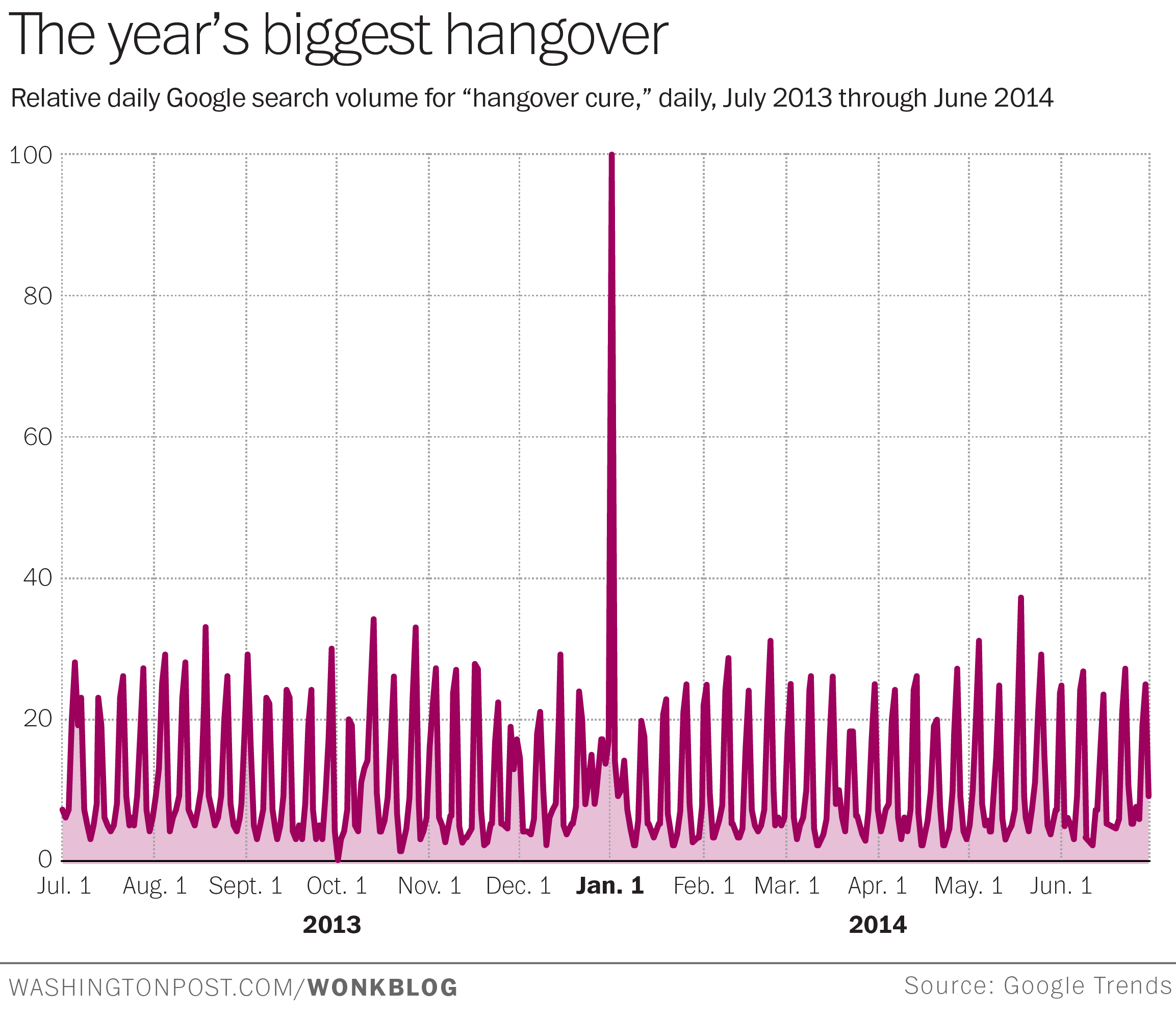
hangover

Christopher Ingraham captions:

Relative to other searches, interest in “hangover cure” is nearly 10 times higher than average on New Year’s day. The reason? Everyone’s out partying on New Year’s Eve. No other day in the calendar year comes close. The next-most hungover days of 2014 were the Saturday after Halloween, followed by a seemingly arbitrary Sunday in May, and then by the 5th of July. The Ten Most Hungover Days of 2014:

Wednesday, Jan. 1
Saturday, Nov. 1
Sunday, May 18
Saturday, July 5
Sunday, Feb. 23
Sunday, Sept. 28
Sunday, Oct. 26
Sunday, July 20
Sunday, Sept. 14
Sunday, March 16

The Ball Dropped, Prices Surged

Alison Griswold says New Year’s Eve is both the best and worst night for Uber:

In 2013, the company generated $10.7 million in gross revenue from an estimated 200,000 rides in 60 cities, according to 7uinternal documents obtained by Business Insider. This year, Uber has extended its reach to 266 cities and 53 countries. It’s projecting 10 times more rides than it delivered in 2013. Since the surges could be different this year than in 2013, you can’t really extrapolate those numbers to project how much revenue Uber is likely to make tonight. But clearly, it will be a lot.

So in terms of the financials, it should be pretty clear why New Year’s Eve is the best night of the year for Uber. But looking at [CEO Travis] Kalanick’s Twitter grief from last year, it should also be evident why it’s the worst. No matter how many times you explain that surge pricing does not take unfair advantage of drunk people, they are still bound to get upset by exorbitant fares. Spiking fares also incentivize drivers to forgo their own New Year’s celebrations to pick up passengers and provide safe transport. I’ll hazard a guess that people wouldn’t be too happy if Uber rides were as hard to come by as standard taxicabs on New Year’s Eve. And Uber, to its credit, is trying harder than ever this year to warn customers about high surges and advise them on the times when it will likeliest be the most expensive to hail a car.

Tim Lee continues to defend surge pricing:

If Uber and Lyft charged the same rates on New Year’s Eve as they did on a typical night, the result would be people facing long waits to get home. Indeed, that’s how things worked in major cities in the pre-Uber world:

when you tried to take a cab home from your post-New-Year’s bash, you’d find that all available cars were taken. Surge pricing addresses this problem by setting prices high enough to bring supply and demand in balance, ensuring that you can always get a ride if you’re willing to pay enough. To some extent, this means that richer people get rides and poorer people don’t.

But that’s not the only factor affecting peoples’ willingness to pay. For example, some people have an inconvenient-but-doable option to get home — a 30-minute walk, say, or a bus ride — while others’ only option to get where they’re going is by taxi. At the margins, surge pricing will cause people who can get home some other way to do so, reserving the taxi rides for people who don’t have alternatives.

Ilya Somin wonders if people will ever be okay with surge pricing:

If Uber surge pricing does become established over time, it is possible that people will come to accept it as “normal,” and opposition may potentially diminish. That may be the reason why few people protest increased prices at hotels during peak vacation season, or increased prices for plane tickets at times when more people fly (though the relative lack of protest may also be because these price increases are less visible to consumers than Uber’s practices). At some point, status quo bias might outweigh the effects of biases cutting the other way. But before Uber surge pricing can start to benefit from status quo bias, it has to survive long enough to begin to seem “normal.” That may not happen if protestors get their way, and government forces the firm to abandon surge pricing before it becomes well-established.

Previous Dish on the practice here.