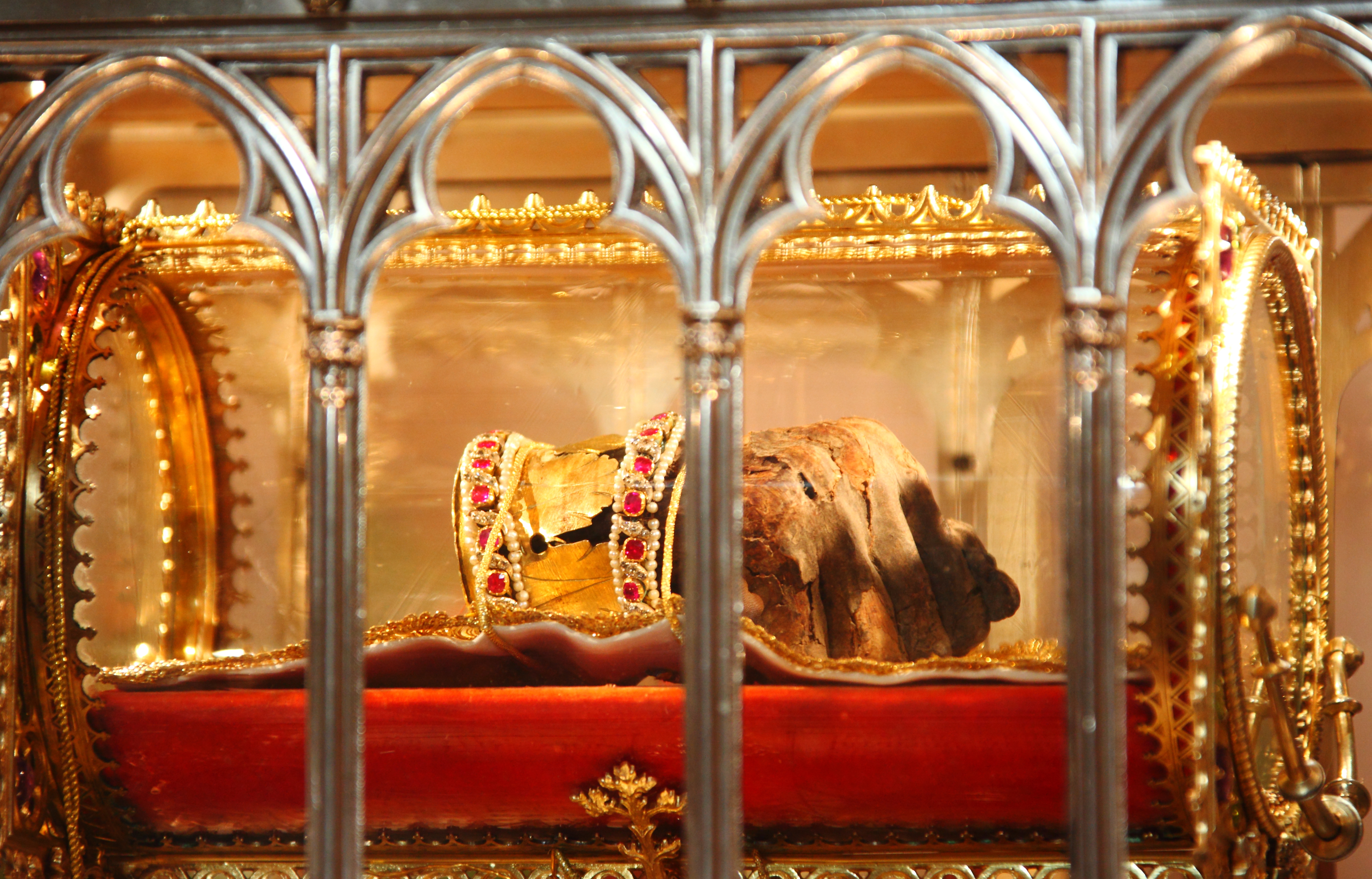
In the ’90s, I visited a church in Budapest where they displayed the 1000-year-old hand of St. Stephen. You have to put a coin in a box to make it light up. I couldn’t bear to look.
Another goes deep:
The problem with Christian opposition to idolatry is that the Doctrine of Incarnation postulates that God really became incarnate in matter. The Body of Christ is literally an idol (although a true idol per Orthodoxy). Furthermore, from the standpoint of Alexandrian theology, the whole point of the incarnation is so that we can become like God through the example of Christ, divinization, e.g. icons of Christ. Otherwise, the whole thing is pointless; you should just give up and study Aristotle or something.
Without saints, and icons and relics, you end up with a God that is just some occult metaphysical abstraction that saves us through some occult metaphysical process in some occult metaphysical by and by. Why not just worship God in an occult metaphysical way too? That is, why not just be nice and think positively? Why make a gesture of prayer or come together in a gesture of worship at all? Obviously, if we look up when we pray, then aren’t we suggesting that God is some kind of being up in the sky? If we speak, aren’t we suggesting that God has ears and can hear us? (And if he has ears, why can’t we draw them?) How is this any different from kissing an icon?
Or even better, isn’t the idea of a God that is not, in some sense, really physically present in matter a vacuous and meaningless idea? And isn’t that the central foundation of a vacuous and meaningless “contemporary” spirituality?
A reader senses that society is ready for the emergence of the first prominent gay rapper:
Maybe I missed it, but I haven’t seen a mention of the current #9 hit on the Top 40 chart – “Same Love” by rapper Macklemore. It was performed just this weekend on the MTV Video Music Awards. Macklemore addresses the issue in as direct a way as you could do it. Slate has a good post on it here.
Though many people on Twitter are assuming Macklemore is gay and bashing him for it. Another reader points to a fictional gay character:
The Wire‘s Omar Little isn’t a gay rapper, but many would consider him the type of street-smart Hood Robin Hood many rappers admire and purport to be in the musical fantasies they sell. I wonder if, and how far, Omar moved the needle.
One person who has definitely moved the needle is Frank Ocean, the black R&B artist who expressed same-sex love in latest album, covered by the Dish here.
A reader illustrates how even cultures known for their patience can frustrate people:
Being from Canada, the simple act of trying to exit a crowded city bus usually involves trying to inoffensively indicate to the other passengers that your stop is next. Contrast that with China, where people just push their way through. I went there for the Olympics in 2008 and I soon realized that my apologies weren’t even registering with the locals – in fact, I probably looked like an idiot saying “sorry” every time someone bumped into me on the Beijing metro.
On a similar note, I went to Israel in 2006 and the company that was hosting the visit took us to Masada, the ancient mountaintop fortress. At one point during the tour we ended up in narrow corridor while our group of five Canadians waited for a group of Israelis to pass. After about a minute they cleared out and, as we moved on, our guide laughed at us saying that in Israel, if you don’t push your way through you’ll never get anywhere.
This got me thinking of how my inoffensive Canadian behaviour (standing patiently, not saying anything) could be considered annoying to any Israeli tourists that happened to be stuck behind us.
Another reiterates how rude tourists accompany any economy that suddenly booms:
The “ugly Chinese” tourist has a precedent in the “ugly Japanese” (and the “ugly American” before that).
I remember a couple of decades ago, being in a Munich beer tavern, when the previous generation of Japanese suddenly found themselves rich enough to hit global tourism sites. A group of Japanese tourists, seriously stressed over too much wurst and a lack of rice and miso, celebrated the end of their German tour by knocking back a few too many beers and singing impromptu karaoke in very loud voices. In the end, they got absolutely hammered and jumped atop the tables to show the stunned Western patrons a rousing version of their traditional Japanese summer “O-Bon” dance. It was behavior you see here in Asia during any given local community’s annual harvest festival.
This all has a cogent economic explanation. Paul Krugman, before his current role as shrill liberal attack dog, used to explain the Asian economic miracle in terms of “inputs” boosting productivity, or agrarian laborers leaving farms and rice fields for the factories, stores or those other middle-class employment opportunities that migrated to Asia from the developed world. These jobs pay more than farming. First Japan, a now other Asian countries have created a middle class able to afford travel for the first time.
Yet this new middle class remains steeped in their agrarian roots. At heart, they are rowdy serfs with little time for our stodgy bourgeois notions of personal space, privacy or speaking in a relatively quiet voice in restaurants. In China’s case, you need to throw in the fact that decades of socialist mismanagement of distribution networks instilled in its citizens a deeply – deeply – held notion that waiting patiently in line is a great way NOT to get what you’re waiting for.
These notions don’t disappear just because you now have had a few years of better management. Japan, again, shows how this will play out. You now have a generation of Japanese that have adopted a more restrained way of conducting themselves when abroad.
Another turns the spotlight on American culture:
I was born and raised in Brazil, and live in DC. Americans are indeed very strict about enforcing their personal space in ways that can be frustrating. For instance, when riding the Metro, one will often see a “crowded” train car that actually has a lot space that would be available if people were more comfortable standing in slightly closer proximity. Perhaps Americans’ strong sense of individuality gets in the way of accomplishing collective needs, and we could learn something from our Chinese counterparts.
Still, I wouldn’t go as far as the three Chinese tourists I saw sharing one urinal in a restroom by the Washington Memorial.
As the US careens toward bombing Syria – without UN or NATO consent, congressional approval, or the interference of Russia – we pointed to strong evidence that intervening in civil wars does more harm than good, a reality that doesn’t conform to the wishes of Reuel Marc Gerecht, Roger Cohen, or the laughable “experts” at the Weekly Standard. Even if the US helps the sectarian rebels overcome Assad, the humanitarian conditions for Syrians could get worse. On a momentary high note, below is a recap of the above video, which “purports to show a father reuniting with his young son, who he thought had been killed [by the Syrian regime]”:
If you can hold it together through all seven minutes, you’re stronger than I am. But this video provides a welcome, if all too rare, moment of solace and joy in a war that has had precious little of either.
On the anniversary of MLK’s legendary speech, we assessed the condition of the mountaintop, recalled the obstacles King overcame, didn’t forget the legacy of Bayard Rustin, and devoted the FOTD to a black woman who reached the promised land and then some.
Reader contributions to the Dish have surged this week; lawyers defended the three-year model for law school against Obama’s critique, many others continued to discuss the curious habits of Chinese tourists, some pointed to more unsavory scenes from childhood classics, others offered historical context to “Support Our Troops”, and still others passed along more deconsecrated churches.
Meanwhile, Matt sounded off on the capitulation of that conservative Catholic on gay marriage. The view from your wildfire here. And this viewless dog still manages to find joy in playing fetch.
Your thread on churches transformed into alternative spaces reminds me of a beautiful building in my hometown, Colorado Springs (arguably the most religious city in America). It was the original home of Grace and St Stephen’s Episcopal Church, which quickly outgrew the space and sold the building. After a couple permutations, it became a nightclub called Syn, and then another called Eden (a particularly sleazy 18+ club, if my high school memories are to be believed). Sometime in the mid 2000s, an ultra-conservative faction of the very same Grace and St. Stephen’s, lead by this guy, broke with the Colorado Episcopal Diocese and formed a new church, St George’s Anglican. After briefly (and dramatically) occupying the newer Grace and St. Stephen’s building and a few other spaces, they bought the original building and reconsecrated it. Amazing how cyclical these things can be.
Another points to the post that started the thread:
Andrew may not have frequented it, since he lived in D.C. at the time, but before this former church in NYC was a gathering of shops, it was a nightclub – Limelight – where I saw things at all hours of the morning that I probably shouldn’t discuss on my work email.
Another sends the above screenshot:
No post about repurposed churches would be complete without a mention of the “Church of Skatan,” a skate shop in the old Second Baptist Church (“Founded Sept 1, 1910; Erected 1925; H. B. Thomas Pastor”) in the heart of downtown Santa Barbara.
Many more entries from readers:
The Netherlands has many deconsecrated churches which have been put to new uses, especially as venues for the arts. Here’s one in Maastricht converted into a bookstore.
Another:
The grand-daddy of deconsecrated churches has to be Mare Nostrum (Our Mother): In a chapel on the campus of the Polytechnic University of Catalonia (UPC), this is the Barcelona Supercomputer Centre, one of the 10 largest non-military supercomputers in the world. Google for pictures.
Another reader:
Chris posted about wanting to find a church that had been converted to a film house. We’ve had one in Houston since 1998. It is currently 14 Pews, which bills itself as a microcinema, and it was previously operated by the Aurora Picture Show.
Another movie theater:
I give you the Bijou Art Cinema in Eugene, Oregon. It is definitely my favorite theater in town. You should come check it out sometime!
Well I am currently visiting family out in Portland, so I just might. Another:
I’ve got a former church that is now an old fashioned movie theater: Wilton Town Hall Theatre, in Wilton, New Hampshire. Facebook page here. It has been at its present location for over 30 years, and trust me, this has it all: two movie theaters, one called the screening room, which is like your own private home theater that seats about 40; the second theater is about four times as large and still has the original choir balcony in back. For more than 20 years they had seating in “the upper balcony” (choir loft) for patrons of the theater. The cost of a ticket is five bucks anytime, and the concession stand has fresh-popped popcorn, drinks and candy, which are all priced very reasonably.
I’m please to add my find. This is a nifty thread.
Oprah Winfrey speaks at the Lincoln Memorial on August 28, 2013. President Obama and others spoke to commemorate the 50th anniversary of the march on Washington where Martin Luther King Jr. delivered his “I Have a Dream Speech”. By Brendan Smialowski/AFP/Getty Images.
I can relate to the readers gawked at by Chinese tourists and gawked at as tourists. When I was traveling in Xian, I was stared at and pulled aside for photos by domestic Chinese tourists quite frequently for being tall and white. However, the most disconcerting manifestation of Chinese curiosity was men peering around me at a urinal. Not in a sexual way, but they were obviously just curious if my genitalia was the same. Perhaps a diet of Western pornography had given them a false impression of what normal was in the US.
Another reader:
When traveling, one of my favorite ways to learn about a new culture is to visit a zoo on a weekend, where you can observe families. How they interact, and how they treat animals, can be revealing. In the developing world, these visits can be thoroughly depressing – a reminder of a time when American zoos kept animals in small cages with no enrichment. But even at such places, it can be heartening to see the joy on children’s faces when they see the animals.
Then there are the Chinese. A few years ago, I visited the zoo in Hong Kong. The facilities were quite modern and the park was extremely well kept. However, the design of the animal exhibits departed from the standard in other First World zoos. Instead of trying to find ways to bring the animals closer, great effort was taken to keep the animals away from people. Animal enclosures were kept several feet back from the public and the cages had an unusually tight mesh. When you watched the people, you knew why. It seemed like the favorite pastime of the Hong Kong Chinese visiting the zoo involved throwing rocks and jeering at the animals. It was appalling.
Another:
I just have to put in a few words on this topic, which I always find more amusing than vexing. I have three stories.
First, my husband and I traveled to Hong Kong in 1997. We took a flight from Hong Kong to Bangkok and there were many Chinese passengers. We boarded the plane by walking across the tarmac and climbing the stairs to the plane. As we exited the building, all the Chinese passengers just started pushing and shoving to get on the plane first. I found it baffling, because we had assigned seats, the plane wouldn’t take off until everyone had boarded, and this was when people still checked their luggage, so finding overhead compartment space was not an issue. But everyone (but us, and the other non-Chinese passengers) did it, and we were probably last on the plane.
Then as the plane got ready to land, the flight attendants instructed, as they always do, that the passengers stay seated with their seat belts fastened until the plane was at the gate and the captain had turned off the seat belt sign. They announced this in multiple languages, including, presumably, Chinese. The second the wheels hit the runway, the Chinese passengers all stood up and started opening the overhead bins, even though we were still traveling quite quickly down the runway. The flight attendants were shouting at the passengers to sit down, but they ignored them, and just crowded the doorway, and pushed and shoved their way off the plane.
Next story is not about Chinese tourists, but is along the same lines. I was going through infertility treatments, and had to have a blood test on New Year’s Day, which I believe also happened to be a Sunday. One of the few labs open in the city on that day was in Chinatown. I got on the elevator with a crowd of people, and when the door opened, I was shoved right off. I picked up the clipboard with the paperwork I had to fill out, and sat down in a chair to complete it. I had a book with me, as I always do, and put the book on the arm of the chair, and my pocketbook at my feet. I filled out the paperwork, and stood to hand it to the woman behind the reception desk, which could not have been more than two steps away. I left my bag on the floor in front of the chair, and my book on the arm of the chair, and expected to sit back down. When I turned back to the seat I had vacated for 5 seconds, there was someone sitting in it. I know that if you move your feet, you lose your seat, but in my regular blood lab, if you stood up from your seat for a moment, and left your things on the seat, it was understood that your seat is saved for you. Not there.
My last story is more recent. For some reason, the very narrow subway platform at my regular stop was very very crowded. There must have been some problem with the trains. I was walking with the crowd down the platform when I felt two hands flat on my back pushing me faster, which made me push the person in front of me. Considering how narrow the platform was, and how close I was to the edge, I found this particularly unpleasant. I didn’t want to fall on the tracks. I turned to see who was pushing me, and it was an older Chinese woman. I gave her a look, and she rolled her eyes and kept pushing. I think she thought she was helping.
I don’t think Chinese people are inherently rude. I think Chinese culture just defines rudeness differently than Western culture does.
Another:
A family member of mine traveled alone on a tour of China a few years back. On more than one occasion, she was in a group that included tourists from Hong Kong. Now, I know that some consider people from Hong Kong different than those from mainland Chinese, but bad manners must be something they have in common. At almost every tourist stop, the Hong Kong tourists would push themselves to the front of every group, jostling others out of their way so they could get a better view. One elderly woman hit my family member with her cane, hard, more than once. My family member turned around and, with a face full of rage, said, “Stop hitting me!” The woman’s response? Hit her again!
The tour guide stepped in and prevented this woman from winding up on the ground with a bloody nose. Her children and grandchildren did nothing to intervene. As the tour guide explained, Chinese people do not travel well, and they just think it’s normal to fight for everything.
Another observation from a guide:
When we were touring China, we noticed many tourists taking photos in public places where “No Photo” signs were posted. When we asked our guide about this, he said that here, these signs were more like “suggestions.” Then after a pause he said: “In China, traffic laws are also more like suggestions.”
Another reader adds to the previous post on the Chinese obsession with blond hair:
These things don’t just happen in Asia. Years ago my husband and I were visiting France with our two-year-old son. We were relaxing in the vast courtyard at the Palace of Versailles when an Asian woman came up to us, spoke something to me in a language I didn’t understand, and proceeded to pick up my young son and run away with him. Frantic, I chased after her. After wondering through crowds of people, I emerged to find my son being held in the center of a very large group portrait with Versailles in the background. I didn’t grab my camera before I bolted to go chasing after them, so I don’t have a picture to commemorate the event. Several of the Asian tourists took pictures, and somewhere on the other side of the world my son is a star, along with the Palace of Versailles, in someone’s photo album.
Years later while visiting the Great Wall of China, Chinese women twice stood next to me while their friends took their pictures. We were traveling with a family that had a very blond little boy. He had so many pictures taken of him on the trip, he took to crying whenever someone brought a camera near him.



 The Dish