Is The Web Getting Less Cynical?

by Chris Bodenner

Yes, according to Eliana Dockterman:

The most read article of all time on BuzzFeed contains no photographs of celebrity nip slips and no inflammatory ranting. It’s a series of photos called “21 pictures that will restore your faith in humanity,” which has pulled in nearly 14 million visits so far. At Upworthy too, hope is the major draw. “This kid just died. What he left behind is wondtacular,” an Upworthy post about a terminally ill teen singer, earned 15 million views this summer and has raised more than $300,000 for cancer research.

The recipe for attracting visitors to stories online is changing. Bloggers have traditionally turned to sarcasm and snark to draw attention. But the success of sites like BuzzFeed and Upworthy, whose philosophies embrace the viral nature of upbeat stories, hints that the Web craves positivity. The reason:

social media. Researchers are discovering that people want to create positive images of themselves online by sharing upbeat stories. And with more people turning to Facebook and Twitter to find out what’s happening in the world, news stories may need to cheer up in order to court an audience. If social is the future of media, then optimistic stories might be media’s future.

Some evidence to bolster her case:

In a recent study from the Massachusetts Institute of Technology, researchers found that “up votes,” showing that a visitor liked a comment or story, begat more up votes on comments on the site, but “down votes” did not do the same. In fact, a single up vote increased the likelihood that someone else would like a comment by 32%, whereas a down vote had no effect. People don’t want to support the cranky commenter, the critic or the troll. Nor do they want to be that negative personality online.

In another study published in 2012, Jonah Berger, author of Contagious: Why Things Catch On and professor of marketing at the Wharton School of the University of Pennsylvania, monitored the most e-mailed stories produced by the New York Times for six months and found that positive stories were more likely to make the list than negative ones.
Your Tattoo Isn’t Special

by Chris Bodenner

418161436_1b5fc7aa6b_z

Amy Larocca observes:

In what is perhaps the greatest fashion shift of a generation, tattoos are now as desired and admired as a Céline bag, a Prada shoe, or one of those long mountain-man beards. They are not subversive; they are not transgressive; they are not a mark of outsiderness. They are not for thugs or sluts, for the angry or the dispossessed. What were once the province of sailors or bikers, and then the pastime of rockers and punks, are now all over bank tellers and advertising executives and stay-at-home moms. Will my daughters want tattoos one day? Probably not: Their parents have them. Odds are, their teachers do too.

(Photo by Andy Pixel)

The Cannabis Closet: Canadian Edition

by Chris Bodenner

Canadian Parliament, in fact:

Liberal Leader Justin Trudeau has smoked marijuana since he became an MP. … The Liberal leader said he last smoked marijuana about three years ago. It was at his house in Montreal, outside on a patio by the pool. “We had a few good friends over for a dinner party, our kids were at their grandmother’s for the night, and one of our friends lit a joint and passed it around. I had a puff,” he told HuffPost.

When will a member of Congress finally admit the same? For a review of US politicians who said they smoked pot before entering office, go here. Two names that might surprise you: Newt Gingrich and Clarence Thomas. By the way, the best part of the Trudeau interview:

Once, in British Columbia, he suspects, friends added hallucinogenic mushrooms to his spaghetti, but he never confirmed it. The mushrooms in his pasta seemed to have a bit more of an impact than they should have, he said.

Yes, who among us hasn’t confused indigestion with hallucinations.

The Best Of The Dish Today

by Chris Bodenner

NEPAL-RIGHTS-GAY-PARADE

The wrap is coming to you late thanks to a three-hour delay at LaGuardia, a missed connection at O’Hare, and a broken WiFi connection on United.

On the chemical weapon crisis in Syria today, the White House appeared passive, to the consternation of many. Analysts also continued to wring their hands over Egypt, while Egyptians were busy censuring themselves and targeting the bearded.

Bradley-to-Chelsea commentary here, with a theological discussion of transgendered people here. The science of consciousness is getting clearer while Washington is getting more paranoid. A workaholic blogged about workaholism, which will only get worse when eau de caffeine comes on the market. And speaking of addictions, get your Breaking Bad fix here and here.

Readers told more tales of grieving pets, compared attitudes toward gays in different parts of Russia, shared their views on subsidized housing in high-rent NYC, and offered some fascinating insights on birth order. They also, according to Facebook, loved watching dogs loving water.

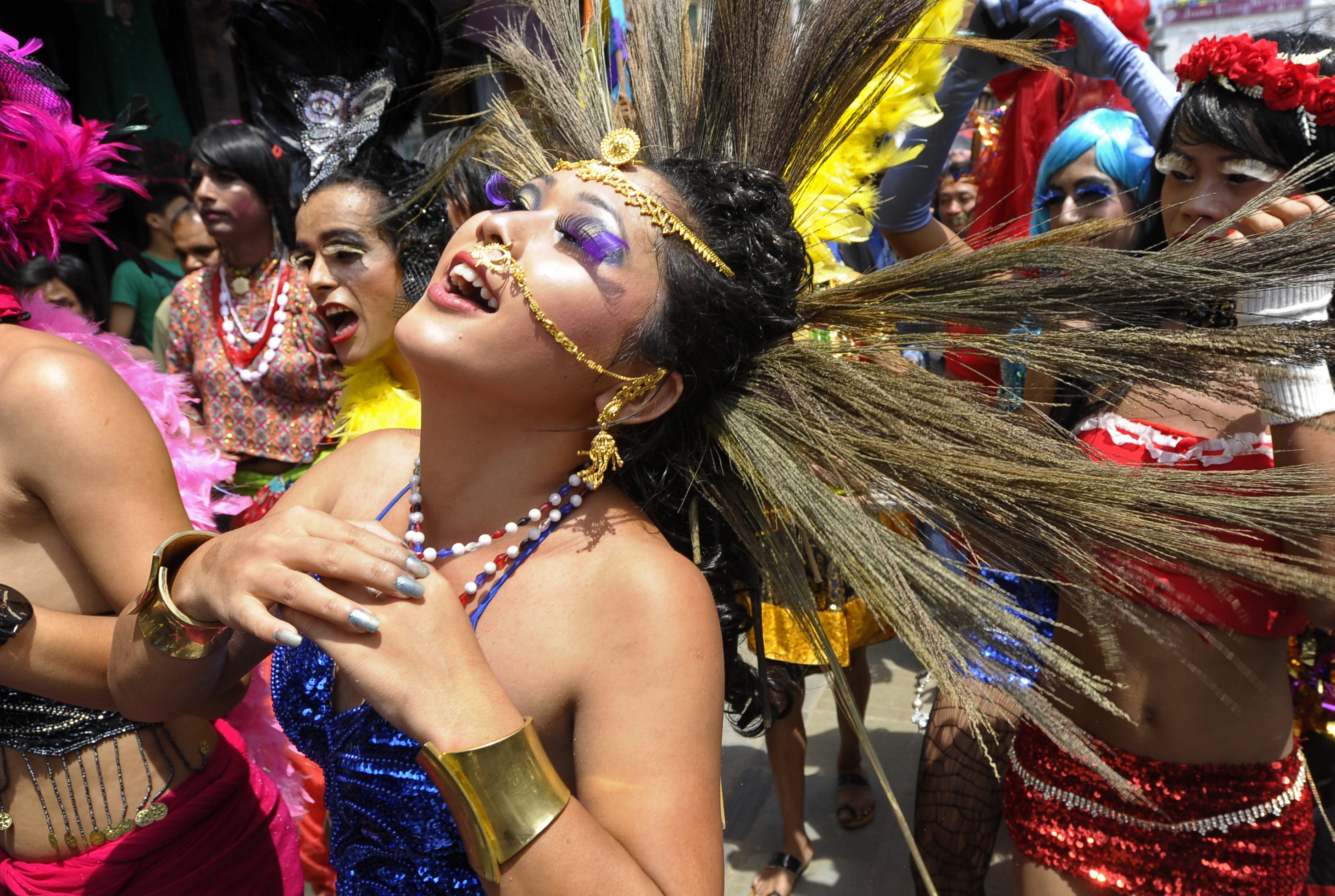
On the above photo:

Participants dance during Nepal’s 4th International Gay Pride parade in Kathmandu on August 22, 2013. Scores of gays, lesbians, transvestites and transsexuals from across the country took part in the rally to spread their campaign for sexual rights. By Prakash Mathema/AFP/Getty Images.

On that note, a reader writes:

India and the places that Hinduism has spread [such as Nepal, whose population is 81% Hindu] are remarkably progressive with respect to the transgendered. It probably has something to do with the prevalence of transgendered characters in the Hindu mythic tradition.

How Gay Is Russia? Ctd

by Chris Bodenner

27liberation1939-1

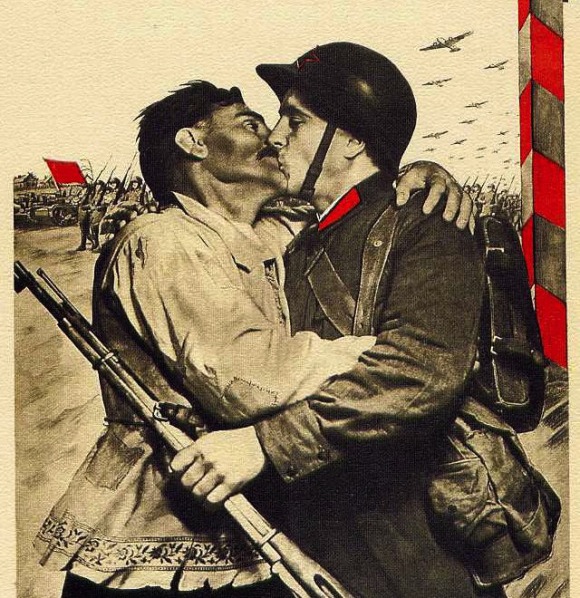
A reader sends a “great image to add to the thread”:

It’s a WWII-era Soviet propaganda poster commemorating the Soviet occupation of Western Belarus, liberating the region from Poland as a result of the Molotov-Ribbentrop Pact. The image you see is being played completely straight, so to speak; Stalinist propaganda in 1939 was NOT the place to be subversive.

Another:

To the reader who said that Russia was until recently less homophobic society than America … wow. I will defer to his personal experience, but then I should share my own, because I wonder how much of his is Moscow-based (and if it’s just Moscow, the apt comparison would be NYC, not “America”.)

I’m straight, but on occasion I went to the one semi-underground gay bar that any of my gay-heavy, Western European circle of friends could find in St. Petersburg in 2002. (This is the country’s second city, mind you.) Two years later I taught HIV/AIDS education in the capital of one of the wealthiest Russian provinces, and the open and vitriolic homophobia displayed by the high school and college kids was intense. I was back there for many months in ’07 and it hadn’t disappeared. All my Russian friends were well-educated: doctors, journalists, judges, etc. The level of homophobia on display was, again, intense.

Maybe Moscow’s different; I wouldn’t know. But I can certainly say that my experiences in the provinces and Petersburg don’t match up with your reader’s.

Does Birth Order Matter? Ctd

by Chris Bodenner

A reader writes:

One point about the arguments you’ve posted so far: They all seem to operate from the assumption the family dynamic is a closed system absent of any outside influences.  That certainly isn’t our experience. With two working parents, our daughters spend a good deal of time with the sitter and her three boys (all older than our girls).  My first born might be that at our house, but she’s the fourth during the day, Monday through Friday.  My wife and I are certain she modeled eating, walking, potty training and many other developmental milestones off of her weekday siblings’ examples. We are grateful for this because it made our lives much easier as first-time parents. But if someone was evaluating her birth order and the impact on her development, temperament, personality, etc. they’d get it all wrong without that additional background about her upbringing.

Thanks for the great blog.  It’s a godsend for busy parents who don’t have a ton of time but still need a helpful filter and fresh perspective on the day’s news.

An expert weighs in:

There are hundreds of studies looking at the effects of birth order, mainly because it is among the easiest parameters to ask a test subject on a questionnaire. Effects ranging from long-term income to personality type get assigned to birth order. Unfortunately, most of these studies suffer from two major flaws, outlined in Welcome To Your Child’s Brain. The first issue is:

who answers the survey? If you ask family members about each other, they answer in terms of their relationships. Mothers tend to think their older children are more responsible, and their younger children are more rebellious. Well, duh – this is the relationship between siblings. In studies where the evaluator is a non-family member, these effects go away.

The second issue is more subtle: every family with children has a firstborn, but only multi-child families have later-borns. So on average, later-borns come from larger families – and therefore have fewer resources per child. Once this socioeconomic confound is removed, many more effects go away.

After all this, one remaining factor that remains significant is theory-of-mind, a measure of empathy. Younger siblings acquire theory-of-mind before older siblings, by about 6-8 months for each older sibling. Reasons might include having a sibling to emulate, or having to understand the motivations of others to compete for resources. This does not necessarily mean more intelligence – but it might mean more empathy.