Not From The Onion

by Chris Bodenner

Wow:

The latest survey from Democratic-leaning Public Policy Polling, provided exclusively to TPM, showed an eye-popping divide among Republicans in the Bayou State when it comes to accountability for the government’s post-Katrina blunders. Twenty-eight percent said they think former President George W. Bush, who was in office at the time, was more responsible for the poor federal response while 29 percent said Obama, who was still a freshman U.S. Senator when the storm battered the Gulf Coast in 2005, was more responsible. Nearly half of Louisiana Republicans — 44 percent — said they aren’t sure who to blame.

Update from a reader:

This is clearly an opinion poll designed by liberals to generate headlines. If the poll question was written in good faith, there would have been more than two options and those options would have only included people who were directly involved with the response to Katrina, including the governor and the mayor. As stated, the question amounts to “Whose fault is it that New Orleans was devastated: A guy you like or a guy you don’t like?” I would assume that most of the people who answered “Obama” either meant “Democrats in general” or “screw you for asking such a slanted question.”

It still shows how partisan hatred trumps everything else.

Does Birth Order Matter? Ctd

by Chris Bodenner

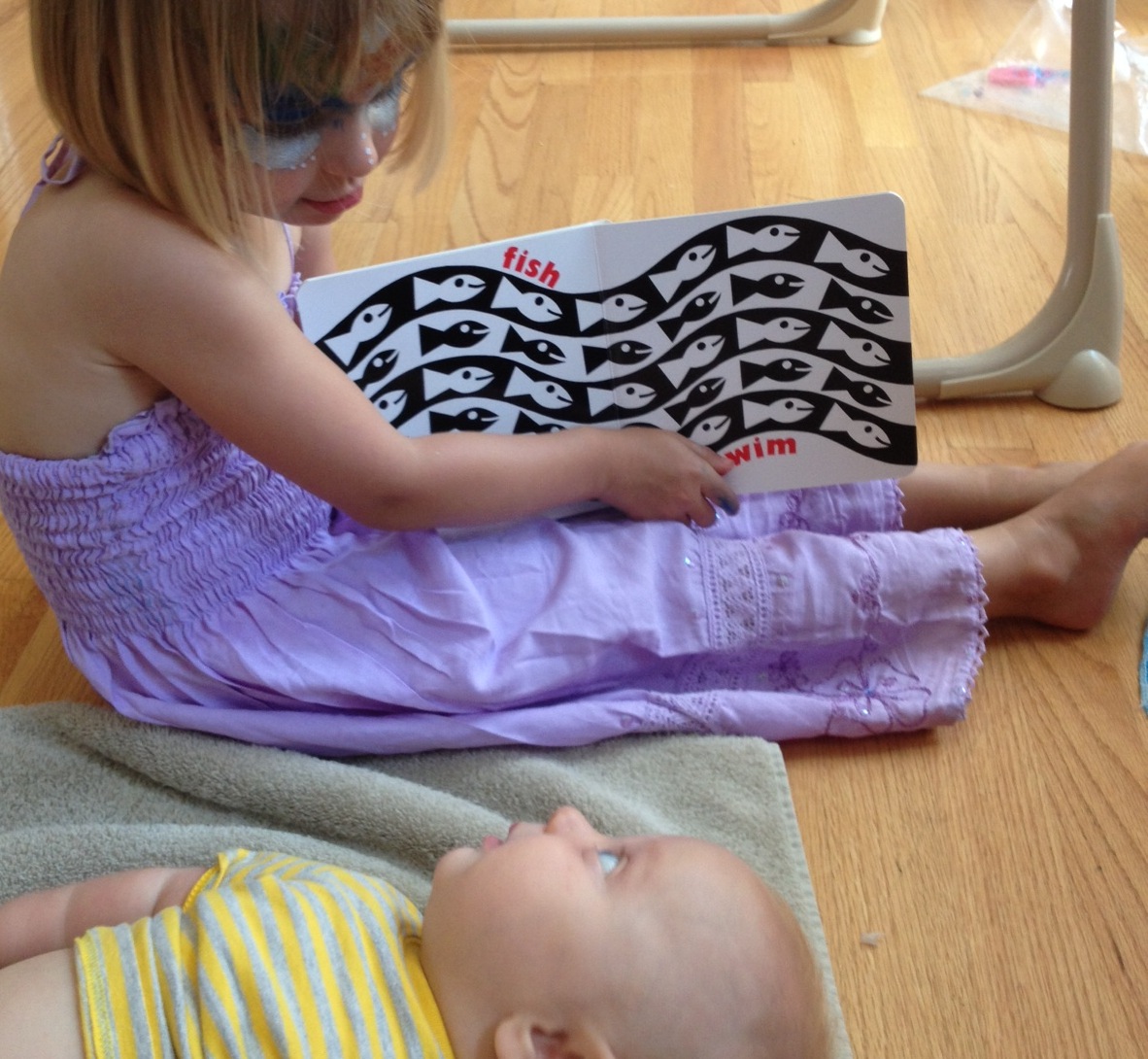
freya-readingto-henry

A reader responds to a recent post:

I can’t cite a source, but during my pediatric residency, I was taught that younger siblings learn a lot from their older sibs.  For example, a 12-month-old girl watches her 3-year-old brother walking and figures out how to walk. Oldest children don’t have anyone to pattern that behavior (adults don’t count), so they have to figure everything out on their own.  This makes for enhanced brain development and thus higher intelligence.

Another reader:

I recently read in Jena Pincott’s Do Chocolate Lovers Have Sweeter Babies? about a nature, rather than nurture, explanation for why first-borns tend to be more intelligent. Apparently, women store omega 3 fats in their hips and ass throughout their lives. When their first baby is gestating, the baby absorbs a lot of these stored fats to help make their brains plump and active. The first baby gets the most, as the mother usually doesn’t have enough time to accumulate that much more in omega-3s between children. (This also may be one explanation for why “mom butts” tend to be a little flatter).

I relay all this as a second-born sibling (whose older brother is certainly smarter in many ways) and a pregnant woman (who is eating her weight in omega-3-rich fish during pregnancy).

(Photo of my niece and nephew by Betsy Bodenner)

When Help Is Not A Choice, Ctd

by Chris Bodenner

In response to a recent post on the ethics of mandatory psychiatric treatment, a reader shares her story:

My brother is schizophrenic. But he’s one of the lucky ones. He has a very involved family, an incredible psychiatrist, and is on medication that works for him. He’s finishing up college. He has a job and a fiancee. Fingers crossed, he’s going to be able to have the sort of normal life that seemed impossible when he first started hearing voices eight years ago.

He never would have reached this point if my family hadn’t managed to involuntary commit him twice. The first time was in the U.S. He was a college student being supported by my parents, but counted as an adult when it came to medical care. Luckily for us, as he’d made suicidal statements, a very understanding judge considered him “a danger to himself” and had him committed and forcibly given medication.

The second time was in Egypt. He was a college student there. His medication made him so exhausted the entire time that he hated it and thought he could safely stop taking it. He relapsed, my sister and I flew to Cairo to track him down, and had him forcibly committed to a private clinic. I signed the papers. It was easy. It’s the only time I’ve ever been thankful for a country’s lack of civil liberties laws.

He was put on a new medicine, which works and doesn’t have the terrible side effects. He’s been sane for five years now, and is very responsible about managing his illness. Now he has complete personal autonomy when it comes to his medical care.

But that’s the point. If someone is in the middle of a schizophrenic episode, they don’t have autonomy over their thoughts, senses or actions. Forcibly putting a person on medication isn’t taking away their autonomy; it’s restoring their autonomy. By committing him, we gave him back his sanity and his personal autonomy, and almost certainly saved his life. It was the best thing my sister and I have ever done.

(Incidentally, he was a very heavy pot smoker as a teenager. And then he moved to hash when he was in Egypt. Our family has a history of severe mental illness, so he was genetically predisposed, but I definitely believe that marijuana contributed to him developing full-blown schizophrenia. I only smoked pot very occasionally in college. I haven’t touched the stuff since my brother became ill. It now terrifies me.)

Previous Dish on cannabis and schizophrenia here.

A Shooting Victim Against Stop-And-Frisk, Ctd

by Chris Bodenner

A reader writes:

A few years ago I was attacked and beaten unconscious on my street in Brooklyn. I was set upon my three young black men, one armed with a pipe and wearing, yes, a hoodie.

During the attack, another man came to my aid. He saw the attack, rushed in and received a blow to the head with that same pipe for his trouble. But this man, a complete stranger to me, made enough noise and drew enough attention that my attackers fled.

Brian Beutler is correct to say that I can’t draw a conclusion from the fact that the only person who has ever attacked me was a young black man wearing a hoodie. But here’s one fact I can add: The only person who has ever rescued me from a street attack was a young black man wearing a hoodie.

Sadly the story of the Australian baseball player randomly targeted in Oklahoma didn’t end nearly as well. Update from a reader with another story:

I lived in the Bushwick neighborhood in Brooklyn for 7 years, moving promptly after a group of black boys in hoodies attacked me on my way home from work.

It was 6:00 PM and the same few blocks I walked for years with no incident. As I left the subway exit, the boys were ahead of me, and since I am a fast walker I passed by them. Bam! One punched me in the face, they all jumped me, stealing my iPhone (I fought back enough that they didn’t get my bag or wallet, and when the other commuters approached they ran). I walked away, which I consider lucky.

What surprised me most was the most common reaction amongst my friends and family: “Why when you saw a group of black boys did you not cross the street? Why would you pass them?” My reply was usually, “If I crossed the street every time I saw a group of black kids, I’d never get anywhere. I live in Brooklyn!”  That night there was a snowstorm leaving about two feet of snow, and in the morning I went to dig my car out so I could look at places to live outside of the city. I was approached by two black kids in hoodies and shovels.

They offered to dig my car out so long as I paid them, as they did a few others digging themselves out. I felt in that moment I had a choice. I honestly didn’t know if these boys were two of the gang that jumped me. I was jumpy enough I could have told them to get lost. Instead, I thanked them for their help. Noticing that one of them was using a heavy coal shovel instead of a lighter snow shovel, I gave him some extra money and told him to buy a better shovel.

I was traumatized by what happened the night before, but if I didn’t accept their help, I felt like I’d be like all those people who told me to assume any group of black boys in hoodies were thugs. I refused to lump all “black boys in hoodies” together. These kids were out trying to earn money, not steal it.  I refused to believe that was true. I wonder sometimes if maybe they were part  of that gang, or knew the kids who were. It doesn’t matter I suppose, but I do feel good about maintaining my integrity. I can say that what happened didn’t make me prejudiced or cynical, because if it did, then those boys who jumped me would have taken much more than my iPhone.

The Best Of The Dish Today

by Chris Bodenner

Readers scrutinized the outrage from Greenwald and Andrew over the detention of Glenn’s partner at Heathrow airport. Ambinder also criticized the use of Miranda as a courier, but Andrea Peterson came to Glenn’s defense. Regardless of Miranda’s role, the destruction of Guardian computers by UK officials was unconscionable.

Over to Egypt, Adam Shatz sensed a counter-revolution, Douthat reassessed the realpolitik approach from the US, and Bobby Ghosh questioned our preoccupation with the country in the first place. Meanwhile, Qatar-based Al Jazeera debuted on American shores.

Despite getting shot by black teenagers in hoodies (coincidentally on the same dangerous block next to Andrew’s apartment), Beutler refused to let the trauma affect his opposition to stop-and-frisk. Bouie and Chait criticized felony disenfranchisement laws and voter ID laws. Readers continued to share stories of their grieving pets.

The VFYW contest was particularly tough this week, and the daily VFYW was particularly popular on Facebook. Brendan James thought through the antihero trend among serial TV dramas like The Sopranos and Breaking Bad (a cinematographic tribute of which is seen above).

In case you missed Andrew’s parting thoughts from Sunday night, they’re here.

Face Of The Day

by Chris Bodenner

NEPAL-SOCIETY-ELDERLY-AVIATION

Nepalese man Bote Rai, 106, is pictured in his window seat of a Yeti Airlines aircraft after flying for the first time during his arrival at the Kathmandu airport on August 20, 2013. Airline officials said they sponsored Rai’s flight after reading in a local Nepali newspaper about his wish to fly on an aircraft. Rai, who has hearing problems and lives with his 75-year-old niece in remote Dhankuta district in eastern Nepal, will spend a day in Kathmandu and visit the Pahsupatinath Temple before flying out to Biratnagar, the nearest airport from his home. By Prakash Mathema/AFP/Getty Images.

Sizing Up A Sociopath

by Chris Bodenner

Prospero offers a brief review of M.E. Thomas’s memoir Confessions of a Sociopath:

Ms Thomas is the pseudonym of a female law professor who is also a confirmed sociopath (as confirmed as it gets, at least, in a field of notoriously murky assessment tools: she says she was diagnosed by a professor of psychology who is also a leading researcher in the field). Blending autobiography, anecdote and research, her book is less juicy for its content than for its writing style, which amounts to an uncut expression of a sociopath’s distinctive traits. There is bombast: Thomas compares herself to God, a lion tamer and a revolutionary soldier, and observes, “I have remarkably beautiful breasts”. There is calculation (“Unless I am actively trying to convey a particular message or to seduce I would rather not talk to people”). There is deceit, presumably: Thomas claims to have averaged a 9.5% stock market return since 2004. And there is plenty of charm, too.

Some advice culled from the book:

Rule #3: The best lawyers are (probably) sociopaths

“Sympathy makes for bad lawyering, bad advocacy, and bad rule-making,” Ms Thomas writes. Sociopaths are free of this burden. They are also, she says, excellent at reading people (useful during jury selection), immune to performance anxiety (useful during trial) and craftily seductive (useful for persuading juror and judge alike).

How to apply to your own life: When in need, seek sociopathic counsel.

The Nanny State Leaves Nannies Alone, Ctd

by Chris Bodenner

This embed is invalid


A reader writes:

There is a grain of truth in the Forbes article you linked to.  But it leaves something out.  Yes, whether an occupation is licensed depends to some extent on the organizational power of the incumbents.  But here’s a more important reason not to license nannies: What a rational person is looking for in a nanny is not knowledge or training, but aspects of character – kindness and responsibility, mostly.  No one is in a better position to asses those traits than the potential employer (by personal observation and by checking references).

The situation with respect to doctors is a little different.  The only people capable of assessing the capabilities of brain surgeons are … other brain surgeons.  So unless we are going to let anyone with a hacksaw and power drill set up in that business, we don’t have a choice but to let the doctors regulate themselves (despite whatever abuses that might entail).

Another reader:

I read your post this morning and found it so hard to believe that someone concluded from the market for nannies that all occupational licensing is a sham, I had to click through. But indeed that is what Pascal-Emmanuel Gobry says. Now that I’ve picked my jaw up off the ground, I have to respond.

I have two kids, now 13 and 10, and I hired several full-time nannies during the years they were younger.  I also am a law professor who teaches, among other things, employment law and classes on work and family. So I know something about all of these issues both personally and professionally. To take Gobry’s big point first:

There are large and obvious differences between hiring a nanny and hiring other kinds of professionals. For example, expertise. I am an expert on my children, what I want them to be fed, their basic schedule, approaches to discipline, etc. And while hiring a nanny to spend hours alone with your tiny baby is incredibly stressful – and I sympathize with Gobry and his wife on this – the reality is that the employer in this situation is pretty well able to monitor the employee, even in the absence of a nannycam (which I never used).

Indeed, the fact that the consumers in this market – the parents – are relatively well-educated and well-off, and are particularly well-educated and well-off relative to the people they are hiring, means that they have the resources to do the relevant monitoring, both before and after the hire.  In my opinion, the two most important things I do in hiring a nanny/sitter is (a) check references and (b) take them for a test drive.  (The test drive is not so much that I think I will learn a lot about their driving abilities – although I have ruled some people out because they were so clearly inexperienced behind the wheel – but because while they are concentrating on driving safely, they let down their guard a little bit and I get a better sense of who they are.)

All of this takes time – a lot of it – and other resources, such as the ability to communicate effectively with former employers, including the ability to answer the phone when they call me back – a luxury many working people do not have.  In other words, I am remarkably unpersuaded that that the fact that parents like Gobry and me have not chosen to use our social and political clout to require professional licensing for nannies tells us anything one way or the other about professional licensing in other contexts.

In fact, the power disparities in the market for nannies is unusual in other ways as well.  When I was hiring full-time nannies, agencies routinely told me that they literally could not send me candidates who were both legal to work in the US and willing to have me do Social Security and Medicare withholding, both of which are legal requirements for household employees.  (Do not assume that my desire to hire only legally employable folks reflects my approval of our immigration laws.)  Because the work of full-time nannies is so badly paid and because many of the arrangements are illegal, the consumers in this context have way, way more power, both economically and politically, than the nannies themselves.  The consumers like it that way.  Why would they want to encourage professional licensing under these circumstances?

Think about other benefits like overtime (not necessarily legally required for household employees), vacation pay, and paid sick leave.  Most nannies do not get these benefits, and yet most people who have nannies would never take a full-time job that did not provide for paid-time off.   (For the record, my husband and I provided all of these benefits to our full-time nannies.  And it really bothered me that I could not figure out how to provide health insurance – something I probably should have tried harder to do.)

None of this is to suggest that I think all other professional licensing is appropriate or necessary.  Gobry is right that at least one effect of such licensing is to create barriers to entry that protect those already in the profession and keep prices up, and in some situations those may be the only meaningful things that professional licensing does.  (Indeed, there are some pretty good arguments about this with respect to some of the kinds of work that lawyers currently have monopoly power over.)  But to draw his absolute conclusion about professional licensing generally is bizarre.  Does he expect to be able to do what he and his wife did in hiring a nanny when they are faced with, for example, (a) a plumbing or electrical emergency in their home; (b) a legal or medical problem that must be addressed right away; or (c) an urgent need for a locksmith, or an auto mechanic?  And even if he would be willing to do that, does he think that everyone has the time and resources to do so? Is he willing to trust that all hospitals and nursing homes and drug stores, for example, would vet their nursing and medical and pharmacy staffs well enough?

Obviously, professional licensing is no panacea, but in situations where the consumers have less expertise than nanny employers do, have less market power and other resources, have significant time constraints, and/or have to rely on a middleman to do the actual hiring and monitoring, there is a lot to be said for some minimum standards.  Just like there’s a lot to be said for some meaningful regulation of entities like banks.
Cameron Proves Greenwald Right, Ctd

by Chris Bodenner

Contra Dish readers, Andrea Peterson insists that “no, Glenn Greenwald didn’t ‘vow vengeance'”:

Greenwald’s point seems to have been that he was determined not to be scared off by intimidation. Greenwald and the Guardian have already been publishing documents outlining surveillance programs in Britain, and Greenwald has long declared his intention to continue publishing documents. By doing so, Greenwald isn’t taking “vengeance.” He’s just doing his job.

We linked to Greenwald’s defense here. Ambinder’s take on the detention of Glenn’s partner:

I don’t like how the Guardian put Miranda on its payroll, turning him into a courier of sorts and conferring on him the patina of the legal and traditional protections afforded to journalists. That’s sloppy tradecraft and it’s cruel to Miranda.

Doing journalism makes you a journalist. As Joshua Foust points out, the transitive property does not apply. (I am not a corporate strategy consultant, and I would not be one if my spouse’s company suddenly paid for me to fly stolen documents to my husband somewhere.)

Greenwald is doing real journalism. If extra protections are afforded, they are afforded to him. If extra scrutiny is warranted, he should get it. I know the Snowden case is a boundary case, that it is of an echelon that other leak cases are not and that there are real first amendment equities involved. I also know that the government takes leaks of this magnitude — and consider the totality of what’s been leaked and what precedents it sets, not just the stuff we like (the U.S. stuff), but everything — terribly seriously. As all governments do, and have done, and will do. A separation between spouse and source is a foundational principle of how reporters approach complicated stories involving secrets and classified information. IF you do choose to involve your spouse, or you and your spouse work together, then you cannot reasonably complain that your partner was harassed for no reason whatsoever. Decisions have consequences.