Choosing Suicide For Your Birthday

by Chris Bodenner

Several readers are seizing upon this story:

Sports journalist Martin Manley, who left the Kansas City Star in early 2012, killed himself in front of a police station on Thursday on his 60th birthday. He left a website that explains his decision making. The gist: he didn’t want a slow lingering death in nursing homes or heroic battle with cancer that he would ultimately lose. He wanted to control his death – every detail.

And that’s one thing I haven’t seen discussed on your great thread about suicide – the need for control. I think about suicide all the time; I have for years. That troubled me until I realized it gave me a sense of control. I, like Manley, am single, in my 60s and have no desire to deal with a lengthy illness or long-term care. Unlike Manley, I’m also broke. And for me, the idea of ending my life is a great comfort. But, of course, it has to be my little secret.

It’s called rational suicide, and I think it will be part of the legacy of the Boomers. We’ve got to get a national conversation going about the need to let people who are at the end of life, have some control about ending their life. Thanks for helping make that happen.

Another reader:

Now that Yahoo! has taken down his site and his sister is battling them to put it back up, I think it’s appropriate for you to add this to your suicide thread: I wish he’d been able to choose some other sure method that would have been less dramatic.

This would require a major shift in how we think about death. We’d have to accept that there are some people who can cooly, dispassionately decide that it’s their time to go, while others will fight to survive for as long as they can – and that both are valid choices. A system that accommodated that, and treated the person choosing suicide with respect rather than as a danger to himself who must be stopped by any means possible, could include counseling to ensure that the choice wasn’t being driven by depression or influence from third parties. The longer we force people to be furtive about it and shame surviving families into silence or into condemning the loved ones they have lost, the worse it is for everyone.

I hope the sister wins her battle. I still have not read his entire website, but what I’ve read presents an interesting and complex picture – neither a hero nor a coward. He had concerns that are not unlike the concerns of others at his age. But to me, his choice doesn’t seem radically different from that of my aunt when she decided not to undergo radiation for breast cancer for a third time. She died within days of the date the doctor said she would upon making that choice, and, of course, it was unclear whether what finally did her in was the cancer itself or the increasing doses of morphine she was taking to counteract the pain.

I respect her decision, as I do Manley’s. I just wish he hadn’t been in a situation where he felt his best option was a police parking lot.
Pogonophiliacs Unite! Ctd

by Chris Bodenner

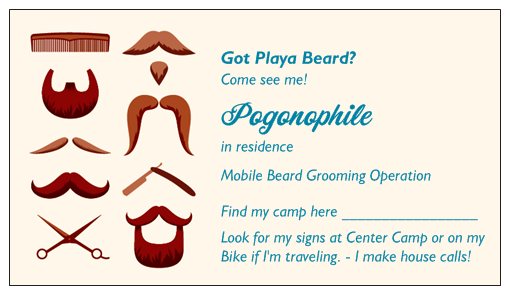
Pogonophile In Residence Card

A reader sends the above image:

In anticipation of Burning Man’s philosophy of gifting, I’m combining my pogonophilia with a free service to all the bearded Burners.  I’m sure your beard will be well cared for, but if you or anyone you know is suffering from “Playa Beard”, feel free to pass along the attached card. I’ll be setting up a part-time operation at Center camp, opening my own camp to beards of all types and even operating a mobile service while passing out cards and performing “house” calls.

Another counters Andrew’s call for letting your facial hair grow:

Why do you get haircuts? Why not just let it grow?  Maybe folks shave the same reasons some people get haircuts. To them, it looks more presentable.

And along those lines, why trim a beard? Another reader:

Oh, the horror of a guy shaving everything – including the pubic area. Do those same male hair lovers (the hetero kind) like women hairy as well? Or do they pride the “hairiness” for males, but females need to shave? Could you delve into that some more? I don’t know – I’m just a curious hairy lesbian …

She should check out the long-running Dish thread, “Why Should Women Shave?” Meanwhile, many readers sound off on a shorter thread of late:

There’s another possible reason why Gillette’s Mach-3 sales are falling. It may well be that the shaving public is getting tired of paying a premium price for their product.

I’m going to be buying razor blades whether I grow a beard or not, since I also shave my head. For years, I was a loyal Gillette customer. The design of the Mach-3 and its follow-on, Fusion, is brilliant. The placement of the hinge is key. It allows you to follow the contours of your face, head, whatever with minimal applied force to the skin.

But that comes at a cost. The cartridges are damned expensive. While they were the only game in town, we paid up. But …

What’s happening now is that the down-market manufacturers are beginning to catch up. Recently, I’ve switched to Wilkinson razors. They’re about as good and the blades are half as expensive. For me that’s an easy choice, beard or no beard.

Another reader:

Some have succumbed to the lure of the old, aided by Reddit. My 22-year-old son bought an old-fashioned razor off the internets, followed the reddited instructions for sanitizing it, and now he shaves with Italian tube shaving cream and a brush. While he has nothing against beards, his would still be a bit scraggly and sparse. But he’s also not supporting the mainstream razor market.

Another Redditor:

Eighteen months ago I bought a Merkur safety razor, a badger hair brush, shave soap, an alum block, and 100 blades, all for around $80. I’ve replaced the soap only, and only once, in that time. The razor and the brush will last indefinitely. At my current rate of shaving (roughly twice a week), it costs me maybe $15 a year to shave. Once one learns how to properly use them, the blades are as comfortable as any multi-bladed contraption. They’re easy to clean and worth several reuses. A straight razor is even more economical, though I found in my own experiment with a straight that I don’t have the patience to learn it.

Reddit has a community of 40,000 dedicated to old-school shaving. It’s just slightly smaller than the one committed to beards.

One more reader:

I pray every day that we have yet to reach peak beard.  This video from a few years back featuring Gavin McInnes (of Vice fame) perfectly captures my predicament (NSFW):

My dear friend and I both suffer from the tragedy of the weak chin.  The era of stubble and bears being acceptable in the workplace was a godsend.  Finally, we could conduct business in the office without looking like Kenneth the Page.  I have not bought a razor in years and I hope society never compels me to do so again.

When Animals Grieve

by Chris Bodenner

A reader responds to Andrew’s latest post about his dogs:

First, thanks for sharing the story about Eddy’s delayed grief for losing her friend Dusty. I thought I’d share a story about when I lost one of my two cats many years ago. Molly was really the first cat I owned (my mom didn’t like cats, so we grew up with dogs). I was renting a small house and took in the stray who stayed there; it was easier to give Custard a home rather than cleaning up the mess he made of the trash cans. While Molly and Custard generally got along, they never seemed particularly close.

Then one day, I was going out of town to visit some friends in New Orleans for a week, so I made arrangements for a co-worker to feed Molly and Custard while I was gone. On my first day in New Orleans, I got a call from Steve – he had gone to feed the cats and found Custard dead. I never learned what happened, but Custard sometimes had the habit of his former stray self and would stuff himself when he had a really large bowl of food and would later vomit. I had a feeling that is what happened, and he probably choked on the extra food he had consumed. Steve very generously offered to bury Custard.

When I got home, I emotionally prepared myself for the loss of one cat but I suspected no emotional response from Molly. After all, cats never gave you any sympathy when you needed it. When I got home, I found a house with no cats and a note from Steve. He said that Molly had gotten away from him and escaped from the house. She then watched him bury Custard from a distance.

He returned a couple of times and left food on the porch but didn’t see Molly. I also didn’t see anything of her the night I got back, but she was at the door early the next morning. The first thing I noticed were that her front claws were completely worn down, and there were marks on the ground where Steve had buried Custard.

She had spent some time digging at the spot where her friend had been buried. My idea of having a cat who paid no attention to Custard’s death was completely wrong. Molly was clearly upset, and my formerly tough, independent cat kept very close to me the next few days. While she eventually calmed down, this represented a permanent change; she spent the rest of her life being much more dependent on me because of the loss of Custard. There clearly had been some deep bond between them I had never perceived.

I’m old enough now to have experienced the death of several pets – dogs in childhood, cats since I’ve been on my own. Dogs and cats can bring a tremendous richness to our lives – it’s just unfortunate we have to experience the pain of their deaths. I hope that you and your husband will take care of each other, along with Eddy, and perhaps consider adopting another dog when your hearts tell you it is the right time.

Another reader remarks on the unparalleled company that pets often keep:

I care for two dogs, brothers/littermates, now just over 10. They have literally never spent a night apart (although at times have slept in different rooms). It is almost unheard of them to not both go on walks at the same time. The only time they are separated for any time is when one or the other goes to the vet.

I live in dread of the impact of the loss of one on the other. They have different personalities, and I can see them reacting differently, but I know the survivor will show grief and possibly worse (if already aged, I think it could speed the process). As much grief as I’ll be feeling, the most important thing I can do at that point is to be there for the surviving brother.

The post that sparked this thread – a reflection on Barbara King’s recent book, How Animals Grieve – can be read here. The long and emotional thread “The Last Lesson We Learn From Our Pets” can be found here.

Don’t Lose Sleep Over Sleepovers, Ctd

by Chris Bodenner

A reader writes:

Marcotte’s Dutch example of more progressive attitudes toward teen sex is not unique to the Netherlands. When I was living abroad, a German friend explained to me that when she and every other girl she knew growing up turned 16, their mothers would take them to get birth control pills. It was entirely permissible for her to have a boyfriend spend the night and have sex with him in her parents’ home. In fact, she said, her parents would probably be concerned if she had a boy over and they DIDN’T hear them doing it. It’s worth noting that this young woman was not the daughter of freethinking hippies, but rather straight, conservative Bavarian Catholics; her dad is a cop and her mother is a theologian (yes, really). She always said she couldn’t understand why American parents were so afraid of their teenage children having sex. As a matter of simple logic, it just didn’t make any sense to her, given how many of them end up pregnant, with STIs, or in unhealthy relationships as a result of having no guidance on the subject.

Ferrett Steinmet focuses on the father-daughter dynamic:

There’s a piece of twaddle going around the internet called 10 Rules For Dating My Daughter, which is packed with “funny” threats like this:

“Rule Four: I’m sure you’ve been told that in today’s world, sex without utilising some kind of ‘barrier method’ can kill you. Let me elaborate: when it comes to sex, I am the barrier, and I will kill you.” All of which boil down to the tedious, “Boys are threatening louts, sex is awful when other people do it, and my daughter is a plastic doll whose destiny I control.”

Look, I love sex. It’s fun. And because I love my daughter, I want her to have all of the same delights in life that I do, and hopefully more. I don’t want to hear about the fine details because, heck, I don’t want those visuals any more than my daughter wants mine. But in the abstract, darling, go out and play.

Another reader:

Slightly off topic: A gay couple I know has an elementary school-age son and daughter who have lots of friends and who adore their parents. The couple is also popular with neighbors and fellow school parents.  The daughter has girlfriends on sleepovers as often as the other girls – meaning all the time. But an awkward and sad problem: The fathers of the boy’s friends, as much as they get along with the two gay fathers, refuse to allow their boys on a sleepover at the gay men’s home. So the boy gets no sleepover parties like his sister and friends get.

Throatlump.

Joking About Suicide, Ctd

by Chris Bodenner

A reader writes:

I actually think the premise of Amy Schumer’s joke is pretty funny, but it might be funnier if the guy arrives at work Monday and gets called on the carpet for not finishing his work. Of course he didn’t expect to be there, but it turns out this is hardly a new issue of his; he apparently never finishes anything he starts. “You need to develop some stick-to-itiveness, son! You need to follow through to the end!”

Another presumes that Comedy Central killed the joke because it was too skittish about the subject:

There’s no place left for black comedy, I guess, in our timid times. Both MASH and Harold and Maude mined suicide to terrific comedic effect, the latter making suicide both the driver and climax of the movie. Within a year or so of those two movies, Ruth Gordon (Maude) also starred in the hilarious and pitch-black Where’s Poppa? We are poorer for our earnestness.

Below are several more cultural references and links from readers:

Another sterling example of suicide played for laughs is the sequence in Groundhog Day, in which Bill Murray, in a fruitless attempt to escape his endlessly repeating day in Punxsutawney, tries over and over to kill himself. In this particular context, suicide is funny indeed. It’s only one of the many elements that makes Groundhog Day a classic film comedy and one of very few movies that succeeds in using suicide in a humorous way (and yet with a poignant touch).

Another:

I’m probably not the first to email the “Bruce’s Cry For Help” skit from Kids In The Hall, but in case you haven’t seen it, it’s a chuckle (2:00 is the one laugh-out-loud moment for me):

Another:

Oh my gosh, you can’t consider suicide humor with Joan Rivers, who began making jokes about her husband Edgar almost immediately after he took his own life. She has continued to so, and it was a theme of her roast.  Not too long ago, she made Terry Gross almost speechless with her comic references to it.

Update from a reader:

How can any discussion of joking about suicide not include “The End?” Burt Reynolds was at the height of his powers, and bearded:

The Best Of The Dish Today

IMG_5483

Andrew popped on the blog today to praise the better-late-than-never endorsement of medical marijuana from Dr. Sanjay Gupta. And his hope in the Francis-led Vatican deepened following the resignation of one of its most homophobic Bishops. A few more quotes in honor of Dusty here and here.

During today’s slow news cycle, we weighed the pros and cons of boycotting the Olympics in the face of Russian anti-gay laws and kept tabs on the diplomatic rift between Putin and Obama. As the demand for journalists actually increases these days, bloggers continued to envision what a Bezos-led WaPo could look like. The last post of the day, on the beliefs of scientists, is already taking off on Facebook. And just when you thought US prison statistics couldn’t get more startling, they do.

Get your latest fix of airplane views from readers here. Today’s regular VFYW – from the Wadi Rum Desert in Jordan – was anything but ordinary. And we marked the end of Ramadan with a boy’s quizzical face.

— C.B.

The Best Of The Dish Today

sidewalk-heart

Hey this is Chris, filling in for Andrew on the wrap tonight. To understand why, read about the passing of his beloved Dusty here and here. Thanks to the hundreds upon hundreds of you who emailed condolences this week. There’s no way we can post them all, but you can read similar sentiments on our Facebook page. And thanks to the readers who provided moving quotes about dogs here, here, and here – please keep them coming.

Foreign policy fueled the big news of the day: Obama cancelled on Putin over the Snowden affair – something Andrew had called for – and the Egyptian interim president pulled the plug on reconciliation talks. We also provided a rundown on the latest analysis of the al-Qaeda alert and kept tabs on the initial moves of the new Iranian president. The healing of the ozone layer offered a silver lining for the day.

Our most popular post on Facebook was a fascinating view of our lawns and how we abuse them. If you still need a Weiner fix, have at it. And he’s not a mermaid, but a merman!

(Photo by Chas Danner)

The Preemptive War On Paul, Ctd

Analyzing new numbers from Pew, Allahpundit finds good reason for Big Brother Republicans such as King and Christie to fear the insurgent libertarian from Kentucky – a “major swing against government surveillance among tea partiers”:

Three years ago, at least a plurality of every ideological segment except moderate Democrats thought the feds didn’t go far enough to protect the country. Three years later, nearly every segment has swung the other way. The only holdouts are moderate Democrats (oddly) and moderate Republicans. More specifically, non-tea-party Republicans tilt 41/43 towards thinking the feds haven’t done enough to protect the country; among tea partiers, the tilt is … 55/31 towards thinking they’ve gone too far in restricting civil liberties, a 35-point(!) swing since 2010. That’s what a battle for the soul of the party looks like — a double-digit spread among the centrist and conservative wings on a key point of national security.

Normally I’d dismiss a turnaround as sharp as that as driven by partisan reaction to the White House. Elect a Democratic president and you’ll see Dems warm to his counterterror program and Republicans sour on it, no matter how much it resembles the last GOP administration’s program. But Pew’s reference point here isn’t an earlier poll taken during the Bush era; it’s 2010, nearly two years into Hopenchange. This shift has happened entirely on Obama’s watch.

The Static Sport, Ctd

A reader writes:

Another reason why inactivity is an integral part of watching baseball was summed up by Robert Benchley: “One of the chief duties of the fan is to engage in arguments with the man behind him.” Watching baseball by yourself is entertaining only in proportion to your understanding of the subtleties of the game; but watching in a group or crowd inevitably turns into conversation, and it becomes the most convivial of spectator sports.

On that note, another sends the above video to defend the sport’s stasis:

At 300 feet away from the batter and the pitcher, you can have this interaction with the right fielder.

Another reader:

Here’s something that drives me crazy when people complain that there’s too much inactivity in baseball, and that it is thus boring.  There are far fewer “time outs” than people realize, especially when there are runners on base.  When the catcher tosses the ball back to the pitcher?  Time’s in.  If the catcher overthrows the pitcher, or throws it back too slowly, or the pitcher drops the ball, the runners will advance.  When the pitcher is looking in at the catcher to get the sign?  The runners can take off.  If there’s a runner on second and the third baseman is playing too far from the bag to cover a throw from the catcher?  Again, there goes the runner.

And all the while, infielders are shifting from one spot to another, to induce the runner to take too big a lead so that he can be picked off, or to hold him closer to the bag.  Plus, the batter and runners take signs from the third base coach that are flashed too quickly for spectators to take notice, and the pitcher and catcher are changing sign sequences to keep their communications secret, often with instructions from the dugout.

Nothing going on?  Bullshit.

Another:

Lowen Liu asks, “What other sport teases your attention in this way, dares you to look away, to yawn … ?” The answer is professional football.

There is almost 60% more action in a three-hour baseball game than a three-hour football game. According to a Wall Street Journal study of four games from week 16, the average NFL game features just 10 minutes 43 seconds of action. Commercials account for nearly 60 minutes of the three-hour affair. And when the networks are showing the game, the bulk of the time is spent either on replays or shots of players huddling, in pre-snap formations or “milling about.”

Another adds:

Sometimes the NFL game clock continues counting down while bunches of players or referees get together to have a chat. And then in a close game, just when the drama should be at its peak, the offensive team with a lead (and sometimes even a narrowly trailing team with the ball) is given an incentive to stand around doing nothing for half a minute every time it starts a play to run down the clock. Stand around, stand around, wait, count 35 seconds, then snap! And then 22 men spend 10 seconds sprinting maybe 40 feet each. Usually less. Then walk around a bit, get back in line, and wait for it, wait for it, have we counted to 35 yet? And repeat.

Ugh.

As a born-and-bred Midwesterner, I never questioned the constant action of the game my family watched every Sunday … until I caught games from the 1998 World Cup on TV. When the NFL season began a few weeks later, I couldn’t stop noticing, and being hopelessly bored by, the long stretches of nothingness that actually characterize the American game. Not that I became some huge soccer fan, but American football, with its endless committee meetings and appellate court proceedings and “athletes” who often play only a few dozen seconds per week, quickly became too boring for me to watch. When I kept a stopwatch of actual game-playing action a decade or so ago, I kept coming up with a figure of about 1/8, or about 88% downtime.

Don’t get me wrong – a football game is great background noise for a party. But to sit down and spend three hours paying attention? Give me a baseball game any time, or hockey, or even, yes, the one-and-a-half soccer games that can be played in the same span.

Another looks to another sport:

Lowen Liu claims that part of the beauty of baseball is the down time. So I guess Test Match Cricket, played over five days; with meal, drinks and sleep breaks in between; where attending any one day of play does not guarantee you will see all the players on the field (or even see the match reach a conclusion); and a two-hour nap wouldn’t matter a jot; then Test Match cricket must be THE beautiful game!

Of course the five-day limit is a modern adjustment – they used to play on until there was a winner.   In Durban 1939, England played South Africa for ten days, until they were forced to call it a draw because the ship was leaving to take the England team back home!  Now there’s a game with down time …