If you’ve ever wondered why some people complain of gassiness after beans, while others eat them with impunity, Roach has the answer. If you’ve never wondered, too bad; Roach is going to tell you anyway. Apparently, half of the population lack a certain enzyme in the colon that is needed to break down the complex carbohydrates in legumes. As a result, they are “troubled by beans.” When the colon inflates, releasing gas, it is a “warning system”: “Because stretching can be a prelude to bursting, your brain is highly motivated to let you know what’s happening down there.”
[I]n saliva there’s these histatins which help wounds heal. So when someone kisses a baby’s booboo, like a scrape, or when a pet licks its wounds, it’s actually – because you think oh, oh, it’s full of bacteria, don’t do that. But there’s these healing elements. Saliva was a home remedy for cuts and scrapes and shankers and things. People would apply the spittle of a – first-thing-in-the-morning spittle of an old man or something would be, like, the remedy. But there’s some medical sense to it.
Jonathan Bernstein recently argued that Obama should talk more about fighting climate change. Digby is puzzled:
I had thought the bully pulpit is not only useless, but often counter-productive, so this is a surprise to me. Ezra Klein explained it to us all in this New Yorker piece from 2012, wherein he outlined all the political science numbers-crunching that proves public opinion is fairly irrelevant to public policy and presidential rhetoric even more so. Indeed, the thesis says that while the president coming out publicly for a particular policy may be able to harden his own troops’ resolve from time to time, he also hardens the opposition against him, so government basically can only be effective through the use of backroom deals and inside the beltway politicking
[A]s far as I understand it, the data we have on public opinion and the bully pulpit are mainly about short-term effects, and especially the (non-) effects of attempting to move Congress on specific legislation by changing public opinion. I don’t think we know much, if anything (and I hope someone will correct me if I’m wrong) about long-term effects, if any. I mean, we know that Ronald Reagan didn’t make US voters more conservative during his presidency…but I don’t think we know anything about what, if any, long-term effects he might have had either on specific issues or ideology in general — including effects concentrated within conservatives. Or, to put it the other way: we could have something here similar to campaign effects in which strong professional electioneering tends to cancel out; if one side saw the minimal effects results and decided to not campaign at all, we’re fairly certain that it would create a very large effect. If Democratic presidents preach liberal ideals it might not change any minds, but if they don’t, it might fail to “educate” a generation of Democratic activists.
Mark Oppenheimer reflects on the aspects of parenting he outsources to others:
Parenting has made me painfully aware of all the skills I don’t have, all that I won’t be able to pass on to my children. Before the children arrived, the future was full of possibilities for the dad I would be: the one who would teach them to play guitar, to garden, to turn table legs with a lathe. All I had to do was learn how to play guitar, to garden, and to turn table legs with a lathe. Also to chant Torah, change the oil, and throw a football with a perfect spiral. And there was plenty of time for all of that.
But then the girls arrived, in short order, all three of them. I found skills I never knew I had, like holding an infant on my forearm, her head in my palm. I once changed a cloth diaper so deftly that my friend Derek was startled to realize it was cloth. “You did that just like a regular diaper!” he said. That was one of my proudest moments. I’ve been known to take all three girls—ages two, four, and six—to the supermarket together, pilfering only one banana and one plastic carton of blackberries to keep them in line. (Shamed by the empty carton and the empty peel, I paid up.) But for all the skills I never expected I’d have, there are more that I know I’ll never acquire.
If millions of people started using bitcoins on a regular basis, the soaring value of bitcoins would actually be disastrous. You’ve heard of hyperinflation: this would be hyperdeflation. Take a gold bar valued at $600,000. At $60 per bitcoin, the value of that bar is 10,000 BTC. But then assume that bitcoins rise in value to $600 apiece, and then to $6,000, and then to $60,000 — as would have to happen if the fixed number of bitcoins was being used to store hundreds of billions of dollars in value. Then the value of the gold bar would plunge, in bitcoin terms — to 1,000 BTC and then 100 BTC and finally just 10 BTC. The same thing would happen to all other goods and services in the world, including your own salary. Everything would be constantly going down in price, if you thought in bitcoin terms.
Inflation is bad, but deflation is worse. The reason is that in a deflationary environment, no one spends money — because whatever you want to buy is sure to become cheaper in a few days or weeks. People hoard their cash, and spend it only begrudgingly, on absolute necessities. And they certainly don’t spend it on hiring people — no matter how productive their employees might be, they’d still be better off just holding on to that money and not paying anybody anything.
The result is an economy which would simply grind to a halt, with massive unemployment and almost no economic activity.
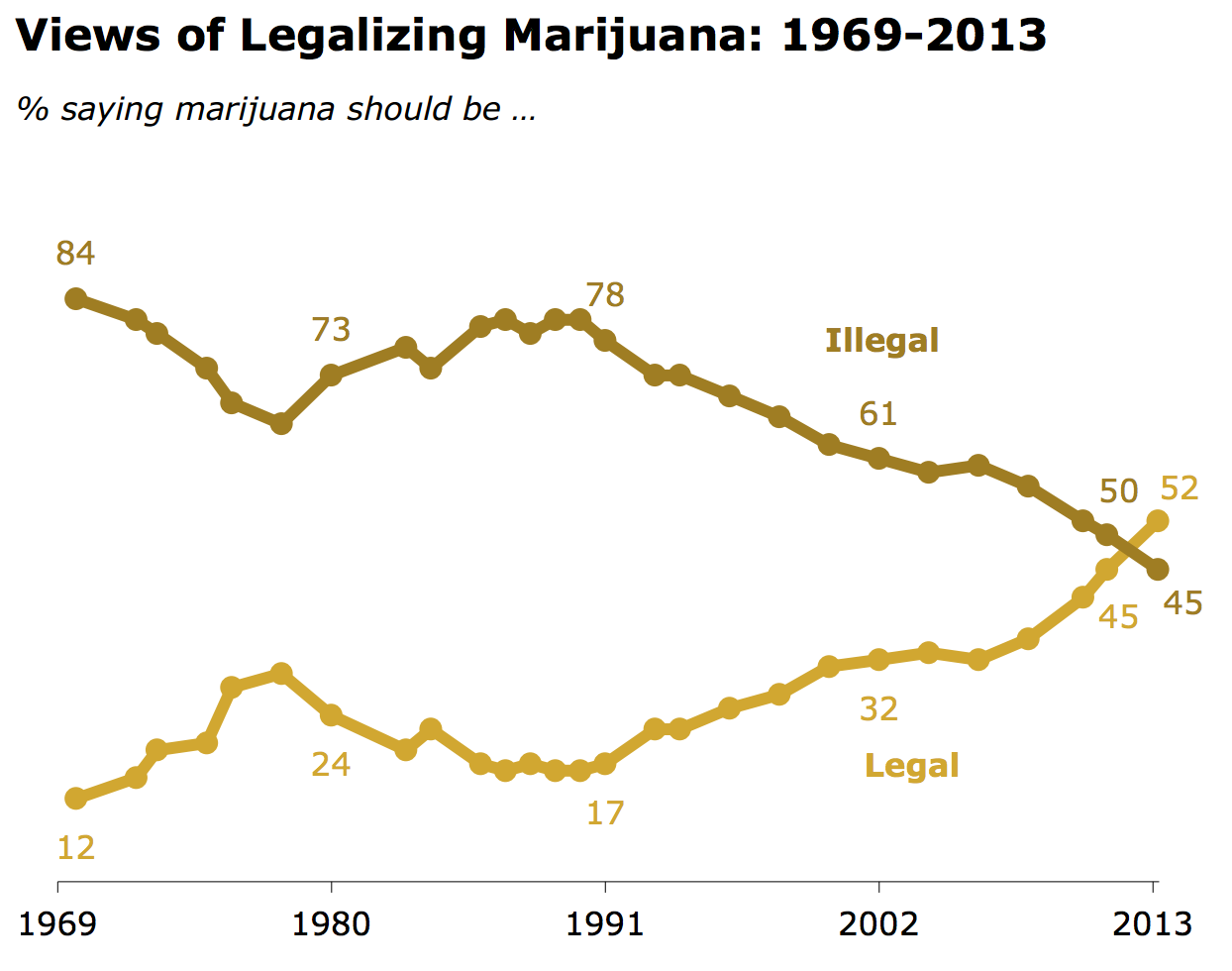
Pew’s latest finds increasing support for marijuana legalization:
There are partisan differences over legalizing marijuana use and whether smoking marijuana is morally wrong. But Republicans and Democrats have similar views on enforcing marijuana laws: 57% of Republicans and 59% of Democrats say that the federal government should not enforce federal marijuana laws in states that permit its use. Substantial majorities of both Republicans (67%) and Democrats (71%) also say federal enforcement of marijuana laws is not worth the cost.
After reviewing public opinion on immigration reform, Harry Enten finds that “overwhelmingly majority of Americans now believe that people who came to this country illegally should not be forced to leave it.” He thinks that opposing reform could hurt Republicans:
The real problem for the Republican party is that its brand is currently in the can. With favorable numbers in the low 30s, the GOP is seen as out-of-step with Americans on many issues.
That’s why you’re seeing Democrats jumping out to a large lead on the House ballot for 2014. The latest Quinnipiac poll puts Democrats up by 8pt, more than enough for them to take back the House. Voters are, at this point, not willing to vote for the party that opposes what they believe in. What Republicans don’t need, then, is another issue – that is, immigration – that contributes to notion that they’re out-of-touch with the way most Americans feel.
Opposing immigration reform would be yet another instance of GOP “obstructionism”, which is what most people see as the Republicans’ biggest fault.
Ellen announced Finding Nemo sequel Finding Dory on her show a couple days ago:
Christopher Orr is dispirited by the rash of Pixar sequels. He suspects Finding Dory was green-lighted because Nemo was “the third-highest grossing animated film—and the best-selling DVD overall—of all time.” A silver lining:
What I do know is this: If Pixar’s films seem to have been slipping back into the pack of excellent-but-not-transcendent animated features of late, it is in part because that pack has dramatically lifted its game. Kung Fu Panda, How to Train Your Dragon, Despicable Me, Tangled, Rise of the Guardians, and a dozen other recent offerings—animated filmmaking has rarely, if ever, produced such quality in such quantity. And it is very, very hard to imagine that this would have happened if Pixar hadn’t been around to show Hollywood that animated films could be such good films (and, not incidentally, such profitable ones).
I can easily see a sequel to The Incredibles that focuses not on the grown-up Parrs, whose arc is largely resolved, but on their children, who are growing up superpowered in a world where the use of their abilities is technically illegal. For all that I’m charmed by the idea of Monsters University, I don’t see the necessity of an origin story for Mike and Sulley, just as I don’t feel particularly drawn to spend more time with Dory, the cheerful, forgetful fish voiced by Ellen Degeneres in Finding Nemo. For sequels to be artistically necessary, there needs to be some sort of narrative or character-driven urgency to them.
I am one of 6 children and a member of an even larger Irish-Slovak Catholic extended family. My wife and I are both college graduates with liberal arts degrees; getting by just fine, but by no means with the disposal income that would be required to throw a nice event for the number of people whom we consider ourselves to be really close to. Once invites are extended beyond parents and siblings, the number of people we would “need” to invite would immediately jump into the hundreds. We simply did not have the budget for this (and it was not a matter of choosing not to dip into savings; savings do not exist). So, with some emotional and brief interpersonal turmoil, we only invited our immediate families and a close personal friend each to stay at 2 beach houses we rented for a weekend in Cannon Beach, Oregon. Our guest list was 30 people. We prepared the food ourselves, we bought the beer, wine, and liquor from costco, there was no photographer, or other hired help. It was a family celebration, as it seems, is the whole idea behind a wedding ceremony, in the first place.
We were able to provide a level of setting/accommodation, food, beverage and activity that we could never have dreamed of if we had to extend invitations beyond the sphere that we did. But, we were able to host an amazing event for the 30 most important people in our lives, that they all still talk about. It was an amazing weekend for all involved. In fact, though we would have liked to share that experience with many, many more people, I think that everyone– us included –enjoyed that experience much more than a rented party facility with standard catered fare, DJ/band, floral centerpieces, etc. We recognized the importance and significance of making our commitment to each other in front of those who are most important in our lives, and wanted to provide them with an experience that they would always remember. I think we definitely achieved our goal, and though the cost was definitely in the thousands of dollars, it was much less than half of what the “average” wedding costs today.
Both my wife and I have many friends from the East/West/Midwest young educated class that have chosen to celebrate their nuptials in similar fashion. I think a nice intimate event shared with those you love most is a much more pleasant and ultimately meaningful celebration than the very expensive cookie cutter fiesta that leaves all involved feeling frazzled and stressed. If I am going to spend $30k on something, I am going to get a lot more out of it than what I have witnessed siblings, cousins, and friends get out of their rather humdrum, but very expensive weddings.
Another reader:
Maybe I was lucky, but last year when my husband and I decided to abandon our plans for a blow out wedding, and instead opt for a small ceremony at my parents’ house over Christmas with family already in town, no one was quick to judge our financial situation. When we sent out invites, I told everyone “I found out I was going to have to pay $600 for table cloths. That’s not happening.” I don’t care how much money we have — that’s just ludicrous! Instead of the financial judgement, though, we got frequent calls asking “Are you pregnant???” from any family or friends over the age of 50. When we mentioned this to friends closer to our age, it was amazing — each of them said “That hadn’t even crossed my mind!” Either there’s a big generational divide in assumptions here or our friends were lying to our faces.
Anyway, our wedding was amazing and meaningful and perfect, and exceedingly cheap to boot! We even streamed it online for the family and friends we had to cut off the invite list to keep costs down. They were happy to watch, and happier to not have to attend or bring a gift. It was perfect all around! (And I’m still not pregnant, Uncle Jim.)
A final reader makes an important point:
“Average cost” does not necessarily mean “typical cost.” This is especially true with something like a wedding, where the wealthy spend exorbitant sums and skew the statistic. If four couples have $9,000 weddings and one couple has a $100,000 wedding, the average wedding cost is $27,000 — but let’s not interpret that to mean that that’s what most people should expect to pay.
For the three surveys, the median wedding cost is closer to $15,000. The median is the middle figure when you line up a set of numbers in order of size. It is a popular choice for social statistics because it is unperturbed by very small or very large numbers.
[P]sychologist Jesse Chandler and his colleagues found that people donate significantly more money to hurricanes that share their initials. So Roberts, Ralphs and Roses donated on average 260% more to the Hurricane Rita relief fund than did people without R initials. Also in 2005, people with K initials donated 150% more to the Katrina relief fund, and in 2004 people with I initials donated 100% more to the Ivan relief fund.
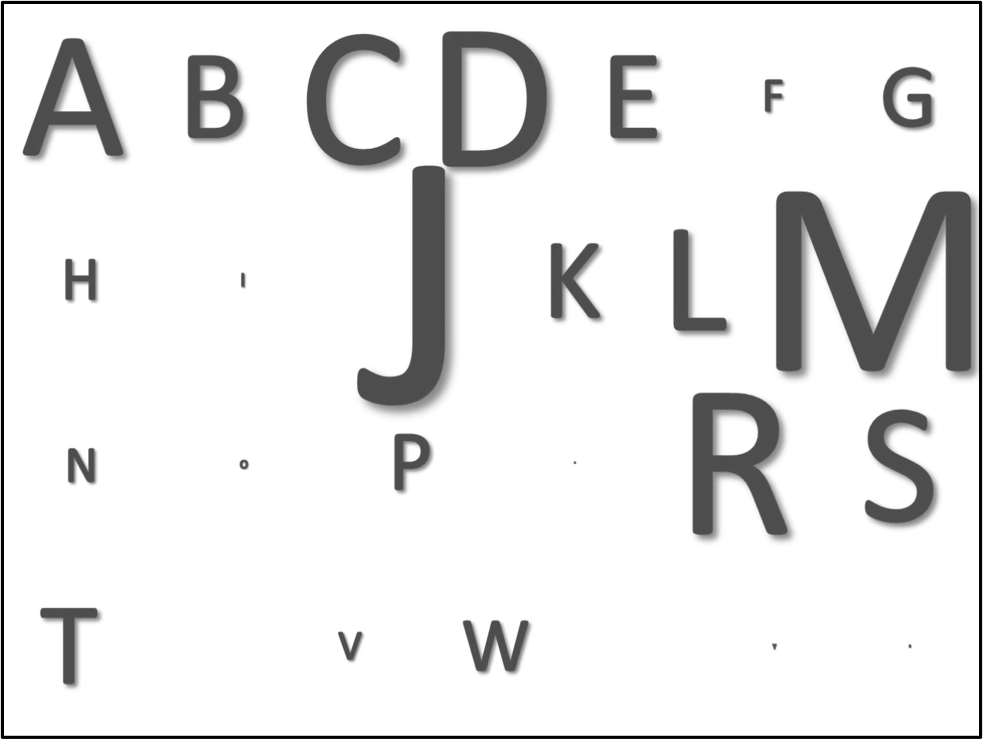
This information isn’t just idly interesting. Since we know that people are more likely to donate to hurricanes that share their first initials, the World Meteorological Organization has the power to increase charitable giving just by changing the composition of its hurricane name lists. In the United States, for example, more than 10% of all males have names that begin with the letter J—names like James and John (the two most common male names), Joseph and Jose, Jason, and Jeffrey. Instead of beginning just one hurricane name with the letter J each year (in 2013, that name will be Jerry), the World Meteorological Organization could introduce several J names each year. Similarly, more American female names begin with M than any other letter—most of them Marys, Marias, Margarets, Michelles, and Melissas—so the Organization could introduce several more M names to each list.
Alter provides the above figure, which “illustrates the relative frequency of each first name initial in the U.S. population by linking the size of each letter to its frequency as an initial.”
Pareene wonders whether they will make an appearance in 2016:
The question for someone considering whether or not to support Clinton in 2016 is, will a Clinton 2016 campaign pass the Mark Penn Test? The Mark Penn Test, which I just invented, determines whether or not a person should be trusted with the presidency, based solely on one criterion: Whether or not they pay Mark Penn to do anything for their campaign. Paying Mark Penn means you’ve failed the Mark Penn Test.
His larger point:
Mark Penn is just the worst example of the general Clinton family habit of associating with the most repulsive party hacks the Democrats have to offer. Her campaign was a dream team of generally useless hacks, from sweatered communications director Howard Wolfson to charmless fundraiser Terry McAuliffe to ill-tempered Harold Ickes (who, unlike the rest of the campaign, at least seemed mostly competent). These are the same Clintons who are responsible for the national stature, such as it is, of Dick Morris.

 The Dish