Is Legalization Driving Kids To Pot?

A new federal report (pdf) on adolescent drug use graphs the percentage of kids smoking marijuana over time:

Marijuana Use

The report (NYT) finds that more high schoolers smoked weed this year than last year and that fewer view it as harmful. And the numbers of teens drinking alcohol, smoking cigarettes, and using other drugs have fallen:

The report raises concerns that the relaxation of restrictions on marijuana, which can now be sold legally in 20 states and the District of Columbia, has been influencing use of the drug among teenagers. Health officials are concerned by the steady increase and point to what they say is a growing body of evidence that adolescent brains, which are still developing, are susceptible to subtle changes caused by marijuana.

Phillip Smith argues that the data don’t really support the headline:

There are short term ups and downs, but they seem to be of mainly rhetorical and polemical significance. If you look at the handy tables at the end of the report, you see that combined lifetime marijuana use for all three grades (8, 10, and 12), was at 30.7% last year, about the same as it was in 1995 (31.6%) or 2005 (30.8%). Much happens, but little changes. Ditto for annual use: 26.1% in 1995, 23.4% in 2005, 24.7% last year. Ditto for monthly use: 15.6% in 1995, 13.4% in 2005, 15.1% last year. Ditto for daily use: 2.7% in 1995, 2.9% in 2005, 3.6% last year. The daily use figures could be alarming (“Daily Teen Pot Smokers Up 25% Since 1995”), except the trend-line is not steadily upward, but varies from year to year (it was 3.7% in in 2001 and 2.7% in 2007).

NORML also pushes back against the media narrative:

Overlooked in the mainstream media’s reporting is that the use of both alcohol and tobacco among all grades surveyed has fallen consistently since the mid-1990s and now stands at all-time lows. (In fact, more teens now acknowledge using marijuana than cigarettes, the study found.) Teens are also finding alcohol to be less available and are far less likely to engage in binge drinking now than ever before. By contrast, teens self-reported annual use of cannabis has largely held steady since the late 1990s but remains elevated compared to the historic lows reported in the earlier that decade. (Present use levels, however, still remain well below the highs reported in the late 1970s.) Approximately 8 out of 10 12th graders surveyed said that marijuana was “fairly easy” or “very easy” to obtain, a percentage that has remained largely unchanged since 2009, but is well below previously reported highs circa the late 1990s. …

And what no public officials wish to acknowledge is the obvious elephant in the room. The reality that an increasing number of teens are steadily turning away from the legally regulated intoxicants alcohol and tobacco — a factoid that once again affirms that the most effective way to keep substances out of teens’ hands isn’t through criminal prohibition; it is through legalization, regulation, and public education. So why does the federal government (as well as the mainstream media) acknowledge the effectiveness of this strategy when it comes to booze and cigarettes, but continue to turn its back on these common sense principles when it comes to pot?

Sullum focuses on the oft-parroted trope that legalizing pot sends the “wrong message to children”:

Looking at annualpast-month, and “daily” use (meaning use on 20 or more of the previous 30 days) among eighth-, 10th-, and 12th-graders, you can see there were some slight increases and slight decreases, but none of the changes was statistically significant. “These findings should put to rest any claims that reforming marijuana laws and discussing the benefits will somehow contribute to more teens using marijuana,” says Mason Tvert, director of communications at the Marijuana Policy Project (MPP). “It’s time for prohibition supporters to stop hiding behind teens when debating marijuana policy.”

Pete Guither adds:

One third of 12th graders get their marijuana from someone else’s medical marijuana…. Um… think about it. Would you rather they had gotten it from a criminal dealer?
Apology Of The Day

Rob Ford: the gift that keeps on giving. Update from a reader in Toronto:

In the past two days, Rob has issued three apologies and danced to Bob Marley in the Council chambers. He indeed keeps on giving. His powers have been largely removed by Council, so he’s turned to performance. I think of him now as the civic mascot.

What If Fewer Young People Buy Insurance?

Sarah Kliff summarizes a new report from Kaiser:

If young adults (those under 35) were 25 percent less likely than the rest of the population to sign up for Obamacare, they would represent 33 percent of exchange enrollees — rather than 40 percent. This means there would be fewer young people to subsidize older insurance subscribers. To make up that difference, the experts estimated, insurers would need to increase premiums by a terrifying … 1 percent. Yes, exactly 1 percent.

Levitt, Claxton and Damico also tested a scenario where young adults are half as likely as older shoppers to enroll. In that case, the younger enrollees would make up only a quarter of the exchange market. Premiums would fall 2.5 percent short of covering subscribers.

And that kinda makes the whole death-spiral argument a bit of a red herring, no? Kilgore comments:

If these numbers are accurate, the widespread assumption (particularly among happy Republicans) that there’s nothing ahead for exchange enrollees beyond “sticker shock” forever could give way to the expectation that Obamacare will eventually be self-stabilizing, at least for most enrollees.

Not everything in the ACA was as incompetent as the website. Adrianna McIntyre identifies more reasons to stay calm:

For the market to unravel, you need fundamentally broken risk pools, not a bad year chalked up to a bad website. Considerable time and resources have been invested in the ACA (see also: the industry bending over backward to accommodate the administration’s mercurial deadlines).

And market power is at play here, too. The new exchanges represent a pretty substantial slice of the potential individual market consumer base; the more enrollees an insurer has, the more power it wields for negotiating prices with providers. Exiting the exchange is likely to be accompanied by a pretty substantial blow to that market power.

There’s one last crucial variable: we don’t actually know what level of risk the insurers baked into their premiums. Obviously they couldn’t anticipate website woes on the scale that we’ve observed in the last three months, but I find it hard to believe that they’d draw up projections that assume a perfectly balanced risk pool from the start. Call me crazy, but something makes me think that actuaries are better at hedging than the blogosphere.

Telling The NSA What’s Good For It

An advisory committee report (NYT) released yesterday encourages Obama to reform the NSA. Amy Davidson provides an overview:

The thirty-page executive summary might be further condensed to a few sentences: Don’t do things just because you can. Tell people what the rules are. Remember that “security” doesn’t just mean chasing terrorists—it “refers to a quite different and equally fundamental value,” spelled out in the Fourth Amendment: “The right of people to be secure in their persons, houses, papers, and effects, against unreasonable searches and seizures.” Stop shutting down debate by muttering about a “balance” that needs to be struck between security and freedom—they are not on opposite sides of the scale. Start thinking about privacy.

Eli Lake highlights key recommendations. Such as:

The review group recommends more stringent standards for protecting the privacy of foreign nationals. For example, it says U.S. monitoring communications of foreigners should not be based on their political or religious beliefs; should not be used to gain trade secrets; and must be “directed exclusively at protecting national security interests of the United States or our allies.” In addition the review group’s recommendations say the U.S. government should apply the Privacy Act of 1974 to foreign nationals as well as U.S. citizens. The nearly 40-year old law requires U.S. government agencies to protect personal information from U.S. citizens and not share it within the government.

Ambers points out other important bits. Third on his list:

The controlling metaphor for privacy should not involve balance; it should involve risk. One hears the voice of panel member Cass Sunstein in the following sentence: “Before they are undertaken surveillance decisions should depend (to the extent feasible) on a careful assessment of the anticipated consequences, including the full range of relevant risks. Such decisions should also be subject to continuing scrutiny, including retrospective analysis, to ensure that any errors are collected.”

Benjamin Wittes calls this “a really awkward document for the Obama administration”:

The President, after all, has stood by the necessity of the Section 215 program and objected to legislative proposals to curtail it. Then the White House handpicks a special review group, and it kind of pulls the rug out from under the administration’s position. The review group concludes “that the information contributed to terrorist investigations by the use of section 215 telephony meta-data was not essential to preventing attacks and could readily have been obtained in a timely manner using conventional section 215 orders.” It also reflects skepticism that the program functions as a kind of insurance policy, “alleviating concern about possible terrorist connections…” Ouch.

Allahpundit speculates about Obama using the report to change course:

There’s no way, really, for him to suddenly change his mind and claim that he’s spontaneously reconsidered everything he said before in defense of the program. But if his handpicked panel floats a few ideas for him, he can portray himself as the can-do executive who took the problem seriously enough to closely investigate it and then listened to his experts when they urged him to change course in a few ways. He conducted a fact-finding mission, by delegation, and now his opinion has changed in a few particulars. What a champ.

Drum bets that few of these recommendations will make it through the political process:

How much of this will survive the president and Congress? I’d like to say I’m optimistic, but I’m not, really. These recommendations are useful but modest, and I suspect that Congress will whittle them down even more.

Crowley zooms out:

It remains to be seen which of the panel’s recommendations President Obama might adopt — and how much change a Congress where the NSA has powerful allies will enact. But if the NSA’s wings are clipped, it will be another step in America’s steady march away from its post-2001 wartime footing, one that has accelerated dramatically, if quietly, in Obama’s second term.

Finally, Conor uses the report to defend Snowden:

If a government employee or contractor leaks classified information to the press, and the result is a judicial finding that the government has violated the Fourth Amendment, multiple pieces of bipartisan reform legislation circulating Congress, and a review for the president that suggests reforms to multiple secret programs, what do you call the leak? I call it whistleblowing.

Chart Of The Day

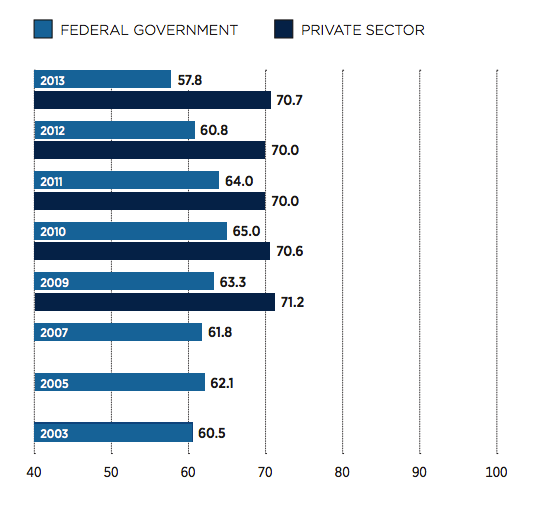
The percent of federal and private sector workers who are satisfied with their jobs:

Government Employees

Among the reasons federal employees increasingly dislike their work:

In particular, government employees hate their bosses. On average, people reported a 51.8 percent satisfaction level with their senior leaders, and this agency-by-agency breakdown indicates that there’s some pretty harsh boss-hate in certain government offices (my heart goes out to you, Financial Crimes Enforcement Network leaders: a 22.5 percent approval rating has got to hurt).

Orszag worries about this finding:

One reason federal workers are frustrated with their senior leadership is that the government isn’t doing much of substance. People are attracted to public service in no small part because they believe government can be a force for good; when the government does little, that belief is harder to sustain. Similarly, political polarization and a general decline in public expectations for government make it harder to attract talented people to lead the bureaucracy.

Cheating Death Taxes

Zachary R. Mider shines a spotlight on the GRAT, “one of a handful of common devices that together make the estate tax system essentially voluntary”:

Hundreds of executives have used the technique, SEC filings show. These tax shelters may have cost the federal government more than $100 billion since 2000, says Richard Covey, the lawyer who pioneered the maneuver. That’s equivalent to about one-third of all estate and gift taxes the US has collected since then. The popularity of the shelter, known as the Walton grantor retained annuity trust, or GRAT, shows how easy it is for the wealthy to bypass estate and gift taxes. Even Covey says the practice, which involves rapidly churning assets into and out of trusts, makes a mockery of the tax code. “You can certainly say we can’t let this keep going if we’re going to have a sound system,” he says with a shrug.

Sheldon Adelson, one of the many tax dodgers cited by Mider, has saved $2.8 billion using the GRAT. The Bloomberg editorial board is not pleased:

In its current form, the estate tax requires the rich to pay a 40 percent levy on wealth they leave to their heirs, after an exemption of $5.25 million (rising to $5.34 million in 2014). That’s the theory, anyway. In practice, for the wealthiest families, the estate tax is largely optional. … The Tax Policy Center estimates that only 3,780 households (0.14 percent of all estates) will owe any estate taxes this year. Their average payment will be $3.8 million on estates worth $22.7 million – an effective rate of 16.6 percent.

Keep in mind, too, that most wealth escapes tax as it accumulates. Appreciation of property, securities and art isn’t subject to capital-gains tax until the assets are sold. When they are passed along, much of this unrealized profit remains untaxed, thanks to the optional estate tax. The oft-repeated charge that estate taxes amount to double taxation is doubly wrong. Congress ought to close the GRAT and other loopholes.

And it might note that the voluntary estate tax exemplifies a wider issue: The U.S. tax code is insanely complicated. This favors the rich because, unlike ordinary taxpayers, they can afford to find loopholes amid the complexity. Simpler tax systems are fairer – and they distort decisions less.

Christmas Hathos Alert

A reader invites us to “celebrate our Lord’s Birth with these assholes, who set a new standard for Hathos”:

Another sees red:

This absolutely awful Christmas “card” has been making the rounds.  Many people think it’s funny and cute, and they’re more interested in the physical attributes of the wife and husband.  But at the end of the day, it’s a freaking plug for their new business. Absolutely awful.

Update from a few readers defending the couple:

Wow, some of your readers are real tight asses.

My wife and I watched this and thought it was hilarious and we didn’t give a shit that they plugged their business. One observation I would offer to many of your readers is that it’s easy to find fault in things on the Internet and to criticize. Try just sitting back and enjoying something without trying to pick it apart or make ad hominem attacks about people none of us know personally. I realize that it’s hard to keep quiet, especially when we have the ability to express ourselves in so many different ways. But I think we all (and I’m including myself in this) need to try to be a little more patient, a little more accepting, and a little more tolerant, especially during this time of year.

Another adds:

As a resident of the Research Triangle, I think you are being a little hard on the Holdernesses (Holderni?).  First off, on a technical note, the video admits it is a shameless plug – I thought being self aware disqualified one from hathos? Second, Penn is one of the few bearable local anchors to watch in Raleigh-Durham.  He is a little hipper and edgier than the standard local news schlock, and he wears his stations perennially low rankings with a degree of resignation and panache.  I don’t know that this disqualifies one from a hathos tag, but jeez, some context may help. (Also contextual is the huge HUGE deal that having a movie filmed in RDU was for the area. I think someone who lived it could be forgiven for blowing it out of context).

See all of our Christmas Hathos from years past here.

The New Precious Metals

Plumer worries about the availability of elements used in high-tech manufacturing, some of which are irreplaceable:

Situations vary widely. Some elements do have easy substitutes. For instance, 54 percent of the world’s palladium is used as a catalyst to control emissions from vehicle exhaust. But if we ran short of palladium, we could still swap in platinum and get similar results. Or: Roughly 88 percent of the world’s titanium is used to create white pigment for paints, plastics, and paper. But in a pinch, we could substitute talc.

Other metals, however, have no ready substitutes. Rhodium is used as a catalyst to control nitrogen-oxide emissions from cars. Right now, there’s no alternative in the event of a shortage. Or: About 90 percent of the world’s supply of manganese is used as a deoxidizing and desulfurizing agent in steel production. Again, no substitute. That’s not to say it’s impossible to imagine a substitute — materials scientists are clever and markets are good at adjusting to shortages. Never say never. The study notes that there’s plenty of ongoing research into things like advanced composite materials. But substitution can be a slow process and performance can suffer in the meantime.

Stephen Leahy warns that vast quantities of “e-waste,” not enough of which is getting recycled, are making future shortages ever more likely:

E-waste is already a big problem. According to a new report, in 2012, every man, woman, and child in the US hauled a 66 lbs. bag of e-waste to the curb. That’s six times more than someone in China, and ten times the average Indian’s haul. “E-waste is exploding. I hope people will re-think their purchases of e-toys, tablets, and such this Christmas,” said not a particularly-grinchy Ruediger Kuehr, the Executive Secretary of the Solving the E-Waste Problem Initiative, which did the forecast. “Re-think” means consider where the device is going to end up when its day is done.

Lily Hay Newman focuses on the environmental consequences of e-waste, especially in the developing world:

E-waste is an environmental and health concern because it can cause heavy metals and other toxic substances to contaminate soil and water. Additionally, people looking to recover precious metals or other parts sometimes scavenge and break down devices that were not disposed of properly, and in the process they can release toxins into the air. As the Guardian points out, Interpol also released a statement last month indicating that e-waste from industrialized countries is being illegally unloaded on developing nations. Interpol is initiating criminal investigations into 40 companies, citing agent reports that for every three containers being checked on their way out of the EU, one holds some type of illegal e-waste. Exporting old electronics is not necessarily illegal if they are being repurposed or reused in some way, but Interpol says that much of the “exporting” going on is really tantamount to dumping.

Our Thirsty Species

WaterStressbyCountry

Brian Merchant introduces a study finding that the number of people facing “absolute water scarcity” may double within the next few decades:

In other words, when global temperatures rise another 2˚C—they’re well on track to do so—there could be anywhere between 40 percent and 100 percent more people living in places—places like Yemen, Pakistan, India, Australia, the American Midwest—subjected to extreme water scarcity. Climatologists believe we may hit 2 ˚C rise—or more—by midcentury. As in, less than 40 years from now. The EPA, meanwhile projects at least a 4˚C rise by 2100. Which will really bring the thirst. …

The UN fears that conflicts over water-rich territory and transportation infrastructure could deepen or break out as the resource grows even scarcer. Analysts like Lester R. Brown has said that “it is now commonly said that future wars in the Middle East are more likely to be fought over water than over oil.”

Matt Ferner looks at another study mapping water insecurity around the world:

Researchers with the Aqueduct project looked at water risks in 100 river basins and 181 nations around the globe — the first such country-level water assessment of its kind. By taking a close look at regional baseline water stress, flood and drought occurrence over several years time, inter-annual variability and seasonal variability as well as the amount of water available to a particular region every year from rivers, streams and shallow aquifers, WRI was able to give each country a score 0 to 5, with a 5 being the greatest level of water risk.

Walter Russell Mead says we have nothing to worry about now that scientists have found an abundance of freshwater underneath the ocean floor:

Some of these reserves will be fresh enough that they won’t need to go through the energy-intensive desalinization process, while some of them will be only slightly brackish, and will be easier and, importantly, cheaper to desalinate. In fact, this kind of offshore drilling for water is already happening; NPR notes that there are already operations in places like Cape May, NJ to drill for and eventually desalinate low-salinity water.

Water scarcity has been a favorite topic for the Chicken Littles of the world. Just 18 years ago the vice president of the World Bank was ominously warning that “the wars of the next century will be fought over water.” It’s easy to drum up fears of “water wars” some undetermined time in the future, but studies like this one, and discoveries of new water sources like this one in Kenya, or this one under the Sahara, suggest that these fears that have gripped Malthusians—and that Malthusians have in turn used to push through otherwise unworkable policy recommendations—are a lot less serious.

Scientists, however, are not yet ready to declare drilling for freshwater a feasible solution:

[T]here are two ways to get to the water: “Build a platform out at sea and drill into the seabed, or drill from the mainland or islands close to the aquifers.” That’s not likely to come cheap. While places such as Cape May, N.J., are already drilling and desalinating freshwater underground for use, getting to freshwater reserves under the oceans will probably be more expensive, says Kenneth Miller, professor of earth and planetary sciences at Rutgers University.

Miller’s research has involved drilling into freshwater reserves offshore, and he says drilling three holes about 2,500 feet down cost around $13 million. And some reserves will be saltier – and need more processing — than others, depending on what kinds of sediment surrounds them. Finer grains seal in fresher water while coarser grains hold saltier water, Miller says. “[Tapping the freshwater reserves] represents a potential alternative that may be economic,” says [Mark] Person, the study co-author. He notes, however, that the scientists have not yet tapped into one of these reserves and that this is a non-renewable resource.