The Question Of Scottish Independence Isn’t Settled

Massie sees the upcoming British elections as “a win-win proposition for nationalists and a lose-lose calamity for unionists”:

First, it is entirely possible that the SNP will win the Scottish part of the election — if their performance matched the latest polls, they would take 50 of Scotland’s 59 Westminster constituencies. (Alistair Darling and Gordon Brown’s belated decisions not to run for Parliament again need to be understood against this backdrop.)

Second, and just as disturbingly, David Cameron may yet win a second term. Scots Tories, more than 90 per cent of whom backed the Union, would face a lose-lose proposition. The SNP’s popularity in Scotland might cost Labour the election but only at the price of further weakening the Union. A Tory government with little support in Scotland would encourage the nationalist narrative that Scotland and England are countries of such divergent character that divorce is inevitable. No wonder the SNP secretly pines for the very thing it professes to hate most: Tory supremacy at Westminster.

Enshrining Inequality In Israel

Last Sunday, Israel’s cabinet advanced a controversial bill that would amend the country’s Basic Laws to define it explicitly as “the national state of the Jewish people”:

According to many critics, the new wording would weaken the wording of Israel’s declaration of independence, which states that the new state would “be based on the principles of liberty, justice and freedom expressed by the prophets of Israel [and] affirm complete social and political equality for all its citizens, regardless of religion, race or gender”. … Netanyahu argued that the law was necessary because people were challenging the notion of Israel as a Jewish homeland.

For my part, I see it as a natural evolution of Israel’s settler policies and the end of any pretense at aiming for a two-state solution. The claim on the West Bank is a religious and racial claim – and that identity is far deeper at this point than any commitment to Western ideas of democracy, and deepening by the day. It’s also a way, of course, to ensure that the slow annexation of the West Bank can continue, because it all but ends any hope of negotiation with the Palestinian leadership. It comes at a time when the Knesset is also considering a proposal (unlikely to pass) that would enshrine punitive home demolitions in Israeli counterterrorism policy, strip citizenship from anyone who expresses support for terrorism, and have anyone brandishing a Palestinian flag arrested for “incitement”. Foreign Minister Avigdor Lieberman openly wants to pay Arab Israelis to leave the country. In such a climate, what can prevent a further weakening of Israeli democracy in favor of racial and religious fundamentalism?

Dahlia Scheindlin nonetheless thinks such a law would be very bad for the Jewish state:

Some insist that it is hypocritical and maybe even anti-Semitic to protest a simple law of national self-definition, when ‘France is for the French people,’ or ‘Germany is the land of the German people.’ Can we lay this argument to rest already? In those examples citizenship overlaps with nationhood. Yes, France is for the French. But what makes someone French is not birth or ethnicity alone, but citizenship. This proposed basic law would codify and demarcate the State of Israel as something that belongs only to a subset of its citizens.

State rights will not overlap with citizenship; they privilege a subset of citizens. Non-Jewish citizens have no route to sharing in the privileged national group. Being Israeli won’t be enough to live equally in this country. In fact, the state has consistently rejected the very idea that there is an Israeli nationality. The true comparison is simple: the law says Israel is for the Jews, just as America once said America is for whites.

The Guardian’s editors come out against it:

Arab citizens of Israel, who make up at least 20% of the population, would be granted civil rights as individuals, but denied “national rights” as a people. This is not a charge levelled by critics. Prime minister Binyamin Netanyahu, who voted for the bill, unabashedly admits that, should it become law – and it still faces parliamentary obstacles – only Jews would be granted national rights. An immediate manifestation of the change could be the downgrading of Arabic from its current status as an official language of Israel.

For nearly half a century, Israel’s defenders have insisted that – whatever the world’s misgivings about the 47-year occupation of lands gained in the 1967 war — the country itself, Israel-proper, is a full-blooded democracy, with Palestinian citizens of the country enjoying full equality. This would render that claim false. The basic laws would enshrine inequality, ensuring Jews had fuller rights than Arabs.

Gershon Baskin also opposes the bill:

How could the State of Israel be less to Muhammad who was born in Kafr Kara, whose father, grandfather, great-grandfather and great-great-grandfather were born in Kafr Kara, than it is to me, who was born in the United States and immigrated here 36 years ago? How could Israel belong more to Svetlana who arrived here a few years ago than to Samira whose family has been living in Haifa for 50 generations? Israel demands loyalty from its Palestinian citizens. Foreign Minister Avigdor Liberman even wanted them to take a loyalty oath. What are they expected to be loyal to? Israel continues to discriminate against its Palestinian citizens. There is absolutely no excuse for discrimination on national or religious grounds in Israel after more than 65 years of statehood. The proposed law for the Jewish state would push us in the exact opposite direction.

But Haviv Rettig Gur downplays the controversy, noting that the idea of a “Jewish nation-state law” has been kicking around for years and emerged from the political center, not the far right:

In the summer of 2009, [Institute for Zionist Strategies] staff working on the bill met with former Shin Bet head and then-Kadima MK Avi Dichter, who adopted the initiative eagerly. Dichter is known as a political centrist, a critic of the far-right and an advocate of separation from the Palestinians.

In fact, in explaining his own support for the bill, he described it as an end-run around Netanyahu’s demand that the Palestinians recognize Israel as the nation-state of the Jewish people – a demand Netanyahu saw as a litmus test for the Palestinian willingness to end the conflict. By defining Israel as the Jewish nation-state in its own constitution, simple recognition of Israel, which moderate Palestinian leaders have been willing to do, would necessarily constitute acceptance of the state’s constitutional identification with the Jewish nation, Dichter reasoned. It would remove a small but significant obstacle on the road to peace.

That sounds like whistling past the graveyard of democracy to me. What road to peace? And doesn’t this law all but make Palestinian engagement a dead letter?

Christie And Cruelty

I think it’s pretty clear by now that governor Chris Christie of New Jersey has one over-riding principle in his political life: getting to be president. That was the key rationale behind the campaign to punish pigsany Democratic mayors who refused to give him an aura of bipartisanship he could take to the national stage. And that’s the only rationale behind his contemptuous veto of the state legislature’s second attempt to ban the use of gestation crates for sows in factory farms. The crates prevent a pig from moving or turning around for her entire life. They’ve been banned in nine states and throughout the EU. The law was passed by the state Assembly by a vote of 60 to 5 and the state Senate by a vote of 29 to 4. It has the support of close to 90 percent of New Jerseyans in a recent poll. But it would tar Christie’s rep with the hog-farmers in Iowa, and so had to be vetoed. Christie denies that there is a widespread problem at all in New Jersey, with a mere 9,000 pigs, but fails to argue why signing the law wouldn’t merely prevent such cruelty in a few cases or in the future. What’s the harm? He calls a very bipartisan vote a partisan plot.

The veto was not unexpected – but need not be the last word. The state Assembly and the Senate can simply over-ride the veto – and it appears they have the votes to do so. Whether the GOP will follow through – they sure didn’t the last time – is an open question. But I fail to see why they shouldn’t. Christie gets to claim he tried to stop it, and New Jersey can end capricious, money-grubbing cruelty. Win-win no? Especially for the pigs.

A Month-Long Black Friday?

Peter Weber highlights a new survey:

According to the [National Federation of Retailers]’s survey, by Prosper Insights & Analytics, weekend sales dropped to an estimated $50.9 billion, from $57.4 billion in 2013, and about 133.7 million people said they shopped online or in stores over the four days, a 5.2 percent drop from last year. The retail trade group stood by its forecast that over the entire season, spending will rise 4.1 percent from 2013, but it had a bunch of conflicting explanations for why Black Friday weekend was a relative bust, especially given dropping gas prices and increasing consumer confidence.

Steven Perlberg sums it up:

The fact remains that while Black Friday has become an American institution – with its brawls and stampedes well-documented across social media – it has also decreased in economic relevance as shopping habits shift.

But Barry Ritholtz questions the survey’s methodology:

Ask a person a specific question, and you will typically get a specific answer. The problem is that the answer is either guesswork or fabricated, bearing little if any resemblance to reality. You have no idea what you spent on holiday shopping last year. You have no idea what you are going to spend on holiday shopping this year. The net result of comparing one made-up number with a second made-up number is a random outcome lacking any relationship to actual spending.

These are facts of human behavior. Credible survey methods seem to be wholly unfamiliar to the NRF. Why bother when the fiction works so well? In truth, no one has an idea what the holiday sales were as of yet.

Ed Morrissey notes that sales are hardly limited to the immediate aftermath of Thanksgiving:

If people find good deals before Thanksgiving, they’ll be a lot more inclined to take advantage of them at the moment rather than enter the Thunderdome on the day after Thanksgiving, especially given the contrivances and artificial shortages that would force them into the lines early in the morning. If Black Friday is dying, as some early data suggested, it’s because retailers themselves are making the day less relevant. It may also be because die-hard discount shoppers know they can get the same deals or better by holding out to the end [.] …

Shoppers are wising up, and retailers will get a little more competitive as a result. That doesn’t make Black Friday a dud, but in a couple of more years, it might become an irrelevant measure — and perhaps an object lesson in desensitizing consumers after repeated panic tactics. One can only cry “Wolf!” or “Limited supply!” so often before losing all credibility.

Joe Pinsker elaborates on how clever shoppers can see through sales tactics:

Many retailers depend on cultivating a sense of urgency in shoppers, which leads them to spend irrationally on a deal they believe could evaporate any minute. Cutting through that anxiety might be possible with a shift in mindset: A recent study suggests that when people reflect on a time when they felt grateful, they can become less intent on instant gratification. In fact, those who were merely happy or amused were willing to sacrifice $100 in a year for $18 immediately, but those who were primed to feel grateful were patient enough to draw the line at $30. Another study, to be published early next year, suggests that disciplined people aren’t actually less impulsive in the moment; they just choose to limit the number of tough decisions they have to make.

Walking While Black

More black men need to bring their cell-phones to these police interactions. The rest of us have to see this shit with our own eyes before we’ll begin to understand the rage that simmers beneath the headlines:

Update: the police department defended the interaction:

Oakland County Undersheriff Michael McCabe said Sunday that the deputy acted properly, and took exception to bloggers and social media commenters who he said took the video out of context, and didn’t bother checking to get the rest of the story.

“The store that called about the man has been robbed multiple times in the last year,” McCabe said. “In addition, employees have been robbed while making deliveries. According to the caller, this man was walking back and forth in front of the store five or six times.

Thoughts On Affirmative Action, Ctd

A reader starts the debate over a big post you might have missed over Thanksgiving:

I make no claim of expertise on this topic, but your mention of the GI bill caught my attention. You seem to see it as a great equalizer, and I do not wish to challenge the fact that the GI bill created tremendous educational opportunities.  However, there is considerable evidence to suggest that the policies of the GI bill disproportionately benefitted whites.  So, a policy that you portray as an equalizer arguably helped ossify and perhaps expand the racial gap in educational opportunities.  Just like so many of the social and housing policies of that era, the GI bill seems to have helped cement not ameliorate racial disparities.  Ira Katznelson has covered this topic well in his scholarly work, as well as in his book When Affirmative Action Was White.  In particular, he engages in a compelling dialogue with Suzanne Mettler, who argues that the GI bill was “relatively inclusive”.

Another expands on that reader’s point:

You claimed that the G.I. Bill “was a huge step forward for meritocracy in America.” You should be very careful with your history here.

As pointed out by Ira Katznelson in his book When Affirmative Action Was White, Jim Crow laws and practices were baked into the G.I. Bill. The congressional “Dixiecrats” at the time ensured that the administration of G.I. Bill benefits (and Federal Housing Administration loan insurance and WPA jobs) was left up to each state individually. This meant that Black soldiers in the South returning from WWII were often denied government benefits from these so-called meritocratic programs. Black veterans in the North were barred from buying houses in white neighborhoods and couldn’t obtain loans in Black neighborhoods due to housing shortages and the practice of redlining. From the NY Times book review (which is easier to copy-paste than my copy of Katznelson’s book):

The statistics on disparate treatment are staggering. By October 1946, 6,500 former soldiers had been placed in nonfarm jobs by the employment service in Mississippi; 86 percent of the skilled and semiskilled jobs were filled by whites, 92 percent of the unskilled ones by blacks. In New York and northern New Jersey, ”fewer than 100 of the 67,000 mortgages insured by the G.I. Bill supported home purchases by nonwhites.”

Discrimination continued as well in elite Northern colleges. The University of Pennsylvania, along with Columbia the least discriminatory of the Ivy League colleges, enrolled only 46 black students in its student body of 9,000 in 1946. The traditional black colleges did not have places for an estimated 70,000 black veterans in 1947. At the same time, white universities were doubling their enrollments and prospering with the infusion of public and private funds, and of students with their G.I. benefits.

I challenge you to do dig deeper into this history before opining that government assistance programs represent anything approaching a meritocracy. In fact, citing the G.I. Bill provides a powerful refutal to that notion. White men were able to attain government-backed housing loans and government-subsidized post-graduate education via the G.I Bill. This allowed them to accumulate wealth in the decades since, while Black people were actively excluded from that process. It’s almost like action was taken to affirm the place of white men in this country!

Many more of your emails to come regarding the debate over affirmative action itself.

Reasons To Hope On Race

Print

William H. Frey marks the slow, steady decline of segregation:

The average white resident, for example, lives in a far less diverse neighborhoodone that is more than three-quarters whitethan residents of any other group. Nonetheless, the average white person today lives in a neighborhood that includes more minorities than was the case in 1980, when such neighborhoods were nearly 90 percent white. Moreover, the average member of each of the nation’s major minority groups lives in a neighborhood that is at least one-third white, and in the case of Asians, nearly one-half white.

He expects the continuation of these trends:

Population shifts that are bringing Hispanics and Asians to previously whiter New Sun Belt and Heartland regions will most certainly continue to alter the neighborhood experiences of these groups by bringing them into more contact with whites. The nation’s blacks are moving onto a path that more closely follows that of other racial minorities and immigrant groups as more blacks move to more suburban and integrated communities. The broader migration patterns are moving in the direction of greater neighborhood racial integration, even if segregation is far from being eliminated.

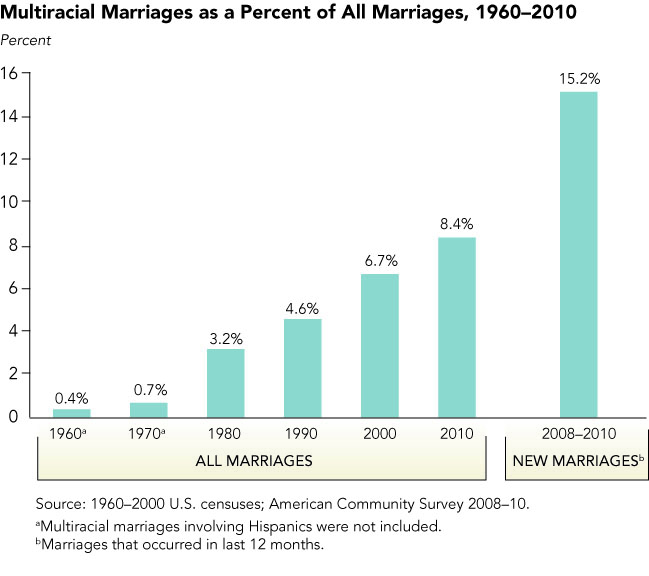
And then it seems to me you have to factor in the increasing number of interracial marriages:

Print

What Chris Rock was referring to with respect to his young daughters is the impact of this big generation of non-white babies. They’ll form yet another new minority – alongside Hispanics and Asians – until all such non-white minorities become a majority in 2050. At some point, it is conceivable that “race” will become so alloyed and meaningless a term it could become irrelevant, or that racism will become more nuanced and diffuse, revealing new variously-hued racial coalitions and identities. Or that at some point, the whole fixation with race will begin to dissipate and disappear in the face of our experience of our common humanity.

Yes, I can hope. And after Ferguson, it feels important to do so.

Freeing The Pharaoh

https://twitter.com/arabiaenquirer/statuses/538726526129152000

On Saturday, an Egyptian judge dismissed murder charges against former president Hosni Mubarak over the killing of hundreds of protesters during the 2011 uprising:

The Cairo court erupted in cheers when the judge said Mubarak should not have been a defendant in the case as the charges against him were added late. Charges against seven senior ex-officials were also dropped. The decision could be appealed. Victims’ relatives waiting outside expressed dismay and frustration. And later police fired tear gas to disperse a crowd of about 2,000 people who gathered near Tahrir Square to voice their opposition to the decision. …

As well as the murder charge, Mubarak was also cleared of a corruption charge involving gas exports to Israel. His sons Gamal and Alaa were also cleared of separate corruption charges by the same court on Saturday.

Mubarak remains in prison on a separate, three-year sentence for embezzlement but could walk free soon, as his pretrial detention for the murder charges will now count as time served. Hossam Bahgat explains the technicality that could set the ex-dictator free:

Following Mubarak’s abdication of power in February 2011, Public Prosecutor Abdel Meguid Mahmoud decided to investigate the killing of protesters during the 18 days of revolt that ended Mubarak’s tenure. On March 23, 2011, Mahmoud, who had served under Mubarak and remained in office until late 2012, indicted Mubarak’s Interior Minister Habib al-Adly and his senior assistants, but not Mubarak himself, for having ordered or otherwise abetted the killing of protesters throughout the country. Two months later, the Supreme Council of Armed Forces, which had succeeded Mubarak in power, faced pressure from street demonstrations demanding accountability for Mubarak too. On May 24, 2011, the public prosecutor added Mubarak as a co-defendant in the case.

The fact that Mubarak was only added as a defendant two months after the case had been referred to trial is the technicality the judge used today to dismiss the charge against him. By not indicting Mubarak from the beginning, the judge reasoned, the prosecution had made “an implied decision that there were no grounds for criminal proceedings” against him. This “no-grounds” decision can be formally reversed by the public prosecutor within a window of three months. Mubarak’s defense lawyers argued, and today the court agreed, that the prosecution reversed the implied no-grounds designation of Mubarak without following proper procedures. For that technical error, the judge ruled the charge against Mubarak for the killing of protesters as inadmissible and dismissed that charge without considering it or ruling on its merits.

Though not unexpected, the ruling serves as a depressing coda to Egypt’s failed revolution and subsequent regression into military dictatorship. That the ruling seemed to follow the public mood, which has soured on revolution over the past three years, is part of the problem, Tamara Cofman Wittes adds:

[T]he trial’s outcome is symbolic of a broken, enfeebled justice system where outcomes often seem arbitrary and where prosecutors and judges often seem to follow public sentiment — first heeding calls for blood by charging the former president on hastily constructed evidence, then dismissing the charges after three years of chaos made Mubarak’s thirty years of dictatorship look rosy in retrospect. The biased workings of this system are also evident in the fact that this judge properly dismissed Mubarak’s charges on technical grounds, whereas preposterously flimsy and/or irrelevant evidence and testimony were allowed to stand in the conviction of three journalists this year and the convictions of 43 NGO workers in 2013. In some ways, this broken system is just one small example of the broken Egyptian state that is the legacy of Mubarak’s long rule.

Juan Cole attempts to find some cause for hope:

The only silver lining of the current situation is that the old Mubarak political and financial elite, the fulul or left-overs, are being reincorporated into public life. Those who committed criminal acts should not be rehabilitated, of course. But South Africa dealt with former regime elements by having them confess in detail to their crimes, after which they were released. What’s wrong here is that Mubarak and his gang are still unwilling to confess. For left-overs who had not been guilty of committing any obvious crimes, it is probably healthier to have them come back into public life than be excluded and sullen (the wealthy are in a position to make a lot of trouble).

One big difference between so far relatively stable Tunisia and unstable Libya is that after the first two years, members of the party of former Tunisian dictator Zine El Abidine Ben Ali were allowed to come back into politics in 2014. In Libya, as in Iraq, the old elite was excluded and stigmatized, and instability ensued. In Egypt there is the wrinkle that the secondary elite, the Muslim Brotherhood, has been more thoroughly excluded from public life than the fulul ever were.

And Bruce Riedel identifies one group of people who are perfectly happy with the ruling, namely the Saudi monarchy:

The Kingdom supported the 2013 coup immediately, with the King publicly endorsing the putsch minutes after it took place. Riyadh has organized the Gulf states to bankroll the generals’ regime since — at a cost of billions. Getting Mubarak out of prison has been a Saudi priority ever since the coup. The coup reversed the momentum of the Arab Spring and extinguished the most important experiment in Arab democracy ever, two key Saudi goals. The defeat of the Muslim Brotherhood was another major objective for Riyadh. The Saudis believe the coup substantially reduced the danger of unrest inside the Kingdom by terminating a dangerous role model.