I never imagined that I would someday be in a position where I personally know someone in solitary confinement, or that I would be able to confirm what Atul Gawande wrote in The New Yorker about solitary confinement: “Whether in Walpole or Beiruit or Hanoi, all human beings experience isolation as torture.” I have been writing to a long-term prisoner since September, 2004. In early 2009, she was placed into solitary confinement, where she remains today, four and a half years later. Our correspondence has continued throughout.
She is an outgoing, social person, and four-plus years of solitary confinement has been particularly hard on her.
For the first year or so, she was in a cell that had an inner door of bars, which remained closed all the time, and an outer solid door which she could slide open, allowing her to talk with other prisoners in nearby isolation cells. Then she was moved to a cell with a door that stays closed all the time. The lights in her cell are left on 24 hours a day. When she leaves her cell, it’s in full irons, with her ankles shackled and her wrists chained to her waist. The guards aren’t allowed to talk to her, except to give her commands. All her visits are non-contact. She loves long hugs, but hasn’t had a hug of any kind in almost five years. Even when her mom and dad visit, she only talks to them over a phone, through a glass window.
The effects of solitary confinement – especially depression and loneliness – are obvious from her letters. She spends much of her day sleeping, and only gets limited time outside her cell for exercise and a shower. Guards are not allowed to talk to her, except to issue commands. To me, the effects are obvious. She wrote regularly; she was optimistic and curious. Today she writes sporadically and fights a never-ending battle with depression. She deals with the depression with prescription drugs, prescribed by the prison psychologist.
Now that I’ve seen the effects of long-term solitary confinement on someone I know, I can say with certainty: it’s torture.
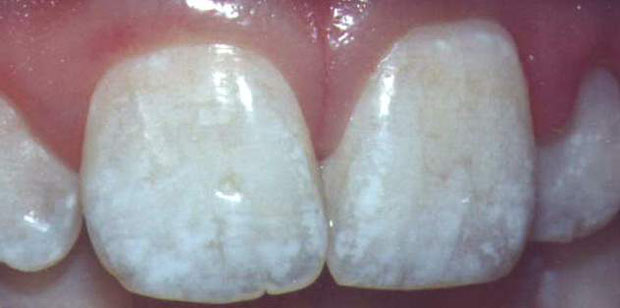
As a former resident of Portland, I’ve followed the fluoridation debate lightly without much of an opinion, but have dug into it some more with the unfurling of this thread. I tip my cap to the reader who linked to the anti-fluoride site. I, for one, have been trying to figure out what’s wrong with my teeth for some time, with no leads (even from dentists) until I saw the pictures of dental fluorosis:
I grew up in Lawrence, KS which had fluoridated water, and my teeth look like those with mild dental fluorosis. (But I also had no cavities while growing up.)
Overall, I thought that some of the arguments made on the site were compelling, some less so. But the reflexive cries of “whack-job” by readers in the following post made me cringe. In addition to providing zero links to their claims of pseudo-science for others to evaluate, there’s a rich irony lost on the responders.
Oppenheimer’s article wasn’t about fluoridation or organic food; it was about the aggressive purification of the left betraying the fundamental values of classic liberalism and subverting its societal priorities. That those readers imagine that they’re proving Oppenheimer’s point by citing Western medicine is laughable. There is perhaps no better example of “liberal” ideological purity and certainty than mainstream Western medicine, which dismisses all forms of knowing that can’t been “proven” in a lab.
A reader with a long-term illness writes:
I couldn’t resist responding to this statement: “Ignorance of science and medicine is a luxury that is great so long as you’re basically healthy. When you’re really sick, however, you’d better toss all that alternative crap out the window.” What upsets me most is the either/or attitude the reader advocates. I think this mindset permeates our culture. I think it’s completely unproductive and does nothing but produce self-righteous justification for one’s current beliefs.
I was raised holistically by both my parents.
On the rare occasions me or my brother did get sick my parents used homeopathy and other alternative methods and home remedies to treat us. When we had colds, it was honey / lemon / cayenne pepper tea, and onion cough syrup. If you look either of the home remedies up you will see that they are very old and have been used for many generations. Neither of us ever had bronchitis, tonsillitis, strep throat or other common childhood illnesses. We had our regular check ups and yes we got our required shots. We were the healthiest kids in our class and of most of our friends.
However, that changed for me around 10-12 when I got bit by a tick. I didn’t know it at the time, but I had contracted Lyme disease. My lyme would go undiagnosed for close to 20 years until I reached 30. In my early 20s I developed very severe endometriosis. After much searching and many visits to various doctors and specialists over a 3.5 year period, I was properly diagnosed and had two surgeries for it. The first was diagnostic but didn’t fix the pain. The second was done two years after my first by a surgical specialist and I was finally on the mend – or so I thought. I was diagnosed with chronic and untreated lyme disease two years after my second surgery. (Before any of your skeptics chime in on my lyme diagnosis, my diagnosis was confirmed based on the CDC guidelines for diagnosing Lyme, even though my bite occurred almost 20 years prior, and I never had any of the initial symptoms of a bull’s eye rash, fever or flu like symptoms.)
I write this brief history to note that I am exactly the type of kid the reader was referring to. But you know what ultimately got me better? BOTH alternative therapies and Western medicine. During the two years between my first and second surgeries, I used prescribed drugs by my gynecologist but I used acupuncture and Chinese herbs to support my system. This kept my nausea and fatigue at bay and was very helpful in lowering my pain. I also used a long list of other therapies, including medical marijuana. My Lyme treatment started with herbs for the first 1.5 years followed by a solid year of long-term antibiotic therapy. During this I worked closely with a kinesiologist that my Lyme doctor (yes, a regular MD) sent me to in order to tweak my supplements and antibiotics as needed.
Without using both holistic and allopathic medicine, I don’t think I would be as healthy and thriving as I am today. My Lyme is in remission and my endometriosis is under control. I still have mild symptoms that are controlled with herbs and supplements in addition to progesterone therapy, and a diet focused on whole foods, fruits and veggies. I think it’s incredibly narrow minded to dismiss the “alternative crap” as “ignorance of science”. I needed the drugs and the surgery, and I was perfectly willing to admit that and to use them as needed. But I wasn’t about to dismiss other treatments I’ve used preventatively my entire life that helped to sustain me and move me through my medical issues in a gentler way.
Update from a reader:
“There is perhaps no better example of ‘liberal’ ideological purity and certainty than mainstream Western medicine, which dismisses all forms of knowing that can’t been ‘proven’ in a lab.” I have my issues with liberal dogma (which most certainly does exist), but if one cannot prove something in the lab, then it isn’t “known” – it is rumor. Worse yet, such logic leads to homeopathy, healing crystals, and other bunk.
True, some herbs have medicinal properties, but unless one has run a double-blind test, then you truly don’t know if the herbs do anything beyond the placebo effect. The US government has spent over a billion dollars trying to prove non-Western medical claims, and guess what? The herbs and other items very rarely do anything positive, occasionally show mild effects, and often have undocumented side effects.
Wanting things that have been proven in the lab might be something many liberals want, but that want is based on what science has done for us, while the dismissal of the scientific method by your reader in nothing short of scientific denialism that is also the father of global warming denying, anti-vaccination movements, and other kinds of crazy.
We have never had a president as outwardly angry as Christie, but then this country has rarely been as angry as it is now. In the tea-party era, conservative anger has often been channeled by figures such as Michele Bachmann and Ted Cruz into a hysteria over very abstract and inflated threats: health-care death panels, the national debt, the specter of a country overrun by illegal immigrants. Christie’s use of anger is very different: It is much more targeted, and therefore potentially much more useful. …
What Christie is doing when he starts arguments with other Republicans—and it is telling that what looks very much like a presidential run has begun with a sequence of fights—is offering his party the chance to preserve its anger, while trading in its revolutionaries for a furious institutionalist.
The colour of the rooster, reminiscent of the iridescent, otherworldly pigment patented by the French artist Yves Klein, offers a surreal, comical contrast to the drab bronze statuary and buttoned-up grey facades of the grand buildings nearby. More importantly, the double entendre of its title is fully intended: with his stiff, punk-like coxcomb and jowly wattle, this puffed-up cockerel is meant to appear pompous and ridiculous. I particularly enjoyed his magnificently rumpled tail feathers. There’s something deliberately deflating about the manner in which they droop, so that the cockerel has the bleary aura of a whoring-and-roistering old rogue, worse the wear from drink, still strutting despite being unable to perform in the bedroom.
Here, then, is a sally by a female artist against the many vainglorious monuments commemorating self-important men that have been erected all over the world.
First, religiosity now strongly correlates with partisan loyalty. Nones are overwhelmingly Democrat. Regular churchgoers, especially but not exclusively Evangelicals, trend Republican. This politicizes religion. Second, religious people are becoming more and more dependent on the Republican party to protect their interests (religious liberty, for example). We could easily become a taken-for-granted base largely irrelevant to the party’s larger policy debate, as African-Americans often are in the Democratic party. Third, religion, especially orthodox Christianity, may end up implicated in the inevitable failures and corruptions of the Republican party. We may be in danger of recapitulating in some ways the disastrous alliances of the Catholic Church with the European right in the nineteenth and early twentieth centuries.
Douthat wonders if Pope Francis could help Christianity avoid this fate:
I think this analysis suggests a positive case, in the American context at least, for a papacy that simultaneously calls U.S. Catholics away from a too-close entanglement with the fortunes and platform of the Republican Party, and that consistently reminds non-Catholics and non-Christians that there is more to Christianity than the particular set of issues that have (understandably) kept many American believers in a right-of-center political orbit.
Israel has taken a diplomatic beating lately, including the E.U. decision to ban financing and cooperation with Israeli institutions in all territory captured in 1967 (including Jerusalem’s Old City). Netanyahu may feel compelled to take some heat off Israel by entering talks even at this painful price, while being confident that the Palestinian leadership will reject any reasonable Israeli offer. If Netanyahu can widen the perception that the absence of peace is due to unreasonable Palestinian demands and intransigence, that may ease the building diplomatic pressure on Israel.
That’s not a bad bet. First, Abbas set an acrimonious tone by this week by restating that no Jewish Israeli —soldier or civilian—could live in his future Palestinian state. Love is not in the air.
Yousef Munayyer doubts Israel has any reason to worry about its image, which is part of the problem:
Israel is pleased with negotiations for negotiations’ sake.
If they can, along with the United States, impose their will on the Palestinians and get them to accept a deal that leaves them with an impractical and indefensible demi-state of Bantustans, they might come to an agreement. If they can’t force such an agreement on the Palestinians, they will likely blame the Palestinians for the failure of the talks and key pro-Israel figures in the U.S. will support this narrative as well, allowing Israel to argue that it did all it could do and to effectively buy more time for the occupation.
To break this cycle, the U.S. must do something they have never been able to do in the peace process before: credibly and resolutely pressure Israel to comply with international law to achieve a just settlement. If Washington cannot do that, then the negotiations that they have convened merely support an Israeli public relations campaign aimed at convincing the world that they are on their way out of the West Bank while they only entrench themselves deeper in it.
More Dish on the current round of talks here, here and here.
Gingrich recently admitted that the GOP should reexamine its foreign policy:
I am a neoconservative. But at some point, even if you are a neoconservative, you need to take a deep breath to ask if our strategies in the Middle East have succeeded. … It may be that our capacity to export democracy is a lot more limited than we thought.
Jacob Heilbrunn sees Newt’s reversal as “a further sign that the old consensus in the GOP is fraying”:
Gingrich has long had an astute sense for the pulse of the GOP. He may well believe—and his belief may be justified—that the party is at a turning point when it comes to examining its stands on foreign policy. The GOP has yet to undertake a real reckoning with the policies of the George W. Bush and Dick Cheney.
It’s interesting that Gingrich is saying these things at a time when most hard-liners and hawks in the party are reaffirming their support for the ideas behind failed Bush-era policies, but I’m doubtful that Gingrich’s “change of heart” is all that significant. As a sign that hard-liners continue to lose ground in the party, it could be a welcome development, but it is just as easy to see Gingrich’s remarks as an effort at damage control. It seems to me that Gingrich isn’t saying these things because he wants to abandon neoconservatives, since he still claims to be one, but because he recognizes that their dead-ender defenses of extremely unpopular wars and attacks on Rand Paul are not having the desired effect.
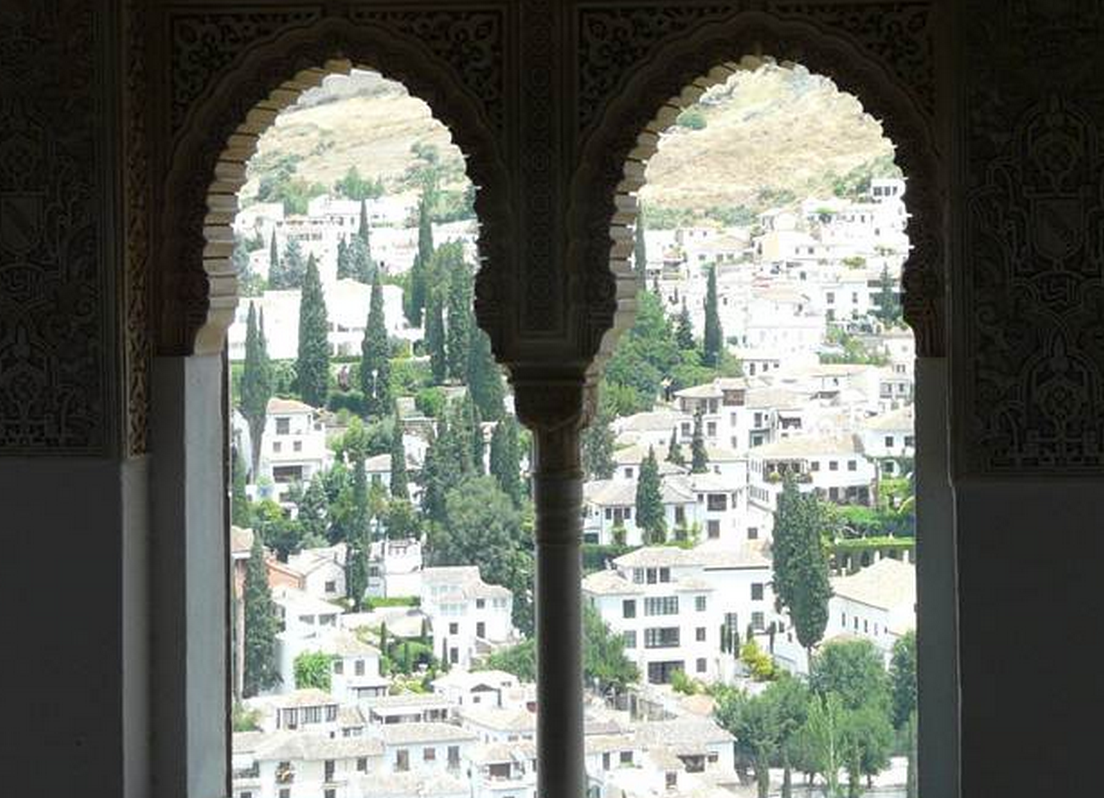
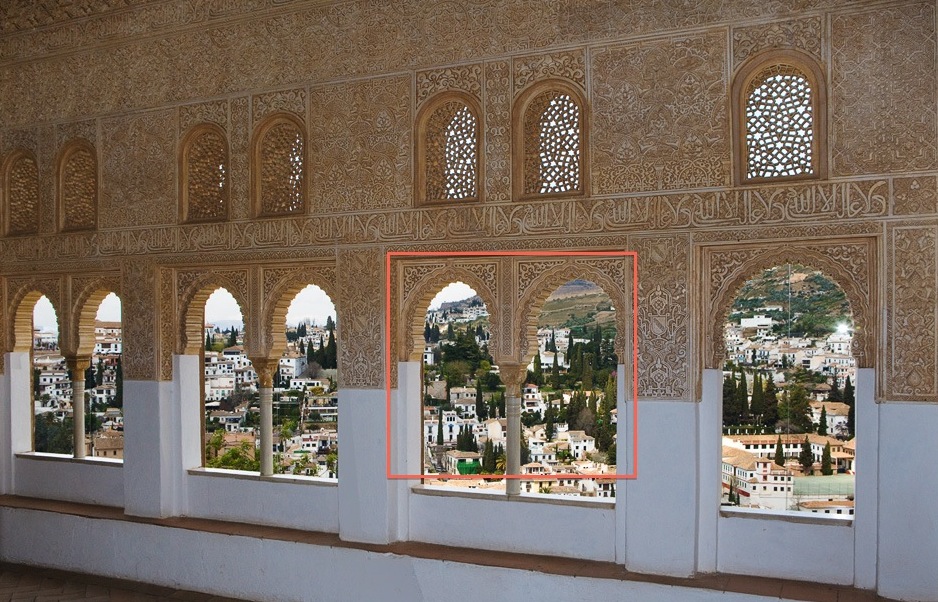
First impression of the picture gives me a distinct eastern Mediterranean vibe. The architecture and climate could fit anywhere between Egypt and Turkey. While it wouldn’t shock me if this was on the Iberian Peninsula somewhere, I’m staking my claim in Jordan. It seems a bit too sparsely vegetated for Turkey, too hilly for the Nile delta, and with conflict in Syria, I’m eliminating that country. It’s a crap shoot between Israel, Jordan, and Lebanon but I had to pick one, so here’s hoping.
Another reader:
I’ve never entered the contest before, but the decoration around the window is the first thing that struck me as so familiar. Though the coloring in the photo isn’t very sharp, the view and the pines also drew me to Villa d’Este, Tivoli, Lazio, Italy. Looking through photos I have from my last visit, so many of the buildings are similar. Though I’m not sure what exact window in the Villa it was taken, I believe it is facing north from a 3rd floor window toward the Reserva Naturale Monte Catillo. The only other problem is most windows in the villa are rectangular with only a few being arched.
But there are so many sights like this in central Italy, it could be just about anywhere. Oh, well! It did take me back to my last trip to Italy.
Another:
Is it the view from the bell tower of St. Francis of Assisi church, Umbria, Italy (and a hat-tip to the pope for his comments about gays last week?)
Another:
It looks like the hilly areas around Jerusalem, the Mount of Olives.
Another:
Tehran? Parts of it are extremely affluent and some of the architecture there is Beverly Hills-esque. That’s my guess.
Another gets in the right territory:
My guess is that this picture was taken in the southern part of Spain, Andalusia region. Specifically I think it is Cordoba. My wife and I went to Malaga for our honeymoon, so when I saw the picture, the South of Spain immediately came to my mind. It looks like the great mosque-cathedral or maybe Alcazar Palace.
Another nails the exact location:
Spain, Italy, Greece, Turkey. Right away, I narrowed this week’s contest to those four countries. Next, I eliminated Spain, since last week’s contest was in Spain, and what are the odds? Then I crossed off Italy, since those windows seemed to be plainer. Nothing really doing in Greece, so I turned to Turkey, fairly confident. The detail on the arches themselves, the Byzantine-looking designs around windows, Turkey seemed like a strong possibility.
But then I found the attached picture, and PLOT TWIST, it’s actually in Spain.
Specifically, it’s from the Alhambra, in Granada, Andalusia, Spain, facing north. Thanks for an easier one after last week. Although I did learn a lot last week, and I was the fifth or sixth best guess, which I’ll take given how hard it was.
Another provides some history:
The Alhambra was originally constructed as a fortress in 889 and later converted into a royal palace in 1333 by Yusuf I, Sultan of Granada. As Ferdinand and Isabella completed the reconquest of Spain, the last Muslim ruler Muhammad XII of Granada surrendered the Emirate of Granada in 1492, a singular year for the Spanish Empire for several reasons besides this final capitulation of Islam in the West. Legend has it that as the Moorish royal party moved south toward exile, they reached a rocky prominence which gave a last view of the city. Muhammad XII, surveying for the last time the Alhambra and the green valley that spread below, burst into tears. Whereupon his mother, clearly a an unsentimental person, reproached him bitterly mocking, “Thou dost weep like a woman for what thou couldst not defend as a man.”
Another reader:
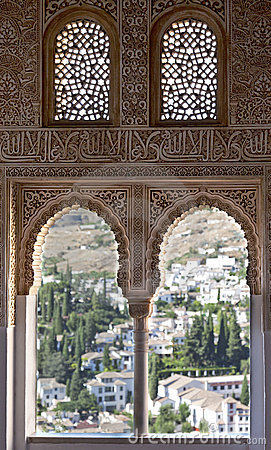
The window is one of four twin arches in the Oratory at the Alhambra, which means Red Castle in Arabic:
I’m still frustrated I didn’t get my submission in on time last week, so I looked at this week and thought: I’m not sure that I’m ready to face it. I gave it to my wife to look at, and in less than ten minutes she said: “It’s Alhambra, Spain!” If I win with this submission – when it wasn’t even me that found it – and when I might have won last week’s really hard one if I’d just got the time change right, then well, I guess c’est la vie.
Another:
I have a feeling that this week’s contest might not be too difficult. It took about 10 seconds to find a higher quality picture similar to the contest photo to confirm that we are in Granada Spain north of the Alhambra. Then it took some time searching images from inside the Queen’s Dressing Room, the Comares Tower, the Ladies Tower, and the Tower of Mihrab before finally stumbling on the Oratory:
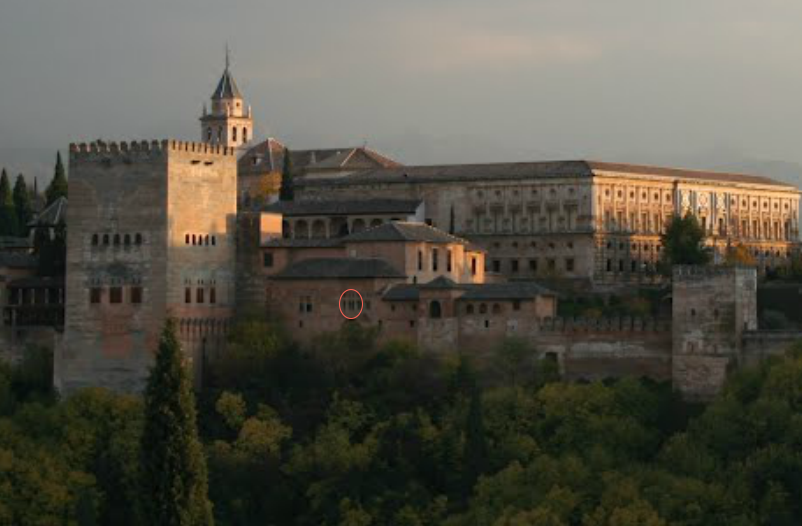
You posted my aerial view with the red lines in the answer to #156. It was one of the first contests I entered and the first time you posted anything I submitted. I assume that I will lose this one because either I was yet again one or two windows off or someone else will win the tiebreak. As always, thanks for the contest.
Another:
The palace is of course beautiful, and its reputation is well-deserved. One interesting fact is that there are some 10,000 calligraphic inscriptions in the palace, which are apparently not at all easy to read even for Arabic speakers. Amazingly, there was no effort to systematically catalog and transcribe them until recently.
Rick Steves provides an up-close tour:
Another reader:
You must be feeling charitable this week. I’ve seen so many of these views where I had not even the slightest clue. This one is obvious enough that I imagine you’ll receive a flood of emails. The Alhambra Palace – one of the most magnificent and beautiful creations of humanity, is the site of the photo. If it’s not, then you’ve really out-tricked me.
I had the opportunity to visit the Alhambra about 13 years ago, and found myself enthralled. I could’ve spent days wandering the place, examining the details and taking in the views. It’s a remarkable achievement from when the Moors ruled Spain.
We did indeed receive a flood of emails this week. Of the more than 150 readers who wrote in, about 95% answered Alhambra. About a dozen of those readers’ email addresses are marked with a “Correct Guesser” filter, which means they have gotten a difficult view (defined as one guessed by 10 or fewer readers) without having won the tie-breaker. Of those dozen, one clearly stands out for the number of contests participated in (31), so that reader breaks the tie this week. (His entry is the first visual one seen above, the one with a “PLOT TWIST”.) One more reader writes:
Didn’t you already do Granada within the last year? Regardless, this week took me all of 12 seconds, and I’ve never even been to Granada, so I’m going to assume that I have a flat zero chance at winning (especially since this is a famous window), but I’ll go ahead and submit a guess to hopefully better my chances of winning someday. Not to complain, but all of the recent contests have regularly been either some of the easiest or most difficult ever, any chance you could try to hit that middle ground a little more often?
Finding a good contest candidate – an interesting location that is not too easy, not too hard – is incredibly difficult, especially lately. Often it takes close to an hour combing through unused VFYWs just to find a decent candidate. So bear with us a little; the contest is only as good as its options.
Christie’s national security rhetoric is best understood as confirmation that he is the candidate of the people that thought Giuliani was a competitive and credible presidential candidate. Many of the people urging Christie to run in 2012 were former Giuliani backers, and Christie seems well-suited to represent the small constituency that combines hawkishness and security state authoritarianism with more moderate or liberal views on some at least some domestic issues. It is not a constituency that will propel a politician to a presidential nomination, but it could ensure a devoted club of admirers among hawkish editorial writers and columnists.
It’s surprisingly easy to envision Christie winning the nomination.
His conservative credentials are pretty good, so now all he needs to do is get Republicans to remember. That shouldn’t be hard for Christie. His charisma and brass-style will make him an excellent Obama-, union-, and liberal-basher once he wins reelection. It’s easy to envision him cleaning up the debates, like Newt Gingrich before South Carolina. It’s worth recalling that he was once a Tea Party favorite for exactly this reason. Unlike 2008, when Giuliani’s northeastern starting point was interrupted by Romney and McCain, there’s not another northeastern, maverick-y candidate to prevent Christie from doing well in a state like New Hampshire, Michigan, or Florida. If Jeb Bush doesn’t run, there isn’t another candidate better positioned to start locking down endorsements and donors. Electability will help, too.
According to a 2011 working paper by the American Association of Wine Economists, the global volume of beer in the 1960s was twice that of wine. As of 2005, beer consumption (153 billion liters) was six times that of wine (24 billion liters). In financial sums, beer is vastly ahead; the authors state that the beer industry accounts for an estimated 130 billion U.S. dollars, while the wine industry brings in around 65 billion.
The increase in beer production is in part due to its growing popularity in China. As of 2011, China, with its enormous population, consumed 20 percent of all beer in the world and replaced the U.S. as the largest beer market.