Cool Ad Watch

A cute campaign to get people to treat stray dogs more humanely:

It was shot in Santiago, Chile:

Created by Violeta Caro Pinda and Felipe Carrasco Guzmán, the dog-centric video follows volunteers as they tie balloons onto strays in the capital city’s La Cisterna area. Each balloon contains phrases (in Spanish), such as “Do not mistreat me,” “Scratch my neck” and “Give me love.”

How To Spin Your Rap Sheet

Convicted murderer Angel Ramos tells Sabine Heinlein how newly released prisoners frame their stories for employers:

“[On the job application, you] put down the penal code of the crime—125.5 for murder, for example,” Angel explained. “Don’t put the crime itself. Write: ‘Will explain further at interview.’ This is a place of business, and you don’t want people to gossip. This shows, ‘I’m looking out for you already.’  That’s a technique. ‘Imagine how I’m going to look out for you once I do work for you.’ It’s great psychology. Plus, people get interested. They want to know, ‘What the hell is 125.5?’ You want the guy to talk to you.

Then it’s your time to sell yourself.

When he asks you about the crime, you go, ‘Well, when I was 18 years old, I got involved with some bad people. Somebody died; I was convicted of murder, and I was given life.’ Not fifteen-to-life. Life! ‘However, I was released for good behavior. While I was in there, I did this and I did that.’ You go through your spiel. You talk about your social skills, your soft skills, your hard skills. You calm that person down. In other words, I went to jail, and it’s not a big deal. You shouldn’t be afraid of me.

Once you see that on his face, it’s no longer an issue. You move on to getting that job. What skills can I bring to this job? What can I do better than the other fifty applicants? I bring a whole different perspective. I think outside the box. I work harder than most guys. I love working. I’ve proved that I’m worthy of work. I can handle difficult people. I’ve been handling difficult people all my life. I have people skills. Then he sees that I’m not typical. I’m already blowing your bubble what prison is all about. It’s all marketing.

How Can The Sea Be “Wine-Dark”?

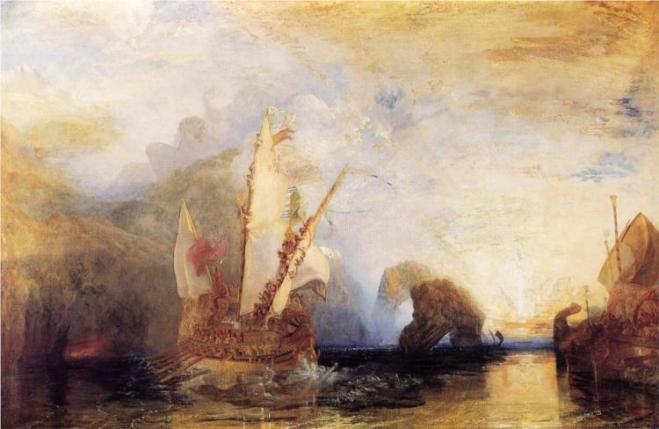
ulysses-deriding-polyphemus-1829.jpg!Large

Caroline Alexander explores the ancient question:

This wine-dark sea has haunted many imaginations. Nineteenth-century British prime minister William Gladstone posited in Studies on Homer and the Homeric Age that the Greeks had a form of color-blindness, their optical palette limited to black and white, and possibly red. Another theory was that a type of algal bloom, red tide, made the Homeric-era Aegean wine-red. In the 1980s, the view was advanced that since the ancient Greeks mixed their wine with water, the alkaline water common to the Peloponnesus would have turned red wine to blue. Another view came from a retired classicist who watched “an unusually vivid sunset” over the sea at the mouth of the Damariscotta River, in Maine, on an evening when the sky was filled with ash that had floated east from the eruption of Mount St. Helens, and was struck by the color of the sea “reflected in the outgoing tide of the dark estuary.” The sea, he said, was the color of Mavrodaphne, a wine of deep purple-brown hue, and the epithet for Homer’s wine colored sea, he speculated, meant “sunset-red.”

Finally, many contend that the phrase is meaningless, an empty expression with a poetic ring whose purpose is only to fill out the metrical requirements of a line of the verse.

Update from a reader:

Of course, one further explanation is that Homer was merely making an allusion to the opaqueness of the sea, not its color per se. He was comparing the inability of light to pass through wine (because of its color) with the similar effect caused by the depth of the sea.

Another:

Radio Lab did a piece on this a while back.  One of the possible explanations is that at that time there was no equivalent word in Greek for blue.

(Painting: Ulysses Deriding Polyphemus by J.M.W. Turner)

Chart Of The Day

unemployment-vs-share

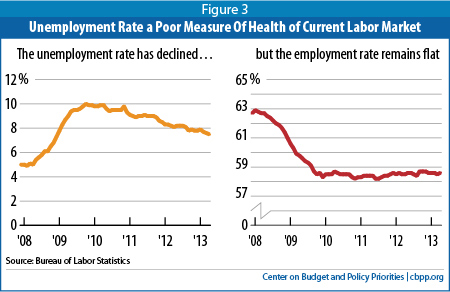
Ezra Klein declares that the comparison seen above “calls the entire economic recovery into question”:

[T]here are two ways to leave the ranks of the unemployed. One way — the good way — is to get a job. The other way is to stop looking for work, either because you’ve retired, or become discouraged, or begun working off the books. The yellow line on the left shows the official unemployment rate since 2008. It’s fallen from over 10 percent to under 8 percent. But the red line on the right shows the actual employment rate — that is, the percentage of working-age adults with jobs. What should scare you is that the red line has barely budged.

(Chart from the Center on Budget and Policy Priorities)

“Critical Making”

Matt Ratto and his colleagues at the University of Toronto, who were the first Canadians to print a gun, are proponents of “critical making.” Say what?

The idea is that, in order to study emerging technologies, people should physically engage in creating them. The goal is not to build better gadgets. It’s to understand how technologies fit into society. Mr. Ratto sees critical making as a bridge between the study of technology that goes on in humanities and social-science circles, and the engineering work typically conducted outside that world. He’s part of a group of scholars pursuing similar approaches. Their work goes by a variety of names: critical design, adversarial design, participatory design, speculative computing.

“We’re really interested in the claims that are made about 3-D printing,” Mr. Ratto says. “The 3-D printing of the gun–we did that in order to take ourselves through the process, not just to examine what other people had done but to see from our own embodied perspectives what it felt like, what types of work were required, how was the result seen and experienced. And what kind of conversation would it kick off.”

“From our own embodied perspectives”. Roll that around in your brain for a bit. Then think about “virtual sex” versus the embodied kind. Then have a stiff drink.

Mightier Than His Microscope

dish_dna

Jon Turney considers the literary legacy of James Watson:

The dominant impression of the American, gawky, gauche, preoccupied with sexual as well as worldly success, but with little experience of either, comes from his own account of the Cambridge days in The Double Helix. The other character sketches in that “personal account of scientific discovery”, as the subtitle puts it, are often little more than cartoons – boastful [Francis] Crick, scary [Rosalind] Franklin, authoritative but avuncular [Lawrence] Bragg. But however uncharitable he was toward others, Watson was equally unsparing of himself. He created a vivid impression of the state of mind of a startlingly young, intellectually arrogant but socially awkward interloper making his way among the British intelligentsia. It was the work not of Watson the scientist, but of Watson the writer.

In fact, surveying his working life, his writing is probably as important as his contributions in research or science advocacy.

He may not have originated the scientific memoir, but he certainly reinvented it. A host of later books chronicling the vicissitudes of research and the tensions and rivalries within and between labs are mainly inspired by The Double Helix. And he was equally influential in a completely different sphere. Molecular Biology of the Gene, first issued in 1965, three years before the autobiographical book appeared, reinvented the undergraduate science textbook, and was another huge publishing success.

Julie Chovanes adds:

When a collection of Watson’s essays were published in A Passion for DNA the New England Journal of Medicine hailed him as the “prose laureate” of the biomedical sciences. Lewis Thomas, Loren Eiseley and Edward Wilson may have better claims to that title. But, while Wilson comes close, Watson has been a more influential writer than any of them.

Someone should archive his writings using DNA.

(Photo by Flickr user kyz)

Hacking A House

Forbes editor Kashmir Hill hacked into eight strangers’ “smart houses” to illustrate the risks facing the $1.5-billion home-automation industry:

“I can see all of the devices in your home and I think I can control them,” I said to Thomas Hatley, a complete stranger in Oregon who I had rudely awoken with an early phone call on a Thursday morning. He and his wife were still in bed. Expressing surprise, he asked me to try to turn the master bedroom lights on and off. Sitting in my living room in San Francisco, I flipped the light switch with a click, and resisted the Poltergeist-like temptation to turn the television on as well. “They just came on and now they’re off,” he said. “I’ll be darned.” …

Googling a very simple phrase led me to a list of “smart homes” that had done something rather stupid. The homes all have an automation system from Insteon that allows remote control of their lights, hot tubs, fans, televisions, water pumps, garage doors, cameras, and other devices, so that their owners can turn these things on and off with a smartphone app or via the Web. The dumb thing?

Their systems had been made crawl-able by search engines–meaning they show up in search results–and due to Insteon not requiring user names and passwords by default in a now-discontinued product, I was able to click on the links, giving me the ability to turn these people’s homes into haunted houses, energy-consumption nightmares, or even robbery targets. Opening a garage door could make a house ripe for actual physical intrusion.

Leslie Horn thinks it’s time to take action:

In this case, Forbes is just talking specifically about Insteon, which is (hopefully) unique in the depth and breadth of its vulnerability. But if the connected home is going to be less of a trend and more of the norm, the companies that handle these systems need to take a cue and lock things down.

Meanwhile, Meghan Neal asks if we shouldn’t just return to simpler times:

The attention being given to hacking the [Internet of Things] is good, as it’s key to fixing the flaws. But it makes you wonder if, instead of controlling our front doors with our easily-lost cell phones, maybe we’re better off with a good old deadbolt.

Previous Dish on smart homes here and here.

The Best Of The Dish Today

This is what happened.

Putin stuck his fingers into America’s eye-sockets by giving Edward Snowden asylum for one year, but leading Christianists loved him anyway because he opposes freedom of speech and assembly for gay people. A Prohibition Rubicon was crossed when Uruguay became the first entire country to legislate a legal, regulated market for marijuana. The New York Times’ company’s subscription revenue grew by 5.1 percent as its online ad revenue fell 5.8 percent. Now you know why the Dish plumped for the subscription model as a first step, not a last one. Subscribe [tinypass_offer text=”here”]! Latest Dish-model data here.

In politics, it became clearer that the House GOP is incapable of actually cutting any spending which might hurt white people in their own districts. And good news: the prevalence of infant male genital mutilation in America is fast declining.

The most popular post of the day – by far – was “The GOP Calls Its Own Fiscal Bluff“. The second most popular was “What’s So Wrong With Virtual Sex?” By far our biggest referrer was the Huffington Post (to the GOP bluff post).

Over the last month, the site we referred the most people to was our old home at the Atlantic, followed by the NYT, Slate and The American Conservative.

See you in the morning.

What Is Sex?

A reader explores the seemingly simple question:

Your post on The Chastity Fallacy reminded me of a discussion I took part in once at a party. The guests were mostly lesbians and the topic was “How do you define sex?” For straight couples, “sex” is usually synonymous with “penis-in-vagina intercourse”.  If a straight girl asks her friend if she and her new boyfriend have “had sex”, that’s usually what is meant.

This leaves a multitude of other sexual activities that are not considered sex in the strictest sense. Dry humping, heavy petting, fingering, hand jobs, and often oral sex are thought of as “messing around” and not “real sex”.  This comes into play when people try to take inventory of their sexual past and figure out how many people they’ve “slept with”.

whats-so-wrong-about-virtual-sex-SDFor lesbians, the line between “messing around” and “having sex” is almost non-existent. Lesbian sex doesn’t have to involve a strap-on or even penetration of any kind.  Sexual activity that’s considered “messing around” for straight couples is “going all the way” for a lesbian couple.

I think at the end of the discussion, the best all-inclusive definition of “sex” we could come up was something like: “Stimulation of another person with intent to cause orgasm”.  Note that nobody has to actually achieve orgasm, and neither party has to be naked at the time of the stimulation.  Under this definition, humping another person’s leg while fully clothed would qualify as having sex.

If straight people counted even half of the things that lesbians consider sex, I suspect they’d have much higher sexual partner totals.

So sexting is the same as sex? And Bill Clinton wasn’t lying?

(Photo by Mathieu Grac, from his fantastic collection of “Amusing and Poignant Photos of Social Media Self-Portraits in Progress.”)

A “Small Meaningless Rebellion” Ctd

Readers sound off on musicians protesting the small royalty rates that Spotify pays out:

I have no tolerance for big time artists like Thom Yorke complaining about Spotify. Granted it was largely (though not entirely) record companies that screwed up the business by fighting the digital revolution every step of the way, and artists like Yorke are now “paying” for it.

Fortunately, it’s the record companies that will ultimately get screwed, as technology has made recording vastly less expensive, and the digital revolution – combined with services like Spotify – has made distribution basically free. At most, record companies will serve as a launching platform for new artists, who will then go “independent” after their initial contracts run out. The fact that big-time artists are still tying themselves to record companies is just emblematic of their own shortcomings.

Ultimately, however, the bulk of musicians’ salaries will come from touring, and to a lesser extent, merchandise. This doesn’t strike me as the least bit unreasonable. I went to college (and now go to graduate school) in order to secure a job where I can work to make an income. Similarly, musicians will go to the recording studio in order to make enough income by touring (i.e. working).

And yet Spotify still isn’t, you know, profitable, which helps dramatize the disruption that online streaming has created in the music world. A working independent musician nonetheless gripes:

I’m in an indie pop band from Kansas City, MO, and we’ve had our songs played about 82,000 times on Spotify.  We’ve been paid $422 for those plays.  That adds up to about a half a cent per play.

If Spotify would just bump that up to a measly 2 cents per play, we could easily have paid for the gas we spent over the last two weeks touring the East Coast.  As most know, it’s increasingly difficult to get people to pay for music these days so revenue streams consist mainly of selling merchandise or licensing your songs to commercials/TV shows/movies (that is, until you build up enough of a following to where door/ticket sales becomes your main source of income).

If Spotify could just adopt more of a nurturing role to small-time artists, we wouldn’t have to spend time devising crowd source campaign strategies or marketing our music.  We could, you know, concentrate on making music.

And yes, I realize that this is the new reality and that every band must become its own small business to some extent.  My point is that Spotify can make that a lot easier on artists, whether they’re great at the business aspect or not.  The fact that it appears most of the money is just going to wealthy shareholders is quite discouraging.

Another reader is conflicted:

I get that Spotify pays artists almost nothing for your music, and that sucks. But revenue is not measured in commissions alone. I’ve gone to see several bands live (and dragged several friends) that I would have never heard of if not for Spotify. And I’ve gone out and paid for a digital download of an album because I heard it on Spotify.

But here’s the thing: most of the time I never actually downloaded the album. It was an act of support, a reverse Kickstarter if you will. How many people out there on Spotify are like me? How many small artists get screwed out of royalties but play well-attended shows in Houston as a result of Spotify’s exposure? How many Spotify listens lead to an actual album purchase? Or a blog post? Or some viral Facebook/Twitter love? How much is that worth? How do you measure it?