The GOP Calls Its Own Fiscal Bluff

Perhaps the most frustrating aspect of the current GOP’s refusal to do anything but propose to slash spending is that “propose” is all they really want to do. They cannot actually stomach the actual cuts their abstract ideology demands. And so what happened yesterday, when the House leadership suddenly yanked a bill slashing transportation and housing spending, is of a piece with the growing incoherence on the right. Beutler has a must-read today, including this fantastic cri-de-coeur:

“With this action, the House has declined to proceed on the implementation of the very budget it adopted three months ago,” said an angry appropriations chair Hal Rogers (R-KY). “Thus I believe that the House has made its choice: sequestration — and its unrealistic and ill-conceived discretionary cuts — must be brought to an end.”

Yep, that’s as long as the Ryan budget discipline lasted this year: three months. Which is still a longer time than it took for the Ryan budget’s details to evaporate last year, as soon as Ryan was put on an actual national ticket, and had to find an actual national majority. In other words: all of this talk-radio rubber is finally hitting the actual fiscal road. And the screech and smell are unmistakable.

Obama’s strategy has been to keep proposing actual things to improve the economy, all of which the GOP will turn down almost as soon as he’s uttered them. Presumably, he’s trying to entrench the general impression that he is the sane one able to compromise while his opponents are out of their fast-shrinking minds. The GOP strategy? Good luck finding one apart from sabotaging growth, but, whatever it is, it seems they cannot follow it. They are opposed to spending when they want to attack a Democratic president; but, in power, they’ve long spent like leftwing Democrats used to. Recently, they sent a huge, unnecessary check to Big Ag. Under the last Republican president, the completely bankrupted the country. And when they actually have to contemplate real cuts in programs that might affect their own constituents, they balk.

They are a slogan, not a party.

And in the end, you do actually have to leave the Fox News studios and actually do the minimal amount to keep the government actually functioning. When they get there, they fall apart. The solution? A huge effort to throw these nihilists out on their ears in 2014, or to forge some kind of alliance between the Senate and a sane bipartisan majority in the House. The latter won’t happen if Boehner wants to keep his job. The former is deemed unlikely or impossible. That logic needs to be challenged.

Ask Frederic Rich Anything: Are Christianists Really Still A Threat?

Yesterday we heard about a fictional President Palin, while today the author of Christian Nation explains his political motivation for writing the book, as well as how he believes there is still a “deep bench” of Christianist politicians worth worrying about:

Frederic Rich is an American lawyer, environmentalist and writer. His novel Christian Nation imagines what would happen if America became a theocracy. From the publisher:

When President McCain dies and Sarah Palin becomes president, the reader, along with the nation, stumbles down a terrifyingly credible path toward theocracy, realizing too late that the Christian right meant precisely what it said. In the spirit of Philip Roth’s The Plot Against America, one of America’s foremost lawyers lays out in chilling detail what such a future might look like: constitutional protections dismantled; all aspects of life dominated by an authoritarian law called “The Blessing,” enforced by a totally integrated digital world known as the “Purity Web.” Readers will find themselves haunted by the questions the narrator struggles to answer in this fictional memoir: “What happened, why did it happen, how could it have happened?”

Our full Ask Anything Archive is here.

When Art Changes Life

Since Fifty Shades Of Grey was first published in Britain, cops have been reporting a sudden rise in “handcuff-related” domestic incidents:

London firefighters have freed 1,300 people with body parts trapped in household objects in the last three years — 307 of which were injured. This includes 79 people trapped in handcuffs, nine with rings stucks on their penises and one man whose penis was stuck in a toaster. Third Officer Dave Brown said, “I don’t know whether it’s the ‘Fifty Shades’ effect, but the number of incidents involving items like handcuffs seems to have gone up.”

Cancel That Moscow Summit, Mr President

United Russia Party Congress Convenes

Vladimir Putin’s decision to poke the United States firmly in the eye over the Edward Snowden case requires a proportionate response. His belief that US-Russian relations can go on unmolested by this provocation needs to be disproven. No sincere partner in the world community would seize this opportunity to leverage world opinion against a flawed NSA spying program that looks in political danger in the Congress already. It’s preposterous to see this as anything but a piece of geo-political theater.

I cannot see how it benefits Snowden. He will be easily portrayed by his enemies, in classic fashion, as a defector to Russia after exposing secret information from the US government. A Communist “parliament” member who’s running for Moscow mayor just exclaimed:

Frankly speaking, he is a also like a balm to the hearts of all Russian patriots.

Why, unless the motive is pure anti-American animus. Snowden is not aiding the enemy, of course, any more than Manning was; he is just allowing himself to be used as a means of further humiliating and taunting his own government. And whatever the US government’s failings, it’s not a reasonable moral or political position to prefer Russia’s authoritarianism. Russia is not, to put it mildly, the model of transparent, accountable government Snowden says he believes in. Its own responses to Jihadist terrorism have been the pulverization of Chechnya and the arming of Bashir al-Assad – not exactly role models for liberaltarians.

It’s a no-win situation for president Obama, but he should not signal that this kind of mischief is no big deal for the US government. No summit meeting with Putin, then. And perhaps a wider review in the Congress of whether the US should attend the Winter Games in Sochi. Threats to arrest American athletes, if they are openly gay, is also something to be taken into account. The new Russian law – which could put an American athlete in jail for merely talking about his or her orientation in public – is a foul piece of work to which the US should not in any way acquiesce:

“An athlete of nontraditional sexual orientation isn’t banned from coming to Sochi,” Vitaly Mutko said in an interview with R-Sport, the sports newswire of state news agency RIA Novosti. “But if he goes out into the streets and starts to propagandize, then of course he will be held accountable.”

Would the US ever participate in an international sports event where the host country is threatening to arrest foreign athletes if they exercize what would, in the US, be their First Amendment rights?

I have mixed feelings about Snowden. In his defense, he has clearly exposed something to wider public view that has resulted in a healthy and overdue debate in the public and Congress. But he broke the law to do it; and Russia’s embrace of him is a provocation that requires a proportionate response. That’s the only language Putin understands anyway. Time to reverse the pressure.

(Photo: Prime Minister Vladimir Putin participates in the United Russia Party congress on September 23, 2011 in Moscow, Russia. The congress is meeting to approve the list for Russian State Duma elections scheduled on December 4. By Sasha Mordovets/Getty Images.)

Quote For The Day

“The conservative backlash against the pope (who could have imagined it!) has become quite the ugly spectacle, while the attempts to spin him into what he obviously is not (the First Things post about the 5 myths was a notable example) are pathetic,” – a commenter on the far-right Catholic blog written by Father John Zuhlsdorf.

The site is an excellent way to read the broader dismay among conservative dissenters with Pope Francis’ initiatives and statements since taking office. The AP has a decent story on it here. Santorum is insisting that nothing substantive has changed, but I must say I have never heard him speak on this issue with the respect, gentleness and humility of Francis.

My own argument that the shift in tone actually reveals a deep, substantive contradiction at the heart of the Church’s teaching on this subject is here.

Kerry’s “Fool’s Errand”? Ctd

US-ISRAEL-PALESTINE-PEACE-TALKS-DIPLOMACY

Michael Cohen credits Kerry for getting this far:

The diplomatic breakthrough engineered by John Kerry that led to direct talks in Washington this week is really nothing less than astounding. Not only did Kerry – largely through his own grit and guile – get both sides to the table, he did so without raising any of the hackles of “pro-Israel” groups in the US and particularly in Congress. [Few] took Kerry’s shuttle diplomacy seriously and then suddenly the talks became a fait accompli before the usual suspects could torpedo it in advance.

Beyond this initial accomplishment, there are two other reasons for confidence in Kerry’s methods: first, he has made clear that the nine month talks are for the whole enchilada, namely all unresolved issues – no interim agreement or confidence building effort that can be undermined by the rejectionists on both sides as was the case with Oslo. Second, by getting the Arab League to reaffirm its commitment to recognizing Israel if a deal for Palestinian statehood is reached, he is not only putting pressure on Hamas, he is giving the Israelis one exceptionally large carrot. Any deal Netanyahu achieves, particularly one that dismantles settlements of divides Jerusalem, will set off a firestorm among right-wing and territorial-obsessed Israelis.

He’s done substantively far more in a few months as secretary of state than Hillary Clinton did in her entire competent, but quietist, term.  Daoud Kattab explains why the Palestinians want heavy US guidance in peace talks this time around, despite America’s strong ties with Israel:

For the Palestinian side, the idea of trilateral, rather than bilateral, talks changes the dynamics of the negotiations for the better. By getting the United States into the negotiation room, the Palestinians are hoping that Washington will square its public posture — which has been rather fair and in sync with the international position on Palestine — and its real position in shielding Israel from the rest of the world. Palestinian thinking is that through their Arab and Muslim allies, they can help ensure that the Americans remain honest in the talks or bear the fruits of overt bias in the already boiling Middle East. Having US negotiators in the room also provides a sense of continuity that might help ensure that the basic issues of the sovereignty of the Palestinian state, equality of the land swaps (in size and quality) and genuine sharing of Jerusalem (especially the Old City) are reached.

While Palestinians are not expecting absolute fairness from the Americans, they are hoping that the cost of failure, that is, its ramifications on foreign policy and the strategic interests of the United States, is such that it will help produce a fairer US role in these talks.

Paul Pillar suggests that Netanyahu, and even Hamas, could still surprise us with progress:

A decades-old charter, even though it has effectively been countermanded by more recent declarations by Hamas leaders, is taken as the basis for saying that Hamas “does not recognize Israel’s right to exist” and therefore should be shunned if not strangled. Yet the charter of the Likud Party, which explicitly rejects the right of a Palestinian state to exist—a rejection that prominent members of the party have in effect reasserted—is not taken as a reason for disqualifying Likud leaders as interlocutors in a negotiation ostensibly aimed at creating a Palestinian state. The important point for the present purpose, however, is that even if one believes that the worst things said about Hamas’s objectives are probably true, careful consideration of cost, risks and possible benefits leads to the conclusion that Hamas should be engaged.

Let us approach Benjamin Netanyahu in the same spirit. We are entitled to retain healthy skepticism about his objectives, the more unfavorable interpretations of which may still turn out to be true. But we should give him every chance to demonstrate otherwise.

Previous Dish on the potential of the new talks here and here.

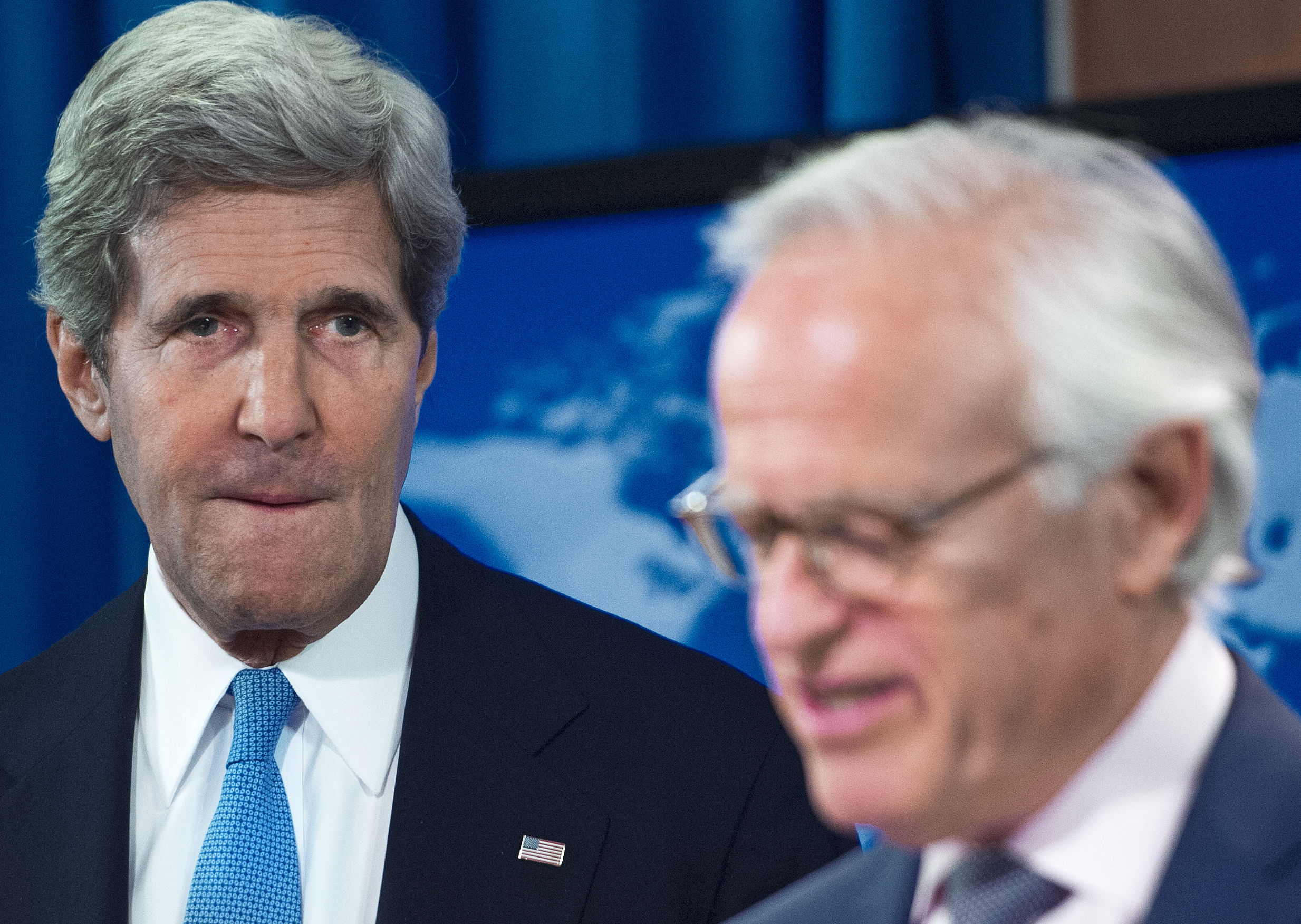
(Photo: US Secretary of State John Kerry listens during a press conference at the State Department on July 29, 2013, after announcing former US ambassador to Israel, Martin Indyk will head the Israeli-Palestinian peace talks that begin later this evening in Washington, DC. Just hours before Israeli and Palestinian negotiators were to resume talks frozen for three years, Kerry said Indyk would take on the difficult task of trying to guide both sides to reach a full-fledged peace deal. By Paul J. Richards AFP/Getty Images)

The Fragile Faith Of Fox News, Ctd

So they finally have to grapple with their inquisition of scholar Reza Aslan because he is a Muslim writing about Jesus in his new book Zealot. How do they air the debate? By getting wingnut Brent Bozell on to pile on. No one is there to present Aslan’s argument; the Foxbot interviewer doesn’t even raise a defense of the author as a means to facilitate a discussion. Criticism of the interview is explained by Muslim super-sensitivity. There is absolutely no intent to explore the issue in a balanced or even faintly open way.

It’s just, well, disturbing, divisive, anti-intellectual propaganda. But for Roger Ailes, all those features are a plus.

A Pit Stop On The Road To Democracy? Ctd

BAHRAIN-POLITICS-UNREST-DEMO

Juan Cole shifts focus to Bahrain, where anti-monarchists are taking on the rhetoric and appearance of the June 30 protestors in Egypt:

A coalition of Shiite groups and some Sunnis (the Waad or Promise Party) continues to agitate against the authoritarian practices of the Sunni monarchy. The dissidents have formed a Rebellion (Tamarrud) Movement in emulation of the one that brought down President Muhammad Morsi of Egypt, and are calling for big demonstrations on August 14.

The Bahrain regime has responded with Draconian new laws threatening to take away the citizenship of protesters and banning protests altogether in the capital. These measures are severe violations of international human rights laws. Washington has been relatively muted in its response to these violations. Bahrain hosts the HQ of the Fifth Fleet in the Gulf and its Sunni monarchy is an opponent of Iranian influence, covering a multitude of sins from the point of view of the Obama administration. Shiites are about 60% of the citizen population, but are discriminated against and many are relatively poor and powerless. The regime maintains that Shiite activists are terrorists working for Iran, but these charges are frankly ridiculous covers for a regime that practices arbitrary arrest and punishment.

Steve Coll’s chilling prediction for the region, as anti-Islamist (and anti-democratic) forces gain traction, is here. Previous Dish on the recent upheavals in the Arab world here and here.

(Photo: Bahraini protestors gather during a rally in central Manama early on July 30, 2013, to collect signatures to support ‘ Bahrain Rebellion ‘ a call going around Bahrain for a mass demonstration on August 14. By Mohammed Al-Shaikh/AFP/Getty Images)

Modernism At War

dupain-bankstown-aerodrome-camouflage

Ann Elias tells the story of Max Dupain and Frank Hinder, two WWII-era Australian artists who “used the techniques of abstraction, cubism and surrealism to help the military camouflage and conceal soldiers, airplanes and military equipment”:

Their overseas counterparts included such illustrious modernist names as Roland Penrose in the UK, and László Moholy-Nagy and Arshile Gorky in the US. These artists researched how to conceal and disguise objects and bodies for military advantage, instructing their respective military forces in the “art” of camouflage. …

There are many synergies between modernism and military camouflage. Camouflage is paradoxical and cryptic. It requires the mind to think in doubles. Abstraction’s dissolution of form, surrealism’s subversion of the authority of vision, collage’s disorientation of perspective and cubism’s fragmentations were all modernist trends that were fundamental to the techniques Dupain, Hinder and their colleagues used to create camouflage. Towards the end of his life Dupain reflected that in the 1940s he was “pattern prone.”

Elias wonders if the modernists don’t get more credit for their wartime work because their collective effort “sits so ambiguously–and uncomfortably–between the history of violence and the history of aesthetics.” Although that doesn’t seem to have hurt the Abstract Expressionists, who received CIA backing in the 1950s and ’60s.

Previous Dish on modern art and international relations here.

(Photo: Max Dupain, Bankstown aerodrome camouflage experiment, c.1943. National Archives of Australia)