The Best Of The Dish Today

Are performing orcas enslaved? I suggest so. Are Tina Brown and Sally Quinn sexist? The argument is here. Who’s the most important author in America right now? Khaled Hosseini. How fragile is the faith of Fox News? As fragile as all fundamentalisms.

We learned that the current Israeli government would rather release cold-blooded murderers from prison than freeze a single building in a single settlement. And that if you really want a good orgy, head on over to Tehran, where the mullahs rule, and the next generation despairs.

The most popular post of the day was my reflection from last night on “This Extraordinary Pope.” The second? My update on the fantastic hypocrisy and chutzpah of the Clintons.

See you in the morning.

When Lights Conceal

dish_artificiallightmap

Paul Bogard, author of The End of Night: Searching for Natural Darkness in an Age of Artificial Light, considers the quality of darkness as a diminishing natural resource. He speaks about the connection between artificial light and public safety:

Ironically, what has happened now is that we have so much light that we can no longer see. We’re blinded — sometimes literally, by the brightness and glare of our security lighting — but also metaphorically, which is to say that when we light everything up, there is really no reason to look over and notice something, and say, “Wow, that’s a weird thing.”

When everything is so brightly lit, why should we look? It’s light, so it’s safe, so we switch off. And, while no one is looking, we’ve actually made life easier for the bad guys. Some studies even show that criminals actually prefer well-lit areas. I had several policemen and security consultants tell me that criminals are as afraid of the dark as we are. They don’t want to go in the dark. The light makes them feel safe, just as it does us.

(Image: Maps of artificial night sky brightness by P. Cinzano, F. Falchi, and C. D. Elvidge)

No Honor Among Cyber-Thieves

Patrick Howell O’Neill tells the tale of a Deep Web defector:

Before he gutted and nearly destroyed one of the most influential criminal markets on the Internet, a man using the nickname Boneless published a detailed guide on the art of disappearing. “I have some experience in this area,” he wrote, detailing how fugitives should best go about buying phony passports, dodging cops, and keeping their stories straight.

The guide was just one of many contributions Boneless made to HackBB, a popular destination on the Deep Web, a group of sites that sit hidden behind walls of encryption and anonymity. Back in 2012, the forum was a top destination for buying stolen credit cards, skimming ATMs, and hacking anything from personal computers to server hardware. And thanks to Tor’s anonymizing software, members were shielded from the ire of law enforcement around the globe. It was one of the safest and most popular places on the Deep Web to break the law.

Then one day in March, HackBB simply vanished, its databases destroyed. One user likened the events to burning a city–its library, market, bank, and entire community–to the ground. It wasn’t hard to guess who’d done it. A few days earlier, Boneless had disappeared–and with him, a serious chunk of the market’s sizable hoards of money.

Nitasha Tiku marvels at the story:

The strangest twist seems to be the staying power of Boneless’ reputation as a stand-up guy–to a point. Even OptimusCrime still believes Boneless didn’t orchestrate the heist as much as “sold his powerful administrator account to the highest bidder.” They say the greatest trick a hacker ever pulled was convincing his peers he’d sell them out rather than hack ’em himself.

The Inimitable Otis

On the release of a new singles collection, Jack Hamilton pays tribute to Otis Redding:

Like all of the greatest singers, Otis Redding was utterly unique. He lacked the technical virtuosity of his idol, Sam Cooke–another ’60s musician whose death came much too early–but made up for it with flawless taste and musical intellect. Despite his well-earned reputation for incendiary live performances–most famously on display in his performance at the Monterey Pop Festival [seen above], six months before his death–Redding was never the frenzied pyrotechnician of later “soul man” parodies. In fact, his greatest gift may have been his command of restraint and understatement.

The best singers are also masters of silence: The moments that Ray Charles doesn’t sing–when he’s just about to sing, just finished singing, or taking a breath (especially when he’s taking a breath)–can be as electrifying as any notes coming out of his mouth. Otis Redding understood and used this power as well as anyone. Critic Dave Marsh once wrote that Redding’s performance of “I’ve Been Loving You Too Long (To Stop Now)” sounds “as though each line is coming to him only the instant before he sings it, quavering notes as if in the grip of an undeniably exquisite passion that must be consummated–now!” a description that itself dwells in pauses, anticipation, the thrill of ensuing discovery.

Stephen M. Deusner marvels at the voice:

“The Glory of Love” is not a very good song. … With its twin melodic lines—“That’s the story of, that’s the glory of love”—and its oppressively chipper tempo, it’s certainly catchy in a nursery rhyme sort of way, yet it’s supremely saccharine and just plain dopey. So why would someone like Otis Redding, at the height of his esteem, choose to cover this song out of the thousands in the American pop canon? It’s hard to imagine anyone save [songwriter Billy] Hill himself thinking it was worth the great singer’s time, even if they didn’t know how limited his time was.

But here’s the catch:

Otis Redding absolutely kills it. He transforms “The Glory of Love” into something moving and even sublime. As Steve Cropper’s guitar traces tears down your cheek, as Isaac Hayes and Al Jackson Jr.’s snare clicks out a tempo about twice as fast as the song demands, and as the horns offer sympathetic punctuation, Redding testifies mightily to the glory of love. It’s soul music, but the process of repetition, variation and elaboration is more akin to jazz. He teases out the song’s central ideas, however corny they may be, until they yield something meaningful, but as the song builds and builds, it never reaches a climax or epiphany. Rather than cut loose, the musicians hold back.

This is why Redding was such an immense figure in pop music in the 1960s and why his death was such a tragedy: He could plumb even the fluffiest pop song and locate a kernel of honest-to-God wisdom.

Heard here:

Are We Still Rooting For The Bad Guys?

Heather Havrilesky notices that, whether intentionally or by accident, TV anti-heroes since Tony Soprano are becoming less and less sympathetic:

The trick that David Chase pulled off with The Sopranos was that he made us feel protective, affectionate love for a bad, bad guy, a guy who wanted to grow but couldn’t, a guy who, at the end of the day, just wanted to daydream about the good old days and stuff his face with onion rings. When Tony had a panic attack or missed the ducks in his pool or got beat up or embarrassed, it made us feel terribly sorry for him in spite of ourselves.

That’s not how we feel about Walter White.

But that’s not how we’re supposed to feel about him. Just as Walt wasn’t designed to occupy the same place in our hearts as Tony Soprano, neither was Don Draper of Mad Men. But because Matthew Weiner and the show’s other writers take pains to show us why Don does what he does, it’s more of a problem when we come way from these character sketches feeling unmoved.

In the show’s sixth season, Don didn’t necessarily make bigger mistakes than he ever had, but his hungry ego and his weaknesses were on full display like never before. Aside from being called a monster by Peggy and assuming the fetal position toward the end of the season, Don didn’t register guilt or awareness of his own terrible behavior that often. Even though it may be Weiner’s intention to demonstrate the limitations of Don’s consciousness, even though Mad Men is arguably guided by ideas more than emotions, and Don’s shortcomings are meant to embody the shortcomings of not just an entire generation but also late capitalist American society itself, the exercise can grow tiresome when Don is less likable than the writers seem to believe.

Reality Check, Ctd

A reader writes:

On that new Gallup poll, you said “The new poll doesn’t change much on the generic question as to approval of marriage equality.”  I’m not so sure. These results struck me as an important (even if incremental) shift for several reasons:

1)  Swings to the right in 2005, 2008, 2009, and late 2011 gave social conservatives some hope that an undercurrent against SSM was part of the trend line.  Once the pendulum swings far enough to the left, they reasoned, it swings back again.  After all, there was +8 gap for marriage equality in 2011, and by the end of the year it was once again a dead heat.  It was important, then, that this last Gallup poll showed no such compensatory shift.  After after consistent momentum across the last three polls, the American public no longer seems to be vacillating.

2) This is the first time in the history of the Gallup poll that that gap between marriage equality proponents and traditionalists has been in the double digits.  In electoral politics, those last 2-3 points is the difference between just a lead and a landslide.

3) Disapproval of SSM is at an all time low (43%), and those respondents seem to have shifted into the “I don’t know” column, which has tripled from 1% to 3%.  This indicates to me that there is growing uncertainty on the right.

A Pit Stop On The Road To Democracy? Ctd

Michael J. Totten reports on the disintegrating scene in Tunisia:

My Tunisian fixer Ahmed tells me he’s all but certain the labor parties will win the next election and that [governing Islamist party] Ennahda will be out on its ass. He can’t really know that, but it’s certainly plausible. Ennahda might even fall sooner than that if one of the liberal parties resigns from the government or if demonstrations become an unstoppable tide like they did during the revolution a few years ago. The country’s political center of gravity has been moving away from the Islamists since the day they entered the government, and the only hard power leverage they have is the banned Salafist movement, and even that’s just theoretical.

Tunisia is mellow, even pacifist, compared with Algeria. The army is smaller than Egypt’s, and it is not—or at least it has not been—a political player. So I don’t expect a full-blown Algerian-style insurgency or an Egyptian-style military coup. Nor is a Tiananmen Square-style massacre in the cards. Tunisia is not a police state, and Ennahda admits it’s afraid of the army.

But tensions are rising, the situation is volatile, the country is more dangerous now than even a week ago, and the region is always surprising. Keep an eye out because even the “moderate” Islamists empowered by the Arab Spring are back on their heels. They thought they owned the future, but they do not.

Max Boot sees an opening for fresh neocon meddling as the Arab Spring “sputters”:

This is why it’s vitally important–as Michael Doran and I argued in Foreign Policy  magazine–to develop our capacity for waging political warfare, as we did in the early days of the Cold War, when the U.S. helped various anti-Communist forces. Today we should be helping anti-Islamist forces. Instead, because we have let our capacity for political warfare atrophy, we are forced to either send F-16s and Predators to push regime change (as in Libya in 2011) or sit by ineffectually (as in much of the Middle East ever since).

There needs to be a better way–the U.S. needs to be able to overtly and covertly support more moderate and secular forces in the battle over the future of countries such as Libya and Tunisia, where there is an excellent chance of a decent and democratic outcome. Instead the widespread perception is of American retreat, leaving our natural allies at the mercy of radicals.

More Dish on the Mideast tumult here and here.

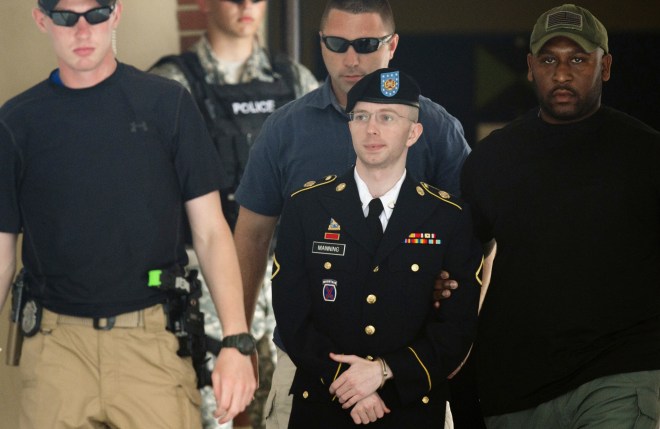
Manning Dodges A Bullet

US-COURT-WIKILEAKS-MANNING

As we mentioned earlier today, Bradley Manning was found guilty of violating the Espionage Act while acquitted of the separate charge of “aiding the enemy.” The former Army private now “faces a possible maximum sentence of more than 130 years in military jail after he was convicted of most charges on which he stood trial.” Paul Waldman and Jaime Fuller’s take:

It’s one thing to have only limited sympathy for Manning—after all, he didn’t just leak evidence of government malfeasance, he leaked hundreds of thousands of documents, most of which showed no one doing anything wrong, and the indiscriminate dump surely did damage to American diplomatic efforts. But if he had been convicted of “aiding the enemy,” it would have set an extremely dangerous precedent. National security leaks happen all the time—those who report on the topic wouldn’t be able to do their jobs without them—and if every time someone in the Pentagon passed a tidbit to a reporter they could be charged with something akin to treason, the chilling effect would be, well, chilling.

Manning was many things—you can call him misguided, overzealous, or foolish if you like. But had the court called him a traitor, we would have entered territory we don’t want to visit.

Fred Kaplan, who called it a “moderate” verdict, is on the same page:

Had the judge accepted the argument and found Manning guilty of the [“aiding the enemy”] charge, the implications would have been profound. By such a verdict’s logic, The New Yorker could have been accused of aiding the enemy for publishing Seymour Hersh’s article about the torture of detainees at Abu Ghraib. Hersh’s intention may have been to call attention to war crimes being committed by U.S. officers in Iraq, but a prosecutor could certainly have argued that the story served al-Qaida’s interests; and it’s certainly true that the revelations over Abu Ghraib were used as recruitment tools by jihadists worldwide.

Though Manning dodged the “aiding the enemy” charge, Dan Gillmor still worries about press freedom:

By finding Manning guilty of five counts of espionage, the judge endorsed the government’s other radical theories, and left the journalism organization that initially passed along the leaks to the public, Wikileaks, no less vulnerable than it had been before the case started. Anyone who thinks Julian Assange isn’t still a target of the US Government hasn’t been paying attention; if the US can pry him loose from Ecuador’s embassy in London and extradite him, you can be certain that he’ll face charges, too, and the Manning verdict will be vital to that case.

DJ Pangburn wants us to revisit the Espionage Act:

How could an act written in 1917 possibly address or, rather, handle the complexity of a whistleblower of Manning’s scale and intent? The fact is that the Espionage Act of 1917 was never written with Bradley Manning in mind. Its goal was not to address whistleblowing at all, but the delivery of intelligence to foreign governments. …

Now, it is one thing to create the legal mechanism to prosecute spies who deliver information to the enemy. But it is quite another to prosecute a soldier, or any American for that matter (journalists, for instance) for publishing documents that shine a light on shameful deeds. Manning wasn’t paid for his work by any foreign nation or agent. He wasn’t working on anyone’s behalf apart from his countrymen. All of this is to say that the Espionage Act needs to be amended to make room for whistleblowers. Because, as it stands, any whistleblower is at the mercy of the law, and the President’s particular whistleblower policies.

Looking back, Peter Walker runs through all the secret information we now know as a result of Manning’s leak.

(Photo: US Army Private First Class Bradley Manning leaves a military court facility after hearing his verdict in the trial at Fort Meade, Maryland on July 30, 2013. Colonel Denise Lind found Manning guilty of 20 of 22 counts related to his leaking of a huge trove of secret US diplomatic cables and military logs to the WikiLeaks website. She said she would begin sentencing hearings on July 31 at the Fort Meade military base outside Washington where the trial was held. By Saul Loeb/AFP/Getty Images)


Cameron’s Online Porn Crackdown, Ctd

tumblr_mqmkcfel6F1qj4tgpo1_500

Peter Jukes says the prime minister’s anti-porn move is smart political posturing:

Hard to enforce and easy to circumvent, Cameron’s plans to censor internet porn has much more to do with the populist optics than any practical policy. With a moribund flat-lined economy, the Labour Party, under new leader Ed Miliband, has established a double-figure poll lead for almost two years. However, with the help of a controversial Australian lobbyist and political strategist, Lynton Crosby (“the Wizard of Oz”), the Tories have managed to claw that deficit back to single figures in recent weeks.

Most of this was achieved through classic Rovian tactics: red meat to the right on issues like immigration and welfare, and—shooting UKIP’s fox—promising a referendum on continued EU membership. Meanwhile other moves, such as the successful passage of much-trumpeted legislation on same sex marriage (against the wishes of most his party) helps keep some of Cameron’s “compassionate conservative” credentials alive. Internet porn is another twist in these kind of triangulations.

Still, it doesn’t seem like Cameron is handling these triangulations very well. First he irritated feminists by declining to support their campaign against Page Three. Then it came out that the controversial firm Huawei – linked to the Chinese government and deemed a “threat to national security” by the US – will control the filter. Then the Open Rights Group found that the filter will be designed to block by default “esoteric material,” “web forums,” “violent material,” “smoking,” and “alcohol”, among other topics.

In protest, the blogger Sicksad built a filter to block everything but the naughty bits.

(Image via Google search)

It’s So Personal: Monoamniotic Twins

Dustin Rowles, who wrote the Pajiba post mentioned by a reader in our earlier post on After Tiller, recently went through a harrowing ordeal with his wife after doctors determined she was pregnant with monoamniotic twins:

The doctor told us that if we went forward with the pregnancy, if one fetus died in utero it would probably leave the other baby severely brain damaged. He said if that happened, we could make a plan to go to one of two states in the country — Florida or Colorado — that still have individual Doctors providing late-term abortions. Kansas used to be an option, we were told, but the Doctor who conducted procedures to terminate the pregnancies of severely brain damaged and deformed babies with no chance of a decent quality of life had been shot and killed. Ain’t that America.

We decided to terminate. It was the most difficult, most agonizing decision either my wife or I had ever made. We both are pro-choice, but when it comes to abortion, in the typical scenario, you decide to terminate a pregnancy you don’t want. We had made a decision to terminate the potential lives of two babies that we did want. That we wanted very badly.

However, we felt that the risks were too high and that it would be irresponsible to risk not only our future but that of our son, who was four. We didn’t want him to have to grow up in a home with parents that had to devote all their emotional and financial resources to profoundly disabled siblings. More than that, we didn’t want to bring beings into the world that would have to spend a lifetime suffering, who might have a severely low quality of life.

The thing is, there was no one from whom we could solicit advice. There’s not even a lot of anecdotal information with which to work when you’re pregnant with monoamniotic twins. There is one major support page online, but there is a lot of self-selection in posters, and most of the people who write have had a positive outcome that has either confirmed or bolstered their religious convictions. Many of the posts make clear that termination was never an option — and/or should not be an option — for others in this situation, which we totally disagreed with. What we were aiming to do was make the right choice for us — a rational, logical decision that an objective couple in our situation would make. We were relatively young. We could still have more children. We could wait a few months or a couple of years and try again.

The more we thought about it, the more sense it made to end the pregnancy. We felt — and we still feel — that this is a fundamentally personal decision, and we were shocked at the politicization of this medical issue, when of course nobody else can tell you what is right for your family. It is a decision that has the potential to fundamentally alter the entire course of your life, and until you are personally faced with something like this, there is no way to know how you are going to react or what the right course of action will be.

Rowles and his wife subsequently changed their minds and opted to continue the pregnancy. Mercifully, though their twin girls were born premature, they both beat the odds and survived with no ill effects. You can read the rest of his story here. And to read all the late-term abortion stories from Dish readers, go here.