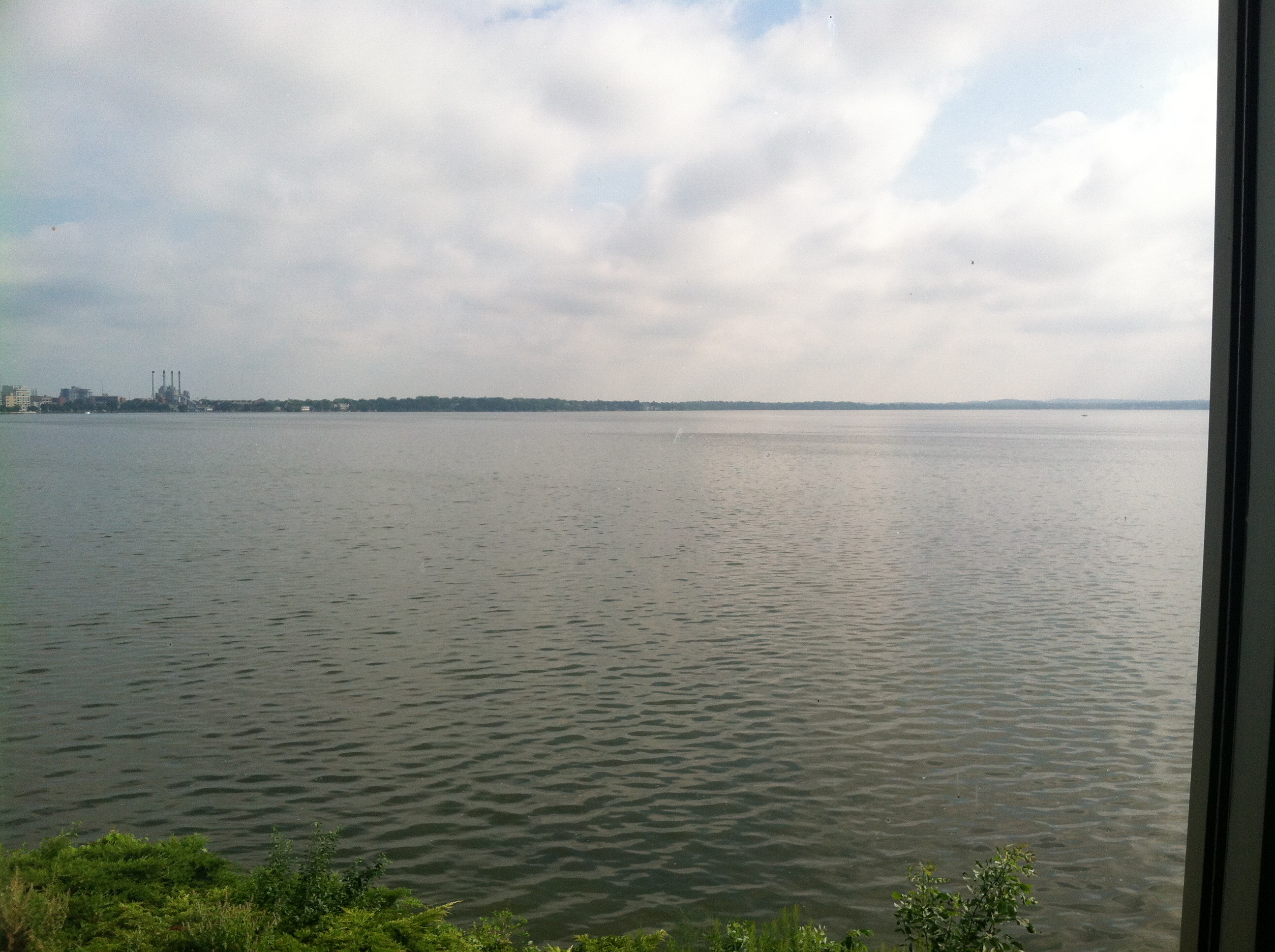
Madison, Wisconsin, 9.29 am. Spurred by our post last night, the reader adds:
Otis Redding died in the water out there on December 10, 1967.
At this point, I’m afraid, I am reduced to giggles. This is his campaign spokesperson’s idea of how to react to a former intern blowing smoke in a tabloid:
“And then like she had the fucking balls to like trash me in the paper. And be like, ‘His communications director was last the press secretary of the Department of Education in New Jersey. You know what? Fuck you, you little cunt. I’m not joking, I am going to sue her.”
I’m just trying to imagine TPM reporter Hunter Walker’s face as he heard this on the phone. Good times.
So, yes, regardless of any of the merits of the debate about sexting and adultery and double standards, we now have ourselves a fantastic shit-show on our media hands. Which requires that I note the top three comments from MrHippity on the Gawker page which features the unpixellated photos of the member from Brooklyn:
I didn’t look very hard at these pics. I just took a quick glans.
I thought these new dick pics would be like his earlier ones, but there’s a vas deferens.
I didn’t have to look at them, of course. Nobody was foreskin me to do it or anything.
Get your popcorn out front.
“The world’s biggest – probably only – pair of flying bollocks” for a good cause:
For all of your scrotum-related Dish coverage, head here.
Gregory Wazowicz and Christopher Richards recently asked a number of gay writers “what books spoke to them when they were coming out, asserting their identities, or putting a name to their desires.” Jesse Bering’s choice:
George Santayana’s semi-autobiographical The Last Puritan played some role in my decision to kick the closet door off its hinges once and for all. I was about 21, and I’d already come out to my family and some close friends. But I was a sad case—I was living an ascetic scholarly lifestyle and throwing myself into my graduate studies to somehow cultivate the illusion that I was ‘above’ sex. I saw aspects of myself in the character of Oliver Alden (in fact, I even faintly resembled the black-and-white etching of him on the jacket cover). And it really wasn’t a flattering sight. I found it irritating how Oliver was sublimating his obvious homosexuality in lofty philosophical abstractions. Santayana would allude to Oliver’s same-sex desires repeatedly in the narrative, but he refused to come out and say it. I remember thinking to myself, ‘Oh, for Christ’s sake, Oliver, just come out already and get some action!’ I found his sexual cowardice—which was in fact a reflection of Santayana’s own—so pathetic and disturbing that it made me reexamine my own erotic austerity.
Related Dish on Christopher Bram’s history of gay literature in America here.

Claire L. Evans, a musician frequently on the road, contemplates the meaning of travel:
Travel is inherently narcissistic. Even if we’re looking to be knocked off our axis, we’re still in the business of self-improvement. People want to go to faraway places and return changed. A lot rides on this expectation. We hunt for perspective, for miraculous connections, but when these moments happen, we don’t always recognise them — or we look in the wrong places.
There is a collection of jungle villages around Ubud on the Indonesian island of Bali, which is as remote and humid and disorienting as any foreign place. The landscape is clogged with temples spewing incense, and yet long lines of Western tourists snake out the doorway of the single mountain temple that featured in Elizabeth Gilbert’s book Eat, Pray, Love (2006). I
t’s easy to laugh at these people. It’s easy to say that they are missing the point, but are they? Maybe they’re just mainlining into the essence of what travel is always already about: pat revelations about the self. When we were in Bali, we went to a different temple, and our dirty tennis shoes looked ridiculous beneath the stiff embroidered sarongs we were commanded to wear. I felt nothing, except for self-consciousness and the impulse to snap a dozen pictures I haven’t looked at since.
(Photo by Flickr user mollybob)
Philosopher Ian Hacking assesses the Diagnostic and Statistical Manual of Mental Disorders, the clinicians’ guidebook for psychiatric diagnoses. He finds a fundamental “fatal flaw”:
The first stab at a medical diagnostic manual was made by a friend and exact contemporary of Linnaeus, with the rather daunting name of François Boissier de Sauvages de Lacroix, a physician and botanist in Montpelier. In 1763 Sauvages published his Nosology Methodica, explicitly stating in its title that it was modelled on the classification of plants. He had ten classes of illness, of which the eighth was madness. Each class was divided first into genera and then into species, producing 2400 kinds of malady.
There have been many systems for classifying mental illness since then, but all seem to me to be on the botanical model, and that has been their fatal flaw. …
Sauvages’s dream of classifying mental illness on the model of botany was just as misguided as the plan to classify the chemical elements on the model of botany. There is an amazingly deep organisation of the elements – the periodic table – but it is quite unlike the organisation of plants, which arises ultimately from descent. Linnaean tables of elements (there were plenty) did not represent nature.
The DSM is not a representation of the nature or reality of the varieties of mental illness, and this is a far more radical criticism of it than [National Institute of Mental Health Director Thomas] Insel’s claim that the book lacks ‘validity’. I am saying it is founded on a wrong appreciation of the nature of things. It remains a very useful book for other purposes. It is essential to have something like this for the bureaucratic needs of paying for treatment and assessing prevalence. But for those purposes the changes effected from DSM-IV to DSM-5 were not worth the prodigious labour, committee meetings, fierce and sometimes acrimonious debate involved. I have no idea how much the revision cost, but it is not that much help to clinicians, and the changes do not matter much to the bureaucracies. And trying to get it right, in revision after revision, perpetuates the long-standing idea that, in our present state of knowledge, the recognised varieties of mental illness should neatly sort themselves into tidy blocks, in the way that plants and animals do.

Grayson Schaffer finds that few Westerners appreciate just how dangerous it is to be a Sherpa:
According to the Himalayan Database, which keeps track of such things, 174 climbing Sherpas have died while working in the mountains in Nepal—15 in the past decade on Everest alone (see sidebar for a country-by-country comparison). During that time, at least as many Sherpas were disabled by rockfall, frostbite, and altitude-related illnesses like stroke and edema. A Sherpa working above Base Camp on Everest is nearly ten times more likely to die than a commercial fisherman—the profession the Centers for Disease Control and Prevention rates as the most dangerous nonmilitary job in the U.S.—and more than three and a half times as likely to perish than an infantryman during the first four years of the Iraq war. As a dice roll for someone paying to reach the summit, the dangers of climbing can perhaps be rationalized. But as a workplace safety statistic, 1.2 percent mortality is outrageous. There’s no other service industry in the world that so frequently kills and maims its workers for the benefit of paying clients.
(Photo: A Nepalese Sherpa collects garbage at an altitude of 26,200 feet during a May 2010 clean-up expedition at Mount Everest. A team of 20 Nepalese climbers collected 4,000 pounds of rubbish during the high-risk operation. By Namgyal Sherpa /AFP/Getty Images)
Doug Mack argues that guidebooks like Fodor’s and Frommer’s “are uniquely effective documents of a changing world—and, more to the point, they have been underappreciated actors in creating social change”:
They … stand out for shaping history, if not always intentionally, because of their authoritative reputation—they have long been the best insight into that which would be otherwise unknown. Most notoriously, the Nazis claimed to have used Baedeker’s guides in a 1942 series of air attacks on English cities, which would become known as the Baedeker Blitz. There’s some disagreement among historians as to whether the Nazis really did use the books, but this was Nazi propagandist Baron Gustav Braun von Sturm’s claim: that Baedeker had unwittingly identified the targets by highlighting Britain’s most beloved landmarks and towns, the places whose destruction would deal the biggest blows to the national spirit, including the cities of Bath and Norwich. More recently, shortly after American troops entered Iraq 10 years ago, Lonely Planet Iraq was pressed into duty for precisely the opposite goal, assisting officials who were prioritizing sites for protection.
Other guidebooks have specifically sought to right societal wrongs, like The Negro Motorist Green Books, a series published from 1936 to 1964, which guided African Americans traveling the U.S. in the era of Jim Crow. As civil-rights leader Julian Bond, whose parents used Green Books, told the New York Times in 2010, “It was a guidebook that told you not where the best places were to eat … but where there was any place.”
The concept comes from Max Weber’s The Protestant Ethic and the Spirit of Capitalism, but the term “work ethic” appears nowhere in the text itself. Peter Womack dives in:
The ‘ethic’ Weber described is a complicated mixture of spiritual and practical imperatives, embracing ideas of self-government, the suppression of natural impulses, the search for marks of divine grace, and the purposive ordering of a person’s whole life. It is distinctively Protestant in the sense that it took the ascetic discipline of the monastic tradition and tried to rewrite it for life in the world. It was also, according to Weber, the victim of a historical irony: these particular virtues, promoted for religious reasons, were often conducive to making a great deal of money, and so bringing about conditions of luxury and leisure that threatened to undermine the virtues themselves. In other words, what Weber has to say about work is embedded in a story about how we became who we are.
Many historians have argued that it is not an entirely true story; but it is nevertheless an interesting one. Reducing it to the simple promulgation of a ‘work ethic’ destroys most of its interest, its power to provoke thought. The cliché works, as clichés often do, to make the idea at once more digestible and less alive.
In the process, several inconvenient signs of life drop away. One of them is the class content. As Weber tartly puts it, a ‘bourgeois businessman’, interpreting his bottom line as a mark of God’s blessing, ‘could follow his pecuniary interests as he would and feel that he was fulfilling a duty in doing so.’ Meanwhile, ‘The power of religious asceticism provided him in addition with sober, conscientious, and unusually industrious workmen’. That is, the shared beliefs of employer and employee caused both of them to act in the employer’s interests. ‘The work ethic’ is not the same for everyone: it depends where you are in a system of working relationships. Abstracting the phrase from the system loses that subtlety. A work ethic becomes the attribute of an individual. Some people have it, some people don’t, and all those who have it have the same thing. Society vanishes from the idea.
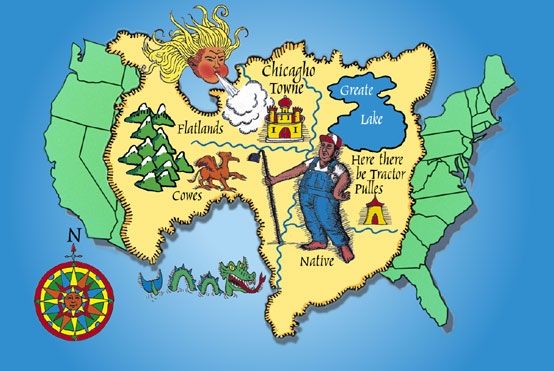
(Image from an Onion article about the Midwest. The popular Dish thread on the amorphous region is here.)
The founders of the Freedom Rights Project believe that the proliferation of human rights treaties obscures the public’s ability to understand the very rights being protected, thus reflecting poorly on an overstuffed bureaucracy:
The expanded and diluted notion of human rights allows illiberal states to change the focus from core freedoms to vague and conceptually unclear rights that place no concrete obligations on states. Enabled by such rhetoric, no human rights violation can stand scrutiny on its own merits. Instead, human rights violations are relativized — intellectually dismembered and discarded when it is politically expedient. In this world, cuts in development aid can be labeled human rights violations just like torture in North Korea.
Crucially, this unprincipled politics of human rights helps authoritarian states deflect criticism. In 2007, Cuba, which has one of the worst human rights records in the Western Hemisphere, succeeded in persuading a majority of HRC members to axe the specific mandate for monitoring its own human rights record. The praise authoritarian states shower on one another for supposedly upholding new, vague and abstract rights are therefore not just empty rhetoric but can produce real political gains.
Unfortunately, much of the human rights community has not only shied away from expressing qualms about rights proliferation, it has often led the process. But this approach has not helped advance the core freedoms that make the difference between liberal and non-liberal states: According to Freedom House, global respect for basic civil and political rights is in decline for the seventh consecutive year.
Of course, it is exactly those basic rights that non-free states want to neuter. When everything can be defined as a human right, the premium on violating such rights is cheap. To raise the stock and ensure the effectiveness of human rights, their defenders need to acknowledge that less is often more.

