Drinking And Drafting

Blake Morrison ponders why so many acclaimed writers have been drawn to the bottom of the bottle:

There’s a window between the first and second drink, or the second and third, when the unexpected sometimes happens – an idea, an image, a phrase. The problem is getting itdown before it’s lost; if you’re in company, that means disappearing with your notebook, which takes resolve or self-regard. The Amis principle – a glassful to relax with at your desk when most of the writing has been done – is fine for those with will power. But there’s the cautionary dish_hemingwayexample of Jack London, who used to reward himself with a drink when he’d done half his daily quota of 1,000 words, then found himself unable to get started without one. The man takes a drink, then the drink takes the man. Liberation becomes stupor. “Write drunk; edit sober” is Hemingway’s much-quoted advice. But the rat-arsed aren’t capable of writing. After a point, the crutch becomes a cudgel.

Why do writers drink? Why does anyone drink? From boredom, loneliness, habit, hedonism, lack of self-confidence; as stress relief or a short-cut to euphoria; to bury the past, obliterate the present or escape the future. If Olivia Laing’s entertaining book fails to come up with a simple answer, that’s because there isn’t one. To the literary biographer, binges and benders are a godsend – a chance to recount lurid anecdotes under the guise of earnest psychoanalytic enquiry. But for the rest of us, the words on the page are what matter. And most of them get there despite the drinking, not because of it. “Drank like a fish, wrote like an angel,” would make a pleasing epitaph. “Drank like a fish, wrote like a fish” is more likely.

Previous Dish on drinking and writing here and here.

(Photo: Ernest Hemingway, via Wikimedia Commons)

“Everybody Poops For The World Of Sex”

Ashley Fetters appreciates how the new film The To Do List disrupts standard teenage sex tropes:

[The film] presents a less common kind of story about a girl having sex for the first time. Brandy loses her virginity to Rusty — who’s clearly not the guy she’s “meant to be with” — then has a moment of thoughtfulness before meeting up with her best friends right in time to announce her recent banging of Rusty Waters and then catch the rest of Beaches. When Brandy’s dad (a hilariously anal-retentive Clark Gregg) discovers what’s happened and races to her rescue, a calm Brandy reassures him, “I’m fine, Dad. I’m OK.”

By sidestepping the “emotional-trauma-after-virginity-loss” construct and replacing it with giddy detail-spilling among friends, The To Do List sends up both a female onscreen teen-virginity trope and a male one: The “late-blooming virgin loses it to generically hot rando, comes away with high-five-worthy story to tell buddies” theme crops up more often in stories about teenage boys. (See: American Pie, Sixteen Candles, Almost Famous, Porky’s, Road Trip, Losin’ It — and Superbad, kinda.) And perhaps more importantly, it provides a positive alternative outlook on what happens to girls who “give away their flower” or don’t “guard their carnal treasure“: Sometimes, they’re pretty much fine.

The Great Microbreweries Of China

dish_beerinchina

Great Leap Brewing co-founder Carl Setzer explains how he’s cultivating a niche customer base in China, the world’s biggest beer market:

One of the … reasons why our product appeals to Chinese consumers on a base level is because it incorporates Chinese cultural elements in the beers themselves and also incorporates Chinese literature and historical references in the naming and branding of the beers. Two good examples of this would be our Iron Buddha Blonde Ale and our Little General IPA. The Iron Buddha Blonde uses tie guan yin wu long tea during the brewing process, which gives the beer a floral note at the end. The name “Iron Buddha” is one way to translate the tie guan yin (铁观音), or the iron goddess of mercy.

The Little General IPA, on the other hand, is a “purity law beer,” meaning it contains only malted barley, hops, yeast and water, but the name is unique because it is an homage to Zhang Xueliang (张学良), a patriotic hero for both mainland China and Taiwan. The nickname “Little General” is a reference to his father (张作霖), a notorious warlord in China’s Northeast region. Zhang Xueliang grew from a spoiled brat with an opium habit into a symbol of China’s future unity against the Japanese during the occupation when he kidnapped Chang Kai-Shek and convinced him to join the KMT’s strength with that of the Communist forces. Upon Chang Kai-Shek’s agreement with this plan, Zhang Xueliang immediately surrendered to Chang’s personal guard and spent the better part of his adult life under house arrest with Chang’s forces in both mainland China and Taiwan. He was released as an old man and relocated to Hawaii to live with relatives in peace. He died at 99 years old, never having returned to mainland China nor Taiwan after his release.

(Photo: Ryan McFarland)

Book-Buying In 3D

Virginia Postrel argues that bookstores like Barnes & Noble can be saved:

Separate the discovery and atmospheric value of bookstores from the book-warehousing function. Make them smaller, with the inventory limited to curated examination copies — one copy per title. (Publishers should be willing to supply such copies free, just as they do for potential reviewers.) Charge for daily, monthly or annual memberships that entitle customers to hang out, browse the shelves, buy snacks and use the Wi-Fi. Give members an easy way to order books online, whether from a retail site or the publishers directly, without feeling guilty.

Peter Osnos agrees that “bookstores are for browsing”:

[T]hey should also be showrooms in which the selection on hand is backed up by the vast catalog and data bases of books that can be ordered. No customer should ever leave a store having asked for a book that can be located somewhere without closing the sale. I once saw a relevant sign in a hotel in Egypt of all places that today’s booksellers should adopt: “The answer is yes; there is no other answer.”

Looking at market trends, James Surowiecki sees optimism for print-lovers:

Of course, a lot of people [find that] physical books are “technologically obsolete,” and the book industry is heading down the path that the music industry took, where digital downloads decimated CD sales and put record stores out of business. It’s true that, between 2009 and 2011, e-book sales rose at triple-digit annual rates. But last year, according to industry trade groups, e-book sales rose just forty-four per cent. (They currently account for about a fifth of the total market.) This kind of deceleration in the growth rate isn’t what you’d expect if e-books were going to replace printed books anytime soon. In a recent survey by the Codex Group, ninety-seven per cent of people who read e-books said that they were still wedded to print, and only three per cent of frequent book buyers read only digital.

He finds that print books are here to stay for good reason:

The truth is that the book is an exceptionally good piece of technology—easy to read, portable, durable, and inexpensive.

Previous Dish on digital reading here, here, and here.

That Is The Question

Could Shakespeare have actually written all the plays we attribute to him? The debate goes on. David Womersley looks to Coleridge to address the logic behind “the zombie argument that refuses to die”:

“What is poetry,” says Coleridge, “is so nearly the same question with, what is a poet? that the answer to the one is involved in the solution of the other.” It is this Romantic approximation of the poet and the poem that laid the foundations for the doubts over Shakespeare’s authorship of his plays. Readers of those plays who had imbibed such Romantic notions of authorship — notions quite foreign to the milieu in which Shakespeare wrote — concluded that a humbly born boy from an obscure Midland town could never have written these dramas, many of which bring on stage kings and nobles, and are set in foreign lands. There had to be some counterpart in the life of the playwright to these aristocratic features of his work. Hence the theory of a nobly born author who was obliged to disguise his authorship because of the indignity of writing for the public stage.

However, for those blessed with deeper insight the true authorship of the plays was concealed within them, either in a tissue of hints and obliquities, or in codes and ciphers which, when handled by an adept, could be made to yield up the identity of the genuine playwright. It is hard to write in measured language about the snobbery which underlies these theories, and the confusion of mind which accompanied their articulation.

(Video: A mega-mashup of Hamlet references from the movies)

The Value Of Visual Literacy

Martin Scorsese underscores it:

We’re face to face with images all the time in a way that we never have been before. And that’s why I believe we need to stress visual literacy in our schools. Young people need to understand that not all images are there to be consumed like fast food and then forgotten—we need to educate them to understand the difference between moving images that engage their humanity and their intelligence, and moving images that are just selling them something.

As Steve Apkon, the film producer and founder of the Jacob Burns Film Center in Pleasantville, New York, points out in his new book The Age of the Image, the distinction between verbal and visual literacy needs to be done away with, along with the tired old arguments about the word and the image and which is more important. They’re both important. They’re both fundamental. Both take us back to the core of who we are.

When you look at ancient writing, words and images are almost indistinguishable. In fact, words are images, they’re symbols. Written Chinese and Japanese still seem like pictographic languages. And at a certain point—exactly when is “unfathomable”—words and images diverged, like two rivers, or two different paths to understanding.

Faces Of The Day

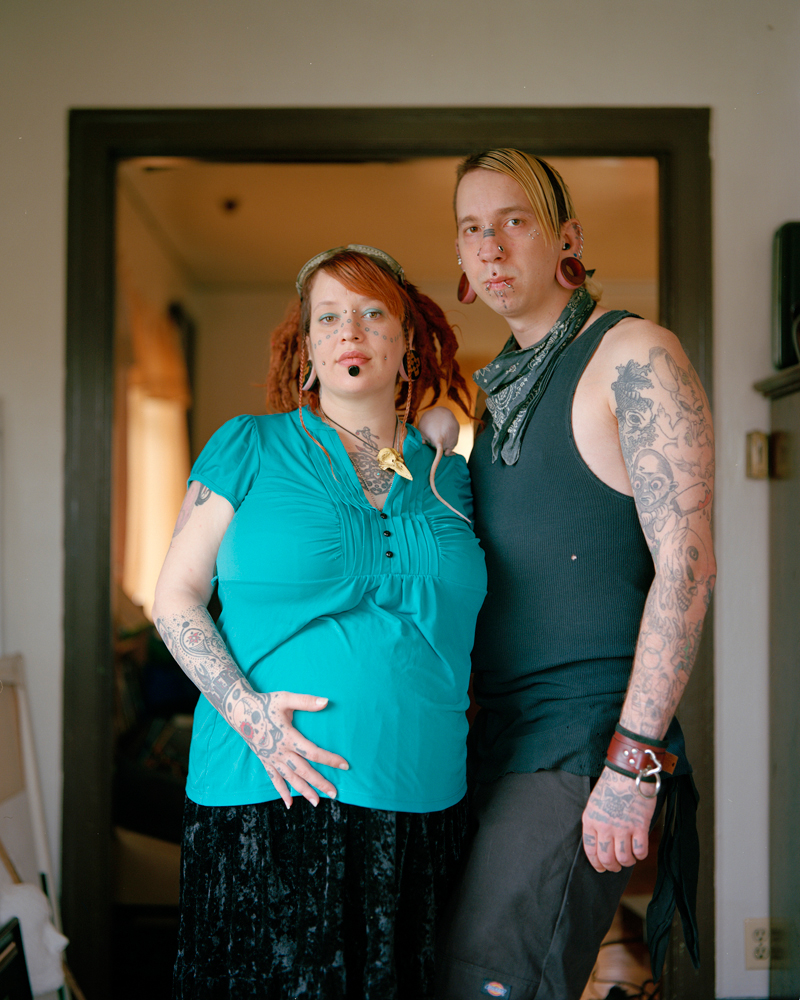
dish_portraitlandia

For his series Portraitlandia, photographer Kirk Crippens took to the streets of Portland, Oregon to snap pictures of residents.  Says the artist of naming the series:

At the end of my Newspace [Center for Photography in Portland, Oregon] residency, I had the pleasure of presenting the images during an artist talk. I posed a question to the audience before showing the work: “What’s the worst title you can think of for a portrait project made in Portland?” My answer was Portraitlandia. Ironically, after my slideshow a group of Portlanders began insisting I name the project Portraitlandia; I resisted (hadn’t I just proclaimed this to be the worst title?) But they were quite insistent! They told me it was what I had created. I had created Portraitlandia.

A gallery is here.

(Photo by Kirk Crippens)

Yglesias Award Nominee

“I’d be leading the charge [for defunding Obamacare] if I thought this would work. But it will not work … You’re going to set an expectation among the conservatives in our party that we can achieve something that we’re not able to achieve. It’s not an achievable strategy. It’s creating the false impression that you can do something when you can’t. And it’s dishonest … You’re not going to stop the funding, but what you will do is shut down the government. Among that group of senators that has been considering this, I was the only one who was here for that. The president is never going to sign a bill defunding Obamacare. Do you think he’s going to cave? The strategy that has been laid out is a good way for Republicans to lose the House,” – Tom Coburn.

Bonus:

There’s some small shred of sanity left, it seems. Combined with Behner’s slapdown of Steve King, lets hope it gains more steam.

The Good E-book

Nir Eyal samples a Bible app, complete with reading programs and special notifications intended to keep believers chaste and sober:

The Bible app is designed to make absorbing the Word as frictionless as possible. For example, to make the Bible app habit easier to adopt, a user who prefers to not read at all can simply tap a small icon, which plays a professionally produced audio track, read with all the dramatic bravado of Charlton Heston himself.

[Pastor Bobby] Gruenewald says his data also revealed that changing the order of the Bible, placing the more interesting sections up front and saving the boring bits for later, increased completion rates. Furthermore, daily reading plans are kept to a simple inspirational thought and a few short verses for newcomers. The idea is to get neophytes into the ritual for a few minutes each day until the routine becomes a facet of their everyday lives.