The Curve Bends?

Brian Beutler points to a recent study showing that the slowdown in healthcare spending we have seen over the past few years could stick:

The study by Harvard researchers, featured in the latest edition of Health Affairs, finds, like all studies of this nature, that the recession and weak economy contributed significantly to the spending growth slowdown. Less generous benefits, resulting in higher out-of-pocket costs, accounted for 20 percent of it. Faced with less generous coverage and less disposable income, people consumed fewer health services.

But the good news is that spending growth also slowed among those whose health benefits haven’t changed, including Medicare patients. And that suggests a more enduring trend. “Our findings suggest cautious optimism that the slowdown in the growth of health spending may persist — a change that, if borne out, could have a major impact on US health spending projections and fiscal challenges facing the country,” the authors write.

Walter Russell Mead likes what he’s seeing:

[W]e’re entering an era where medical tech developments are more about data collection and streamlined service delivery. This kind of tech is one of the best hopes we have of bringing health care costs down. These studies are an early sign that this tech may be living up to its promise.

The study also makes another important point: increased out-of-pocket spending is driving health care consumption down. When third parties bear the cost of care, patients have little incentive to bring market discipline to the health care sector. When patients have to bear more of the cost themselves, they’re more likely to limit their consumption of care. It’s too early to tell whether the slowdown in health care spending will continue, but the structural changes these studies point to are encouraging.
Consumed With Grief, Ctd

The death toll from the factory collapse in Bangladesh has topped 800. Take a moment to look at Taslima Akhter’s heartbreaking photograph of a man and woman buried in the rubble:

I spent the entire day the building collapsed on the scene, watching as injured garment workers were being rescued from the rubble. I remember the frightened eyes of relatives — I was exhausted both mentally and physically. Around 2 a.m., I found a couple embracing each other in the rubble. The lower parts of their bodies were buried under the concrete. The blood from the eyes of the man ran like a tear. When I saw the couple, I couldn’t believe it. I felt like I knew them — they felt very close to me. I looked at who they were in their last moments as they stood together and tried to save each other — to save their beloved lives.

Every time I look back to this photo, I feel uncomfortable — it haunts me. It’s as if they are saying to me, we are not a number — not only cheap labor and cheap lives. We are human beings like you. Our life is precious like yours, and our dreams are precious too.

Earlier coverage of the tragedy here and here. Above is an award-winning report from Brian Ross and his team on a massive fire in a Bangladeshi garment factory late last year that killed more than 100 people. The deaths, like the ones from the factory collapse, were caused by poor safety regulations that kept victims from escaping the inferno.

Intervention In Syria? Just Say No, Ctd

Steven A. Cook anticipates that Turkish Prime Minister Erdogan will lean on Obama to ramp up involvement in Syria when he visits the White House next week:

Ankara has tried to enlist a deeply reluctant Washington to play a role in helping to topple the Assad regime through stepped up support for the rebellion, the establishment of safe zones within Syria’s territory to relieve pressure on Turkey, and a No Fly Zone.  For Turkey, the Syrian civil war has all kinds of effects on its national security ranging from the challenges of playing host to anywhere between 325 and 450 thousand refugees and the complications the conflict has on the nascent peace process with the [nationalist Kurdish party] PKK and Ankara’s relations with Erbil.

There is a broader issue at play as well.  Ankara now finds itself in a proxy war with Iran in Syria and would like Washington’s help rolling back Iranian influence.  Turkish policymakers are confounded that Washington does not see Syria as a place to deal Tehran a blow. Although it seems that some change in U.S. policy is in the offing, Washington is clearly wary of a Syrian quagmire and does not believe that the end of Assad means the end of Iran’s role in Syria.  Under these circumstances, whatever the Obama administration has to offer Prime Minister Erdogan, it is likely to fall short of what Ankara believes it needs.

Don’t Fear The Budget Bus

Jim Epstein tears into the National Traffic Safety Board study (pdf) that concluded that curbside bus companies such as Boltbus, Megabus and the various Chinatown companies “were ‘seven times’ more likely to be involved in an accident with at least one fatality than conventional bus operators”:

The study is bogus. Not only is the “seven times” finding incorrect, the entire report is a mangle of inaccurate charts and numbers that tell us virtually nothing meaningful about bus safety. There’s no evidence that curbside or Chinatown buses are any less safe than any other kind of bus.

How did the study authors figure curbside bus companies are “seven times” more prone to fatal accidents? For starters, they counted 37 accidents during the study period involving curbside buses in which there was at least one fatality. When I rebuilt the study data and contacted the companies involved, I found that, in 30 of those 37 accidents, curbside buses were not involved. In fact, 24 of those 30 misclassified cases involved Greyhound’s conventional bus fleet. (Greyhound’s curbside subsidiary BoltBus had no fatal accidents during the study period.) …

“When I first read the NTSB report, I thought this is just terrible statistics,” says [quantitative analyst Aaron] Brown. “But it goes way beyond that. It’s almost as if someone took some random data and shook it together.”

Previous Dish on curbside buses – “the fastest growing [pdf] form of intercity travel in the U.S.” – here, here, here, here, here and here.

Ask Josh Fox Anything: The Land Under Your Land

The activist and filmmaker behind Gasland offers a primer on mineral rights, and how the natural gas industry can legally drill on your property against your will:

Back in February, Hallie Seegal explained the “compulsory pooling” that gas companies often use to access gas deposits in cases of split rights:

Compulsory pooling, also known as forced pooling, allows oil and gas companies to use private property without permission if a certain number of adjacent mineral rights owners lease their acreage out for gas production. Part of the new wave of the shale boom that has raised property owners’ fears involves horizontal drilling, which includes subterranean infrastructure that crosses dozens of property lines at a time. If just one property owner objects, the whole project could dismantle. Forced pooling prevents this situation from becoming an issue.

ProPublica has reported on the practice as well. Fox’s previous Ask Anything answers are here. Full AA archive here.

Combating Military Rape, Ctd

A reader writes:

As someone who leads sexual assault prevention programming and has worked with soldiers, I will attest that sexual assault is a serious issue in the armed forces. While the statistics that the military released about the increase in sexual assaults are alarming, it may actually be a good thing. The more education you provide to service men and women around sexual assault, the more you are going to initially find an uptick in incidents whether documented or unreported, because people are more aware now.

The military is doing a ton of primary prevention education with their soldiers currently around sexual assault. Problematic behavior that would have been minimized or not even viewed as sexual assault is now being properly viewed, because of this education. Therefore you will see an uptick in reporting. This is a good thing, not a bad thing. Cultural change takes a long time, therefore you will see increased reporting and increased incidents in the military around sexual assault, but over time this should decrease. So this doesn’t mean that sexual assault is happening now more frequently; it means that people are now recognizing the problem or feel comfortable enough to properly report it.

But we should not just view sexual assault as a military issue, but a larger social issue.  Females between the ages of 16-24 are more vulnerable to sexual assault than any other age group – at a rate almost triple the national average (think about the average age of women serving in the military). What we need to be looking at is the issue of men and sexual assault. Men are responsible for 90% of all sexual assault. The question, we should be asking ourselves is what about the military (and society in general) is fostering this hyper-masculinity that equates strength with power and sexual control over women.

Map Of The Day

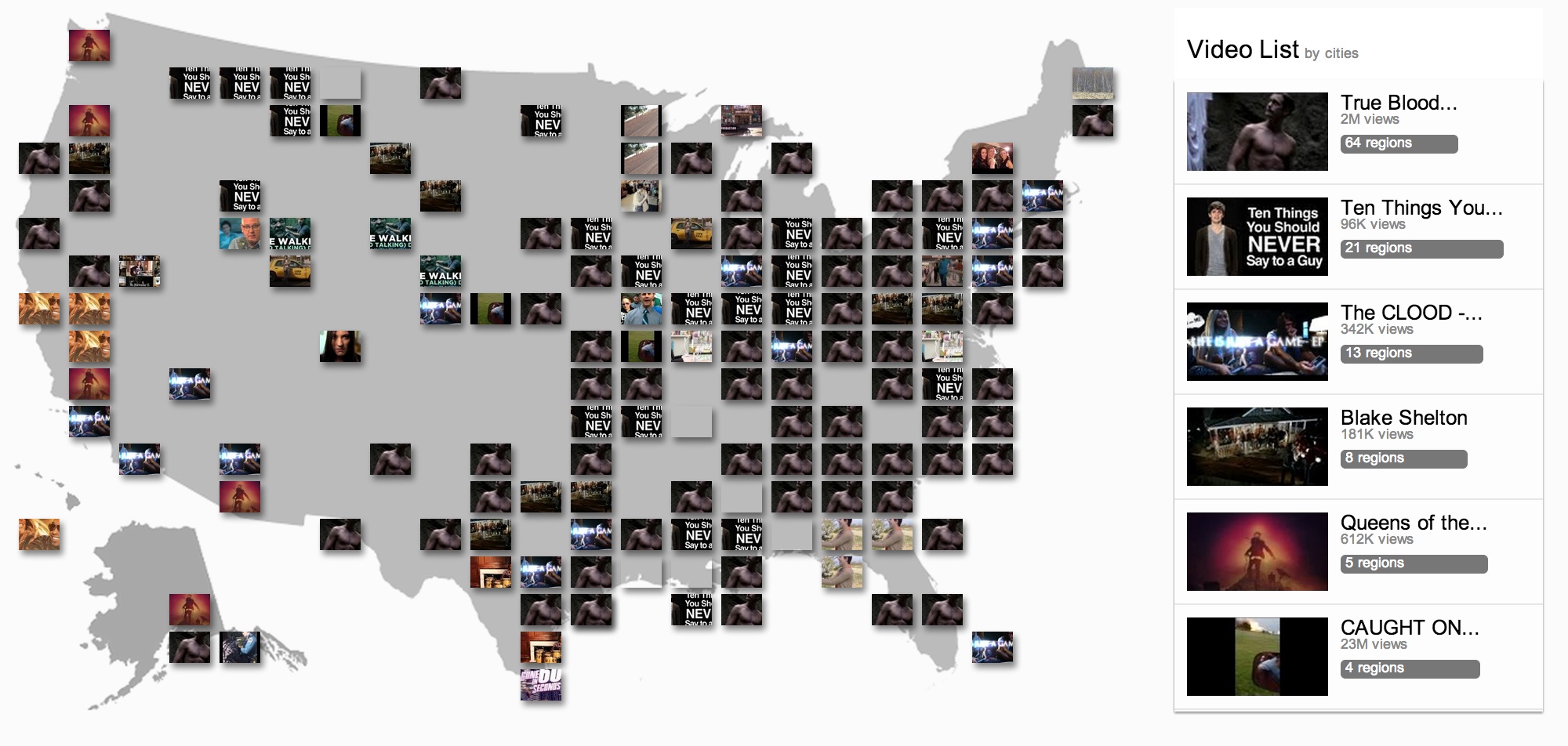
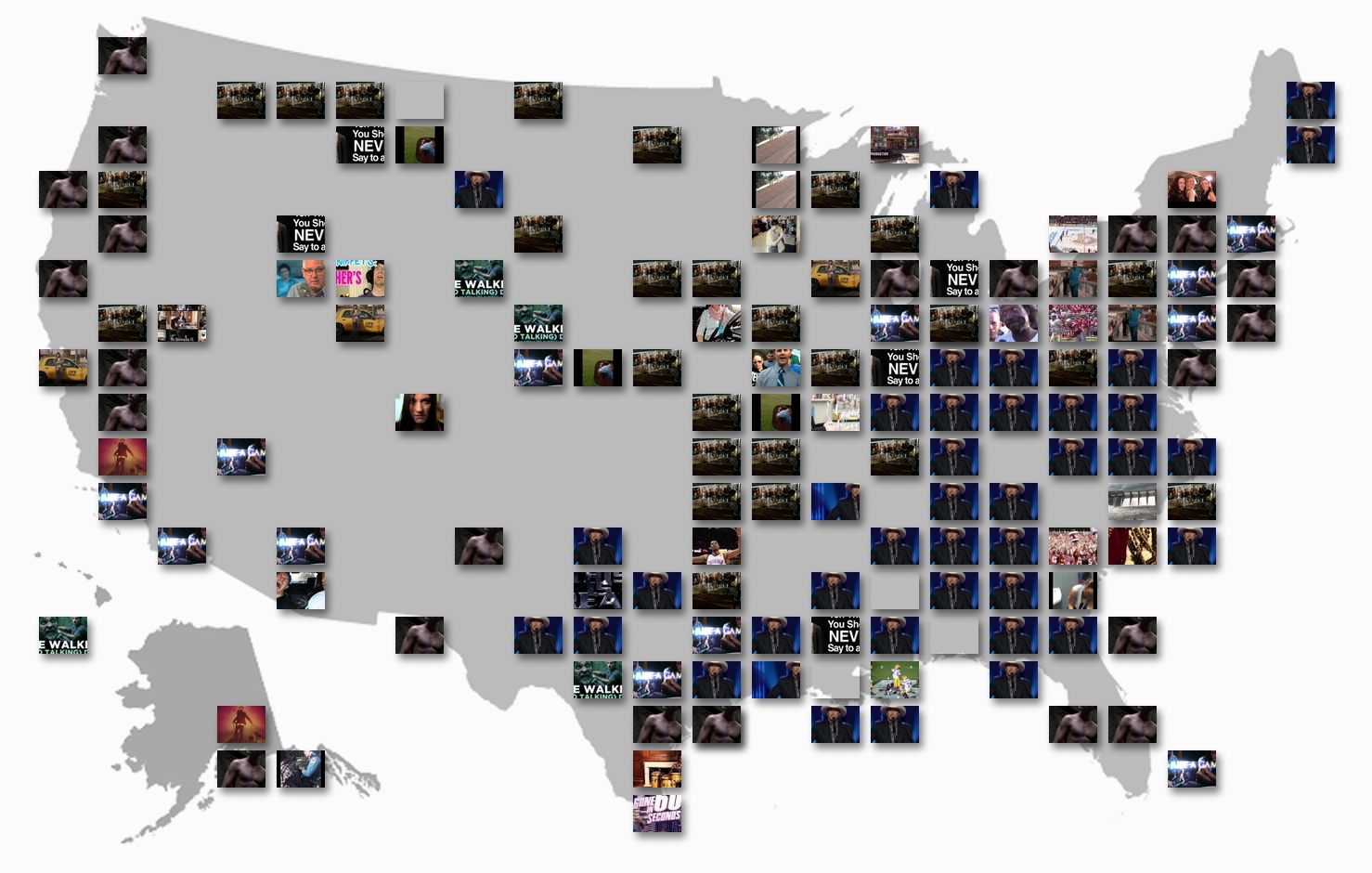
YouTube has released an interactive map showing the most popular videos throughout the country. At the moment, the top videos appear to be the Charles Ramsay interview and Alan Jackson’s rendition of “He Stopped Loving Her Today” in honor of George Jones’ (covered by the Dish here and here):

YouTube Map 20130507 A

When the metric is switched to just men, the video “Zachary Quinto vs. Leonard Nimoy: ‘The Challenge’” surges in popularity. Recently, when the metric was switched to just women, the 6th season trailer for True Blood swept the nation.

Butters: Let’s Get More Involved In The Middle East

Lindsey Graham, super-serial today about his Benghazi hearings, draws one basic lesson from the tragedy:

I think it’s a foreign policy gone wrong here. Syria, Libya, Egypt — I think the greater story is that the light footprint approach to the mideast at a time of turmoil is is not working.

So Butters wants a heavier footprint. But what on earth does he mean by that? Is this just more primary meat to keep the base hounds at bay? Or is Professor Chaos acting out again?

The Wisdom Of Owls

Theodore Dalrymple reflects on the creature:

The first owl of my life was Owl in Winnie the Pooh. I think he had a delayed effect upon my intellectual development, or perhaps I should say upon my Weltanschauung. Owl held himself to be intellectually the superior of every other character in Pooh: in fact he was the intellectual among them, and took himself very seriously, as the embodiment of knowledge and wisdom. But he wasn’t very good at spelling (he signed himself WOL) nor were his thoughts always of the most brilliant. He put a notice up outside his home in a tree asking visitors to ‘PLEZ CNOKE IF AN RNSR IS NOT REQID.’ Of course, I delighted as a child in the absurdity of this: why would anyone go to his door if he did not want an answer (notwithstanding the fact that I sometimes rang doorbells myself and ran away).

So Owl gave me the first intimation in my life that all are not wise who claim to be learned. And Owl was a hint also that the clever could be the most foolish of all.

(Photo by Hans Splinter)