Forget Footnotes, Ctd

A few readers sound off in detail:

Contrary to what Tim Parks may say, footnotes are not simply a “protocol for checking the quotation.” Rather they are the steel in a scholar’s argument. I’ve always imagined texts I read to be like a ship. Good scholars (the best ones I was lucky to know, anyway), like good shipwrights, need only “go below” into the notes to discover if the arguments have been put together thoroughly and whether the structure of the analysis is sound. Far from being pointless, over-long lists to “cover one’s rear end,”as Parks claims, a thorough footnote with a sizable number of sources can give away the game: has this person mastered the relevant literature, and if they have, whose design are they building on to navigate this topic? Are there any major sins of omission?

And, yes, the pesky details of publication matter.

The year of publication says a lot about what trends in the field influenced the writers’ intellectual development, and the state of their discipline at the time of publication. And presses have agendas: editorial directors and staffs at university presses are curators who sign books to build their press’ reputation in certain sub-fields (criticism of nineteenth century French literature, say). Seeing a press name in the notes makes a good shorthand for discerning biases and points of view. Even the city matters. Of course Oxford University Press is in Oxford, England, but if the footnote reads, Oxford University Press, New York, then that is a whole different shop within the organization.

Celebrity scholars like Doris Kearns Goodwin, who abandon the plodding craft of meticulous citation for the art of a ripping yarn, and then leave the details to their research assistants, who think footnotes are just hyperlinks to library databases, run leaky ships and get entangled in plagiarism accusations brought by eagle-eyed peers. Their academic reputations get sunk.

Another has a very different take:

Hear, hear to Tim Parks! Here’s my story: I completed an M.Litt degree (essentially 1/2 a Ph.D, or in other words a 50,000 word thesis of original research) in Medieval History (specifically 15th century English military history) at Oxford in 1999.

What, you may ask, was the most daunting aspect of my work? Finding and painstakingly unrolling yellowed muster rolls from the 15th century at the Public Record Office? Trawling the works of chroniclers long forgotten for tidbits on important events? Deciphering Latin or French as well as the handwritten shorthand of scribes working on horseback for an impatient Henry V of England?

No, the most daunting aspect of my work was keeping track of all of the footnotes. Here’s an example:

If I was to write a sentence such as “Henry V’s fleet left port on the morning of July 30th with approximately 600 ships and 50,000 men in his army” I’d need a footnote citing every source that substantiated those facts, and in addition explain those who varied (unless that explanation was of enough interest to require more main text). That was tough enough. But what if I broke that sentence apart? I would need to keep track of which sources confirmed it was July 30th, which mentioned it was in the morning, and which sources recorded the numbers of the ships and/or men.

For a 50,000 word these I ended up with over 600 footnotes, almost each one containing multiple citations. In many cases my prose was stilted due to a need to avoid breaking up sentences and having to review the footnote attached to place the references where they needed to be. Eventually, as I was writing, I developed a significant aversion to any revision of what had been written so far, probably to the detriment of the writing.

That’s not all. A mere 10 years before I did my work (i.e. predating the World Wide Web) it was considered adequate in my field for you to consult sources readily available in the Oxford and Cambridge libraries, the British Library, the Public Record Office and maybe the Biblioteque Nationale in Paris. But by the time I was working if an article was published or thesis pursued anywhere in the world that was even tangentially related to my area of study, I was expected to have considered it.

Here’s the kicker: once you are finished and have submitted your thesis for review, you are scheduled for what’s called a “viva”, where you are interviewed by, in my case, 2 fully-fledged experts in the field. In my case one professor was an Oxford don who was a 20th-century giant in the field. The other was a budding giant in the field. They spend the first 30 minutes asking minutiae questions to, as I was told, “confirm that you actually wrote the thesis” and then past that it’s a more congenial conversation regarding your findings.

I enjoyed my time at Oxford and will always be proud of the work I did and degree I obtained, but this was one of the many reasons I did not stay in academia. I hope the increased number of texts actually available online is making this work somewhat easier for the postgraduates of today, but I kind of doubt it.

The Best Of The Dish Today

Every now and again, the truth emerges from the cult:

For the past couple of weeks, I have been trapped in a dystopia of sorts. I am in New York, ostensibly on a sabbatical, during which I intended to rattle off a 400-page thriller and maybe have a romcom-style meet-cute in Central Park. Instead, I have found myself spiralling into hysteria, driven slowly mad by the New York subway. On first appearance, it is like the London underground – trains, tickets, announcements, the crush of bodies. But then, slowly, the entire system reveals itself to you. It is the work of a sadist, cooked up in a fever dream and delivered with a flourish and an unhinged grin …

Read the whole thing. I particularly loved this:

Where in London the Central line (red) is distinct from the Piccadilly (dark blue), which is markedly different from the Hammersmith and City line (pink), New York’s map has designated the same forest green to the 4, the 5 and the 6 lines. The B, D, F and M all rejoice in exactly the same shade of violent orange … But wait, there’s more! There are no live departure boards on the vast majority of the network’s platforms. It means you descend into the bowels of the city with no idea when your next train will be.

Lagos is more civilized.

Today, we analyzed the relatively tepid support for another Iraq war among Americans; and the sad Arab coalition against ISIS, even as the president banged the war drums at the UN; I wasn’t buying Michael Tomasky’s view that this war is utterly unlike any of Bush’s (oh yes it is!); and we noted how far Obama has come from his original mentor, Abraham Lincoln, when it comes to war and peace. We also covered yet another firing of another faithful Catholic for marrying the man he loves – and the grotesquery of the Archbishop who mandated it. Plus: koala fight!

Many of today’s posts were updated with your emails – read them all here.  You can always leave your unfiltered comments at our Facebook page and @sullydish. 22 more readers became subscribers today. You can join them here – and get access to all the readons and Deep Dish – for a little as $1.99 month. Gift subscriptions are available here. Dish t-shirts and polos are for sale here.

A reader writes:

I’m so honored you posted my photo of Palm Beach, Aruba. This is particularly meaningful because I traveled to Aruba to see my youngest brother marry his husband on that beach last Sunday. When we learned that strangers on the public beach would be able to observe the ceremony, we feared hostile reactions from the crowd (or boorish behavior by drunks). You will be pleased to know that when the onlookers of many ages and nationalities and races realized that a gay couple was marrying, they grew both hushed and excited to witness history changing (one woman urgently waved her children to her side to watch us). Many applauded and cheered at the ceremony’s end. A Chilean woman told my brother she was so glad he did this, as she has a gay son. So much to be joyful about.

See you in the morning.

A Poem For Wednesday

15478253_a28e399f92_o

“Cornkind” by Frank O’Hara:

So the rain falls
it drops all over the place
and where it finds a little rock pool
it fills it up with dirt
and the corn grows
a green Bette Davis sits under it
reading a volume of William Morris
oh fertility! beloved of the Western world
you aren’t so popular in China
though they fuck too

and do I really want a son
to carry on my idiocy past the Horned Gates
poor kid                        a staggering load

yet it can happen casually
and he lifts a little of the load each day
as I become more and more idiotic
and grows to be a strong strong man
and one day carries as I die
my final idiocy and the very gates
into a future of his choice

but what of William Morris
what of you Million Worries
what of Bette Davis in
AN EVENING WITH WILLIAM MORRIS
or THE WORLD OF SAMUEL GREENBERG

what of Hart Crane
what of phonograph records and gin

what of “what of”

you are of me, that’s what
and that’s the meaning of fertility
hard and moist and moaning

– 1960

(From Lunch Poems, Expanded 50th Anniversary Edition © 1964, 2014 by Maureen Granville-Smith, Administratrix of the Estate of Frank O’Hara. Used by permission of City Lights Books, San Francisco. Photo by Peter Organisciak)

Face Of The Day

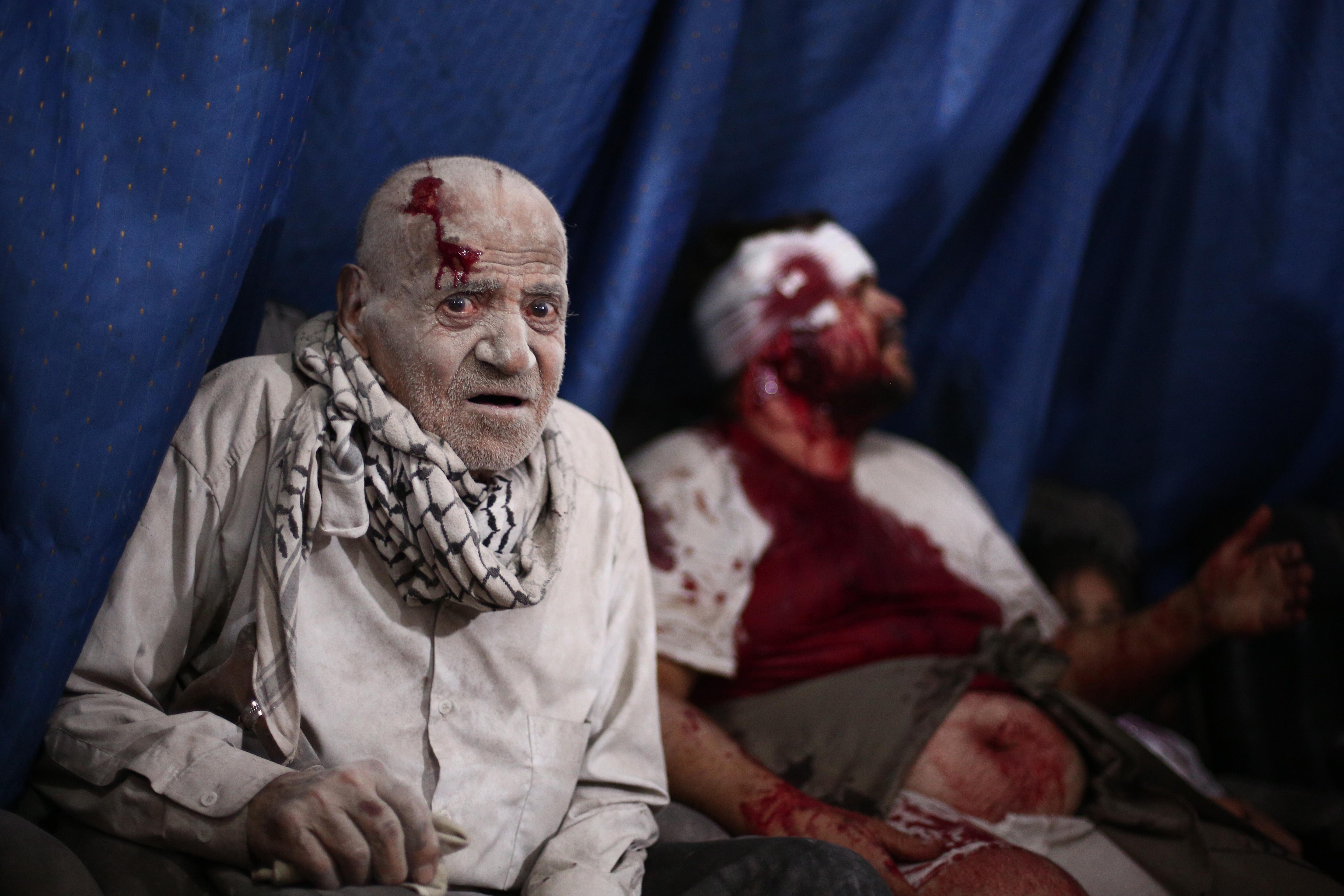
SYRIA-CONFLICT

An injured man looks on as he waits to be treated at a makeshift hospital in the besieged rebel bastion of Douma, northeast of the Syrian capital Damascus, on September 24, 2014, following reported airstrikes by government forces. Some 191,000 people have been killed since an uprising against President Bashar al-Assad’s rule erupted in March 2011. By Abd Doumany/AFP/Getty Images.

Gabbin’ About God

Republicans think pols aren’t doing it enough, according to a recent Pew poll (the same one showing how self-pitying white evangelicals are). Christopher Ingraham elaborates:

Fifty-three percent of Republicans say that political leaders are talking too little about their faith, compared to less than a third of Democrats. Again, while Democrats have remained consistent on this measure since 2010, Republicans have shifted nearly 10 percentage points. For reference, in September, the word “God” has been spoken on the House and Senate floors 75 times, “Christian” 65 times and “Jesus” 10 times. Democrats and Republicans seem to use these words at similar rates.

Paul Waldman remarks, “I actually don’t have a problem with it on an individual level, much as I might bristle at the endless Prayer Breakfasts”:

The reason politicians don’t do it more isn’t because there’s some kind of stigma associated with proclaiming your piety, because there isn’t. They don’t do it more because they know it comes off as exclusionary. If you ran a campaign under the slogan, “John Smith: Because we need more Baptists in the Senate,” everyone who wasn’t a Baptist would think you won’t care about them and their concerns, and that isn’t something too many candidates want to risk.

Politicians don’t want to draw those stark lines, which is why there are only a few (who come from homogeneous districts) who talk publicly in religious specifics, like mentioning “Jesus” as opposed to just “God.” Likewise, they want the churches’ help, but they could probably do without direct church endorsements, because then it would look like they’re the candidate of one particular sect. Which is to say that even if lots of voters express the opinion that they’d like to see more religious involvement in partisan politics, what they have right now is probably all they’re going to get. And that’s plenty.

Millennials Of The Mideast

Robert F. Worth reviews Juan Cole’s The New Arabs, which offers reasons to be hopeful about the future of the Middle East, focusing on the generation of young activists that “has already wrought deep social changes, and is likely—eventually—to reshape much of the Middle East in its own image: more democratic, more tolerant, and more secular”:

Cole describes a dedicated and influential group of Internet activists who came of age in the early years of this century in Egypt, Tunisia, and Libya (his book excludes other Arab countries where uprisings took place, conceding that young people had less impact there). Focusing especially on the Internet’s liberating effect, he traces figures like Lina Ben Mhenni and Sami Ben Gharbia in Tunisia, and Wael Abbas, Shahinaz Abdel Salam, and Amr Ezzat in Egypt. These young activists were less ideologically inclined than their elders, more willing to work with Islamists, and eager to form links with labor. Ahmed Maher, the charismatic and principled cofounder of Egypt’s April 6 movement, appears frequently throughout Cole’s book, as a kind of model figure of the “revolutionary youth” who helped focus the discontents that produced the 2011 uprisings.

Cole may be right that these people will continue to press for democratization, and that “as the millennials enter their thirties and forties, they will have a better opportunity to shape politics directly, so that we could well see an echo effect of the 2011 upheavals in future decades.”

The memory of 2011, and the glimpse of unity and civility it offered, can never be taken away, and surely it will inspire many young (and old) people in years to come. One line of thinking, often heard among liberal revolutionaries, holds that the current chaos across the Middle East is the result of a doomed, desperate ploy by the various Arab anciens régimes to cling to power and forestall the inevitable triumph of a new order. Like many others, Cole invokes a parallel with the European revolutions of 1848, suggesting that something like France’s relatively liberal Third Republic, established in 1870, is around the corner for the Arab world.

Another book Worth considers, however, suggests a more fraught way forward. He looks at Shadi Hamid’s Temptations of Power: Islamists and Illiberal Democracy in a New Middle East:

The secular youth movements of 2011 seemed so powerful and prophetic largely because they managed, briefly, to unify their efforts with those of Islamists and labor movements: a synthesis made possible by the catastrophic misrule of Zine el-Abidine Ben Ali in Tunisia, Muammar Qaddafi in Libya, and Mubarak, among others. (Several young people in Tahrir Square in 2011 told me earnestly that they were grateful to Mubarak for causing them to reconcile with their ideological rivals.)

The fissures reappeared soon afterward. But many remained optimistic because of a belief—more widespread in the West than among Arabs—that attaining power would necessarily moderate political Islamists, reining in their ambitions to impose sharia. What came to be known as the “pothole theory” was famously articulated a decade ago by George W. Bush, among others: being responsible to constituents makes you focus less on ideology than on day-to-day governance.

This hopeful doctrine, Hamid argues, is largely refuted by the experience of recent years. Islamist parties in Egypt, Jordan, and Tunisia grew more moderate over the past two decades during a period of renewed government repression, not democracy. “There was never any reason to believe that this process of moderation would continue indefinitely under an entirely different set of circumstances,” Hamid writes. “Some Islamist parties, such as in Tunisia, are more willing to come to terms with liberal democracy than others. But all Islamist parties, by definition, are at least somewhat illiberal.”

Quote For The Day

“Let me first state what I understand to be your position. It is, that if it shall become necessary, to repel invasion, the President may, without violation of the Constitution, cross the line and invade the territory of another country; and that whether such necessity exists in any given case, the President is to be the sole judge … But Allow the President to invade a neighboring nation, whenever he shall deem it necessary to repel an invasion, and you allow him to do so, whenever he may choose to say he deems it necessary for such purpose – and allow him to make war at pleasure….

If, to-day, he should choose to say he thinks it necessary to invade Canada, to prevent the British from invading us, how could you stop him? You may say to him, ‘I see no probability of the British invading us’ but he will say to you ‘be silent; I see it, if you don’t.’ The provision of the Constitution giving the war-making power to Congress, was dictated, as I understand it, by the following reasons. Kings had always been involving and impoverishing their people in wars, pretending generally, if not always, that the good of the people was the object. This our Convention understood to be the most oppressive of all Kingly oppressions; and they resolved to so frame the Constitution that no one man should hold the power of bringing this oppression upon us. But your view destroys the whole matter, and places our President where kings have always stood,” – Abraham Lincoln.

Obama is no Lincoln, is he?

(Hat tip Conor and Glenn)

The Ticket For Cricket

dish_cricket

According to the British philosopher David Papineau, it’s a sport where nurture trumps nature:

When it comes to environments … cricket and soccer are like chalk and cheese. Every kid gets plenty of chance to kick a football around. But cricket skills are by no means easily acquired. It’s not just that you need special equipment and facilities: there are deep-rooted habits to overcome. Both batting and bowling are very unnatural, all sideways and no swiping. So you need to be taught young; if you haven’t been initiated before your teenage years, it’s probably too late. … I’d be surprised to find any top-class cricketers without at least one enthusiastic club cricketer somewhere in their family background.

If environments matter more in cricket than in soccer, then this makes cricketing skills look less genetically heritable than footballing ones. In football, most of the differences come from genetic advantages just because there aren’t many environmental differences (if you live in a soccer-mad nation, opportunities to play are everywhere). But in cricket, there would still be a wide range of abilities even if everybody had exactly the same genetic endowment, because only some children would get a proper chance to learn the game. In effect, environmental causes are doing a lot more to spread out the children in cricket than they are in football. To sum up, cricket runs in families precisely because the genetic heritability of cricket skills is relatively low.

(Photo by Alden Chadwick)

How To Contain An Epidemic

Teju Cole shares a heartening report about Nigeria’s successful public health response to the Ebola crisis:

Meanwhile, Jon Cohen suggests that Ebola survivors could help stem the spread of the disease:

As far back as 431 B.C., the Athenian historian Thucydides recognized that people who survived the plague made for excellent caregivers. As Thucydides wrote: “It was with those who had recovered from the disease that the sick and the dying found most compassion. These knew what it was from experience, and had now no fear for themselves; for the same man was never attacked twice—never at least fatally.” Nicole Lurie, HHS’ assistant secretary for preparedness and response, is one of several doctors who suspect that people who survived Ebola may have developed immunity to that strain of the virus and could care for the infected with little risk to themselves. Lurie suggests that in these West African countries, where jobs are hard to find and Ebola carries such serious stigma with it that survivors sometimes are shunned, training survivors could be a win-win.

Michaeleen Doucleff notes that the CDC and WHO are on the same page when it comes to fighting the disease, but the horizon doesn’t look good:

Both agencies agree on how to turn the tide of this epidemic: Get 70 percent of sick people into isolation and treatment centers. Right now, [WHO’s Christopher] Dye says fewer than half the people who need treatment are getting it. If all goes well, Dye expects the goal of 70 percent could be reached in several weeks.

“Our great concern is this will be an epidemic that lasts for several years,” he says. The epidemic has hit such a size – and become so widespread geographically – that Ebola could become a permanent presence in West Africa. If that happens, there would be a constant threat that Ebola could spread to other parts of the world.

Rohit Chitale of the Armed Forces Health Surveillance Center calls the international spread of Ebola “a significant possibility,” leaving poorer countries at highest risk:

The [CDC and WHO] and many nations have established guidance for entry and exit screening (e.g., thermal or fever screening at airports), and many nations had put them in place weeks or even months ago. Regardless, some cases will probably be imported into other nations. However, [if] cases occur in nations with a strong medical and public health infrastructure, like the U.S., patients that are suspected for Ebola will be isolated, exposed patients will be quarantined, and we would expect little to no spread of cases locally. So this is really not a direct threat for nations with robust health systems. But where resources are lacking and health systems are inadequate (as in West Africa), and where initial cases are not quickly discovered and managed, there is a real threat of local spread in the community from imported cases.

James Ciment argues that Americans have a special obligation to help those suffering in Liberia:

Pioneers from America settled Liberia and established it as Africa’s first republic; they modeled its institutions after our own. If we are true to our values and obligations, we will not abandon Liberia again once the current crisis has passed. Our government has earmarked an unprecedented sum to reverse the epidemic in Liberia and its neighbors. But as Americans, we can and should give as individuals. There are any number of organizations doing sterling work in fighting Ebola and aiding its victims—Doctors Without Borders, Save the Children, Global Health Ministries. Find one online and send it money now.

Viewing America From The Outside

Linker feels that Americans need to hear “a little less about how important it is for us to blow other people to bits and a little more about what it’s like to live in a world in which a single nation has the power to strike a deadly blow wherever it wishes, anywhere on the planet”:

How would we feel, I wonder, if we lived in a world in which another country was so powerful that it could inflict military pain on any nation, including us, with impunity? Without an act of imagination, we can’t even begin to answer that question — because we are the only nation in that position, or even close to it. Russia, our nearest rival, may be flexing its muscles in Ukraine. But as with all of Russia’s post-Soviet military adventures, this one is taking place right next door. The United States, by contrast, hasn’t fought a war with a neighboring power since the mid-19th century, and it regularly (as in: every few years) starts wars many thousands of miles from its territory. In this sense at least, America truly is an exceptional nation.

I will never write a word in defense of ISIS and its bloodthirsty, homicidal ambitions. But if we wanted to understand some of what motivates people from around the world to join its seemingly suicidal cause, we might start with the very fact of America’s incontestable military supremacy and the cavalier way we wield it on battlefields across the globe.