Chivalry Is Stubborn

Joe Pinsker asks why the tradition of men paying on first dates with women persists:

A [new] survey … found that about 77 percent of people in straight relationships believe men should pay the bill on a first date. The survey, put together by the financial website NerdWallet, polled roughly 1,000 people who had been dating their partners for six months or more.

The company’s survey indicates that, in the early stages of courting, the pressure to pay falls primarily on men, but this imbalance hardly dissolves as the relationship progresses. Fifty-six percent of men foot the bill in full once they’re in an established relationship, and, even further down the line, 36 percent of men pay all of household bills, versus 14 percent of women. There’s not much in the way of historical data on the question of who pays for dates, but the findings of a 1985 poll suggest that very little has changed in the past 30 years. …

Who’s expected to pay for a date may seem trivial—some would even argue that covering the tab is a form of respecting women—but there’s reason to believe that this minor, “benevolent” form of sexism can lead to a fraught question of what the man is then owed.

“The Only Time He’d Ever Felt ‘Sexiness'”

Alice Robb presents new findings on why some disabled men pay for sex:

[Sociologist Kirsty] Liddiard interviewed 25 physically disabled men and women, recruited through ads on websites and in publications for people with disabilities. (The ads didn’t mention that she was studying sex work.) Of the 16 men included in the study, seven said they had at some point purchased sex from a female sex worker. (None of the women had ever paid for sex.) This is consistent with other research that suggests disabled men seek out prostitutes or “sex surrogates” at higher rates than non-disabled men.

In a 2005 survey carried out by the British magazine Disability Now, 22 percent of the 1,115 disabled male respondents admitted they had at some point paid for sex, and 37.6 percent said they’d at least considered it. (Only 1 percent of disabled women had hired a sex worker, though 16.2 percent had thought about it.) Researchers estimate that about 10 percent of all British men have ever visited a prostitute. …

[Liddiard] found that for many of the men, it was as much about demonstrating their independence as it was about the sex. For Harjit, a 23-year-old-student whose parents had moved into his university residence to care for him, making secret arrangements was as much an accomplishment as the sex itself. “From the excitable way such stories were told, it appeared that a lot of the ‘buzz’ … was as much from exercising agency, autonomy, control and independence as it was about experiencing sexual fulfilment, pleasure, and satisfaction,” wrote Liddiard.

Other men simply wanted to have an experience they believed they wouldn’t have otherwise. “I wish I could go out and meet someone, but it’s not that easy,” one man complained. “I can’t go into a nightclub and easily pull, although I have in certain circumstances, but I can’t do it easily,” said another. Mark, a 35-year-old Liddiard interviewed in person, said that his experience with a sex worker was the only time he’d ever felt “sexiness.”

Go Ahead, Let Netflix Autoplay

New research suggests there are real benefits to vegging out – so long as you don’t guilt yourself out of them:

Participants were recruited via a gaming website and through psychology and communication classes.  Specifically, the participants answered questions about the previous day, including how much work or study they’d done (answers ranged from half an hour to 16 hours), how depleted they felt after work or college, how much TV they’d watched or video-gaming they’d played (this averaged around two hours), whether they viewed it as procrastination, whether they felt guilty, and how recharged they felt afterwards.

The key finding is that the more depleted people felt after work (agreeing with statements like “I felt like my willpower was gone”), the more they tended to view their TV or gaming as procrastination, the more guilt they felt, and the less likely they were to say they felt restored afterwards. The same findings applied for TV or video games.

“Rather than diminishing the beneficial potential of entertaining media,” the researchers said, “we believe that the results of this study may ultimately help to optimise the well-being outcomes of entertaining media use by extending our knowledge of … media-induced recovery and general well-being.” If the researchers are correct, then if you cut yourself some slack when you watch TV after a hard day, you’re more likely feel rejuvenated afterwards.

The Varieties Of Stoner Experience

Benjamin Breen prefers the 19th-century literature of laughing gas to the druggy musings of 1960s writers like Timothy Leary. He cites the “exuberant, experimental, playful, funny, honest, and intellectually curious” trip-lit of William James:

After huffing a large amount of nitrous oxide, James set out to tackle a prominent bugbear of 1880s intellectual life: Hegelian dialectics. He came up with a stream of consciousness that centered on a kind of ecstatic binary thinking:

Don’t you see the difference, don’t you see the identity?
Constantly opposites united!
The same me telling you to write and not to write!
Extreme—extreme, extreme! Within the extensity that “extreme” contains is contained the “extreme” of intensity
Something, and other than that thing!
….
By George, nothing but othing!
That sounds like nonsense, but it’s pure onsense!
Thought much deeper than speech … !
Medical school; divinity school, school! SCHOOL!
Oh my God, oh God; oh God!

James acknowledged to his readers that these ravings were the product of a mental state that, like alcohol intoxication, “seems silly to lookers-on.” But he came away from the experience with a remarkably positive take on nitrous oxide. James had argued that drunkenness produced a kind of “subjective rapture” occasioned by its ability to make “the centre and periphery of things seem to come together.” Nitrous oxide, he believed, produced a similar effect, “only a thousandfold enhanced.” On the gas, his mind was “seized … by logical forceps” and jolted into a new order of consciousness which, he thought, made the logic of Hegelian dialectics perfectly obvious to him.

Smartphone Sex

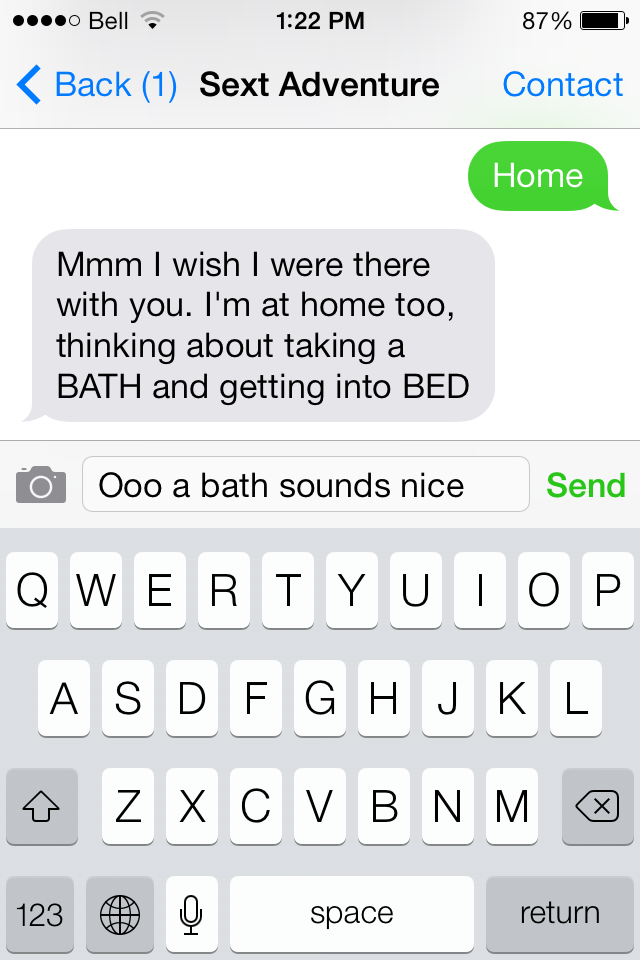
Megan Patterson interviews Kara Stone about Sext Adventure, a game she designed to be played on smartphones:

You mentioned to me a couple of weeks ago that a lot of women that hear the title Sext Adventure, and they just hear the word “sext” and assume that it’s made to appeal to guys, and not women. When that’s not remotely true at all!

Yes, totally! I think partly it’s the assumption that video games are for men, and I think if I heard about a sexting game, I’d be like, “Ugh, it’s gonna be dish_sexting hetero, it’s gonna be for men, and it’s gonna be by a bunch of white dudes who think they’re funny.” So I recognize that.

It has been funny seeing guys who play it, expecting one thing, and then they end up getting random dick pics, or not being able to get the exact kind of body type they want, or the gender they want. I’ve gotten a few emails being like, “Um, how do I make sext bot a woman?” I can imagine them having played a few times, like, “I can’t get the right narrative!” I didn’t make this game to troll dudes, but it’s a very funny consequence.

I was thinking more about making a game everybody could play, and also explore sexuality in a cyborg light, to get people thinking about the roles of gender and technology. We often gender technology, and sentient technology might not have gender. What would that mean? How would it express desire? How would it understand humans?

In other sex-and-tech news, Kottke points to amusing erotic poetry formed exclusively from snippets of iPhone 6 reviews:

I have really big hands

Would be an understatement.

This is quite helpful.

When the tips of your fingers are grasping on for dear life,

Your fingers need to secure a firm grip.

I can still wrap my fingers around

Well…

More of everything.

More here.

(Image via Sext Adventure)

Play It Again, Sam

A cool new TED-Ed animation explains why we love repetition in music:

As professor Elizabeth Hellmuth Margulis wrote earlier this year:

Cultures all over the world make repetitive music. The ethnomusicologist Bruno Nettl at the University of Illinois counts repetitiveness among the few musical universals known to characterise music the world over. Hit songs on American radio often feature a chorus that plays several times, and people listen to these already repetitive songs many times. The musicologist David Huron at Ohio State University estimates that, during more than 90 per cent of the time spent listening to music, people are actually hearing passages that they’ve listened to before. The play counter in iTunes reveals just how frequently we listen to our favourite tracks. And if that’s not enough, tunes that get stuck in our heads seem to loop again and again. In short, repetition is a startlingly prevalent feature of music, real and imagined.

Face Of The Day

dish_fotdlight

Photographer Nicolas Rivals creates portraits out of spinning molten metal:

While other artists use pigments to paint, Nicolas Rivals uses light. His work isn’t exactly a painting as it is an photo captured through long exposure then flipped to create a sort of Rorschach image made of light. Nicolas has another series of light paintings featuring a bright circle of light floating in the middle of an urban setting. He said: “There is always hope that even in the depths of night a glimmer will appear. Light is never as reassuring as the anguish of the shadow. A little light, a little sense, would for a moment, make the chaos disappear”.

Rivals is a member of the Prisme Noir collective. See more of his work here.