Civil Liberties Become A Lower Priority

This is depressing news:

LibertyThe Pew Research Center poll shows 50 percent of Americans say the government has not gone far enough to protect the country, while 35 percent are more concerned about the government going too far to restrict civil liberties. That’s the most pro-security posture Americans have had on this question since 2009 and one of the highest on record since Sept. 11, 2001.

In contrast, 10 months ago, in the midst of several big Snowden leaks, significantly more Americans favored the civil liberties emphasis (47 percent) over taking additional steps to secure the homeland (35 percent).

The reason for the shift? People are scared.

And Gallup found that “Republican Party has expanded its historical edge over the Democratic Party in Americans’ minds as being better able to protect the U.S. from international terrorism and military threats.” Allahpundit digests that fact:

Incredible though it may seem, the GOP’s lead is wider on that question now than it was a year after 9/11, when Bush’s popularity was still stratospheric and Republicans ended up gaining seats in the midterms because of his terror-fighting cred. Looking at that and the Pew data above, I wonder how Rand Paul’s campaign will deal with the already building pressure for the GOP nominee to run as a member of the loud-and-proud party of hawks again. Maybe, as the fight against ISIS drags on, a new round of war fatigue will take the edge off these numbers or even reverse the trend. I don’t know, though: Republican voters stuck with Bush a long time on Iraq. As recently as last month, with 71 percent of the broader public saying that the Iraq war wasn’t worth it, more GOPers still said that it was worth it than that it wasn’t (46/44). Rand’s got a lot of work to do on the way to 2016.

The Clock Is Ticking On Climate Change

Plumer reads through a recent PricewaterhouseCoopers report (pdf), which calculated that “the world is steadily becoming less and less carbon-intensive.” That means “we need to burn fewer fossil fuels to generate a dollar’s worth of economic activity”:

But here’s the bad news: Carbon intensity isn’t falling fast enough. Between 2000 and 2013, carbon intensity fell by 0.9 percent per year. Last year, it fell by 1.2 percent. But the global economy grew fast enough to overcome that, so overall emissions rose. If these trends continue, we’re on track for about 4°C of global warming in the future, which many scientists have deemed extremely dangerous.

By contrast, if the world wants to a) keep growing and b)avoid more than 2°C of global warming (which is the current international goal), then carbon intensity will have to decline much, much faster — by roughly 6.2 percent per year between now and 2050.

James West further unpacks the report:

Overall, PricewaterhouseCoopers paints a bleak picture of a world that’s rapidly running out of time; the required effort to curb global emissions will continue to grow each year. “The timeline is also unforgiving. The [Intergovernmental Panel on Climate Change] and others have estimated that global emissions will need to peak around 2020 to meet a 2°C [3.6 degrees F] budget,” the report says. “This means that emissions from the developed economies need to be consistently falling, and emissions from major developing countries will also have to start declining from 2020 onwards.” G20 nations, for example, will need to cut their annual energy-related emissions by one-third by 2030, and by just over half by 2050. The pressure will be on the world’s governments to come up with a solution to this enormous challenge at the much-anticipated climate talks in Paris next year.

The Ground War To Come

IRAQ-CONFLICT

Larison suspects that it’s inevitable:

Escalation was always very likely, because that has been the pattern in U.S. interventions over the last twenty-five years. Obama already demonstrated in Libya that the U.S. would go far beyond the original stated goals of an intervention, and he is now on record saying that his greatest regret about the Libyan war was that the U.S. didn’t follow it up with a post-war military presence. That should be something to bear in mind when you next hear Obama pledge that there won’t be any American ground forces in combat in this new war. That’s why we should have expected this from Obama, but what made escalation even more likely is that our current political culture and foreign policy debate don’t really permit the U.S. to limit itself to small, achievable goals when it uses force overseas. That is especially true once administration officials irresponsibly stoke public fear about a group being an “imminent threat to every interest we have.” Sooner or later, the mismatch between the administration’s alarmist rhetoric and the initial “limited” action was going to be fixed by adopting a more aggressive policy.

Rich Lowry, for one, is ready to send in the infantry:

ISIL has occupied an enormous amount of territory in Iraq and Syria, including major population centers. That is why it declared a caliphate and why it has unprecedented resources. To defeat it, this territory must be taken back and it is unlikely to happen exclusively from the air—especially in the cities. It will take ground forces.

We hope to work with proxy forces, but they are motley groups that will almost certainly need vetting and advising by special operators working closely with them on the ground. But the president ruled out American ground forces. The cynical interpretation is that he is hoping to do enough against ISIL to satisfy domestic political opinion and keep the terror group at bay until he can hand off an incomplete campaign to his successor, who will be left with the difficult choice of whether to truly defeat ISIL.

James Jeffrey agrees that Obama was wrong to rule out boots on the ground:

[S]ometimes local forces are not enough. U.S. troops have capabilities they cannot approach, beginning with the crucial combat multipliers: “speed” and “decisiveness.” The commitment of even a few U.S. troops with actual ground combat missions signals credibility and seriousness. Such a troop presence can integrate rival local forces (as U.S. joint platoons did with the Kurds and Iraqi Army in 2010-2011), prevent friendly atrocities against civilians, and shape the goals of ground combat.

Still, local forces in Iraq and Syria should be the first choice, with commitment of our ground troops only an emergency contingency. Once in combat they introduce entirely new risks beyond those of drones or F-18 strikes, Special Forces trainers, and Navy SEALs. These risks begin with casualties. Ground combat is bloody.  While overall casualty rates are down from Vietnam, thousands have died in each of America’s last two wars, and tens of thousands have suffered serious wounds.

And Dov Zakheim argues that they’re necessary to hold the coalition together:

It is one thing to offer funds or training facilities, which Saudi Arabia is apparently willing to provide. It is quite another to deploy troops. Whether the Saudis, Emiratis, Jordanians, and others will be ready to do so absent American leadership on the ground is at best an open question. It is true that America led a coalition “from behind” in Libya. But that coalition did not commit ground troops; apart from very small numbers of European special forces, it was the Libyan rebels who provided the overwhelming majority of troops conducting operations on the ground against Muammar al-Qaddafi.  Moreover, the aftermath of that conflict hardly was a showpiece for coalition operations: Libya is now virtually a failed state.

Morrissey implies that Americans would come around to embrace another land war in the Middle East if only the president had the courage to give us one:

[I]t’s true that a move to send ground troops to deal with ISIS would create a large amount of political backlash, and would also call into question Obama’s endgame strategy in Afghanistan — even more so that ISIS has. If the American public won’t back a decision to put combat troops back into Iraq, then it would take a President willing to go it alone politically at home to give that order, and clearly that’s not the case with Obama. However, a lack of progress against ISIS will play badly for Obama too, and it will sap the resolve of Americans to see the job through to victory. We may end up looking weaker than we do now, especially if we can’t even get our traditional allies on board for just the 30,000-foot tactical decisions.

Highlighting some of the characteristics of the classic neocon freakout over ISIS, Chait observes that among this crowd, there’s no such thing as too much force:

The nub of neoconservatism is a belief that the only possible strategic failure is the insufficient use of military force. This is more of an atavistic reflex than a cogent form of thought. Cruz assails Obama, “Instead he suggested targeted attacks and focuses frankly on political issues that are peripheral from the central question of how we protect America from those who would take jihad to our nation.” Targeted is bad. Political is bad. Protecting is good. Here is [Jennifer] Rubin’s response:

[Obama] insisted, “This strategy of taking out terrorists who threaten us, while supporting partners on the front lines, is one that we have successfully pursued in Yemen and Somalia for years.” But if the Islamic State, which occupies vast territory and is highly trained and very well organized, than I suppose it won’t work.

That is not even an English sentence. Nonetheless, the underlying impulse is clear enough.

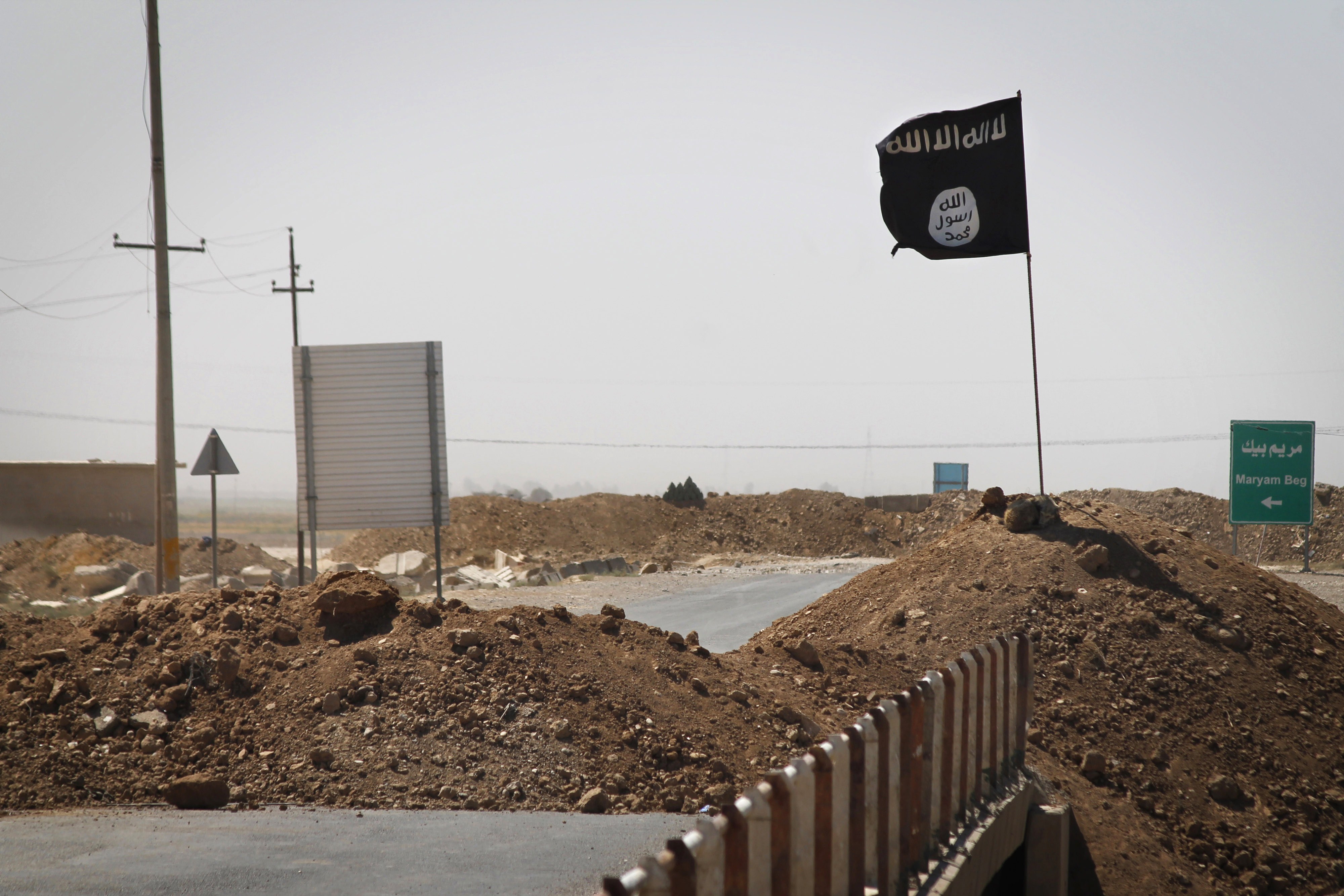
(Photo: A flag of the Islamic State is seen on the other side of a bridge at the frontline of fighting between Kurdish Peshmerga fighters and Islamist militants in Rashad, on the road between Kirkuk and Tikrit, on September 11, 2014. By JM Lopez/AFP/Getty Images)

Threat Inflation And The Case For War, Ctd

Beinart takes the MSM to task for swallowing the government’s line on the ISIS threat:

Many publications have uncritically accepted Secretary of Defense Chuck Hagel’s claim about the number of Americans who have gone to fight with ISIS—a figure that New America Foundation terrorism expert Peter Bergen argues is dramatically exaggerated. Other media commentary simply assumes that if Westerners go to fight with ISIS in Iraq or Syria, they’re destined to attack Europe or the United States. But that’s not true. Bergen notes, for instance, that of the 29 Americans who have gone to fight with the Somali jihadist group al-Shabab, none have tried to commit terrorism against the United States. One reason is that many of them ended up dead.

Press coverage of ISIS often ignores the fact that, in the past, the group has not targeted the American homeland. Jihadist groups, even monstrous ones, don’t inevitably go after the United States. Al-Qaeda began doing so as part of a specific strategy.

Keating stresses that for the most part, “the much-discussed threat of ISIS’s international fighters returning to their home countries to carry out attacks has been theoretical”:

As David Sterman pointed out in an analysis for the New America Foundation this week, “no one returning from or seeking to join a Syrian jihadist group has even been charged with plotting an attack inside the United States.”

Moner Mohammad Abu-Salha, the Florida man who returned to the U.S. for a time after training in Syria in 2012 and was under surveillance by the FBI, tried but failed to recruit friends to the cause, and eventually returned to Syria where he carried out a suicide bombing. If anything, greater U.S. involvement in the conflict will make ISIS—a group that until recently was most concerned with local territorial gains—more rather than less likely to target U.S. interests and citizens.

That’s what makes Yglesias uncomfortable with the way Obama talked up the threat on Wednesday night:

Public opinion always matters in politics and therefore in policymaking, but the fact of the matter is that the American people have this a bit mixed up. The beheadings are not the most alarming thing ISIS did this summer (try taking Mosul or genocidal violence against religious minority groups) and the rise of ISIS isn’t even the summer’s most alarming foreign policy crisis (try Russia’s invasion of Ukraine and apparent probing of Estonian and Finnish borders). There is no good reason for the United States to take maximal action against ISIS, not least because none of our potential partners in the region are going to.

Alarmist rhetoric and a policy of wise restraint make odd bedfellows. If the US catches some lucky breaks (or ISIS some bad ones) it may all work out for the best. But Obama’s speeches are writing checks his policy can’t necessarily cash. And eliminating ISIS’ ability to occasional kidnap westerners who travel into the conflict zone is much more difficult than eliminating its ability to capture new Iraqi cities or threaten major oil fields. If another shoe drops in a bad way, there is enormous risk that the president has set the country up for a cycle of unwise escalation.

The Scottish Vote Is Neck-And-Neck

No has regained a slight lead:
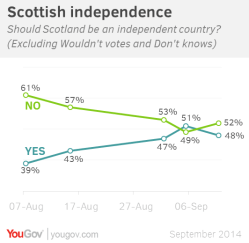
Scotland VoteYouGov’s latest survey has No, on 52%, narrowly ahead of Yes, 48%, after excluding don’t knows. This is the first time No has gained ground since early August. Three previous polls over the past month had recorded successive four point increases in backing for independence. In early August Yes support stood at 39%; by last weekend it had climbed to 51%. …

A key reason for the renewed fears of independence is what might happen to people’s bank accounts. The biggest single advantage of the union cited by No voters is that the UK would have the resources to step in if Scotland faced another crisis of the kind that erupted in 2008.

Fraser Nelson focuses on the decline in support among the youngest voters:

You need to treat all Scottish polls with caution, due to the sample size and the fact that the turnout may be high enough to include people who polling companies don’t know exist. But YouGov found that the under-25s (the ones more likely to vote on the day, rather than by post) have switched form a 20-point lead for ‘yes’ to a 6-point lead for ‘no’ in under a week.

Now, 20pc of people born in Scotland have concluded that their future lies outside of Scotland. Being fully plugged into the network of the rest of the UK is an advantage: as a Scot in London I feel (and am treated) like a fellow countryman, not an immigrant. I have to say: it’s a good feeling, and one I’d certainly want to protect if I were a teenager mulling my future options.

Examining the coalitions for and against independence, Tom O’Grady argues that “the referendum has arguably ceased to be about independence at all”:

[T]he pro-independence coalition looks much like the types of groups that are rejecting conventional politics in Europe today more broadly. Younger and poorer voters show lower turnout in elections, are more likely to vote for anti-establishment fringe parties, and are scornful of traditional political elites. Overall, the Scottish National Party’s success has come partly from framing independence as a form of anti-establishment protest, as well as the sheer luck of holding a referendum that coincides with a Conservative government in the United Kingdom.

This means, though, that support for independence could ultimately prove fragile.

Adam Taylor profiles Alex Salmond, the leader of Scotland’s independence movement:

Salmond seems to divide opinion like few other politicians. He has substantial support, enough to be elected as first minister of Scotland, yet polls show almost as many are dissatisfied as satisfied with him. Strangely, women seem to have a particular problem with him: One recent poll from the Scottish paper Daily Record found that half of women surveyed saying his role makes them want to vote against independence. Salmond was described as “arrogant,” “ambitious” and “dishonest” by those polled.

Perhaps it’s logical that a man who espouses a radical plan would elicit both love and hate. But there’s an even bigger factor here: Salmond doesn’t just espouse a radical plan – he also promotes it very, very well.

Eric Posner approves of independence:

[W]hile it’s true that Scottish nationalists often make mystical arguments (as nationalists always do), the case for independence is based on serious policy considerations. Some Scots believe that independence would give Scotland sole ownership of valuable oil deposits off its coast in the North Sea. Although those resources may well be almost depleted, it is possible that advances in oil-extraction technology would enable Scotland to create an oil-financed welfare state like Norway’s.

More importantly, if Scotland were independent, Scots would control the whole array of policy instruments that Scotland now shares with the rest of the U.K.—above all, taxing and spending. The Scots would be able to govern themselves however they want—and that includes putting into place the more generous welfare state that the more right-leaning English public has denied them.

Though not against independence in principle, Megan McArdle has misgivings:

My basic position on this sort of thing is that if places want to be independent, they should be independent, unless the reason that they’re seeking independence is so they can have more freedom to oppress minority populations. Yet I can’t say this seems like a good idea, for reasons that my friend Alex Massie has ably outlined. Scotland is a net recipient of transfers from the U.K. government, so going it alone will probably require some belt tightening. The process of separating all the intertwined institutions, from banking to education, will be daunting.

But Justin Fox outlines how breaking off could be economically beneficial for Scotland:

What has made small countries so economically successful over the past few decades is less their smallness than the ways they’ve taken advantage of it. David Skilling, a former New Zealand government official and McKinsey consultant who now advises small-country governments and companies from a base in Singapore, has spent as much time thinking and writing about the strengths and weaknesses of small states as anybody. In a 2012 paper that should be required reading in Scotland, he lists two main characteristics of successful small states:

1. They’re cohesive, and thus able to make policy decisions quickly and stick with them.

2. They tend to make good policy decisions, in part because they’re very aware of the world around them and what it takes to compete in it.

Ilya Somin searches for historical parallels:

One relevant precedent is the experience of the “Velvet Divorce” between Slovakia and the Czech Republic, whose success is sometimes cited by Scottish independence advocates as a possible model for their own breakup with Britain. Like many Scottish nationalists, advocates of Slovak independence wanted to break away from their larger, richer, partner, in part so they could pursue more interventionist economic policies. But, with the loss of Czech subsidies, independent Slovakia ended up having to pursue much more free market-oriented policies than before, which led to impressive growth. The Czech Republic, freed from having to pay the subsidies, also pursued relatively free market policies, and both nations are among the great success stories of Eastern Europe.

Like Slovakia, an independent Scotland might adopt more free market policies out of necessity. And the rump UK (like the Czechs before it), might move in the same direction. The secession of Scotland would deprive the more interventionist Labor Party of 41 seats in the House of Commons, while costing the Conservatives only one. The center of gravity of British politics would, at least to some extent, move in a more pro-market direction, just as the Czech Republic’s did relative to those of united Czechoslovakia.

Jason Sorens watches the markets:

So far capital markets seem to be telling us that the economic costs of independence to Scotland would be significant but not catastrophic, and that they would be virtually nil to the rest of Britain. How much of those costs are due to the policies Scotland would implement after independence, rather than secession as such? It is difficult to know, but the differential returns to particular firms give us a clue. Transportation companies have closer links to the state, so a more statist policy regime might not hurt them. Financial companies might lose because of the lender of last resort issue (Scotland might not have a credible one). Energy and engineering companies might lose because nationalists want to tax oil heavily to fund social programs. Also, stricter environmental laws may hurt the electric utility SSE, which lost heavily on Monday.

Speculatively, then, capital markets seem to be telling us that the costs of secession as such are modest, but that the costs of dramatically different economic policies are substantial.

And Simon Lester doesn’t see what all the fuss is about:

In terms of war and peace, there have been no Mel Gibson sightings that I’m aware of. On trade, there may be some bureaucratic challenges, but it seems clear the goal is for Scotland to join the EU and be part of its large, single market. As for trade with the rest of the world, Scotland will take on the EU’s trade policy–which is not perfect of course–but has followed the trend toward liberalization that the rest of the world has pursued over the past few decades. In all likelihood, Scotland will continue to search for export markets for its whisky and allow the free flow of imports.

If Scottish independence meant it would become like North Korea, I’d be concerned. But it doesn’t seem like that’s the path it is on. With the exception of a few regions, we live in a highly integrated, peaceful world. Scottish independence would not change that.

Previous Dish on Scottish independence here.


Abuse In The Public Eye, Ctd

A reader broadens the conversation on domestic violence:

I watched with full video of the Ray Rice incident, and one of the first things I noticed is that outside the elevator, when Ray is waiting for his fiancée (now wife) Janay, she walks by and hits him in the face. She definitely did not connect hard, but it is clear she did connect. Then inside the elevator, she attempts to elbow and punch him in the head, and when he retreats, she comes at him with her fists up in a fighting stance. It is only at this point that Ray punches her. You can see the full video here. [Update: Another notes, “It has been reported (ESPN etc.) that Rice spit in Janay’s face twice – before they entered the elevator and right after they entered the elevator, and her physical movements were reactions to both events.”]

I am a man and I was once the victim of domestic violence from a woman. She would hit me and take advantage of the fact that I would never hit back.

It is likely that this was not the first time Janay hit Ray, and based on the fact that she had no hesitation to square off with him, she may have done it many times before and he never hit her back. He may have gotten tired of this and warned her he would start hitting back.

It is certainly wrong of Ray to punch Janay. It is also wrong for Janay to punch Ray. It is certainly wrong to blame the victim, and at the moment Ray hit Janay, she was the victim. But every other time she hit him, including just moments before he hit her, he was the victim, and being the victim of
repeated domestic violence can make someone stop thinking clearly.

It seems we all want to talk about Ray punching Janay, but no one wants to talk about the punches Janay directed at Ray. Until we do that, we aren’t really talking about the truth of what happened there and what happens all the time in our society. We are only talking about a made-up narrative that does not match reality. So let’s start talking about reality. We need to talk about how men can avoid being the victims of violence from women, and what they can do to protect themselves without striking back.

Update from a reader, who elaborates on the first update:

I have no idea what video your reader watched, but it doesn’t appear to be the same one the rest of the world did. While, yes, Janay Rice lightly taps Ray Rice on the chest before they get in the elevator, I don’t think you could even call that a “hit”. It’s somewhere between a light brush and a tap, and it doesn’t look particularly malicious – let alone violent. Also, when the two are in the elevator, Ray Rice is closing in on her, and it looks like he’s trying to intimidate her when she sort of pushes him away. He spits on her, etc. Then, she clearly loses her temper and moves toward him, and he knocks her the hell out.

This statement, from your reader, gives the game away: “We need to talk about how men can avoid being the victims of violence from women, and what they can do to protect themselves without striking back.”

Yes, men certainly can be the victims of domestic violence – I’ve been one myself. But treating the issue as if it’s even remotely an equal problem is the trademark of a men’s rights advocate, who sees the plight of poor, oppressed men as equal to the violence propagated toward women – this would be laughable, if it weren’t so tragic. Men are far, far more likely to injure, abuse and murder their partner than women are; it’s not a remotely equal situation, and treating it as such undermines the very real danger millions of American women are facing every single day.

Who Ted Cruz Won’t Stand With

Cruz got booed off stage at a Christian event:

Peter Grier provides background:

On Wednesday night, the Texas GOP senator gave a keynote address at a gala sponsored by a group named In Defense of Christians. The organization’s objective is to focus public attention on the plight of persecuted Middle East Christian groups. Near the end of his speech, Senator Cruz said, “Christians have no greater ally than Israel.” At this point, some in the audience started to boo, according to eyewitness accounts and video of the incident. Cruz continued with, “Those who hate Israel hate America. Those who hate Jews hate Christians.” At that point, the boos got louder and things began to get out of hand. Eventually, Cruz decided he could not continue.

Elizabeth Dias determines that “Cruz’s problem was one of context”:

First, he pinned his remarks to the conflict between Israel and Hamas when one of the group’s primary agenda points was actually the plight of Iraqi Christians. Second, Christians are far from a monolithic group, especially when it comes to views on policy on Israel and the Middle East. The American evangelicals Cruz typically addresses tend to be worlds apart historically, culturally, theologically, and politically from the Christian leaders in attendance.

Larison feels that “Cruz was completely out of line to set some kind of ideological litmus test for the attendees that requires them to endorse the ‘pro-Israel’ views that Cruz happens to hold”:

Cruz is free to hold those views, and many of his voters agree with him, but it is obnoxious to demand that others, including many Arab Christian clergy in attendance, subscribe to those views in order to obtain Cruz’s sympathy for their plight. Not only is “standing with Israel” irrelevant to the reason for the summit, but as this incident has proven it is a completely unnecessary distraction from the work of the organization that sponsored the event.

Jonathan Tobin sees the story differently:

Today, Christians find themselves under tremendous pressure in a region where true freedom of religion only really exists in Israel. Yet some who claim to represent Christians are once again outspoken in their hate for Israel and even absurdly blaming the Jews for their plight at the hands of hostile Palestinian Islamists. Instead of making common cause with Jews who are also targeted because of their faith, some Christian groups have become among the most outspoken advocates of hate against Israel.

But Dreher doesn’t think that is the issue at hand:

Anti-Semitism among Christians, Arab and otherwise, is appalling, but it doesn’t sound like that’s what was at issue here. Ted Cruz came to this event apparently seeking to score points with a domestic US political constituencies at the expense of the desperate need for international Christian solidarity in the face of horrendous persecution by ISIS and other radical Islamic groups. To add to the insult, now Breitbart, a leading website of movement conservatism, questions the Christianity of these Arab men and women in that Washington room.

This is beyond infuriating. Arab Christians in the Middle East face persecution and death every day, simply because they are Christian. And this Dr. Susan Berry person on Breitbart distorts the truth — saying that Cruz was booed because he supported Israel, when in fact he was booed because he turned his speech into a pro-Israel lecture to a hostile audience — and then writes as if the only thing worth knowing about the Christians in that audience is that some of them had met with Hezbollah.

Pascal-Emmanuel Gobry, who calls himself “a full-throated supporter of Israel,” was disgusted by Cruz’s antics. He contends that Cruz was “using one of the world’s most beleaguered minorities as a prop for his own self-aggrandizement”:

Cruz tarred and attacked one of the most powerless and beleaguered minorities in the world, solely for personal political gain. He was speaking truth to the powerless. He was strong against the weak.

In the end, what was most striking about Cruz’s tirade was the last phrase: “If you will not stand with Israel and the Jews, then I will not stand with you.” Cruz was literally standing in a room with his fellow Christians. In the Bible, the idea of the fellowship of Christian believers is a very important one, and to break fellowship is to put oneself outside the community. What Cruz was saying was that agreeing to his views on Israel was more important as a badge of fellowship than believing in Jesus Christ.

Omar Baddar calls out Cruz for conflating “Israel” with “Jews”:

When the crowd booed Cruz for praising Israel as an ally of Christians, he responded by saying “those who hate Jews hate Christians.” That would be an interesting argument, except no one in the crowd was booing Jews. In fact, the transcript and audio recording of the speech clearly show that when Cruz said, “Tonight we are all united in defense of Jews,” the crowd was united in applause. And Cruz’s ending statement of “if you will not stand with Israel and the Jews” demonstrates an inexcusable conflation of the Jewish people, on the one hand, and Israel on the other. The former is an ethno-religious group, and hostility toward them is indeed hateful bigotry, which should be opposed by all people of conscience. The latter, however, is a state with an egregious record of violations of human rights and international law.

And Jonathan Bernstein hopes that we’re “not really going to pretend that Ted Cruz had a ‘Sister Souljah Moment’ when he stormed off”:

A true Republican Sister Souljah moment wouldn’t involve taking on opponents of Israel. Rather, it could be a smackdown of Republican-aligned fans of Israel who use extreme language. Or it could involve going to some mainstream conservative event hosted by opponents of comprehensive immigration reform and bashing someone who had used extreme anti-immigrant language. Or (as Rand Paul did) questioning Republican efforts to raise hurdles to voting.

You know what would be a real Sister Souljah moment for Cruz? Denouncing his own father’s comments.

But He Defends Your Right To Drink It

Joseph Stromberg questions the safety and value of raw milk:

Raw milk might be more dangerous and no more nutritious than pasteurized milk. But this issue isn’t entirely black-and-white. For a few reasons, it’s unfair to paint raw milk proponents as recklessly anti-science, like those who oppose vaccination. For one, even though raw milk may be riskier than pasteurized milk, that doesn’t necessarily mean it’s the riskiest food out there. Milk is a relatively low-risk food to begin with, and some researchers estimate that the risk of getting sick from drinking raw milk is still lower than from eating home-cooked chicken or hamburgers.

The CDC provides detailed data on disease outbreaks caused by contaminated food going back to 1998, and during that time, raw milk or cheese have been involved in 149 different incidents (that doesn’t mean it’s the contaminated ingredient in each instance, just that it was suspected). It’s tough to find a good comparison, because raw milk is an uncommonly-consumed food. But raw oysters, for instance, were involved in 144 incidents.

A Growing Industry In Colorado

CO Marijuana Sales

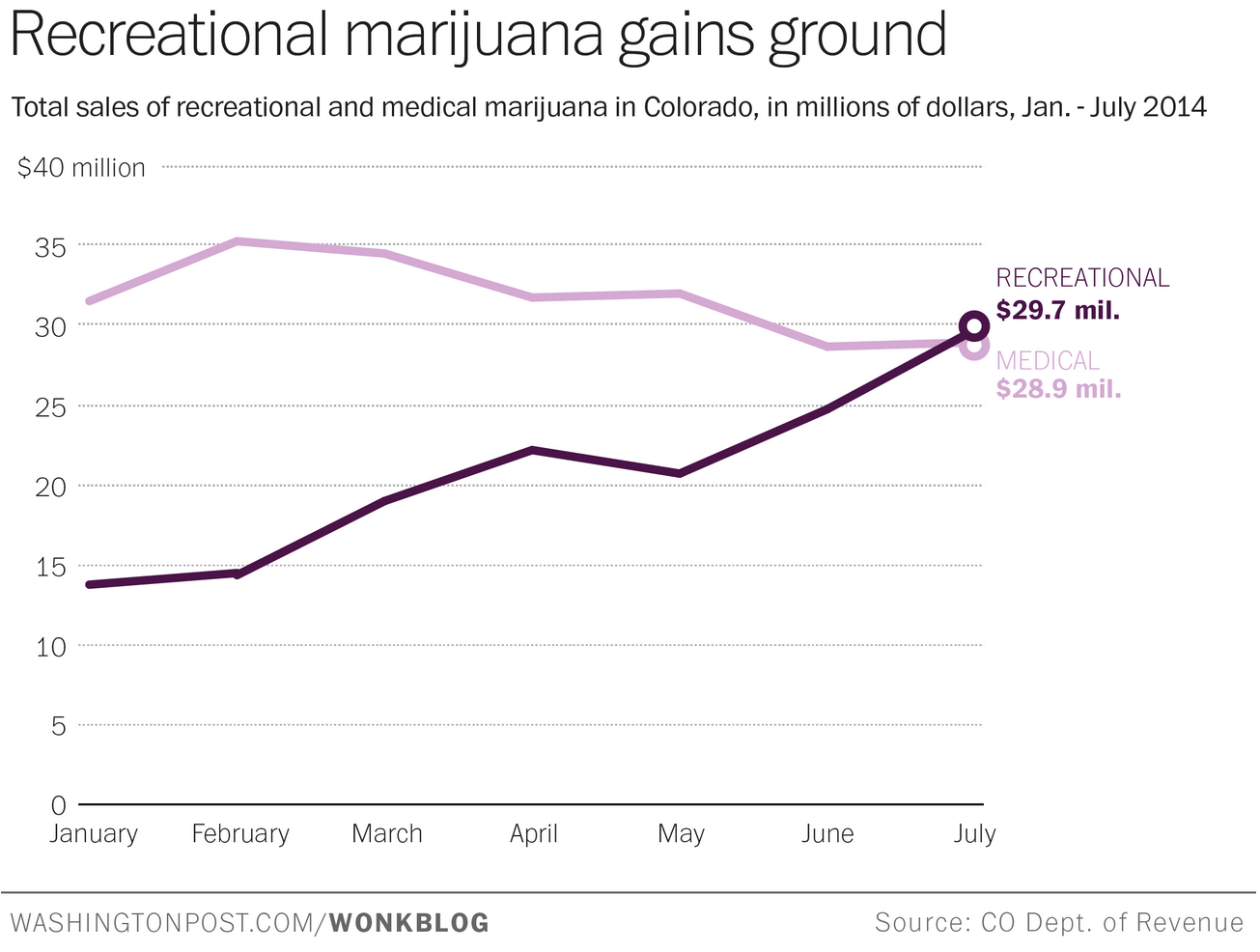
Colorado’s recreational marijuana sales have now surpassed medical marijuana sales:

Many legalization proponents welcomed the latest sales figures. But they don’t necessarily mean the imminent demise of Colorado’s black market. “I don’t think the increase in sales necessarily reflects a decrease in the black market, although it may,” Brookings’ [John] Hudak said in an interview. The sales increase could be due to “increases in marijuana tourism – an industry growing pretty rapidly in the state.”

A cultural shift is also likely under way, as more residents dip their feet in the recreational market. “It might reflect a relaxation of state residents where people are coming around and saying ‘Ok, this is real, this is legit and I’m not going to get arrested for it.’”

Katy Steinmetz keeps an eye on marijuana tax revenue:

During the month of July, the state received $838,711 from a 2.9% tax on medical marijuana, meaning that patients spent an estimated $28.9 million at dispensaries. The state meanwhile raked in $2.97 million from a 10% sales tax on retail marijuana, putting those sales at about $29.7 million, according to calculations by theCannabist.

Though that amounts to a less than $1 million gap between retail and medical sales, this is a small victory for champions of legalization who have argued that the experiment will be profitable for the state, as revenues have lagged behind some expectations.

Early this week, Jon Walker passed along a poll finding that Coloradans have no regrets – 55 percent support the legalization law:

Although a sizable minority still doesn’t like the new law there is little active opposition to it. Only 8 percent of adults say they are trying to have the law overturned. On the other hand, roughly half of the people who favor the new law say they are actively supporting it. Both the raw numbers and the intensity of support are with the pro-legalization side.

If voters and politicians in other states are “waiting to see” how legalization goes in Colorado the general consensus seems to be that it has gone pretty well. Most Coloradans are happy with legalization and would do it all over again.