This Is How Homophobia Ends

The relatively quiet, undemonstrative and yet decisive moment to allow self-identified gays to march in New York’s Saint Patrick’s Day parade is an almost text-book case of how homophobia can be undermined. There was mercifully no coercion – freedom of association is a critical principle for a free society. There was growing social pressure – from ordinary folk, organized gays, and, more critically, boycotts by New York politicians. No one is jumping up and down rubbing this quiet victory in. Yes, it took years of protest and anguish and anger to get here – and all the while, homophobia ran rampant. Cardinal Dolan has decided to remain the Grand Marshall of the parade, even with an explicitly gay group in its ranks – a remarkable turn-around from the past. The decision was a pragmatic one:

Dolan said Wednesday that the parade committee that operates the annual event “continues to have my confidence and support.” “Neither my predecessors as archbishop of New York nor I have ever determined who would or would not march in this parade … but have always appreciated the cooperation of parade organizers in keeping the parade close to its Catholic heritage,” he continued. Dolan concluded by praying “that the parade would continue to be a source of unity for all of us.”

Is that a sign that the Francis effect – downplaying the divisiveness of the issue in the Church – or just a sign that the society has evolved to a point where exclusion of gays seemed to counter “unity”?

My bet is that the threat of Guinness boycotting the parade was the final straw. The decision by the march’s organizers to include one gay group was unanimous. Bill Donohue is livid, of course. But even Donohue was reduced to merely arguing that a pro-life group be explicitly included in the parade alongside the gays – and when that didn’t transpire, he threw a tantrum and his organization – presumably him and his fax machine – will not be gracing the parade with its presence.

Too bad. He’s part of the New York Irish community and he belongs there as well. And what you see here, I suspect, is simply another reflection of greater informality in many religious groups and congregations, in favoring more inclusion without explicit rejections of orthodoxy. Michael Paulson has an interesting take on that development in American religion, especially with respect to gays and lesbians:

In the new results, 48 percent of congregations allow openly gay people in committed relationships to be members, up from 37 percent since the second study in 2006, and 27 percent of congregations allow them to serve as volunteer leaders, up from 18 percent.

Alas, Catholics are going backward – because inclusion was easier when gay couples couldn’t get married in a civil ceremony (creating a bizarre discrimination against those gays who have committed to one another for life). But the society moves on – as do congregations, as do public events.

Know change. And it may well come not with a bang, but a whimper.

Back From The Desert, Ctd

shirts111

This week we have aired various opinions from readers on the fantastic month of guest-blogging. Or how one puts it:

Unbelievably awesome viewpoints and people, even when I don’t agree. So well written. I am reading all of their stuff! In years past, I maybe skipped when Andrew went on vacation. Stupid me.

Another reader:

I have vastly enjoyed this rotation of guest bloggers. From the feminist libertarians to socialist Freddie, I have thoroughly enjoyed the quality of writing, the coherent world views (as opposed to reactionary bluthering), and diversity of opinion. I love disagreeing with such well-articulated philosophies. This is a fabulous place for great ideas and conversations. Much appreciated.

Another:

Can Andrew stay in Ptown another month?  Between DeBoer and Shepp and whoever “Dish Staff” may be, I see more of an emphasis on hard thought-provoking news instead of beards, male body hair, and dogs.

Another differs:

Ive followed you for years, through various iterations of your online presence, initially driven by getting your reaction to whatever was going on in the world. I eventually made the Dish a daily stop and started to appreciate the non-topical posts. It was fun getting to know someone more personally who I had admired for years.  I liked the fact that there was no public comments area, but that reader responses were often posted and engaged.  Maybe we risked getting a little too insular at times with recurring jokes and the development of some jargon, but I think it was still a welcoming online environment.

I’ve been on board with the move to independence and hiring staff from the beginning, but the blog has developed into more of an e-zine than a personal blog. This is accentuated, of course, with you on vacation. I guess all of this is to say, I like it, but this is not what I came here for.

Maybe it’s inevitable, as your site evolves, your audience will too.  Some like me may become less engaged, but you may add more new readers in the process.  But while there’s a lot of interesting content to be found on the web, mostly for free, there’s only one Andrew.

More feedback:

I am so sad to see Sue Halpern and Bill McKibben’s guest stint come to an end. I enjoyed their humane, sane, engaging, and thoughtful posts.  In particular, I’m grateful for McKibben’s posts about the golden age of radio. I have since listened to several of the podcasts/shows at Radiotopia and will certainly listen to many more – what a trove! I probably would not have come across it without his Dish post, so thank you. I also appreciated the posts on climate change and wish I could be in NY to join the protest. The variety, range, and quality of all the guest bloggers’ posts has made it a particularly stimulating month at the Dish. I especially loved Matthew Sitman’s “Reading Your Way Through Life” thread, as well as his post on Reinhold Niebuhr; and I appreciated everything posted by Freddie deBoer.

In the past, I’ve found myself checking the Dish less often (though still regularly) during Andrew’s vacations. But the opposite has been true these past few weeks. The Dish has served up quite a feast in his absence. Thanks again!

And props to another young blogger:

I really enjoyed Jonah’s post on expatriates – it caught my attention like nothing else has today. I don’t really have anything to contribute, personally, but I wanted to compliment his writing and perspective. I look forward to follow-up posts on different people’s experiences on a fascinating subject.

Read those here. Another reader:

I just wanted to voice my happiness with the content Elizabeth and Phoebe have provided thus far. I’ve really enjoyed reading their perspective on family leave, affirmative consent, and female sexuality. The Dish has always covered gender issues more than many people are aware, but it’s nice to get some more in depth editorial comment on those topics.

Another:

The stories that were commonplace in my other online spaces (Facebook, feminist blogs, women writers groups) were suddenly appearing on The Dish (and it made me realize I hadn’t seen as many of them before). Now, one of the reasons I come to The Dish is for stories I don’t find elsewhere. So it’s not like I need to see these stories of interest to women in yet another place. But. Their inclusion made me feel more like I belong here. And more importantly, for the majority of your readers, who I know are men, I’m glad they are seeing stories that focus on issues important to women.

Another adds, “I love Andrew, but the feminine energy these two ladies brought to the Dish was a refreshing change of pace.” As another puts it:

Nice to have a heterosexual female perspective from Phoebe with some splash of fashion!  Certainly rounds out all the talk of back hair.

But another woman dissents:

I’d like to respectfully disagree with the reader who wrote that he/she would miss Elizabeth Nolan Brown and Phoebe Maltz Bovy. I will not. Their posts struck me as the kind of unfocused, rambling conversations that my friends and I have. Nice and all, but rarely leading to new information or thoughts; these are “sharing” kind of conversations about our own experiences. I read The Dish because there is a lot of detailed information and sharp analysis/perspectives. Yes, the Dish turned into a sort of Jezebel, but for that I can go to Jezebel.

Another reader:

I’ve put off subscribing for far too long. I always had some excuse, usually “the internet should be free” which is obviously a cop out. In any case, the tipping point came last week and this, when you’ve let others like Elizabeth Nolan Brown and my personal friend Freddie deBoer guest-post. How can I not endorse a blog like yours, that has regularly featured other voices that ardently dissent to your own opinion? How can I not support a website that has on five different occasions featured my emailed comments?

I very often disagree with you. For example your reactionary stance on circumcision makes me roll my eyes every time you bring it up. And honestly I don’t care whether your blog’s economic model will work for others online. But the bottom line for me is that I want you to keep doing what you are doing, and by subscribing I can help you with that.

Another has a different line of reasoning:

I am laughing at myself as I write this – but here’s why I just became a brand new subscriber to the Dish: your guest bloggers are annoying! Sometimes the content is annoying, and sometimes it’s just that they expend an absurd amount of verbiage to make very simplistic points: droning on about Buzzfeed, say, in a treatise whose length you would devote only to a very thoughtful meditation on an important world event. I now fully appreciate how rare your talent and keen insight is, because it’s been made painfully evident by its absence this month. If this was a clever marketing scheme, well played.

One more:

I’m sure these emails get vetted by staff, which is good because this isn’t directed to Andrew anyway. I just wanted y’all to know that I am very much looking forward to Andrew’s hiatus. Of course I am a big fan of his, or I wouldn’t be a subscriber. But last year when he was on vacation I enjoyed the fresh takes on the topics and the change in “voice”. For what it’s worth, I believe the regular introduction of guest bloggers – even when Andrew is around – will only improve the Dish. So keep up the good work.

The Rebirth Of Political Correctness, Ctd

Nick Gillespie reacts to some freedom-of-speech controversies on campus:

A student publication at the university [of Western Ontario], The Gazette, published an irreverent special issue for incoming freshmen. Among the articles was a clearly satirical piece titled, “So you want to date a teaching assistant?” It included such tips as, “Do your research. Facebook stalk and get to know your TA. Drop in on his or her tutorials, and if you’re not in that class — make it happen…. Ask your own smart questions, answer others’ dumb questions, and make yourself known in the class. Better yet, stand out as a pupil of interest.” …

The piece immediately set off “a furor,” with the union representing T.A.s calling for the piece to be taken down for promoting sexual harassment and the university provost publicly castigating the paper for being “disrespectful.” The offending material was quickly pulled off from the paper’s website and the editors wrote a groveling, ritualistic apology, promising to report “on these issues in a more serious manner in the future.”

Gillespie fears the educational implications of such incidents:

We’re told that college is an absolute necessity in today’s advanced society. Higher education alone can cultivate the critical thinking skills and independence of thought that drives not just economic innovation but social progress too. Yet over the past 30 or so years, college has become an irony-free zone, one in which every utterance is subjected to withering cross-examinations for any possibility of offense across a multitude of race, class, gender and other dimensions.

Previous Dish on the subject here.

The Syrian Quagmire

SYRIA-CONFLICT

Douthat considers Obama’s case for war in Syria specifically and finds it lacking:

Writing in support of our initial northern Iraqi intervention, I argued that it passed tests that other Middle Eastern interventions, real and hypothetical, did not: There was a strong moral case for war and a clear near-term military objective and a tested ally to support and a plausible strategic vision (maintaining Kurdistan as a viable, American-friendly enclave, while possibly giving the government in Baghdad an incentive to get its act together) for what such an intervention could accomplish.

Based on what we’ve heard from the president, an expansion of the war to Syria does not pass enough of those tests to seem obviously wise or necessary or likely to succeed. We have no Kurd-like military partner in that country and we’re relying on Saudi training(!) to basically invent one, there isn’t even the semblance of a legitimate central government, and the actor most likely to profit from U.S. airstrikes is an Iranian-aligned dictator who makes Maliki look like Cincinnatus.

Josh Rogin sympathizes with the Free Syrian Army, whose leaders say that if the US provides them with arms, they will use them to fight Assad as well as ISIS:

[T]he Syrian opposition and the Free Syrian Army aren’t waiting for legal authorization to fight the Damascus regime; they are getting bombarded by Assad’s Syrian Arab Army every day, as it continues to commit mass murder of Syrian civilians through the siege of major cities, the dropping of barrel bombs, and the continued use of chlorine gas to kill innocents, according to international monitors. “The fight against ISIS is one part of a multi-front war in Syria. The brutal rule and poor governance of the Assad regime generated the conditions for ISIS become the global threat that it is today,” Syrian National Coalition President Hadi AlBahra told The Daily Beast on Thursday.

But Allahpundit thinks its crazy to expect the FSA to prevail, even with American backing:

Some dissenting U.S. analysts think there are moderates still in Syria we can work with but good luck picking them out of the gigantic crowd of Sunnis currently fighting Assad. For the sake of my own sanity, I need to assume that this whole “training the moderates” thing is just a big ruse being cooked up by the Pentagon as a pretext for inserting more reliable Sunni forces into the fray in Syria against ISIS. The Saudis have already offered to host the “training”; presumably, a whole bunch of the “Syrians” who end up being sent back onto the battlefield are going to be Saudi, Iraqi, and Jordanian regulars with U.S. special forces support. They could hit ISIS where it lives while posing as locals so as to spare their governments the political headache involved in sending their troops into the Syrian maelstrom. (They’d also suddenly be well positioned to threaten their other enemy, Assad.) If I’m wrong about that and we really are depending upon Syrian non-jihadis to somehow overrun ISIS in the east, hoo boy.

Jessica Schulberg points out that Washington has already been arming the Syrian rebels for a year, albeit covertly:

Obama’s decision to shift the Syrian training operation from the CIA to the Defense Department could also indicate that he sees a longer-term role for U.S. advisers in Syria than he did previously. The CIA’s advantage is that it is capable of carrying out small operations quickly, unencumbered by traditional bureaucratic restraints. The Defense Department, by contrast, requires authorization but is more capable of training a large, conventional fighting force. In this case, however, the $500 million Obama has requested from Congress for the Syrian opposition will likely prove inadequate. The U.S. has already spent over $2 billion in Syria, with little effect. It took more than $2 trillion of U.S. spending in Iraq to restore some semblance of a centralized government and military.

Juan Cole suspects that geopolitical considerations are at play here:

[I]n Iraq the outside great powers are on the same page. But in Syria, the Obama administration is setting up a future proxy war between itself and Russia once ISIL is defeated (if it can be), not so dissimilar from the Reagan proxy war in Afghanistan, which helped created al-Qaeda and led indirectly to the 9/11 attacks on the US. Obama had earlier argued against arming Syrian factions. My guess is that Saudi Arabia and other US allies in the region made tangible backing for the Free Syrian Army on Obama’s part a quid pro quo for joining in the fight against ISIL.

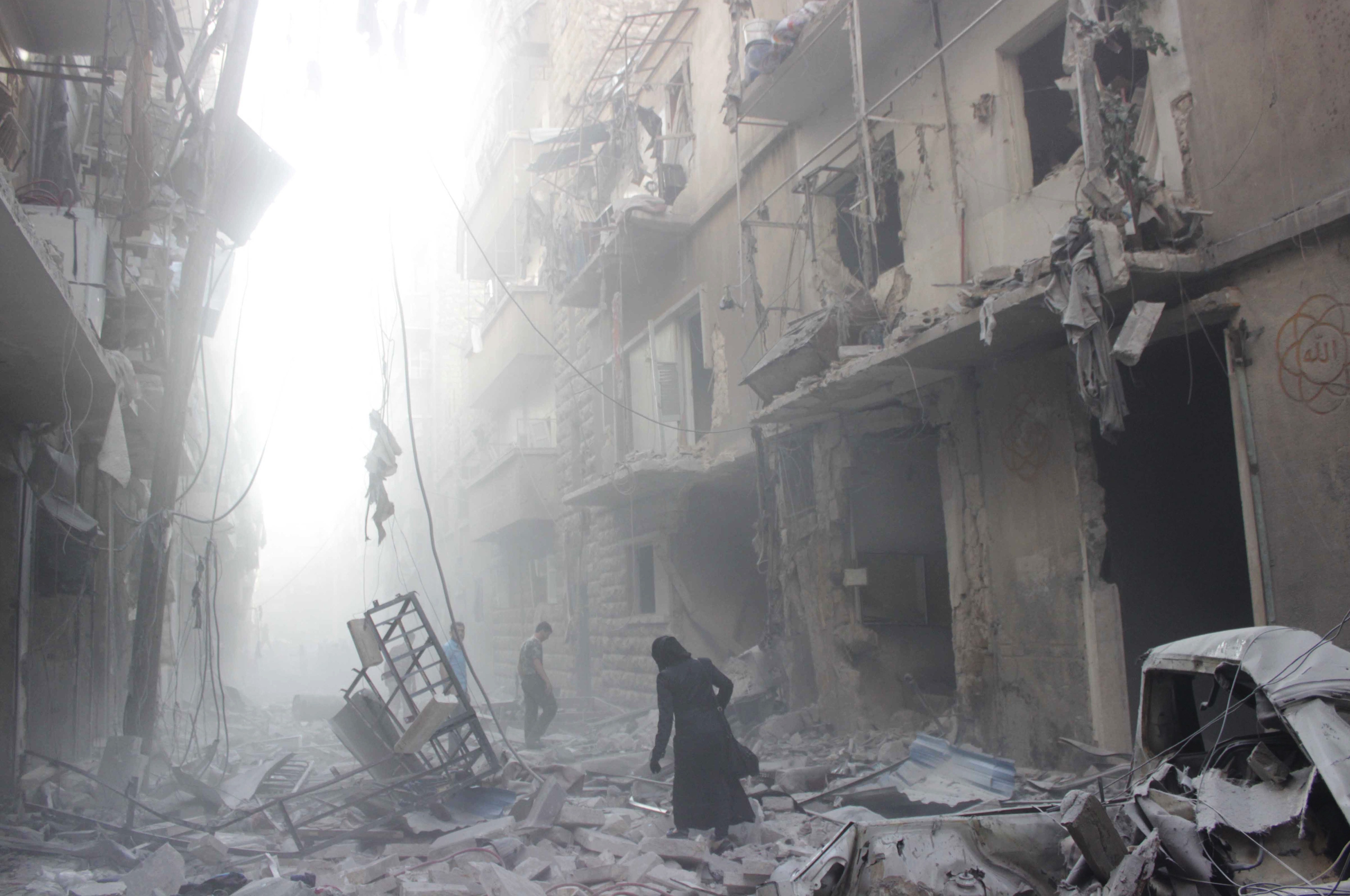
(Photo: A Syrian woman makes her way through debris following a air strike by government forces in the northern city of Aleppo on July 15, 2014. By Karam Al-Masri/AFP/Getty Images.)

Writing Tip: Don’t Write, Ctd

A reader responds to a recent post:

Don’t Write – the best tip that’s going round these days for inspiring authors. I agree with this advice for no other reason than it makes me feel better about my own writing. I completed a manuscript a little over a year ago and have been slowly refining it. I can go months without writing a single word and then suddenly out the blue I get inspired and write dialogue in my journal or an idea on a sticky pad. If I’m truly inspired I get out three to five pages worth of world building.

I do think about writing while washing dishes, taking a shower, folding the laundry.

When doing so I consider plot twist and turns, whether or not I should introduce a new character for the protagonist to contend with, or should I change the sex of a central character because it may work better with the overall theme of the story. Usually I don’t save my idea. I have to mull it all over for a while, taking the risk that I might forget.

Hayes’ guidance is liberating for a writer like me, where being a writer is more than actually writing. For me it is a process of thinking and then doing. Has it made me a better writer? I don’t know.  I don’t write novels for a living so there’s not a way for me to measure if I am improving. In my current profession I do technical writing and follow this same process with few to no complaints. But until I’ve finished revising my manuscript and get published I won’t know if my style of writing makes me a good writer worth reading. I do know that if I’m successful my style will be the one to recommend. I’ll be sure to give a shout out to Bill Hayes.

Still to just “Don’t Write” instead of growing frustrated with forced and unforced breaks is good advice to take. Writers block can build inspiration and momentum to slog it out to the end. To feel good about my writing I have to spend time away from the keyboard and journal. I have to be curious about the things that are happening around me so that my stories are told authentically and with empathy for the characters I develop.

I’ll only add one thing to the Writing Tip: Don’t Write, Live.

Andrew Asks Anything: Christian Wiman On Poetry And Faith

I was on break when Matt Sitman’s Deep Dish essay on Christian Wiman and the need to find new language for Christianity in modernity appeared. If you read the essay, you’ll see why Matt is such an integral part of the Dish team, both in terms of the depth of his reading, the elegance of his writing, and the miracle of his enduring faith. Matt and I also had a chance to sit down with Wiman and talk to him about what it really means to be an intelligent, modern person who is also a non-fundamentalist Christian.

Here’s a segment from our conversation when Wiman talks about his descent into unbelief, around his cancer diagnosis, and how he found a way forward through writing poetry that surprised him with its lingering hope. He rejects – as I do – any clear dividing line between belief and unbelief, believing that they both form a process in which belief can be transformed into something more real, and honest:


Dish subscribers can listen to the full podcast here. If you still need to subscribe, here’s the link. Matt’s Deep Dish essay on Wiman is here. A reader loved it:

I’m just writing to give a big thank you to Matt, Andrew, and Christian Wiman for the wonderful conversation, and an special thank you to Matt for his insightful, illuminating essay on Chris’s work. (I feel like I can use that rather intimate name after listening to the conversation this morning). I have long loved Chris’s work and enjoyed listening to him on the Poetry Foundation podcasts for years. What a joy (I use that word reservedly, but it is appropriate here) to hear him discuss his own work, as well as his faith.

As someone who was not raised in any religious tradition, it is a long, confusing, and often lonely path towards finding some way to acknowledge/accommodate/celebrate my strange knowing that God exists, that we are all somehow held by God. As you all acknowledged in your conversation, finding people who feel the same way, or similarly, so helps to ease that loneliness. I felt in communion with all three of you this morning as I walked through my neighborhood with my earbuds in, smiling at your jokes, nodding at so many of your observations. I didn’t feel lonely.

Abuse In The Public Eye, Ctd

A reader expands on this update and then some:

While I will not dispute that men can and are abused too, 85% of domestic violence victims are women, and women are most likely to be murdered by an intimate partner. On the specifics of the Rice situation, an examination of the tape with audio clearly shows that he spit on her, she reaches out to strike him (punch would be a stretch), they go into the elevator, he spits at her again, she lashes out back at him, he strikes her face, she strikes back and then he delivers the knock-out punch. I don’t know about you, but I don’t take kindly to being spit upon, especially by my fiancee. Clearly none of her attempts at striking him even landed and he connected with her head twice.

Yes, the video does indicate to me that there was previous violence and disrespectful action in their relationship.  But no sir, this is not a case of a man being abused and then finally saying enough and striking back. Also too, Ray Rice is maybe 5’7″ 205 and a trained boxer (oh, and plays the 2nd or 3rd most violent sport in the world), so there’s the small issue of strength and the dis-proportionality of response.

But hey, what do I know? I’m just a woman who grew up with domestic violence and has been abused myself. Your male writer may have a reason to be sensitive to male DV, but this ain’t that.

Another takes a different angle:

Please be courageous enough to explain to people that although we may be justified in showing moral outrage in the Ray Rice situation, there are still laws, and unless women educate themselves on laws, they will never be fully protected by them.

First, there is a notion out there that says provocation doesn’t exist. Sorry, it does.

It clearly exists with all laws, as provocation is the basis for any self-defense argument. Socially and morally we have double standards that benefit women, but there are no such double standards written in laws that allow women or people who are smaller to get away with something that their opposites cannot. Universal legal standard is if someone, no matter gender or size, attacks you (provocation), you have the right to respond with equal or lesser force (self defense).

Secondly, if we ignore all of what Janay did and just focus on Ray Rice’s action, he may have attacked her, but he also backed away. The moment where he retreated and then she charged him effectively made it impossible for the DA to prosecute him, hence her being arrested that night as well. Mutual combat. He retreated, she re-engaged him, menacing at that, and with further irony if his lawyer was good/shiesty enough he could argue he was defending himself.

#WhyIStayed is great. But unless women have a #WhyILearnedThe Law, the law will never be on their side.

But another underscores an essential point:

Proportionality matters.  If you are a muscle-bound, 210-pound man, you don’t punch someone half your size.  Ray Rice barely flinches when she touches him outside the elevator; he shrugs off her elbow (and looks like he slaps her). Meanwhile, Janay fell like a slow-motion rag doll.  It was horrifying – I’m surprised she didn’t get a severe neck injury from catching the hand rail on the way down.

That’s not self defense.  The only time it’s OK for a 210-pound guy to throw a left hook at a woman is if the woman in question is Ronda Rousey and you’re both in a cage match in a dystopian Hunger Games future.

And look at Ray Rice after he hits her.  He isn’t on his knees, trying to bring her to, and in disbelief of his own actions.  He’s trying to toss her dead weight out of the elevator.  Based on his actions alone, I’d be shocked if this was the first time he hit her.

Start talking about reality, your reader says?  Start talking about common sense.  You don’t hit someone unless there is no other option for your self defense.  Know your own strength. Don’t escalate a situation by getting in someone’s face.

Or as another puts it:

For your reader’s benefit, here’s one surprising trick men can use to protect themselves from physical abuse: Walk away. That’s all Ray Rice would have needed to do. Walk away. Don’t get on the elevator. Be a man.

More emails to come. Follow the entire thread here.

Haters Be Calling This War A “War”

How dare we. State Department spokeswoman Marie Harf tries to spin how dropping bombs on two countries to destroy an entity that has yet to attack the US doesn’t count as a preemptive war:

Allahpundit watches the clip:

Preventing a dangerous enemy from hitting the U.S. by hitting him first sounds pretty preemptive-y to me. If I understand her correctly, the reason this isn’t preemptive war a la Bush is because it isn’t war, period. A war is something you engage in against a nation-state; we don’t recognize ISIS’s caliphate, ergo, they’re just a bunch of terrorists and preemptive war against terrorists is simply counterterrorism. I think that’s why you’re seeing such a moronic sustained effort today among White House mouthpieces to avoid using terms like “war” and “victory,” with Harf refusing even to accept “war on terrorism” as a label at the beginning of the video [above]. (Obama himself never once described the new “effort” against ISIS as a “war” [Wednesday] night, by the way.) The parallels here to 2003 — preempting a threat to the U.S. by overthrowing a brutal regime in the heart of Iraq — are too obvious and too politically uncomfortable to adopt Bush-era terms like “war” and “preemption” too. And of course, the more you talk about it as a new “war,” the more the public’s left wondering why an Article I declaration of war by Congress is unnecessary.

Asawin Suebsaeng catches John Kerry making the same claim:

“If somebody wants to think about it as being a war with [ISIS], they can do so, but the fact is that it’s a major counterterrorism operation that will have many different moving parts,” Kerry said Thursday on CNN. “I don’t think people need to get into war fever on this,” he told CBS News’ Margaret Brennan. … It is true that this latest round of airstrikes and other actions against ISIS is not a war in the classic sense. It isn’t as flashy or big-budgeted as past wars, and significantly fewer boots are on the ground. It is not a war in the sense that war has not been declared, but by that standard, the one that Kerry fought in (that disastrous one that served as the basis of three Oliver Stone movies) wasn’t a war, either.

Froomkin interprets the attitude Obama projected in his Wednesday night address:

This was not going to be a huge deal, he indicated. He called it an “effort,” not a war, and stressed that “this effort will be different from the wars in Iraq and Afghanistan. It will not involve American combat troops fighting on foreign soil.” There was no talk of shock and awe; what Obama had in mind was a ”counterterrorism campaign” that “will be waged through a steady, relentless effort.” And Obama’s lack of any specificity regarding the scale of the effort, the timing, goals for partner participation, or any kind of metrics for success was either cover for him not really having a viable plan — or a brilliant rhetorical strategy to keep open the option of ratcheting everything back once the hysteria passes. Or both.

Mary Ellen O’Connell underlines that in international law, the kind of preemptive defensive operation the Obama administration envisions is still illegal:

Late last month, Yale law professor Harold Koh, the former legal adviser in Obama’s State Department, asserted that the United States had the right to attack ISIL under international law to “to avert humanitarian disaster and to protect U.S. nationals and vital interests.” But international law is clear: The right to use force in self-defense arises following a significant armed attack against a country when more such attacks are likely. The use of force in self-defense must target the territory of the state responsible for those attacks. The United States has faced only one such situation under current law: It occurred on Sept. 11, 2001, and led to the war against Afghanistan, which gave safe haven to Osama bin Laden and the al Qaeda forces that orchestrated and carried out the 9/11 attacks. There simply is no right under international law to resort to major military force to avert humanitarian disasters or to protect nationals or “interests.”

Indeed, the administration is trying to claim authority for this operation under the 2001 AUMF that opened the way for the war in Afghanistan. That’s transparently illegal too, but Massimo Calabresi doubts that will make a difference:

If Obama is breaking the law, don’t expect much to come of it in the short term. The consequences of Obama’s legal interpretation, beyond his own discomfort, are not likely very great. The Bush administration showed the bar for legally constraining presidential counterterrorist actions is high, and even when it is surmounted there are little or no penalties. Politically, the president has nothing to fear: no matter how angry they are about the new effort against ISIS, the left wing of Obama’s party isn’t going to impeach him, and the right won’t either, at least not for going after Islamic extremists. In the long term, perhaps Obama’s legal legerdemain will boost those who want to come up with new, clearer legal frameworks for international counterterrorism operations. But for now Obama, like Bush before him, seems determined to act without them.

And that scares the crap out of Jonathan Hafetz:

Going to war against ISIL through the rubric of the AUMF has significant implications. Among them is the deterioration of the levers of democratic accountability for waging armed conflict in an age of global terrorism. It suggests not only the relative ease with which the United States will go to war, but also the way in which new military actions are subsumed under a more generalized war against extremist groups. War is becoming increasingly open-ended, while also more able to avoid democratic checks, as each successive military operation gets subsumed within an existing–and ever growing–conflict. War doesn’t end; it just expands, all without the friction that the separation of powers is designed to provide.

Why Obama Launched Another War

President Obama Marks Anniversary Of September 11th Attacks At The Pentagon

I wish I could say that my fears have abated somewhat since returning from vacation and finding the country in a bout of total hysteria over ISIS. No, I know I have no legs to stand on when it comes to hysteria, and may be over-reacting to Obama as badly as the country seems to have over-reacted to ISIS.

But consider the following facts as they have emerged this week. The key element of any intervention – as argued by the president – is that we have clear regional allies on the ground. We don’t. The Turks are AWOL; the Saudis claim they will train some Sunni forces to fight ISIS (drawing Iran into bolstering its balancing Shiite force); the European allies are not joining the military air campaign; and the Arab world is deeply suspicious – even when faced with a movement almost every government there despises. Even Jordan refuses to say publicly it is in the fight – and Jordan may be one of the most vulnerable Sunni dictatorships out there.

So let’s be clear: we have waded into a war alone. We seem to regard the ISIS problem far more seriously than anyone in the actual region. We are therefore Americanizing this war almost as soon as it begins, which means that almost everyone in the region will be hoping for our defeat. The hatred for America is deeper than the fear of ISIS:

Even in Baghdad and across Syria, where the threat from ISIS is immediate, reactions were mixed. Members of Iraq’s Shiite majority cheered the prospect of American help. But many Sunni Muslims were cynical about battling an organization that evolved from jihadist groups fighting American occupation. “This is all a play,” said Abu Amer, 38, a government employee, who withheld his family name for his safety. “It is applying American political plans.”

So this is almost a text-book example of the dumb war Obama was elected to avoid. It vitiates everything he has said through his candidacy and presidency. Its potential consequences are utterly opaque and we have no exit plan in the wake of our defeat. And yes – there is no war in the Middle East that leads to victory. It is always some kind of version of defeat.

So you have to ask yourself why. This is a calm and smart president who has just launched a war with no provision for its cost, no end-date, no Congressional authorization, no troops on the ground who can really do the work, and no reliable allies. The worst possible reason is an emotional response to the beheadings and enormous political pressure before the mid-terms. If that’s why he acted, he deserves our contempt. But there is another reason that deserves to be taken seriously. Jeffrey Goldberg puts it this way:

The only possible way to slow ISIS’s progress, and to possibly reverse it in some more-than-negligible way, is to provide air cover and intelligence and logistics support to our hapless allies on the ground. A second reason: President Obama was careful not to speak of an imminent or specific ISIS threat to Americans, because none currently exists. But it is not implausible to argue that a Qaeda-inspired group of limitless cruelty and formidable financial resources, one that has an omnibus loathing for “infidels,” and one that has thousands of members who hold passports from countries that participate in the U.S. visa waiver program, poses a non-trivial threat to American civilians.

The first objective – containing it in Iraq – was underway before this new and open-ended war. It had modest success – although it also precipitated the bait of the beheadings, which gave us this new wave of war. See how things evolve? So the second one is the most plausible. Obama is scared that minimalism won’t be enough, that ISIS could grow in strength, that a new Caliphate could be the final result of a war to bring secular democracy to the Middle East.

So he is acting out of fear. He believes that if you hit ISIS more comprehensively now, you can perhaps keep it at bay. No such threat can be left to fester. If you’ve heard of this kind of mindset before, you’re not wrong. It’s Dick Cheney’s one percent doctrine all over again. In abandoning what he said just last year about unwinding the war machine, Obama holds that the United States must be constantly at war, bombing and drone-striking other sovereign nations in order to prevent terrorist enclaves from becoming more dangerous over time – even when they have made no direct threat to the US, even though they are consumed by their own regional conflicts. But even Cheney was forced to go to the Congress to get authorization. Obama will have no truck with that. This new emperor assesses the threat himself, makes decisions later, and informs us that, whatever we believe, we are now at war again. If no-drama Obama has caved to this kind of hysteria and over-reaction, then what future president will ever be able to stand firm and unwind the cycle? If the un-Cheney Obama has just endorsed a Cheney-like idea of what the executive branch can do on its own, he has all but assured us that a future Republican or Clinton will have a solid precedent to conduct war as if they were emperors.

I can’t believe I have to say this in the Obama era:

the only way the blight of this modern-medieval bloodlust can be turned back is if the Muslim world does it. If we do it, it comes back again more potently, fueled by hatred of the distant empire. If we do it, it gains strength. We may bomb it into some kind of submission, but it will only come back, like a virus, mutated and stronger. Why on earth do you think we are confronting ISIS anyway? It’s because we destroyed the country of Iraq, allowed al Qaeda a foothold, and ISIS exploited the shift to Shiite power in Iraq by becoming al Qaeda’s more brutal successor.

In fact, by intervening, we make a possible regional resolution of these centrifugal forces less likely. By meddling, we could postpone a potential resolution of this long, difficult struggle as the Arab Muslim world tries to come to terms with the modern world. We are actually forestalling a possible Arab future by conflating it with a fight against American intervention.

I’m trying not to despair. I know plenty of you will mock me for over-reacting. And maybe I am and this lack-luster, transparently pointless move is just a gesture to reassure a nervous public and Obama will prevent this whole thing from metastasizing. I sure hope so. I sure hope that by some miracle, this will have some effect. I hope that the Iraqis put behind their sectarian hatred and unite against these fanatics. I hope the people subjected to this new Caliphate rebel against its insanity and evil. I hope this new front doesn’t lead to a wider Shiite-Sunni war or to the collapse of the critical nuclear negotiations with Iran. I hope the president hasn’t just put out a sign to ISIS that says: “You want a war? Come and Fight America.”

But this blog was transformed on 9/11, and has been a searching, grueling attempt to find a way out of that terror and out of the huge errors we made thereafter. Obama, for me, was the only man able to get us there. And he has folded – and you can see he knows it by the wan, listless look on his face. His presidency may well now be consumed by this new war and be judged by it – just like his predecessor’s. And all because when Americans are faced with even the slightest possibility of future terror, they shit their pants and run to daddy.

You know a country gets the future it deserves. And ours may have just gotten a lot darker.

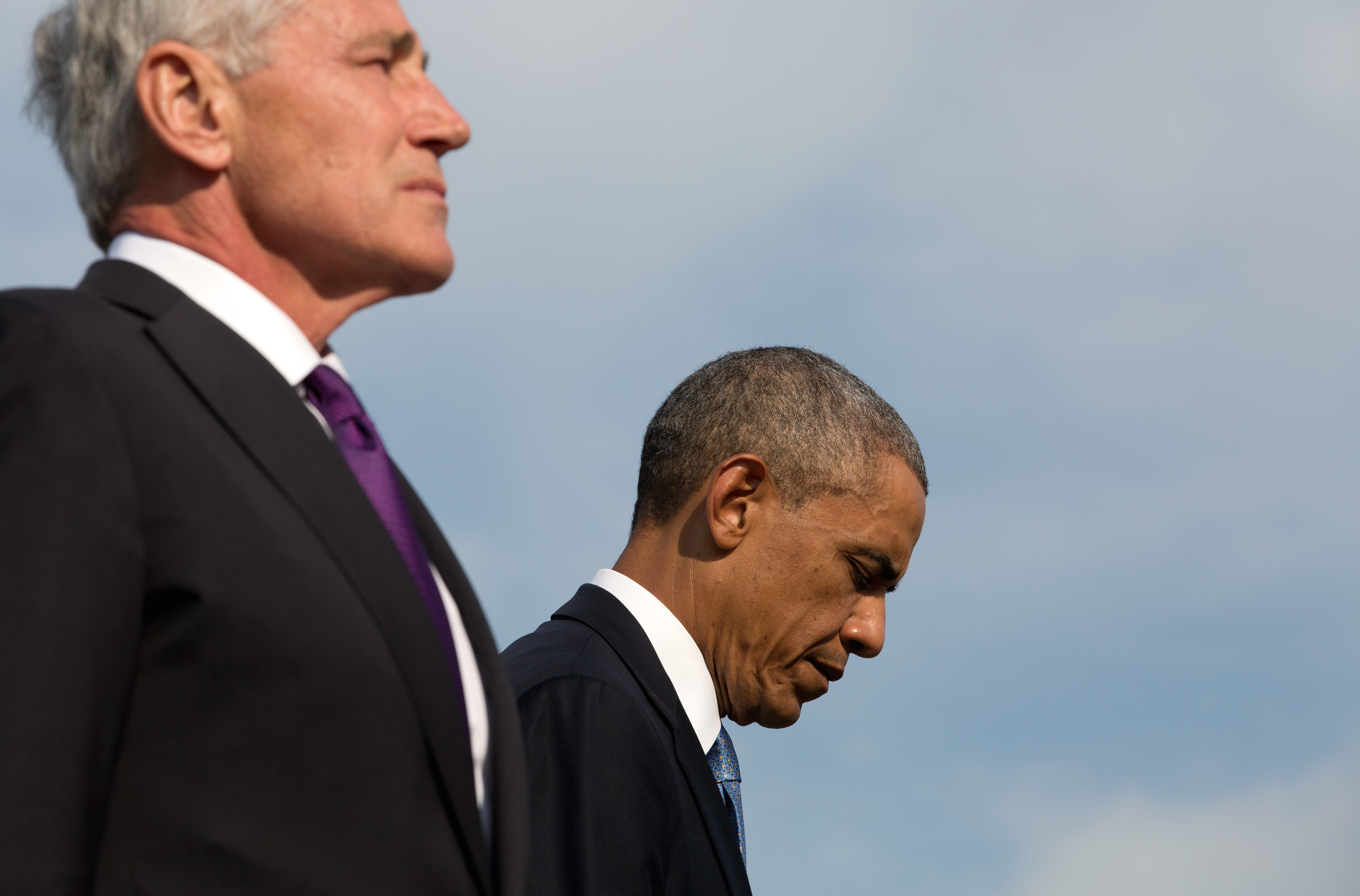
(Photo: U.S. President Barack Obama bows his head, as Defence Secretary Chuck Hagel looks on, during a ceremony to mark the 13th anniversary of the 9/11 terrorists attacks at the Pentagon Memorial on September 11, 2014. By Martin H. Simon-Pool/Getty Images)

The Problem With Partners, Ctd

John Kerry - Recep Tayyip Erdogan

Thomas Seibert scrutinizes Turkey’s reluctance to commit to anything beyond a “passive role” in the war on ISIS:

Officially, Turkey argues it has to keep its operations low-key because a more active posture would endanger the life of 46 of its citizens held hostage by ISIS. The jihadists kidnapped the Turks and three of their Iraqi colleagues when they overran the Turkish consulate in the northern Iraqi city of Mosul in June. Ankara says it is trying to secure the hostages’ release, but has ordered a news blackout that makes it difficult to assess where those efforts stand. …

Even without the hostage situation, Ankara would face difficult options. Turkey could take part in Western strikes against ISIS and risk a backlash from the jihadists themselves and other Islamist groups in the region. Or Turkey could refuse to have anything to do with the strikes, angering its Western allies and being a mere spectator despite its ambition to become a regional leader. Faced with that choice, Ankara appears to have decided to muddle through, officially joining the alliance against ISIS, but keeping out militarily.

Shane Harris expects the US to depend heavily on Jordan, particularly its intelligence service:

Jordanian intelligence “is known to have networks in Iraq which date from 2003 [the year of the U.S. invasion] forward,” said Robert Blecher, the acting program director for the Middle East and North Africa at the International Crisis Group. “The Jordanians have good connections and have tapped them before,” Blecher added. They’ll have to do so again. But it’s not just Jordan’s spying prowess that the United States needs. Jordanian intelligence also has ins with Iraqi Sunni tribes aligned with the Islamic State. …

The Jordanians are also likely to provide logistical support to the American air campaign, which has so far launched more than 150 strikes against Islamic State fighters, vehicles, and artillery using drones and manned aircraft. (The CIA now says that the militant group has recruited as many as 31,500 fighters, up from an earlier estimate of 10,000.) Blecher said that Jordan has allowed the U.S. military to use its air bases throughout the past decade, though Jordanian officials are reluctant to acknowledge that. [Former Jordanian foreign minister Marwan] Muasher said the country will likely lend logistical support but that he didn’t envision a role in direct military operations.

Adam Taylor and Rick Noack round up some international reax to Obama’s speech. They notice that Egypt is also toeing the noncommittal line:

Perhaps in response to Obama’s speech, Egypt’s Egyptian Foreign Minister Sameh Shokri called Thursday for a global strategy for dealing with extremists. However, when a diplomat was asked whether Egypt would cooperate with Obama’s strategy against Islamic State, they offered a vague reassurance. “Cairo will discuss every effort which can be made by the alliance to eradicate the phenomenon of extremist groups in the region,” the unnamed diplomat told Asharq Al-Awsat.

Ed Krayewski is dismayed to see our allies abandon their own national security commitments and let America do most of the work:

Countries like Turkey and Saudi Arabia have given varying degrees of support to the virulent strains of Islam that feed extremists like those in ISIS. Yet ISIS is hardly a puppet. Whether they decide to move north to Turkey or south to Saudi Arabia will be a decision over which those two countries will likely have no influence. But why bother treating ISIS like a national security threat when the United States is doing it for you?

Saudi Arabia, Turkey, other nations in the region, Arab and otherwise, are all threatened by ISIS in a way the United States isn’t, and in a way I think their leaders intrinsically understand they’re not being threatened by other countries in the region despite the official propagandas. Though the U.S. is the worldwide leader in military spending, these countries have spent decades building their militaries. They ought to make the decision to use them or not, to work with other countries in the region or not, and not have those decisions deferred by U.S. action from afar.

Likewise, Rosa Brooks argues that we should step back and let our local “partners” fight this war themselves:

Obama says the United States will “lead” a coalition against IS, but the United States should instead step back and let other regional actors assume the lead. They have a strong incentive to combat IS (an incentive we undermine when we offer to do the job for them), and the common threat of IS may even help lead to slightly less chilly relations between Iran and Saudi Arabia (though I won’t hold my breath). Other Middle East powers also have greater ability than we do to understand local dynamics, not least of which because many share a common language with IS or with other actors in the mix. The Kurds and the Jordanians may need some U.S. help to protect their own territory, and other states may need intelligence or other forms of logistical assistance. But we can provide such support to any of our allies and partners without putting ourselves front and center in the effort to combat IS.

Keating notes that other than Russia, none of our rivals seems to have a problem with us bombing Syria—even the Damascus regime itself is signaling that they’re OK with it:

Another interesting wrinkle is the ramifications of this Amerian operation for Assad’s backers in Moscow. Russian Ambassador to the U.N. Vitaly Churkin said today that if the United States bombed Syrian territory “without the Syrian government’s consent,” it would “complicate international operations and will pose problems for Russia as well as for many other countries respecting international law, including China.” But Russia may be the only country bothered by Obama’s campaign. It appears the Syrian government isn’t going to object too much to the operation. China, which has concerns about its own citizens cooperating with ISIS, seems likely to offer quiet support. Even Iran seems finally to have found an American war in the Middle East it can get behind.

Judis isn’t impressed with Obama’s stated strategy for a number of reasons, one of which is that it ignores Iran:

In trying to answer IS’s challenge in Iraq, the United States needs Iran’s cooperation. Obama didn’t mention Iran at all in his speech but instead referred to “Arab” countries and even to the NATO countries that he claims are going to join the anti-IS coalition. Arab countries are imporant, and one NATO country, Turkey, also is.  But Iran is crucial. It’s the main backer of the Shiite Iraq government and of Assad.  What, at this point, is the American strategy toward working with or against Iran in the region?  And what can be done to ease relations between Iran and Saudi Arabia, which would be important to resolving conflicts in Iraq and Syria? How much bearing do the nuclear talks, which seem to have stalled, have on the possibility of cooperation with Iran in the region?

And the way Tom Ricks sees it, our perforce partnership with Iran is really the only news here:

I think the Iraq war is best seen as one continuous conflict since the Iraqi invasion of Kuwait in the summer of 1990. I remember getting on the Metro that morning, seeing the headline, and thinking, “Hey, we’re gonna go to war.” And so we did, with an air campaign followed by a short ground campaign. When that was over, we went back to several years of air campaigning, complemented by some covert operations on the ground. Then, in 2003, we had another major ground campaign. It was supposed to last a few months, but instead lasted 8 years. And now we are back to an air war, probably again supported by occasional covert ops. The biggest difference I can see is that where once some Americans said we were doing this to prevent Iran from gaining influence, now we are working alongside the Iranians in Iraq.

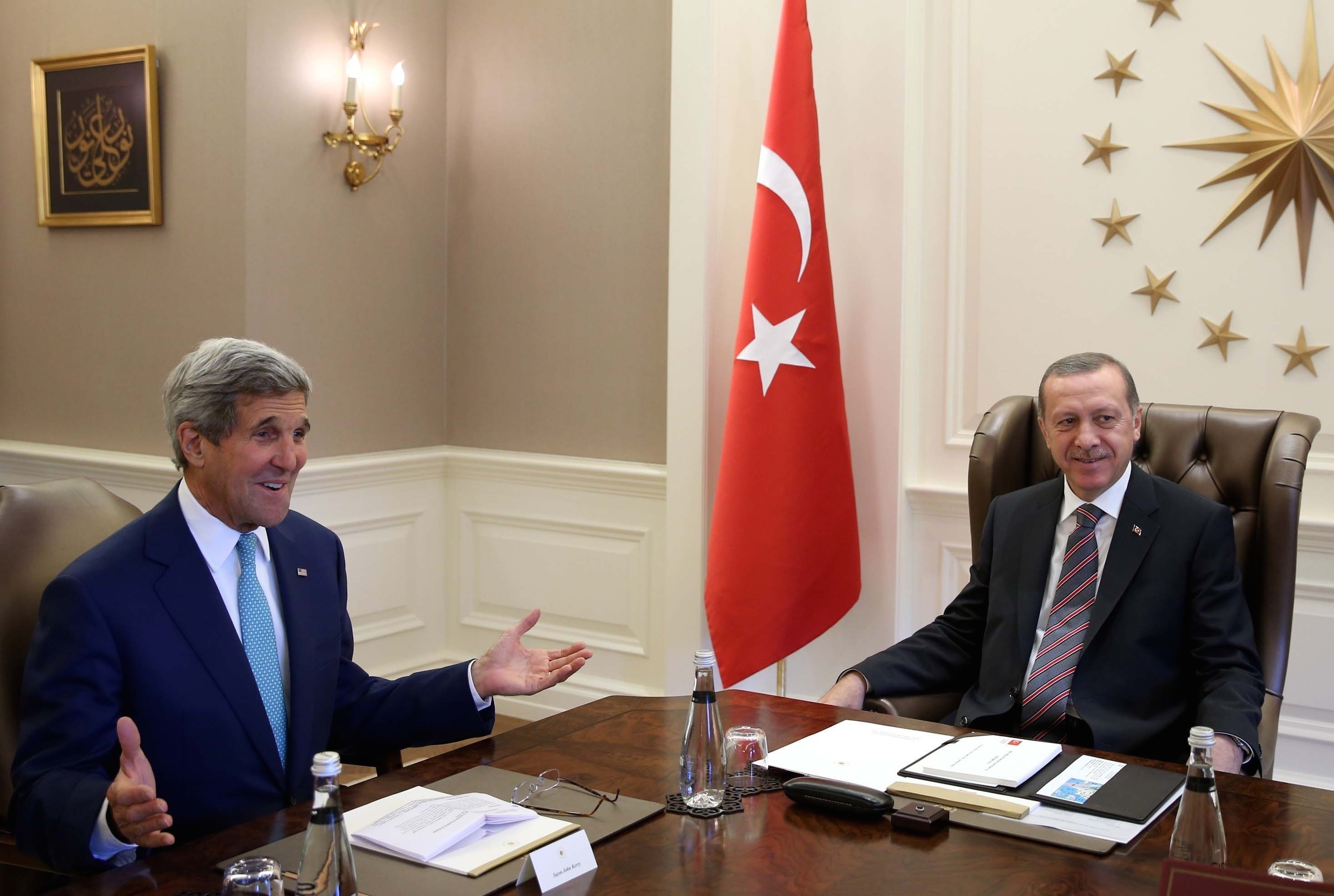
(Photo: U.S. Secretary of State John Kerry (L) meets Turkey’s President Recep Tayyip Erdogan (R) during Kerry’s official visit at Cankaya Palace in the capital Ankara, Turkey on September 12, 2014. By Kayhan Ozer/Anadolu Agency/Getty Images)