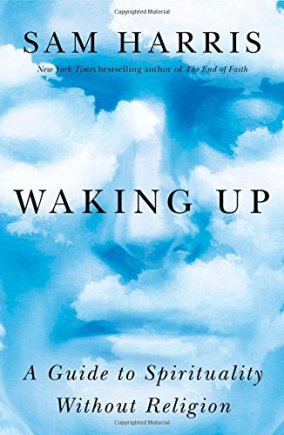
Well, I couldn’t resist, could I? Sam Harris is a friend and great interlocutor. We’ve hashed out the issues on Israel and, indeed, religion itself in dialogues. See the Gaza conversation here; and the longer exchange of emails on religion here. I always learn something from him – and I have always thought of him as somewhat different than an atheist like Hitch. Why? I cannot imagine Hitch spending time in an ashram, or being dedicated to regular and disciplined meditation, or writing something like this:
I once spent an afternoon on the northwest shore of the Sea of Galilee, atop the mount where Jesus is believed to have preached his most famous sermon … As I gazed at the surrounding hills, a feeling of peace came over me. It soon grew to a blissful stillness that silenced my thoughts. In an instant, the sense of being a separate self – an “I” or a “me” – vanished. Everything was as it had been – the cloudless sky, the brown hills sloping to an inland sea, the pilgrims clutching their bottles of water – but I no longer felt separate from the scene, peering out at the world from behind my eyes. Only the world remained.
That’s a passage from Sam’s new book, Waking Up: A Guide To Spirituality Without Religion. It tackles big subjects – neuroscience, consciousness, meditation, faith – in his sometimes dense but always pellucid fashion. At times, the book is actually quite funny – there’s a part about him dealing with various water leaks in his house that cracked me up.
And the book’s argument is a rare and serious one: that it is possible to find a place in one’s mind where one is no longer in one’s mind. This elusive idea of consciousness is the basis of a peace and serenity and balance that we in the West have so often failed to achieve, even as our civilization constantly scales new heights. This can be achieved within a religious tradition – such as Buddhism or a Merton-like Christianity – but Sam also insists there need be no religion to the experience at all.
Now, I’m religious as well as spiritual, a believer in prayer and meditation as vital parts of any healthy faith life – while Sam is unrepentantly hostile to any idea of divine revelation, or anything but consciousness beyond our own delusional egos. And it struck me that many Dish readers – some engaged in our religious and spiritual coverage, some hostile to religion but open to the sublime and the spiritual – would get a huge amount out of the book, and the conversation it could prompt.
So drum roll … this is our September book of the month.
Buy the book now at Amazon and help us get a little affiliate revenue while you’re at it. I have a head start, because Sam got me an advance copy. He’s agreed to join the conversation in its final stages. I hope we can get somewhere in a debate often defined by polarization and cheap rhetoric – and see where we overlap and where we still differ.
And with your input, religious and spiritual people, I hope we can advance the conversation about spirituality as opposed to religion as well. I’ve long believed that the key thing we need right now is a revival of a Christianity less concerned with dogma and more focused on faith as a way of being in the world. Sam’s is as good a provocation on those issues as any out there. So join in! Get the book here – and we’ll start the discussion after the beginning of October. Send your thoughts to bookclub@andrewsullivan.com and there’s a good chance you’ll see them posted.
Contra Steven Pinker, political scientist Tanisha Fazal argues that war is not necessarily less common than it used to be. Rather, she says, improvements in battlefield medicine simply mean that more people are surviving:
These medical advances have several implications for scholarship and policy. Major academic data sets on war and armed conflict typically use a battle death threshold to determine which cases count as wars/armed conflict. This battle death threshold is constant over the time period covered by these data sets. But a conflict that produced 1,000 battle deaths in 1820 will likely produce many fewer overall casualties (where casualties, properly understood, include the dead and wounded) than a conflict with 1,000 battle deaths today. In other words, the events scholars (including this one) are comparing may not be as similar as we think they are.
Improvements in medical care in conflict zones also hold important implications for policy. While the recent Veterans Affairs Department scandal was surely driven by an aging population of Korean War and Vietnam War veterans, it seems at least possible that pressure on the VA system also emerged from unexpectedly large numbers of returned wounded coming home with a new set of injuries and illnesses. The widespread use of personal protective equipment in the U.S. military, for example, has saved many lives, but surviving soldiers are more likely to come home with traumatic brain injuries, severe facial disfigurement, or as amputees. More broadly, our thinking about casualties and the costs of war has tended to focus on the dead rather than the wounded, while the wounded are growing in number. Medical advances in conflict zones are a positive development, but one that will not be fully realized until we recognize that both the wounded and the dead “count” as casualties.
Greenwald is shocked but not surprised at how the notions that ISIS is a grave national security threat and “of course we’re going to war with them” have both become conventional wisdom:
If the goal of terrorist groups is to sow irrational terror, has anything since the 9/11 attack been more successful than those two journalist beheading videos? It’s almost certainly the case that as recently as six months ago, only a minute percentage of the American public (and probably the U.S. media) had even heard of ISIS. Now, two brutal beheadings later, they are convinced that they are lurking in their neighborhoods, that they are a Grave and Unprecedented Threat (worse than al Qaeda!), and that military action against them is needed. It’s as though ISIS and the U.S. media and political class worked in perfect unison to achieve the same goal here when it comes to American public opinion: fully terrorize them.
Larison fumes over the war’s rapidly expanding objectives:
It hasn’t taken very long for last month’s “limited” intervention in Iraq to expand far beyond anything that the administration originally described to the public.
Administration officials were denying that they planned for a “sustained” campaign just a few weeks ago, and now they’re saying the opposite. Obama said that he wouldn’t “allow” the U.S. to be dragged into a new war, and he is now setting out to take the U.S. into that war. What we’re seeing now is not so much mission creep as mission gallop, and it all seems to be happening without any serious consideration of the costs or the potential dangers of such an expansive campaign.
Even if the U.S. does not eventually commit large numbers of ground troops to this campaign, the U.S. will be at war in two countries where it does not need to be fighting. This is every bit as much a war of choice as the earlier wars in Iraq and Libya, and it hasn’t been thought through any better than those were.
Christopher Dickey thinks the ISIS threat is being overhyped, though he worries about lone ISIS-inspired nut-jobs like Mehdi Nemmouche, who killed four people in an attack on a Jewish museum in Brussels in May:
Veteran terrorism expert Brian Jenkins notes the alarmism in Washington has reached such proportions, there’s a kind of “shock and awe in reverse.” Thus, as Jenkins writes, Defense Secretary Chuck Hagel proclaims ISIS is an “imminent threat to every interest we have.” A congressional staffer argues that it is “highly probable ISIS will…obtain nuclear, chemical, biological or other weapons of mass death…to use in attacks against New York [or] Washington.” Texas Governor Rick Perry claims there is a “very real possibility” that ISIS forces may have crossed the U.S.-Mexican border. Senator James Inhofe asserted, “We are in the most dangerous position we’ve ever been in as a nation,” and retired Marine four-star Gen. John Allen goes so far as to say, “World War III is at hand.”
All this plays to the advantage of the self-proclaimed Caliph Ibrahim, formerly known as Abu Bakr al-Baghdadi, whose ragtag army conquered a huge swathe of Iraq mainly by filling the vacuum left by incompetent Iraqi government military commanders. The conquest—and the reaction to it—have given him an aura of invincibility that holy-warrior wannabes find quite thrilling.
I actually hadn’t absorbed the sheer hysteria in Washington after the beheadings-bait. It’s truly shocking – and utterly insane. My earlier thoughts here.
A trending hashtag is providing insight into why abuse victims stay with their abusers. Alex Abad-Santos spotlights the powerful tweets, which are a response to the Ray Rice video:
Looming over this violent act is the fact that Janay went on to marry the man who beat her — leading some people, most notably the anchors on Fox News’sFox and Friends, to wonder why she, and other abused women, wouldn’t just immediately flee an abusive relationship. They don’t, because it’s not that simple.
It was started by writer Beverly Gooden, who wrote, “I believe in storytelling. I believe in the power of shared experience. I believe that we find strength in community. That is why I created this hashtag.” It began trending on Twitter on Monday night, as women used the hashtag to explain the psychology and the reality of their domestic abuse situations — some thought it would get better, others didn’t have a place to turn, many felt shame, several wanted to keep the family together. The testimonies are powerful to read, and they shred the idea that it’s easy for victims to leave their abusers.
Olga Khazan rounds up #whyistayed tweets and research on domestic abuse:
In 1999, law professor and domestic violence survivor Sarah Buel offered up 50 obstacles to leaving, most of which remain unchanged. She points out that the end of the relationship can be just the start of the most serious threats. A battered woman is 75 percent more likely to be murdered when she tries to flee than if she stays.
Welfare is the major safety net for single moms, but its monthly benefit levels are far below living expenses for a family of three. In a study of Texas abuse victims who returned home, the number-one reason cited for returning was financial, Buel writes.
The National Coalition for Prevention of Domestic Violence estimates that 25 percent of women experience intimate partner violence, and according to the National Domestic Abuse hotline, it takes an average of seven tries for a victim to leave an abusive relationship.
The types of tweets you will find over at #whyistayed:
I tried to leave the house once after an abusive episode, and he blocked me. He slept in front of the door that entire night. #WhyIStayed — Beverly Gooden (@bevtgooden) September 8, 2014
#whyistayed because I “knew” no one else would want me. I was “lucky” that he chose me. I finally left because he almost killed me — thriftymaven (@thriftymaven) September 9, 2014
#WhyIStayed ….because I thought I was a strong person who loved a damaged person and only I could help him.
Yesterday, the Iraqi parliament approved a new government headed by Prime Minister Haideral-Abadi. While John Kerry calls the swearing-in a “major milestone”, Juan Cole advises us not to get our hopes up:
Although al-Abadi is a more congenial and less paranoid figure than his predecessor, Nouri al-Maliki, he derives from the same fundamentalist Shiite political party, the “Islamic Call” or “Islamic Mission” (al-Dawa al-Islamiya), founded around 1958 with the aim of creating a Shiite state. The Dawa Party did very well in securing cabinet appointments. The cabinet lacks a Minister of the Interior (akin to the US FBI or Homeland Security director) and a Defense Minister, because the parties could not agree on the names that had been put forward. Hadi al-Ameri, the head of the Iran-backed Badr Corps militia, had been bruited as an Interior Minister, but apparently calmer heads prevailed (or perhaps there was severe American pressure). The Badr Corps in the past has been accused of involvement in torture, and it is despised by many of the Sunni Arabs.
Given the revolt of the Iraqi Sunni Arabs this summer, that anyone even considered al-Ameri for such a sensitive position is astonishing. During the first Ibrahim Jaafari government, the Badr Corps was accused of abuse and the extra-judicial jailings of Sunni Arab rebels. If the Iraqi elite were smart they’d put a Sunni Arab in as head of the Department of Defense.
But Jill Carroll asserts that no amount of representation in a failed political system will assuage the fears of Iraq’s Sunni Arab minority. Only autonomy, she argues, will solve the problem that enabled the rise of ISIS:
Sunni trust in the political process and central government is broken beyond repair. Sunnis do not see the Shiite-led government as a political opponent they disagree with. They see it as an existential threat. The local Iraqi players who aid the Islamic State — Sunni tribesman and former Saddam Hussein regime military elements — need to be enticed to turn against the organization. Getting them to “buy back in” will require a powerful incentive, and what this Shiite-dominated government in Baghdad currently has to offer is not enough.
It is time for a bold solution. Baghdad should offer the Sunni tribes some sort of political autonomy, or perhaps even independence in the territory the Islamic State has carved out, on the condition that they ruthlessly eject the jihadists. This new Iraqi Sunni political entity could be a new country, a semi-autonomous regional government like Kurdistan, or a federation of tribal powers under a loose national framework like the United Arab Emirates.
On the other hand, Michael Rubin blames a lack of Sunni leadership for Iraq’s governance problems:
The real problem facing Iraq—and the reason why no amount of military reform or imposed political quotas will succeed—is that the Arab Sunni community is leaderless. Like them or hate them, the Shi‘ite community has established political parties like Da’wa and the Islamic Supreme Council of Iraq and, if political infighting grows too great, the clerical hierarchy will use their offices to kick the Shi‘ite politicians into gear. The Kurdistan Regional Government is far from democratic, but its parties are well established: Kurds may resent their political leadership, but they do not doubt it.
The Iraqi Sunni Arab community has no real leadership. There is no religious structure among Iraqi Sunni Arabs (or Sunnis in general) that approximates what exists in Najaf. Those assisting the U.S. military and diplomats new to the Iraq issue often talk about the importance of tribes, but there is hardly a tribe in Iraq whose leadership is uncontested. Former President Saddam Hussein—and, indeed, almost every leader before him–promoted rivals to tribal sheikhs in order to better control the tribes. The result is often a mess. Make a Dulaim minister of defense? Don’t count on assuaging the Dulaim because chances are few will recognize the individual as legitimate, or will criticize him as coming from the wrong sub-clan.
But when I ask myself what has changed since I took off, I see nothing truly new. Russia continues to dick around with eastern Ukraine; the latest Sunni insurgency in Iraq has been beaten back a bit, but is still strong; the militarization of the police in the US has been more fully understood after Ferguson (Radley Balko, your hour is now); and the president should never, ever wear a tan suit.
Does that sound too calm an analysis? Maybe, and it usually takes a little time for me to acclimate myself to the news cycle and the conversation. So give me some time to get excitable again.
No, Andrew, you hit on something important. Don’t apologize for it.
Just yesterday I was reading about reactive vs. responsive mindsets. Reactivity is exactly what you’re describing as being “pressed against history’s window”. It’s a short-term, highly excitable state that reacts to each stimulus with equal weight. Responsivity is what you get when you step back, allow yourself to prioritize, and gain perspective before wading back in. It’s the state that allows you to find your authentic voice and your true thoughts, and distinguish them from the echoes of the noise machine. It’s where we all do our best work – and it’s what many of us hope to hear from you more often. Don’t get caught prioritizing speed and quantity over depth and clarity. It’s a bad trade, and one that Buzzfeed will beat you at every time.
That’s my new year’s resolution, actually, since my new year always really begins in September. I’m going to try each day to take a step back from the news cycle – even as the Dish aggressively dissects and analyzes it – and concentrate on writing with more distance and moderation. I couldn’t do it without my wonderful colleagues. And I may fail. But I’m gonna try.
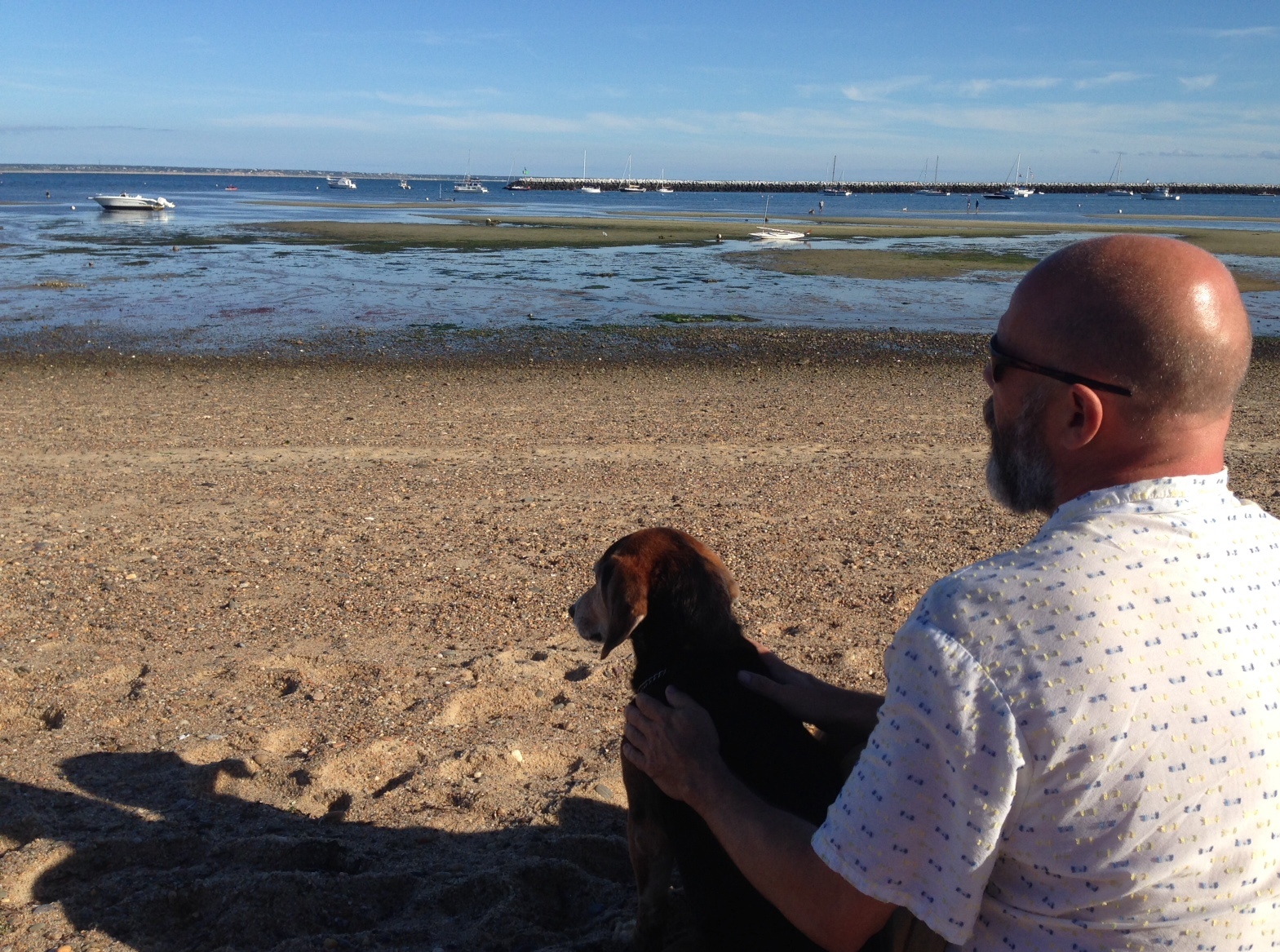
(Photo: Bowie and me watching the tide, not the news)
Josh Rogin observes that the president isn’t showing much interest in getting Congress’s permission to go to war with ISIS:
The president and his staff have made clear that they don’t feel they need congressional authorization to go after ISIS, but leaders in both parties disagree, and a long list of congressional figures believes the president must come to Congress for explicit authorization within 60 days of when he began striking ISIS in Iraq, on August 8.
But some of the hawks in Congress aren’t eager for a vote, Tim Mak finds:
Hawkish Sen. Lindsey Graham (R-SC) offered the frank assessment Monday that a congressional vote could hinder presidential power at a time when Obama most needs it to counter ISIS, putting him on the same page as senior Sens. Carl Levin (D-MI) and Dianne Feinstein (D-CA), both of whom indicated an interest in deferring to the president on war strategy. The Daily Beast asked Graham if the absence of a vote reflected congressional acquiescence to the president’s will on war strategy. A vote would be nice, he said, but bringing the issue to Congress could mean all sorts of measures that blunt the president’s response. “What if [Obama] comes here and [Congress] can’t pass it? That would be a disaster. And what if you put so many conditions on it that it makes any military operations ineffective? That’s what I worry about,” the senator said. “I think the president has an abundant amount of authority to conduct operations. It would be good to have Congress on board… if Congress doesn’t like what he’s doing, we can cut the money off.”
Still, some Senators are rightly insisting that the new war come to a vote:
On Monday, Sens. Bill Nelson (D-Fla.) and Jim Inhofe (R-Okla.) introduced resolutions to authorize military action in Syria, as did Rep. Frank Wolf (R-Va.). Speaking on the Senate floor, Nelson said he believes Obama already has authority to act, “but there are some who disagree, so rather than quibble about legalities, I have filed this legislation.” Inhofe said that an authorization vote would attract widespread, bipartisan support “because people realize — even [Defense Secretary Chuck] Hagel and others have made the statement — that the threat facing us is unprecedented.”
The Florida Panhandle? This is somewhere south of the Mason-Dixon Line.
Another heads west:
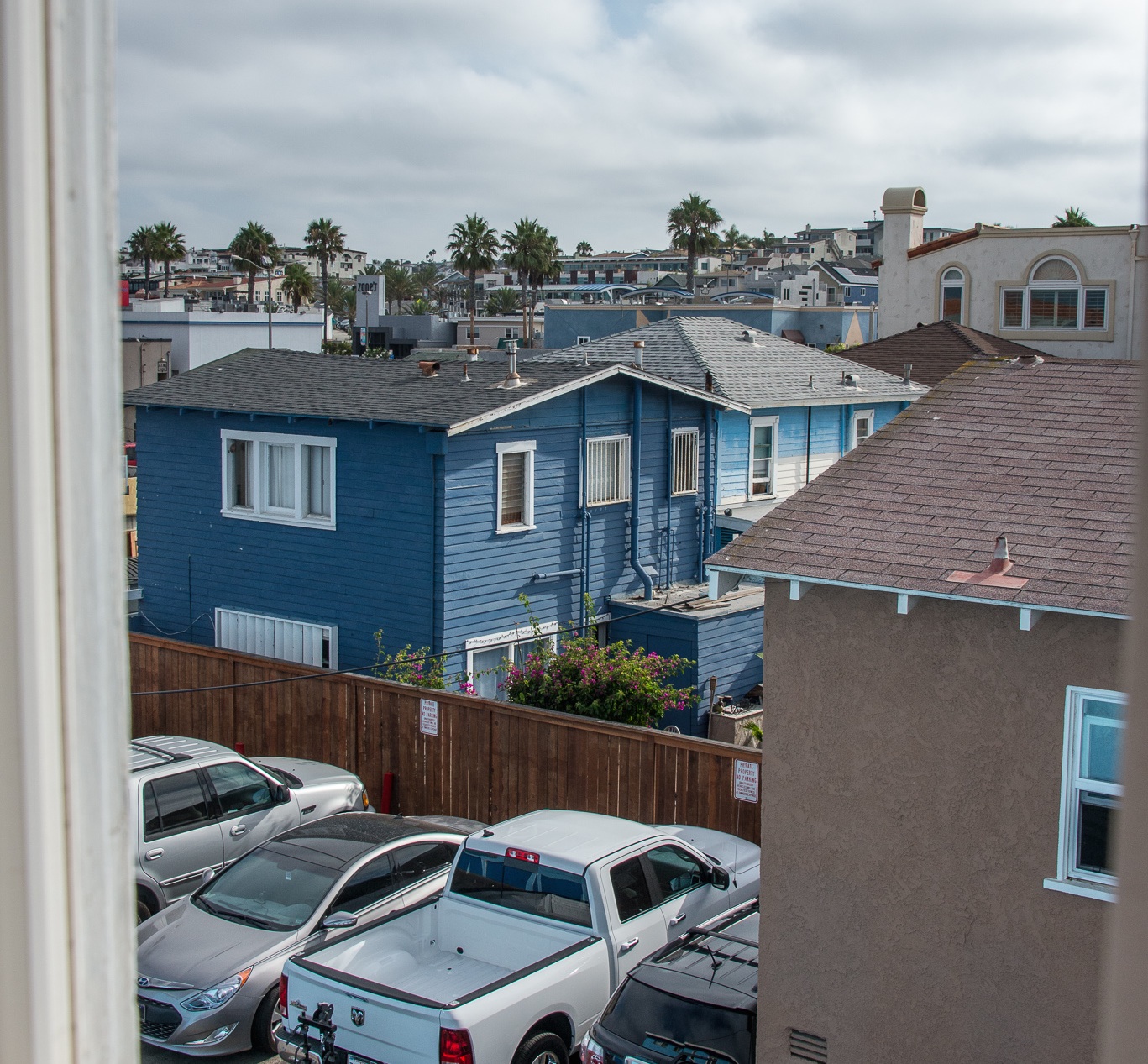
Definitely on the West Coast with a temperate climate that allows both exposed plumbing and palm trees. I could find nothing about “Zone’s” other than it’s a tech company and also a catering firm on the East Coast. The rounded blue roofs look like they may cover platforms for a lite-rail system. It might be San Francisco, but I’ll bet on Portland, Oregon.
Just south, actually:
We’re in the US (“Private Property, No Parking” signs on the fence). The combination of cloudy skies, tightly packed buildings, tightly packed cars, and sparse palm trees screams Southern California to me, and particularly reminds me of the Pacific Beach neighborhood in San Diego.
Another gets closer:
Los Angeles? Boy, I could be totally wrong about this, but it looks so much like an early painting of Richard Diebenkorn’s.
One key clue led to hundreds of correct entries:
Thanks for the ridiculously easy contest. It’s a good opportunity to let the incorrect guessers know that they need an eye exam.
Another explains:
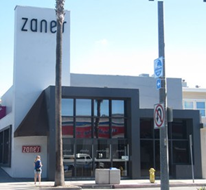
A building in the distance labeled either “Zane’s” or “Zone’s.” I’d searched these terms, along with words like restaurant, gym, store, and nightclub by themselves with little success. Once I deduced it was in California, I searched, “zanes california” and found this: It’s a restaurant located in Hermosa Beach, California.
Correct! A happy rookie:
OH MY GOD I ACTUALLY GOT ONE! Have tried several times in the past, but always ended giving up relatively quickly and lamenting the apparent futility of it all. Never even bothered submitting a guess. Now I know this isn’t the trickiest one in the world. No doubt I will be one of dozens to get it (or at least get the building right). No matter. To me, it is huge.
This picture screams SoCal. After that, the two biggest clues are the sign in the background and the building with the curved chimney. I decided to focus on the sign. And, after a fruitless search for “Zone’s” in various search engines and databases, I realized the “o” was an “a.” Zane’s. So a simple “Zane’s SoCal” led me to Hermosa Beach. After that, focusing on finding two blue houses side by side, Google Street View walked me to the Sea Sprite Motel and Apartments.
Thanks for the great work and for picking one us mere mortals had a fighting chance at!
Playing the contest is like Nintendo, it seems:
It finally happened. Dozens of such VFYW contests and humbled each time, until now. The best analogy I can think of takes me back to playing Super Mario Brothers on the original NES as a child. I could get to the final level, but time and time again I’d fail to best the evil boss at the end to save the princess. And then, one fateful day, it all came together. Perhaps through sheer luck, or maybe by logging enough hours to hone my skills, I made it through King Koopa and rescued Princess Peach.
My reward? A brief thank-you from that ungrateful princess. Then, the option to get sent off on a new quest altogether!! What the hell? Mario had risked fire-spewing lava and defeated a series of mutant reptiles, and all he gets is a mere “thanks” and an invitation for more life-risking adventures?! I’d assume if you get the title of “princess” one’s family could offer a little more in the tangible reward department.
I digress.
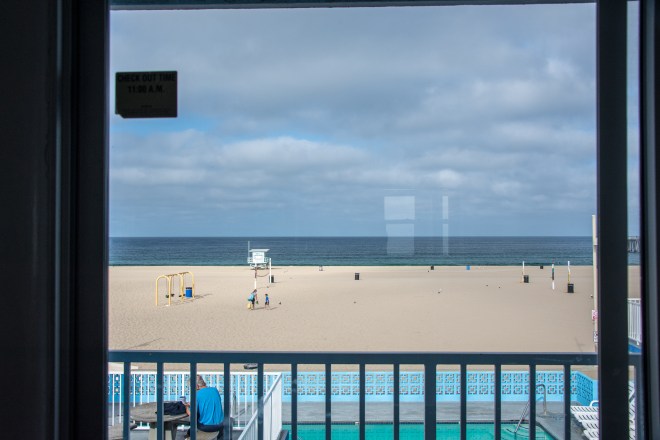
This view is from the Sea Sprite Motel (& Apartments) in Hermosa Beach, CA. It’s taken from the top floor, but I cannot tell which unit. Interestingly enough, the view from the other side of the building would be of the Pacific Ocean.
Fortunately, in the last 25 years I have learned to enjoy the satisfaction of a job completed as reward unto itself.
Another agrees:
Husband: “But if it’s that easy, won’t everyone else guess that too? You won’t win.”
Me: “Yes, but it’s not about winning, it’s just exciting to get one right!”
A detailed visual walkthrough:
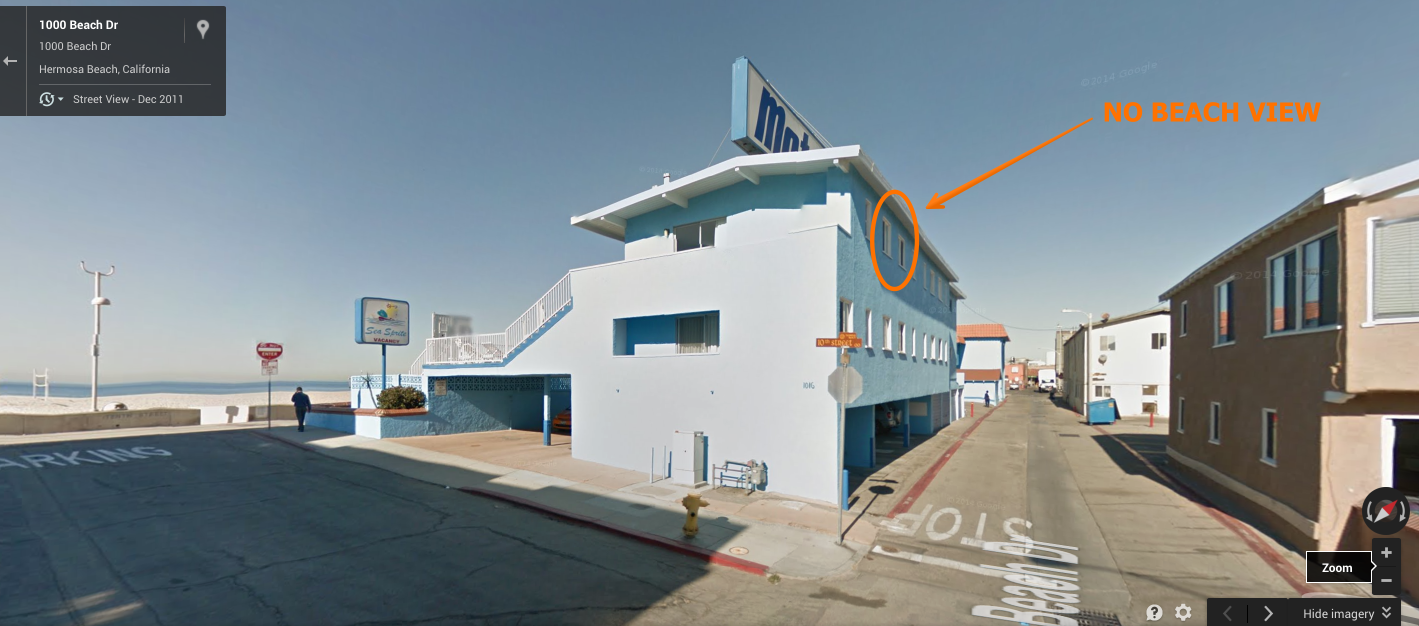
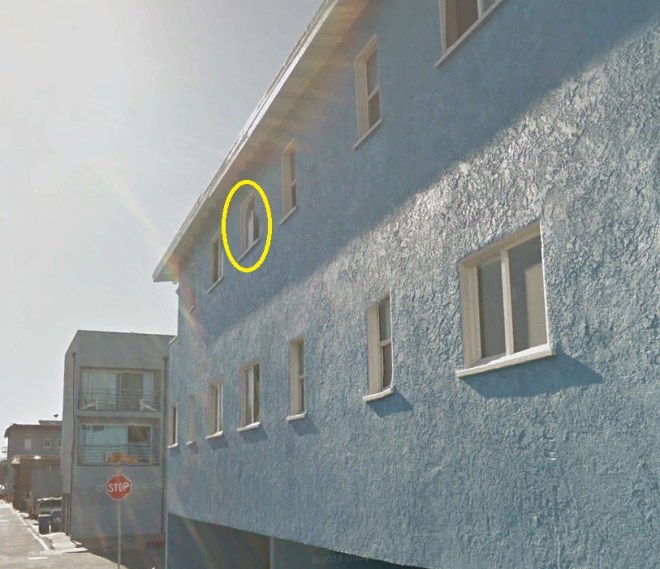
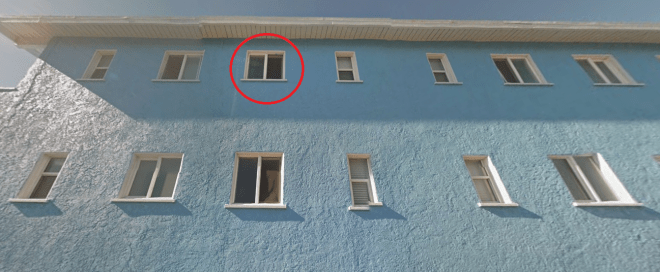
Using the awnings in the midfield of vision, and the blue house with small parking lot, it can be traced back to the second floor of Sea Sprite Motel and Apartments at 1016 The Strand. Because the window doesn’t seem to have a horizontal split, I am going with the window with the vertical split, circled below.
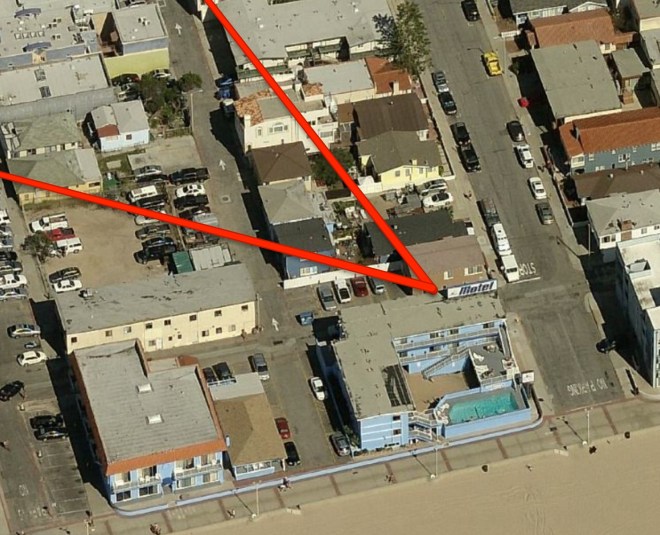
The map view is below showing the hotel, the building with the curved awnings, and Zane’s in the background:
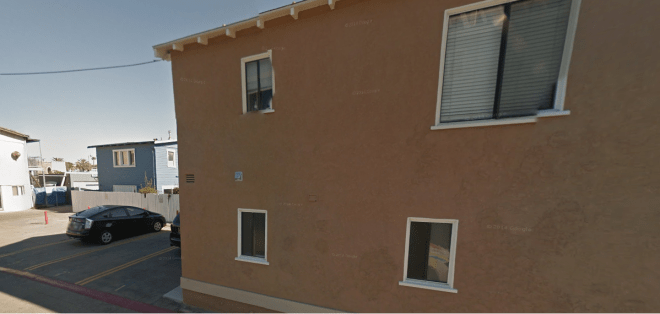
Here is the view from the alley looking at the small parking lot and the tan building in the rear with the darker blue house behind that:
Another rags on LA:
The vague location came to me immediately. It was the general seaside atmospherics – the low cloudy sky of the Los Angeles beach areas that I grew to know years ago when I lived out there. Hunter Thompson once called it “the shitmist,” but I never thought of it that way. That gentle overcast was just a relief from the usual relentless sun.
Another reader looks to Hollywood:
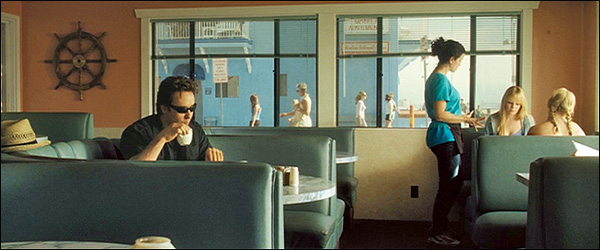
This one might be a gimme for movie and TV buffs, since all kinds of things are shot in Hermosa Beach, given its proximity to LA. John Cusack ate in a diner across the street in Steven King’s 1408 and the Sea Sprite is visible through the windows behind him:
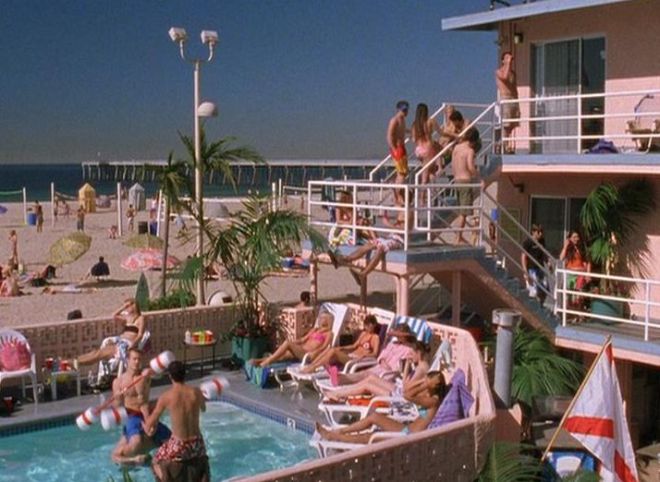
It also starred in a pool party scene from Gilmore Girls:
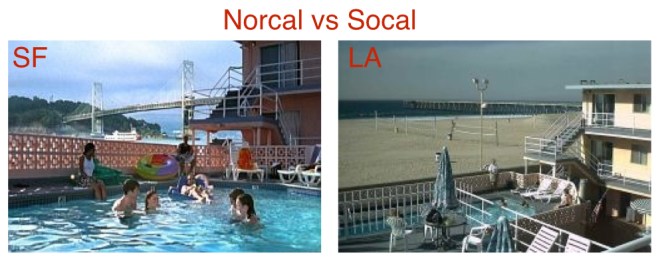
And, bizarrely, in a scene from Monk set in San Francisco but shot 400 miles to the south and photoshopped into the Bay Area via a digital Bay Bridge:
This is an obvious fraud, since there are only 2-3 days per year one might throw a pool party next to the Bay Bridge. In SF, everyone in that scene would be hypothermic.
And you can’t have LA without pulp:
Marlowe crawled back to consciousness and tried to remember what it was that Zane had told him last night just before somebody put his lights out. Who was it swung the sap? Eddie Mars’ boys? They were waiting for him outside that steakhouse, the one on the corner of Pier and Hermosa Avenues, where he’d dropped in to get the lowdown from the kid (not the one looking for the black bird, the other one).
The bar there was nice and dim and they poured a decent gimlet, but still Marlowe hadn’t been ready to believe that it could be this easy. “Hell,” he reflected, “that dame didn’t need a private dick. Type ‘Zane’s California’ in any search engine and she gets the motherload. It’s Hermosa Beach, not Santa Monica or Hollywood, but this is still Raymond Chandler country: sunburnt stucco and palm trees.”
It took nothing to retrace steps from the steakhouse to the Sea Sprite Motel at 1016 The Strand and to wait there for the hard guys to make their next move. “Next time I’ll get a window facing the beach,” he thought. “The surf’s loud enough, you might as well get to see it.”
Another player finally found a way to incorporate a teen soap opera into a contest entry:
Palm trees. California! But WHERE in California?? Oh no!
It’s in times of need just like this that I humbly turn to the “World’s Greatest Compendium of Locations where The O.C. was Filmed“. And, as always, TWGCOLWTO.C.WF puts the competition to shame. What you need to know about the Sea Sprite Motel at 1016 The Strand, Hermosa Beach, CA:
A cheap motel where pornographer Lance Baldwin stays.
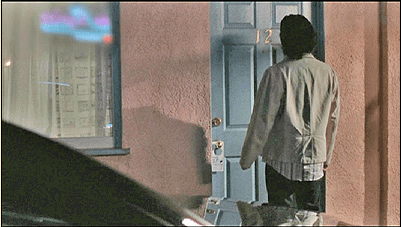
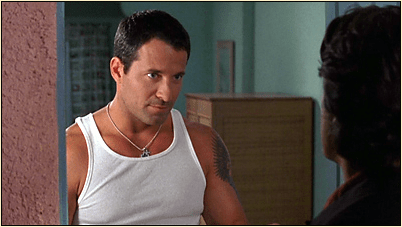
Episode 16 (of season 2), when Sandy Cohen goes to the blackmailer Lance’s apartment to try to negotiate the ransom for the porno tape which Julie made when she was young. We see it again later when, after Julie has confessed her sordid past to Caleb, Caleb also goes to Lance’s apartment at the Sea Sprite motel and shows him the extortion money. But after getting his hands on the tape, Caleb double-crosses Lance, takes back the $500,000 cash, and has two thugs beat Lance up.
I have no idea what room, but let’s say … 12, because my research indicates that’s where all the shit went down:
And I choose to believe that our photo submitter was this guy:
Readers truly went to extraordinary lengths to distinguish themselves this week:
Since you will undoubtedly have lots of correct answers, I better up my game, here’s more info:
Trivia: Dizzy Gillespie, Tito Puente and Mose Allison stayed there, as did Ice Capades performers.
Personal Connection: I’ve now spoken to the desk clerk on the phone, as I called the hotel to ask for the room number of my guess. Sounds like quite a few Dishheads are calling and even stopping by to scout it out! End unit is #17, my guess is #16, he said some folks were guessing #15. Pretty certain the right answer is the window I indicated in my original post which I now know is in room #16.
Given the apparent on-site investigations, I expect the winner will provide at least one of the following: (a) a picture of themselves at the window posing with the motel’s owner and/or (b) a DJI drone video fly-through out the window showing the view, circling over the hotel for some areal footage, ending with a stunning sunset shot over Hermosa Beach (roll credits).
Another shares a story from their eventful stay at the Sea Sprite:
My wife and three young kids stayed at the Sea Sprite for July 4th in 1998. We had just moved to California and wanted to see the fireworks (and we did not drive on the Jewish sabbath, thus the need for a local hotel – as well as local parking). We did not realize that the Strand in Hermosa Beach was a central vortex for 20-somethings gone wild. We survived the interesting cultural experience, and my wife’s car survived the partying that occurred in the parking lot and everywhere else.
The problem surfaced when we drove just a few short miles home. Our other car was stolen off our street in Redondo Beach. So I called the Redondo Beach police and told them that my car was stolen. The officer replied, “Why do you think that your car was stolen?” I replied, “I went to where it was parked, and it is no longer there!” Without missing a beat, he replied, “In the police business, that is what we call a clue.”
Turns out, it was just taken for a joy ride. About ten days later, as another Redondo Beach police officer was writing a second ticket for illegal parking, they gave me a call and said if I could pick it up in the next 20 minutes, they would tear up the tickets. And so it was.
A visual entry:
There’s also a good jazz scene in town:
The VFYW this week looked immediately familiar, as this is an area I have spent a lot of time visiting over the years. As a certifiable jazz nut, I have spent a lot of time just down the block at the famous Lighthouse Cafe, arguably the home and birthplace for the type of “cool” jazz that defined the “West Coast” jazz as opposed to the hard bop made famous in New York and locales further east. While the Lighthouse is now a venue for a wide range of musical styles, it was made most famous during the 60s and later years as a fantastic venue to hear the very best West Coast jazz musicians:
Another reader:
I finally know what Chini must feel like. This was a five-minute window, and it only took five minutes because I was working out which of the windows it must have been taken from. In fact, my nine year old took one look and told me to start looking in California. I found myself frustrated that it wasn’t more difficult, seeing as how I planned to devote a full day to the search. Crazy, eh? I get frustrated when I can’t find it, and frustrated when I do. Madness, this.
And here’s the Chini, the myth, the almost-screwed-up-this-week legend:
So the only real trick with this one is how you read the store sign at left. If you read it properly, as “Zane’s,” you were a four-second Google search away from finding the right spot. If, like some people I know real well, you looked at it on your iPhone and thought it said “Zone’s” you instead spent a nice chunk of time searching for a business that doesn’t exist. Epic. Chini. Fail. Thankfully, the uber LA-ness of the scene and the Bank of America sign rescued me later on Saturday.
This week’s view comes from Hermosa Beach and looks northeast along a heading of 38.99 degrees from the second floor of the Sea Sprite Motel, most likely room 16. As an aside, kudos to your viewer for picking a motel straight out of my Jersey Shore childhood. Most Dish readers stay at posh hotels and fancy B&B’s. Nice to see someone kicking it old school for once.
A tie-breaking idea:
Since this week’s contest features such an easy clue, I think the winner should be the person who guesses nearest to the number of correct entries. 162!
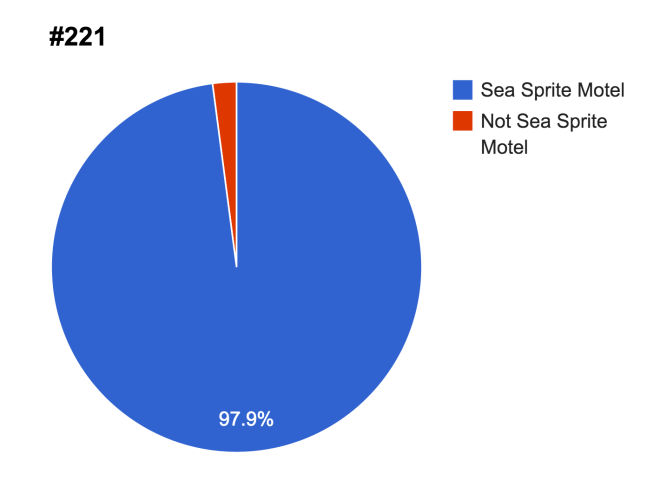
More than twice that actually. In fact, here is a relatively accurate pie chart for this week’s guesses:
And as is usually the case in an incredibly easy contest like this one, our winner comes from our prestigious list of winless guessers of difficult contests from the past:
Sea Sprite Motel, back of the building, second floor looking northeast, second room from the south end of the building. Got it from the Zane’s restaurant sign, which I mistook for Zone’s. It’s either room 16 or 17. I’m going with 16 based on the angles.
Congrats! From the reader who submitted the view:
Looking east from the third floor bathroom window of room 16, Sea Sprite Motel, Hermosa Beach, California. Here’s another view from the motel:
Lastly, a reader figures out our dastardly plan:
So, I’ve never entered a VFYW contest before, because I never really had any clue how to start. I always counted myself lucky if I guessed the right continent. And since I figured this out, I’m sure virtually everyone did. But now you’ve got me hooked. There go my Saturdays.
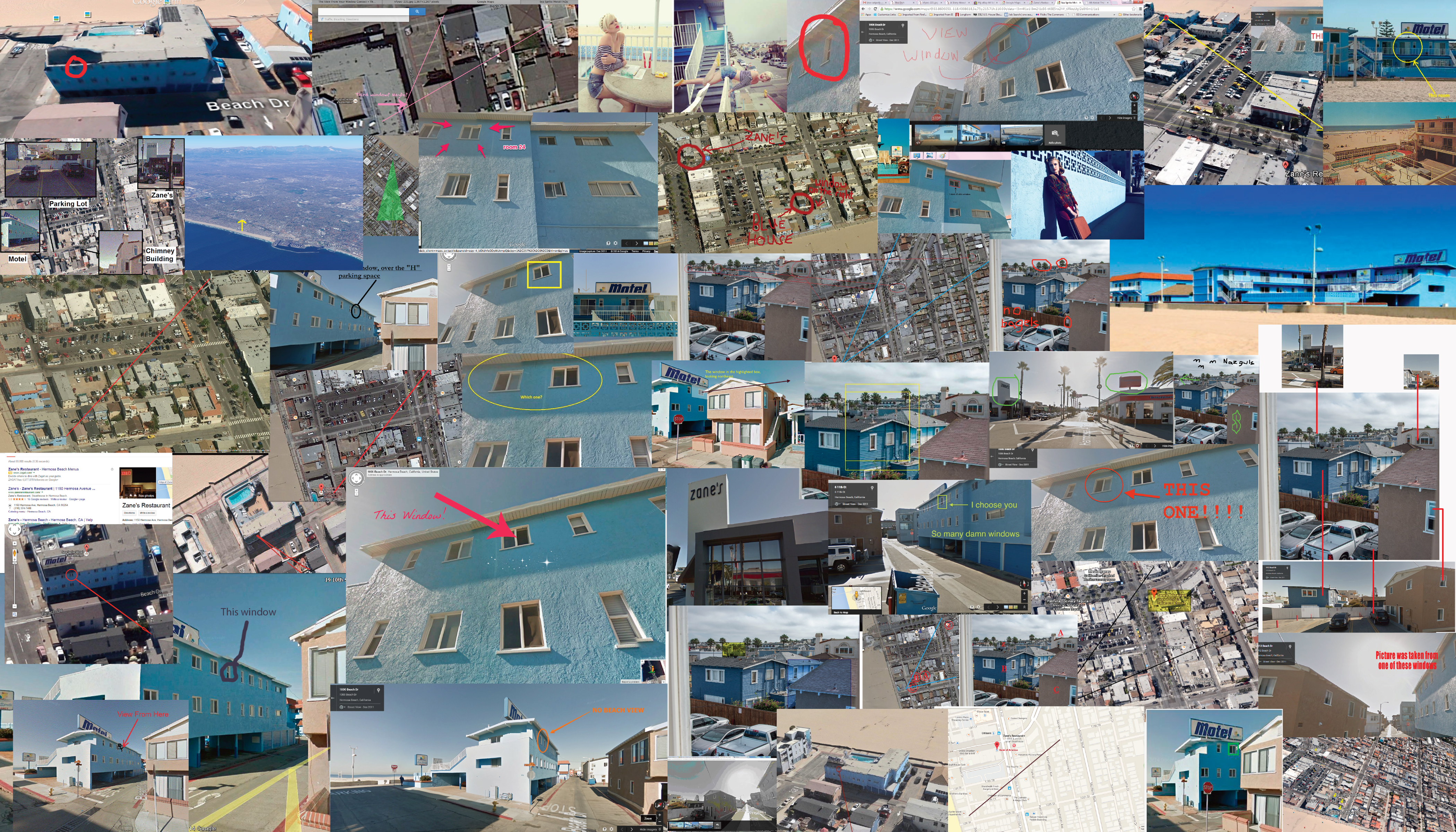
See you then! Until then, see if you can spot your entry in this comprehensive collage:
Heaping scorn on Obama for delaying action on immigration, Beutler fears that the decision will come back to bite the president and his party should Democrats lose the Senate:
Obama will have placed himself in an incredibly awkward position. He will still be bound by his modified pledge to announce deportation relief before the end of the year, but will have to act in the aftermath of an election Republicans just won opposing what they tendentiously describe as “executive amnesty.” They’ll rewrite the story of their victory around their position on deportation.
The delay might also motivate some Democrats to stay home in November, Suderman suggests:
The potential flip side … is the move could depress turnout amongst pro-immigration Democrats. And it’s clear that immigration activists are not happy. The administration says the move is still coming, but there’s skepticism that it could be put off permanently.
“All the progress we’ve made over two years was destroyed in six weeks,” ImmigrationWorks USA head Tamar Jacoby toldThe New York Times. “Given the string of broken promises from this president to the Latino community on immigration, there is a real question as to whether he will follow through,” America’s Voice director said to the paper. But the administration seems to have decided it’s worth the risk. Basically, the White House is betting that the GOP’s negative response to a pre-election announcement would be more significant than whatever effect this has on Democratic turnout.
Sargent, on the other hand, sees Democrats playing a long game:
Democrats have an interest in seeing this happen just before the GOP presidential primary, because it makes it more likely the GOP candidates will out-demagogue one another in calling for Obama’s protections from deportation for millions to be rolled back, pulling the GOP field to the right of Mitt Romney’s “self deportation” stance in 2012.
Byron York shakes his head at the way Obama has punted on this issue for years:
During the days when his power was at its peak, Obama pursued higher-priority issues even as he led immigration activists to believe they were up next. Which leads to the conclusion that perhaps immigration reform — the substance of it, not the politics — has never been all that important to the president. Now, there’s still something more important: protecting vulnerable Democrats from voter disapproval of unilateral presidential action on immigration. Obama says he will finally act, after the election, after voters can no longer hold him or his party accountable. But who knows? Maybe something more important will come up yet again.
[T]here is another possibility, which is that Caesarism delayed will eventually become Caesarism eschewed altogether … or else that Obama will eventually do something unilaterally on immigration, but it will be much more modest (a down payment on reform, the White House can tell activists) than what’s been floated and promised these last few months. Maybe the politics will keep looking somewhat ugly, maybe Democrats up for election in purple states in 2016 will pressure Obama to keep punting — or maybe the president will actually heed some of the criticism of his plan and revert to a more modest conception of how presidential power should be exercised on this issue. I’m not such a cynic that I don’t believe the last scenario is impossible, and it’s a good reason for the White House’s critics to be pleased with this delay: Sure, it could be setting us up for an even balder power grab in four months, but where there’s procrastination there’s hope, and a journey away from executive overreach could begin with exactly this kind of step.
 part about him dealing with various water leaks in his house that cracked me up.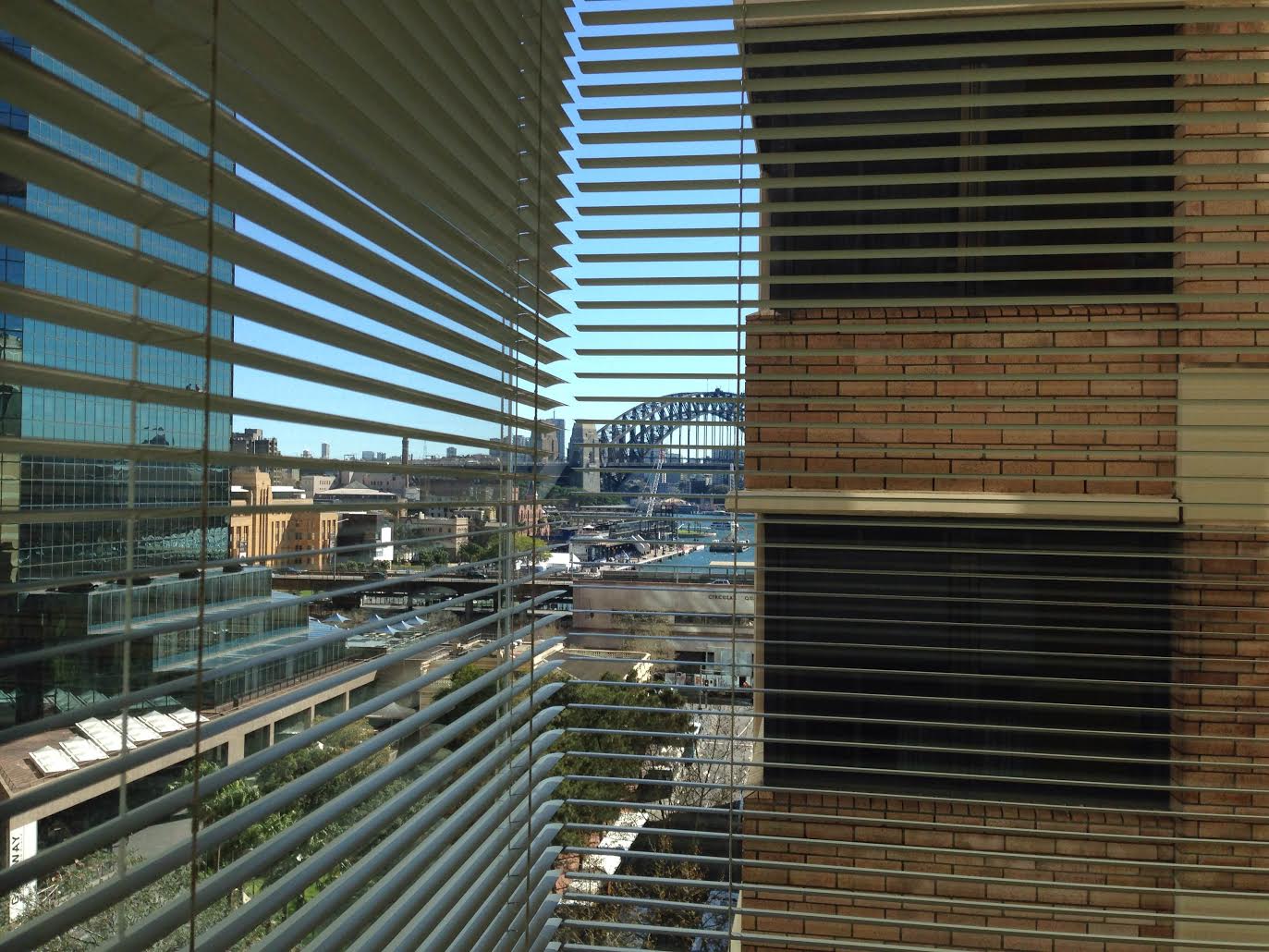

 desk clerk on the phone, as I called the hotel to ask for the room number of my guess. Sounds like quite a few Dishheads are calling and even stopping by to scout it out! End unit is #17, my guess is #16, he said some folks were guessing #15. Pretty certain the right answer is the window I indicated in my original post which I now know is in room #16.