The Scots And The English: Some Guilty Thoughts

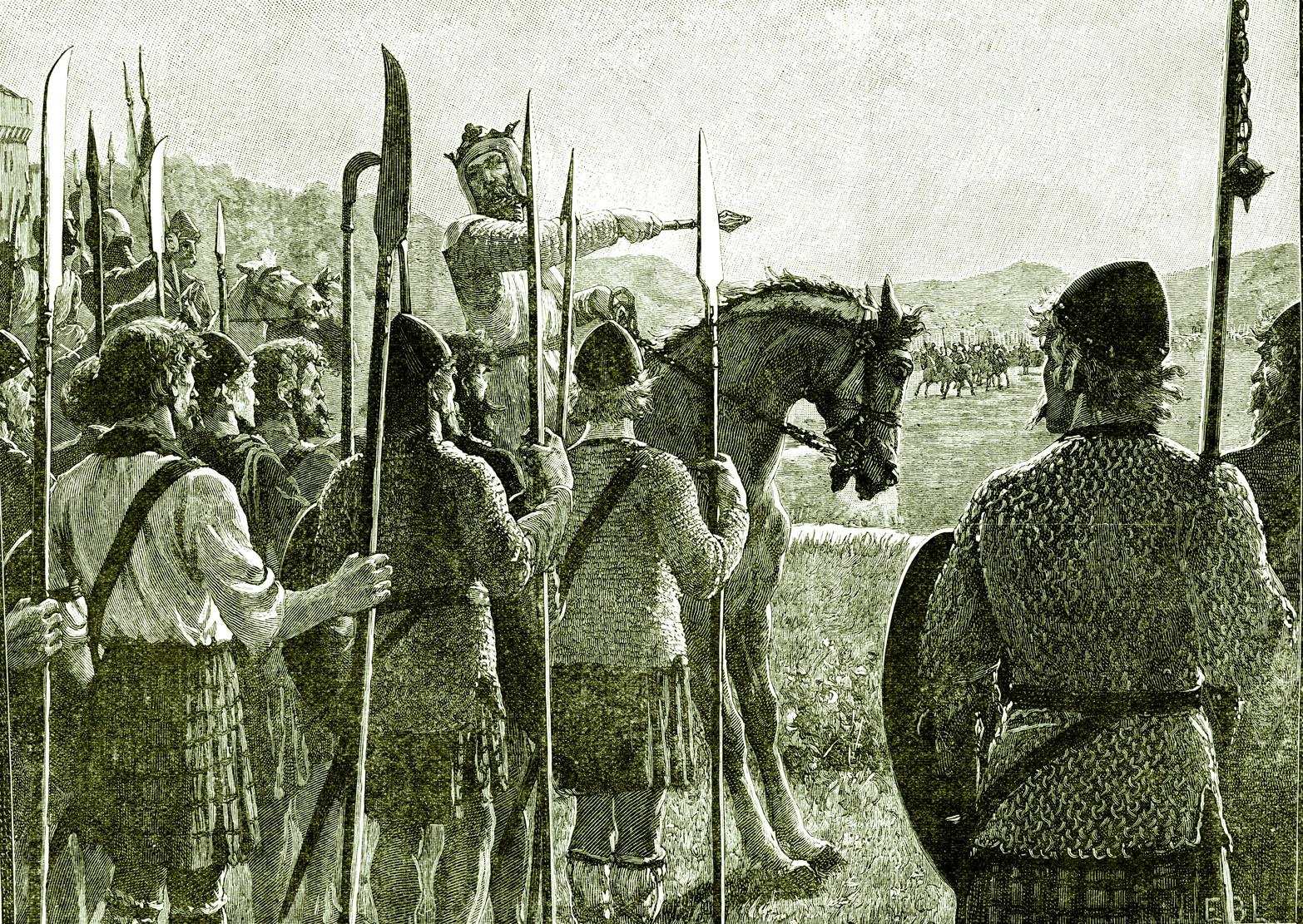
Battle of Bannockburn - Robert the Bruce reviewing his troops

Josh Marshall is bug-eyed at the possibility that the union of England and Scotland may soon end. The Sunday Times poll last weekend gave the markets the willies, and prompted what looked to me like a panicky bunch of last-minute concessions from London. My old chum Boris Johnson had a very Boris defense of Britain and “British” as core identities for a multicultural country in the Telegraph yesterday. Money quote:

The entity under mortal threat next week is Britain itself. You cannot refer to a state called “Britain” unless you include Scotland, because it is a basic fact of geography that Britain comprises everything from Land’s End to John o’Groats.

Look at the map – so often rendered by cartoonists from the 18th century onwards as Britannia sitting down: rump in east Anglia, feet in Cornwall, and topped off with that sweeping Scottish cerebrum and helmet. Chop it off – decapitate Britain at Carlisle and you can no longer call it Britain; and what goes for geography must go for politics, too. Take Scotland away from England and you are losing a critical part of our political nomenclature. There was no British government before the union with Scotland; there was no British electorate; there were no British interests. There was England and Wales, and there was Scotland. Take away Scotland, and we destroy Britain.

He’s not wrong – and part of the alchemy of Britain has always been the mixture of the shire and the highlands, the Angles and the Celts. Blair and Brown were both Scots. BoJo notes that the great Englishman, Samuel Johnson, needed his Scottish side-kick, James Boswell, to be fully who he is in our collective civilization. That’s the kind of national chemistry that independence might destroy. And it was a Scot, “Queen” James I, who cemented England’s religious settlement for a while after the death of Elizabeth I.

And yet … I have to say, I find myself a little emotionally indifferent, even as I am rationally persuaded by the argument that an independent Scotland with the pound as its currency could be headed for Greece-like status. And it’s that conflict between emotion and reason that will Nicola Sturgeon Continues Health Campaigndetermine the result. Maybe it helps Americans to understand those emotions if I examine my own. So why the indifference?
For one thing, Scotland is not like, say, California. It’s an ancient nation, and, unlike England, was never pacified by the Romans. It’s a prickly country, bristling often at England, its exports to London often having more than a bit of a chip on their shoulders. More to the point, it gets to have its own parliament and yet also have a full presence in the London parliament – an arrangement not accorded to the English. It’s politically well to the left of middle England, and is a big net beneficiary of British Treasury. After a while, if you’re English, and right-of-center, and taxed to the hilt, endlessly subsidizing the Scots in return for their thinly veiled disdain, you get a bit irritated. Deep, deep down in my Sussex soul, there’s a “fuck ’em” urging to come out, even as my own Irish ancestry gives me some emotional accord with the Scots.

And since “Britain” is at stake, why should one small part of it be the only part that has a say? What do the English think about Scottish independence? Or the Welsh? Or the Northern Irish? Why shouldn’t they be a part of the deliberation? I guess it says a huge thing about British democracy, decency and fairness that Scotland is being allowed this no-fault divorce option (one only has to look at Ukraine to see the alternative) – but it also says a lot about the way Scotland often wants to eat its cake and have it too.

“Britain” as an entity, moreover, is indistinguishable from empire. From 1707 on, the Scots played an outsize role in creating and sustaining that empire across the world – and I can understand why a thoroughly post-imperial country doesn’t quite have the collective martial spirit to keep it all together any more. A long while back, I saw this coming. Back in 1999, I wrote, after re-visiting my homeland, that:

As the century ends, it is possible, I think, to talk about the abolition of Britain without the risk of hyperbole.

The United Kingdom’s cultural and social identity has been altered beyond any recent prediction. Its very geographical boundaries are being redrawn … To begin with, Blair is proposing what amounts to the end of the unitary government of the United Kingdom. Scotland’s new Parliament will be elected in May, a symbol of self-government not known since the 16th century. In the referendum that sanctioned it, 74 percent of Scots voted in favor. More significant, a full 64 percent supported the notion that such a Parliament should have tax-raising powers, essentially replacing Westminster.

Blair has allowed the Scottish Parliament the leeway to lower or raise the British rate of income tax by only 3 percentage points. But the direction is clear enough. Blair clearly believed that by devolving some power to Scotland he would defuse the independence movement. Instead, the opposite could happen. The latest polls suggest that in the new Edinburgh Parliament the largest single party may well be the Scottish Nationalists, who see the new Parliament as a way station to full independence. Of the dozens of conversations I had in London about the future of the United Kingdom, literally no one I spoke with believed that Scotland would be a part of Britain in 10 years’ time…

What Blair has ushered in, in other words, may well turn out to be a return to a political Constitution last seen in the late Middle Ages: an English state with an almost independent European metropolis on the Thames, a feisty neighbor to its north and a half-heartedly controlled province to its west.

You end the empire, you unravel – through a new cosmopolitanism – the cultural power of Britishness, you see London emerging as essentially a separate country as well, and you devolve power more and more to Scotland … and, well, you can see why we are where we are. The logic of recent history – and ancient history – points solidly to an amicable divorce. This is not some sudden, unforeseen act of madness. It is the result of history and culture and economics.

And then there’s English nationalism as well. By far the most striking new development I saw in Britain at the turn of the century was the adoption of the English flag over the Union Jack:

When I left for America, the clear, simple symbol of England was the Union Jack. It is now increasingly the bare emblem of St. George: a red cross on a white background. You see it in soccer stadiums and emblazoned into the skulls of East End skinheads. In 1995, the biggest greeting-card distributor introduced a card to celebrate St. George’s Day on April 23. Within two years, as the journalist Jeremy Paxman pointed out, the number of cards sold had grown to 50,000.

And when I hoisted a flag on my cottage in Ptown during last year’s Olympics, it was the English flag, and not the British one, that I flew. For it is England I truly love. Scotland? Best of luck to them.

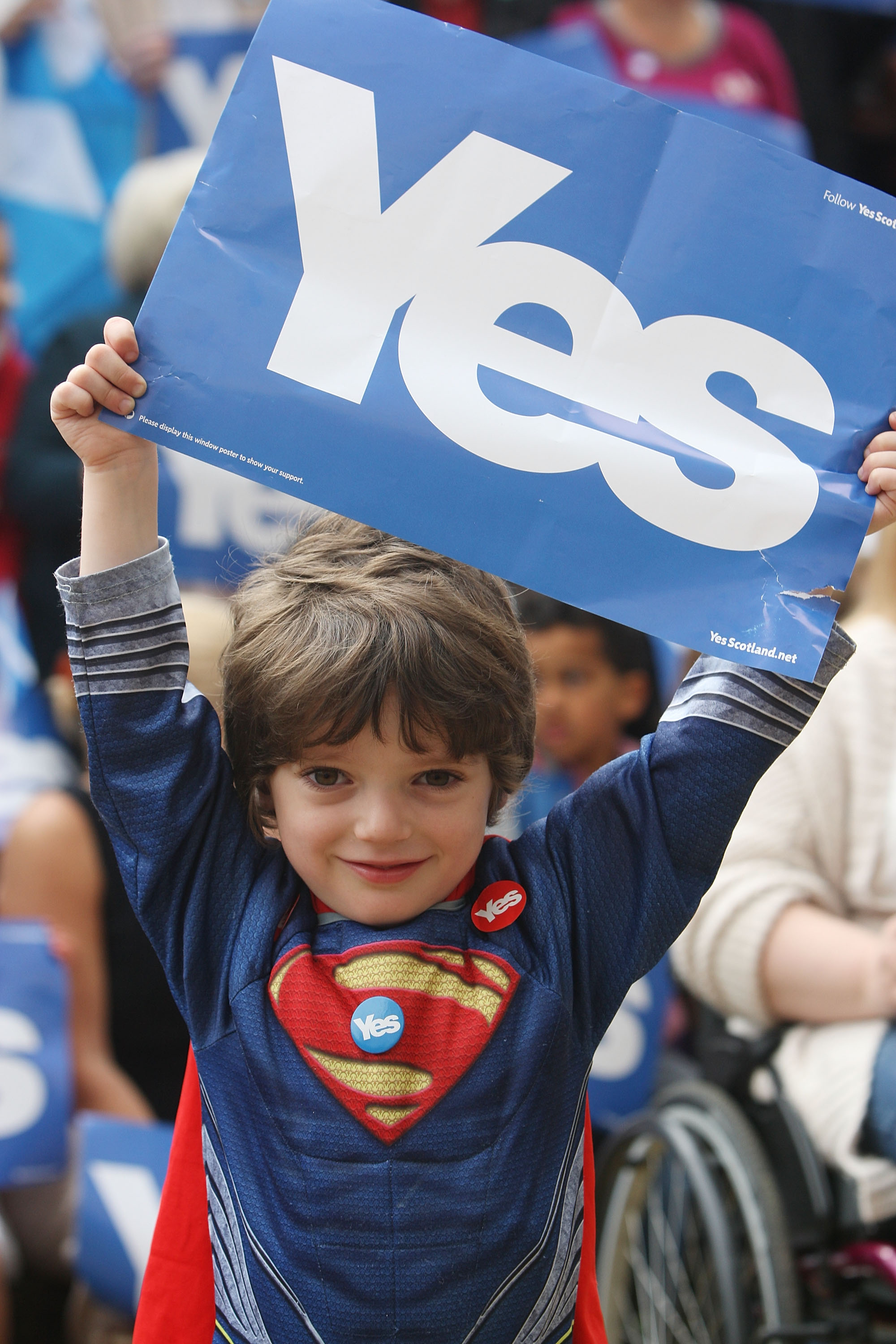
(Painting: Battle of Bannockburn – Robert the Bruce reviewing his troops before battle, 24 June 1314. Significant Scottish victory in the Wars of Scottish Independence and  the decisive battle in  First War of Scottish Independence. By Culture Club/Getty Images; Photo: Danny Barbieri, 4-years old, dressed in a Superman superhero outfit, holds aloft a Pro-Scottish independence ‘Yes Scotland’ campaign sign, as he and other supporters await the start of a press event in Glasgow, Scotland on September 8, 2014. By Jeremy Sutton-Hibbert/Getty Images)
The Republicans’ Outreach To Women

It’s starting to take shape. One high-profile example is Republican Senate candidate Cory Gardner actively campaigning on over-the-counter contraception:

Other Republicans are taking similar positions. Byron York names names:

The idea is to make the birth control pill available over the counter, to all, 24/7, without a prescription. It’s becoming a trend among Republican candidates in Senate races around the country. In North Carolina, GOP candidate Thom Tillis recently embraced it. So has Ed Gillespie in Virginia. Mike McFadden in Minnesota. Gardner in Colorado. And one of the leading proponents of the move is a potential 2016 GOP presidential candidate, Louisiana Gov. Bobby Jindal.

Kilgore understands the political logic of this move:

There’s no question it’s clever—even sort of a threefer: (1) taking The Pill out of the Rx drug equation protects those “pharmacists of conscience” who don’t want to fill prescriptions if they don’t approve of the marital status or lifestyles of the women involved; (2) it also makes the fight against Obamacare’s contraception coverage mandate less portentous and controversial; and (3) most obviously, lets Republicans claim a “centrist” position on reproductive rights: pro-contraception, anti-abortion.

But he rejects the idea that Republicans now “have the high ground on reproductive rights.” Rebecca Leber agrees with that:

For some time, some doctors and reproductive health advocates have argued that an over-the-counter pill is good policy, because it would make the pill easily accessible to more women. The American College of Obstetricians and Gynecologists endorsed it in 2012, and so do two-thirds of American women polled.

But there’s a catch. Doctors aren’t the only hurdle between women and contraceptive access. For low-income women, cost can be what’s most prohibitive. Under the Affordable Care Act, the pill and other forms of contraception count as preventative care, which means insurance covers them completelywithout any out-of-pocket expenses. This is not a position the Republicans have endorsed.

Elizabeth Nolan Brown counters such arguments:

[A]ffordability isn’t the only factor in making something accessible. Those championing the contraception mandate as a way to increase access assume everyone always has insurance coverage. What about undocumented women? Or those between jobs and temporarily uninsured? What about young women who can’t let their parents know they’re on the pill? Or domestic abuse victims who want to keep this information from their husbands? These are just a few of the situations in which a woman would find OTC pills much more accessible and affordable than the prescription-only kind, even if those prescription pills came with no co-pay.

It’s one thing for progressives to question the sincerity of support that male GOP politicians have for OTC birth control (some of it’s definitely a bit suspect), but trying to diminish the good OTC birth control could do in order to prop up Obamacare’s contraception mandate is inexcusable. Those who claim they want to increase contraception access while panning OTC birth control entirely look a lot more like partisan hacks than people with women’s best interests in mind.

Previous Dish on the OTC pill here.

Nuclear Superpower Is Nuclear

The Ukraine conflict isn’t the only thing raising concerns about a resurgent Russia. James Inhofe is even more worried about Putin’s efforts to revitalize and upgrade Russia’s nuke program:

Russia deploys aircraft and submarines armed with cruise missiles around the world that already threaten our allies. But air and submarine bases can be targeted and destroyed by the U.S. military in the event of a confrontation. A mobile GLCM [ground-launched cruise missile], on the other hand, is much harder to find. General Philip M. Breedlove, the senior NATO commander, has said that this new weapon is “absolutely a tool that will have to be dealt with.”

Strategically, the deployment of a nuclear-armed GLCM further increases the disparity in regional nuclear forces between Russia and NATO, which could weaken alliance deterrence and assurance calculations. Russia currently enjoys about a 10-to-1 advantage over NATO in nonstrategic nuclear weapons in Europe. It provides Russia a counterbalance to those countries near Russia that are developing intermediate-range nuclear forces and, in some cases, long-range conventional strike capabilities, such as China. Russia also feels that GLCM capabilities compensate for shortcomings in Russia’s conventional forces.

Jeffrey Lewis also catches Putin talking nukes:

Putin was holding court at the Seliger 2014 National Youth Forum, which attracted some 800 of the country’s young teachers and postgrads, when an attendee asked the Russian president about the role of “historical memory” in Russian foreign policy. Putin decided to point out that Russia’s enemies should be careful, and then he got to the good part: “Let me remind you that Russia is one of the world’s biggest nuclear powers. These are not just words — this is the reality. What’s more, we are strengthening our nuclear deterrent capability and developing our armed forces.”

Hey, the more you know, right?

Earlier in the month, Putin had already promised to surprise the West with new nuclear weapons systems. “Some things have already been disclosed; say in the area of strategic offensive arms, I mean nuclear deterrence forces,” Putin explained. “Some information remains secret, but we will disclose it when the time comes. We are working hard, and our engineers, researchers and workers are putting a lot of effort into it.”

The GOP And The Gays

Could things be starting to change a little? Here’s an ad for a Senate candidate in Oregon, Monica Wehby, a Republican in favor of abortion rights and marriage equality:

This embed is invalid

 
What’s particularly interesting is that this ad is running statewide as a last-ditch attempt to get some traction against the Democratic incumbent, Jeff Merkley, having beaten a Christianist primary opponent. That suggests that one key way for Republican candidates to make an impression on independents is to carve out a more inclusive and individual liberty argument. Politico notes, of course, that

Republicans in blue states endorsing gay marriage is not totally new. Three openly gay GOP House candidates have featured their partners in campaign materials, including Richard Tisei in Massachusetts, Dan Innis in New Hampshire and Carl DeMaio in California. But no Republican Senate candidate has ever run an ad like this statewide. Even in a blue state like Oregon, where gay marriage is more widely accepted, running this ad in 2010 or 2012 may have been judged too risky because it would keep conservatives home. If Wehby won, she would join four Republican senators who support same-sex marriage: Illinois’ Mark Kirk, Ohio’s Rob Portman, Maine’s Susan Collins and Alaska’s Lisa Murkowski.

Portman is also interesting as an unlikely but conceivable potential presidential candidate in 2016. His personal evolution on marriage equality – because of his gay son – is an argument that can truly change minds, and reflect the core pro-family message of marriage equality. And yes, he just visited New Hampshire.

Know hope.

“The Passion To Be Reckoned Upon Is Fear”

And so ISIS’ medieval brutality and horrifying videos have worked like a charm:

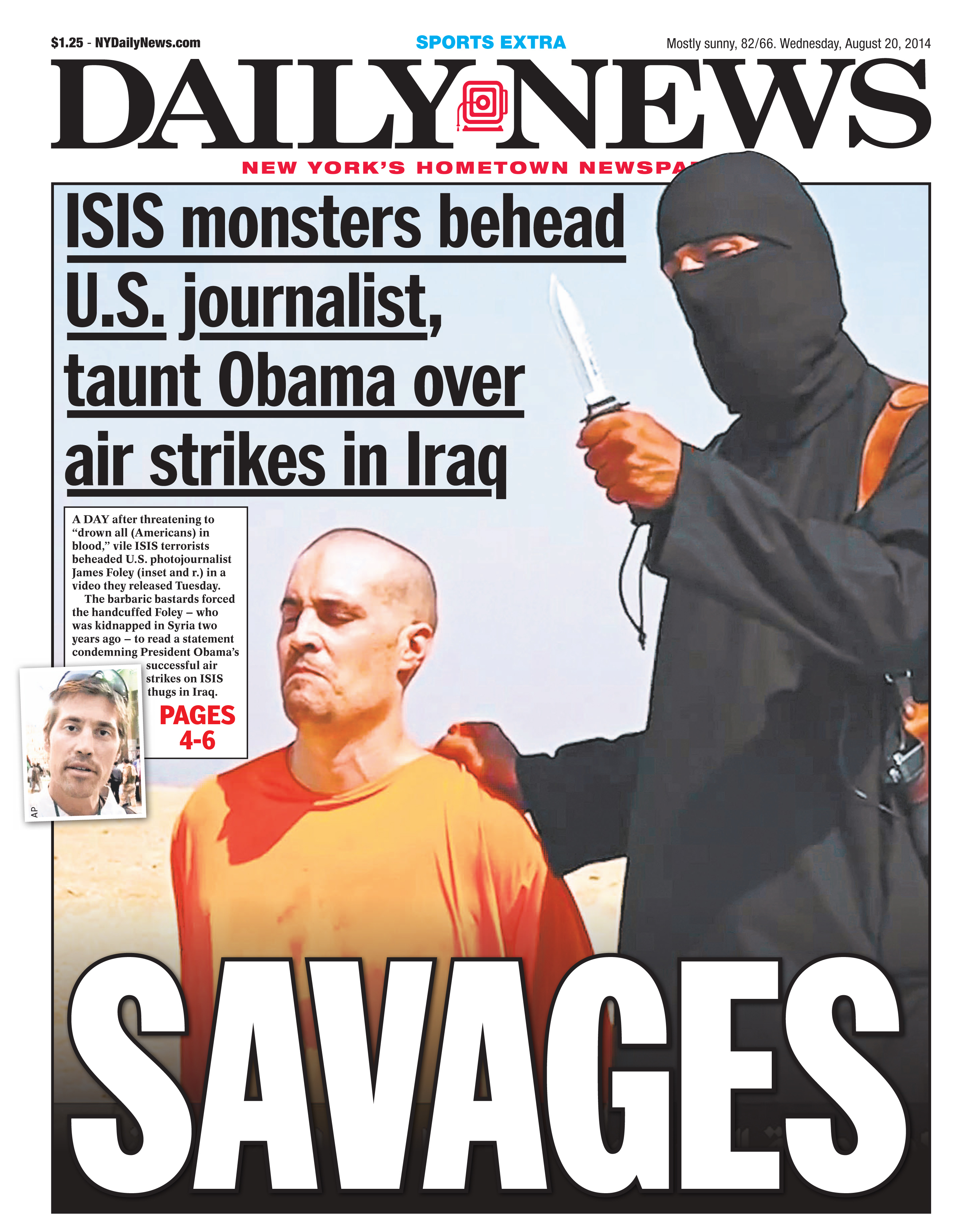
Support for military action has risen dramatically in just the past few weeks, coinciding with the beheadings of two American Daily News Front Page James Foleyjournalists, James Foley and Steven Sotloff, which were recorded on video and released to the world by Islamic State terrorists. Today, 71 percent of all Americans say they support airstrikes in Iraq — up from 54 percent three weeks ago and from 45 percent in June. Among those who say Obama has been too cautious, 82 percent support the strikes; among those who think his handling of international affairs has been about right, 66 percent support them.

Nearly as many Americans — 65 percent — say they support the potentially more controversial action of launching airstrikes in Syria, which Obama has not done. That is more than double the level of support a year ago for launching airstrikes to punish the Syrian regime for using chemical weapons … Nine in 10 Americans now see the militants as a serious threat to vital U.S. interests, and roughly 6 in 10 say they are a very serious threat.

But I have yet to see or be shown any solid intelligence that suggests that these fanatics are aiming at the US. We may well have a problem of home-grown Jihadists returning and wreaking havoc – but that is a manageable threat. And direct military intervention by the West could easily increase these losers’ incentives to strike us here at home. So, in that narrow sense, this return to fighting other people’s civil wars in the Middle East may actually increase the risks to us. That’s what I mean by “taking the bait“.

More worryingly, the president appears to be choosing September 11 to make the case for a war against ISIS in Iraq and Syria. The fear factor is thereby evoked all the more powerfully – and any return to normality, or restraint, or prudence that we have slowly achieved since then will be wiped away. I just ask you: did that fear and terror help us make wise decisions about foreign policy back then? Do we really want to recreate that atmosphere – with no solid evidence of a tangible threat to the US?

I await the president’s proof of ISIS’ threat to America and the West. And not the kind of intelligence that gave us the Iraq War. I await the proof of an eager coalition of every Iraqi sect to destroy ISIS – and a broad regional coalition united to prevent its consolidation of gains. Then, it seems to me, there must be a declaration of war by the Senate if this open-ended, unknowable military intervention is to be embarked upon. Every Senator and House member should be on record, ahead of the November elections, on this question. If they want war, they must take full responsibility for it, and not play partisan games to score points off it.

Maybe it’s because I was not exposed to the news cycle of the last few weeks that I still see things this way. Maybe I’m wrong and ISIS really does have the means and the will to attack the US or the West.

But in this march to another war in Mesopotamia, I recall that almost every US military intervention in the Middle East has backfired. Even the first Gulf War, deemed a great success, helped give us al Qaeda, as Lawrence Wright reminds us today in the New Yorker. Our intervention in Iraq eventually gave us ISIS. Our intervention in Libya gave us chaos and terror. The only intervention in that region that worked was a peaceful one, the UN-sponsored, Russia-brokered elimination of Syria’s WMD arsenal.

Notice also that this would be another pre-emptive war. We have not been attacked, as we were on 9/11. We are pro-actively entering a civil war in two countries simultaneously … because one malevolent group of Islamist terrorists threaten the region and because the regional actors have yet to take it on. This kind of responsibility is indeed neo-imperial. It’s open-ended and revives the delusion that we can change that part of the world more than it will change us.

But here we go again. Under this president. Into the unknown, propelled by fear and panic. The change we hoped for is evaporating into thin air. And the war drums get louder and louder every day, as if nothing, nothing, was learned in the past decade.

A Marijuana Lifer

Aaron Malin interviewed Jeff Mizanskey, who is serving a life sentence for marijuana. He “is the only person in Missouri sentenced to die behind bars for marijuana, a victim of the state’s rather unique three strikes law”:

I asked Jeff about his future. He told me calmly that all of his appeal options have been exhausted. Unless the Governor of Missouri grants Jeff clemency and sets him free, he will likely die there. He will never know his grandchildren, or his great-grandchild on the way, outside the walls of the sprawling Jefferson City Correctional Center.

As I drove away from the prison, down the very visibly marked No More Victims Road, I thought about the man, and the horribly cruel irony, that I was leaving behind. Unless the Governor of Missouri intervenes and grants clemency, Jeff will die behind bars at 8200 No More Victims Road, having never victimized anyone in his life.

Jacob Sullum reflects on Mizanskey’s case. And he spotlights other perverse consequences of our draconian marijuana laws:

In 2004, according to a 2007 report from the Bureau of Justice Statistics, marijuana convictions accounted for 12.7 percent of drug offenders in state prisons and 12.4 percent of drug offenders in federal prisons. Applying those percentages to the drug offender numbers for 2011 (225,200 state, 94,600 federal) suggests that roughly 40,000 people are serving time in state and federal prisons for marijuana offenses. That number does not include people serving shorter sentences in local jails, where a total of about 182,000 drug offenders were confined in 2011. Nor does it include the vast majority of the 758,000 people arrested for marijuana offenses that year. Nearly nine out of 10 marijuana arrests are for simple possession, a charge that typically does not result in a jail or prison sentence.

The fact that most people arrested on marijuana charges do not spend much time behind bars does not mean they are not punished. In addition to the humiliation, inconvenience, and expense directly related to their arrest and prosecution, they can suffer lasting ancillary penalties, including disruption of their educations, loss of their professional licenses, and impairment of their employment prospects.

The End Of Britain? Ctd

Scotland’s independence movement has the wind at its back. But the increasing likelihood of a Yes victory sent the Pound tumbling yesterday. And the economic consequences of independence don’t end there:

Douglas Flint, the Scottish-born chairman of HSBC (HSBC), predicted that uncertainty over Scotland’s currency arrangements could “prompt capital flight from the country, leaving its financial system in a parlous state.” Independence advocates haven’t said whether Scotland would establish its own currency or maintain an informal link to the British pound. Whatever approach is taken, Flint wrote in a recent column for the Telegraph, “Scotland’s borrowing costs and those of its businesses and consumers would rise, at least in the near term.”

Should Scotland secede, Drum suspects the country will get its own currency soon enough:

The pro-independence forces probably feel like they need to support continued use of the pound for now, just to take it off the table as a campaign issue. But if independence succeeds, there’s a good chance that Scotland will adopt its own currency within a few years for all the reasons Krugman brings up. Being stuck in a currency union is so obviously dangerous that it will probably be abandoned once things shake down in an independent Scotland and the new government has time to focus on it.

Yglesias agrees that “the most sensible option might well be for independent Scotland to have its own central bank and its own currency that would trade freely on global markets”:

Other small developed countries (Norway, Iceland, New Zealand, Sweden) do this successfully, and it appeared to work well enough for Denmark and Finland in the past. Small countries are inevitably very exposed to developments in the global economy that are outside their control, and currency flexibility can help cope with that. … The downside of creating a new currency is that it would have no track record, and might be catastrophically mismanaged and destroy the value of everyone’s savings. Independence campaigners appear to feel that these fears are widespread, and have not made the creation of a new currency part of their proposal for Scottish independence.

But this all assumes the Scots vote for independence in the first place. Justin Wolfers has doubts:

In contrast with the polls, traders at the British betting exchange Betfair.com currently assess the “No” vote as the likely favorite, assigning it a 72 percent chance of winning. To be sure, that still suggests a sizable 28 percent chance that a majority of Scots will vote for independence, but the odds that it will happen seem a lot weaker than polls would suggest.

And, even if the polling is taken at face value, the goodies Westminster is promising Scotland might boost the No vote. But Fraiser Nelson wouldn’t bet on it:

So Gordon Brown has spoken, and the unionist parties are in agreement: if there’s a ‘no’ vote then more powers will be given – we’re told – ‘to Scotland’. And why? Because there’ll be another commission and another Scotland act and the Great Broon announces that the results will come out on Burns Night! Neeps and haggis all round! To me, this is only a little better than the Treasury telling Scots that they should vote ‘no’ because they’ll be able to afford more bags of chips. It’s patronizing, not credible and I doubt will make very much difference. This so-called Devo Max should have been offered six months ago; to offer it in the last few days of the campaign smacks of desperation.

Indeed it does. Peter Geoghegan remarks that the “No side might still be the favorite to stumble across the finish line first in the coming referendum, but it has singularly failed to make an emotional case for the United Kingdom”:

A Better Together activist told me recently, “It is like a business transaction. I look at the sums, they don’t add up, so you don’t do it.” This might be a good reason to reject independence, but such instrumentality hardly bodes well for the union’s future health — and such sentiments leave plenty of room for uncertainty about what will happen on September 18. Nationalists have won the argument that Scotland could be a separate state. The question now is whether they can persuade their fellow Scots that it should be. If they can, what seemed unimaginable just a few months ago could become a reality.

Should that happen, Robert Kuttner imagines that other independence movements around Europe will take notice:

If the Scots actually become independent, it’s not Britain alone that is affected. Also threatened are such venerable unitary nations as Spain, France and Italy. That’s why the leaders of the E.U. have signaled that an independent Scotland would not be welcome as a member. If Scotland secedes, Catalonia will be next. And if Catalonia, why not Brittany and Northern Italy? Why not Wales? Not to mention Quebec.

Most major nations were created by acts of conquest and often brutal suppression of ethnic and linguistic minorities. Irish schoolchildren got their knuckles rapped for speaking Irish in school. In Catalonia, kids caught speaking Catalan were warned, “Habla Cristiano!“—as if Castilian Spanish were the language of Christ and Catalan the idiom of Satan. But it is absolutely startling to see hundreds of years of political history unwinding.

Terrorism Is Hard To Pull Off

David Sterman points out another reason why the threat of homegrown jihadis fails to live up to our outsized fears of it:

Once in an American city, an extremist must still acquire weapons. And if he plans to conduct a large-scale strategic attack (rather than a lone wolf-type shooting), he must also connect with others, engage in planning and surveillance activity, and finally prepare and carry out the attack. All of these steps are constrained by the willingness and ability of local Muslim and non-Muslim communities to report extremist and suspicious activity, as well as by the domestic efforts of law enforcement. …

None of this is to say that Jihadist groups in Syria should be allowed to fester and develop the capability to conduct attacks in the United States, or that it is impossible that a returning Syrian foreign fighter will evade the layered defenses that protect the American homeland. That Abu Salha was able to return undetected to the United States after participating in Jihadist training should concern law enforcement. The layered defense system may need reinforcement to deal with new challenges, but the constraints it imposes upon jihadist activity ought not be obscured, particularly when making the case that the threat posed by foreign fighters calls for military action. Doing so does a great disservice to the admirable efforts of Muslim communities, local and federal law enforcement, and American citizens in confronting Jihadist extremism at home.


Recidivism By Design?

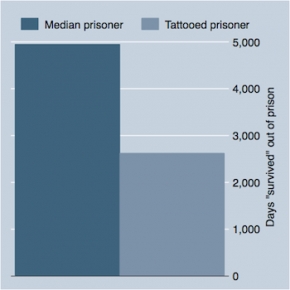
Research finds that “someone lasts 5,000 days (about 14 years) before finding themselves back in the cooler,” but “a tattooed ex-con lasts half that”:

[Researcher Kaitlyn] Harger compares people with different types of tattoos: dish_tattooedprisoners those that can easily be seen, and those that cannot. People with tattoos on the face, head, neck or hands go back to prison 714 days earlier than other tattooed ex-offenders. Having a visible tattoo is the real problem for employers.

What’s the cost of all this to the hard-pressed American taxpayer? Uncle Sam pays roughly $30,000 a year to house one prisoner (though this figure varies wildly from state to state). About 600,000 prisoners are released each year, 70% of whom have tattoos. Tattooed types return to prison earlier: that translates into an extra cost of $5.5 billion per year (a little less than the budget of the Federal Prison System, which houses 200,000 prisoners). Tattoo removal can cost thousands of dollars. Even so, free removal for every prisoner would be sensible economics.

Update from a reader:

As you have often pointed out, correlation does not equal causation. The data in Kaitlyn Harger’s research might lead one to assume that face tattoos are causing a higher rate of recidivism. I suspect that the reverse is true. Face tattoos are very common in gangs. The recidivism rate for gang members is high because they go back to that life when the get our of prison. Tattoo removal will not wipe away all of their connections and affiliations. They are not career criminal acts because they have face tattoos; they have face tattoos because they are career criminals.

Paternity Pays

Claire Cain Miller discusses new findings showing that having kids furthers men’s but not women’s careers:

This bias is most extreme for the parents who can least afford it, according to new data from Michelle Budig, a sociology professor at the University of Massachusetts, Amherst, who has studied the parenthood pay gap for 15 years. High-income men get the biggest pay bump for having children, and low-income women pay the biggest price, she said in a paper published this month by Third Way, a research group that aims to advance moderate policy ideas. … [M]uch of the pay gap seems to arise from old-fashioned notions about parenthood. “Employers read fathers as more stable and committed to their work; they have a family to provide for, so they’re less likely to be flaky,” Ms. Budig said. “That is the opposite of how parenthood by women is interpreted by employers. The conventional story is they work less and they’re more distractible when on the job.”

Update from a reader:

Hi Andrew, welcome back! I have no doubt that paternity pays, at least in the corporate world, and need look no further than the phrase I most despise when used in a business setting: Family Man. I can’t tell you how many times I’ve heard, following a hire or a promotion, “Bill’s a great guy, a family man”. It doesn’t matter if Bill is a good father/husband, just that he is one. You will never hear, “Jill is a great gal, a family woman”. Family Man = Stable, solid, dependable. Family Woman = More devoted to family than career. This is why it pays to be a dad.