Obama’s Imperial Presidency? Ctd

Ross defends his “Caesarism!” charge from critics:

I will concede, certainly, that there are scenarios where congressional inaction obligates some presidential creativity, and that a House as dysfunctional as this one might create more such scenarios than usual. (Which is why, again, I haven’t written angry columns every time — and there have been many — this president has made dubiously-constitutional moves.) And I will concede, as well, that certain crisis-level situations might necessitate more extraordinary moves. (See Constitution, suicide pact, etc.) Posner invokes “the costly and ridiculous near-failure to raise the debt limit in past years,” which isn’t a terrible example: Had Congress actually failed to raise the debt limit, it would have been derelict in its duties, and the White House probably would have been justified in pushing the envelope significantly to deal with whatever economic fallout ensued.

But immigration reform is simply not that kind of issue. We’ve had millions of people here illegally for decades; we will probably have millions of people here illegally a decade hence even if Congress decides to pass major immigration legislation tomorrow; and there is no emergency situation requiring legalization as the obvious, there-is-no-alternative response.

For the record, I think Ross has the better of the arguments here. Yes, Obama is facing a nullification House – a body that will not even allow its own proposals to be signed into law by this president. They are by far the guiltiest party in our governmental dysfunction. But the remedy for that is voting them out, not supplanting them with the executive on a matter this controversial, this political and in this climate. Obama was right the first time: the Congress needs to do this. Ezra, meanwhile, reminds us how gridlock and this kind of executive temptation are not going to go away as long as we have a reactionary, nihilist rump in the House:

Conservative critics go too far when they pretend that Obama’s actions are unprecedented. President Jimmy Carter, for instance, unilaterally pardoned hundreds of thousands of draft dodgers — an action more extreme than anything Obama is said to be considering. At the same time, there do need to be limits on the president’s ability to win policy fights by selectively enforcing laws. …

Congressional dysfunction doesn’t justify any particular executive action. But it should worry both liberals and conservatives who fear the steady expansion of the president’s powers. Congress is going to be divided for a long time. Even as demographic changes make it easier for Democrats to win presidential elections, geography and redistricting make it nearly certain Republicans will hold the House well into the next decade. The result is that this kind of bitterly polarizedutterly ineffectivewildly unpopular Congress is likely to be the norm.

The less Congress is able to do, the more that other power centers in the government will feel they need to do. The system will survive congressional inaction, but it will survive it in part by leaping into the antidemocratic dark.

The Troubling Triumph Of The Israeli Right

Tensions Remain High At Israeli Gaza Border

The Gaza conflict has fortified Israel’s right wing, Gregg Carlstrom admits:

Public opinion polls confirm the Israeli right’s gains during the current conflict. A survey conducted by the Knesset Channel last week found that the right-wing parties would win 56 seats in the next election, up from 43 last year. The center-left bloc would shrink from 59 seats to 48. Other surveys suggest that the right could win a majority by itself, without needing religious parties or centrists to form a coalition. But perhaps more striking is the public’s near-unanimous support for the Gaza war, from Israelis across the political spectrum. Roughly 90 percent of Jewish Israelis support the war, according to recent polls. Less than 4 percent believe the army has used “excessive firepower,” the Israel Democracy Institute found, though even Israeli officials admit that a majority of the 1,800 Palestinians killed so far are civilians.

Even scarier, Carlstrom adds, is that “this time, public dissent hasn’t just been silenced, it’s been all but smothered”:

A popular comedian was dumped from her job as the spokeswoman for a cruise line after she criticized the war. Local radio refused to air an advertisement from B’Tselem, a rights group, which simply intended to name the victims in Gaza. Scattered anti-war rallies have drawn small crowds, mostly in the low hundreds; the largest brought several thousand people to Tel Aviv on July 26. But most of the protests ended in violence at the hands of ultranationalists, who attacked them and set up roving checkpoints to hunt for “leftists” afterwards. Demonstrators have been beaten, pepper-sprayed, and bludgeoned with chairs.

In Assaf Sharon’s incisive reading of Israel’s recent history, this strain of ultra-nationalism has been years in the making:

The conventional wisdom is that Israel has moved to the right. But as public opinions and analyses of voting trends clearly show, this is not the case. Although the right has grown, its rise has been relatively small. Israelis remain evenly divided on peace and security, and the left enjoys a clear majority on social and economic issues. The deeper shift is not in the level of public support for the two political camps, but in their make-up.

On the right, the liberal and democratic elements have been overtaken by chauvinist populists. Prime Minister Netanyahu’s party, Likud, whose members used to walk out on [Rabbi Meir] Kahane, is now populated by some of the most vocal inciters. The last remnants of its democrats were ousted in the last primary elections, and the remaining moderates pander to the pugnacious extremists that dominate the party. The prime minister himself has maintained utter silence in the face of growing racism and political violence. The left, on the other hand, has lost its political stamina and its moral courage. A depletion of ideas, debilitation of institutions, and putrefaction of leadership have left it politically inert. The social mechanisms that kept Kahane’s racism at bay have all but disintegrated.

When the philosopher and public intellectual Yishayahu Leibovitz called Kahane and his followers “Judeo-Nazis,” not everyone agreed, but everybody listened. More importantly, many understood the threat he identified and were willing to combat it. Breaking the moral siege demands active and resolute opposition to Jewish jingoism, not ignoring it and certainly not accommodating it.

(Photo: Police keep right-wing supporters of Israel separated from left-wing protesters during a rally held by the left-wing calling for an end of the Israeli occupation of Palestine and for a ceasefire of the current Israeli-Palestinian conflict on July 12, 2014 in Tel Aviv, Israel.At least one person was arrested and one person was injured. By Andrew Burton/Getty Images)

Three Red States Are Big Winners From Obamacare

A new Gallup survey illustrates the uneven impact of the law. HuffPo maps the data:

Uninsurance Rates

Margot Sanger-Katz contends that the “numbers demonstrate the big difference the Affordable Care Act could have for the country’s poorer states”:

I’ve written before about the “two Americas” in health care, with richer Democratic-leaning states expanding coverage to more of their populations and poorer Republican-leaning states sitting out the expansion.

According to the new Gallup poll, Arkansas and Kentucky have had the largest reductions in uninsured rates in the country. Arkansas reduced its rate by more than 10 percentage points, to 12.4 percent from 22.5 percent last year; the rate in Kentucky declined by 8.5 percentage points. (The margin of sampling error for the results varies by state size, but is around plus or minus two percentage points for those two.) West Virginia also made Gallup’s top-10 list. These three states had very high numbers of residents who lacked insurance and qualified for the new public programs; it is not a surprise that, with a commitment to these new programs, they saw significant coverage gains.

It’s one of the great tragedies of the last few years: that a black president offered many poor white states a healthcare law that would help them more than others – and most chose to reject it. I mean, it’s not as if Massachusetts needed it. Cohn draws attention to the tangible consequences of states opposing Obamacare:

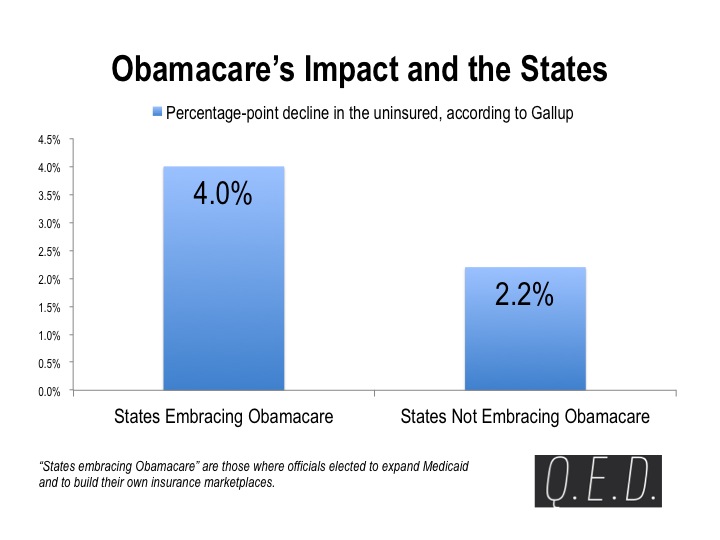
[T]he numbers do suggest a pattern, one Gallup’s own researchers observe. The states that made the most headway covering the uninsured, according to Gallup, are states in which officials decided to build their own insurance marketplaces and to make all low-income people eligible for Medicaid, as the Affordable Care Act originally envisioned.

Obamacare Impact

Pivoting off the Gallup numbers, Greg Sargent asserts that Obamacare is becoming less central to this year’s campaigns:

All of these little data points help tell a larger story, which Politico told really well today: The fading of Obamacare as an issue in many states, including those with hard fought Senate races with massive expenditures such as those from the Koch group. To be sure, Dems very well could lose control of the Senate. But it is becoming increasingly accepted that even if that does happen, Obamacare might not be a major reason why — the makeup of the map and the economy could prove far more important in determining the outcome.

Busting Hamas’ Nihilism

An Indian news crew managed to capture this rare video footage of a rocket being fired from a densely populated residential area in Gaza yesterday morning, less than an hour before the ceasefire went into effect:

Michael Peck discusses why this is significant:

The film clip doesn’t show an Israeli retaliatory strike. But if there was one, it would have struck a built-up area, possibly injuring civilians. And there’s no way Hamas could not have been aware of that. By the way, the Indian film crew didn’t release the film until after they left Gaza, apparently in order to avoid retaliation by an image-conscious Hamas.

What can we conclude? From a military standpoint, a rocket that can fit under a small tent is going to be tough to eliminate with an air strike or artillery barrage. It takes troops on the ground. … It also illustrates exactly why guerrillas and irregular armies so often can prevail, or at least endure, against superior forces. Rockets and mortars are easy to assemble and fire. The launch crew can vacate before warplanes or artillery responds. When the counter-bombardment inevitably comes, civilians get hurt and the guerrillas gain support.

But Seth Lazar doesn’t buy Israel’s argument that Hamas’ use of human shields justifies bombing civilians:

[O]ne might think that Hamas’ joint responsibility provides some grounds for discounting the weight of those innocent civilians’ lives when tallying up the bad effects of the IDF’s actions. Suppose that Hamas were to literally treat innocent civilians as hostages by advertising an intention to kill a certain number of them should the IDF not withdraw. Then many would think it plausible that those deaths should not receive the same weight in the proportionality calculation as those directly inflicted by the IDF, in part because of the ‘intervening agency’ of Hamas. Perhaps human shields are analogous to hostages in this way.

We should resist this conclusion. Innocent people’s lives have weight in the proportionality calculation because of their moral status—their right to life. This status, and these protections, cannot be diminished by the impermissible actions of some third party.

Meanwhile, Human Rights Watch reports possible Israeli war crimes in Khuza’a:

On the morning of July 23, Israeli forces ordered a group of about 100 Palestinians in Khuza’a to leave a home in which they had gathered to take shelter, family members said. The first member to leave the house, Shahid al-Najjar, had his hands up but an Israeli soldier shot him in the jaw, seriously injuring him. Israeli soldiers detained the men and boys over age 15 in an area close to the Gaza perimeter fence. Based on statements from witnesses and news reports, some were taken to Israel for questioning. Israeli forces released others that day, in small separate groups. As one group walked unarmed to Khan Younis, Israeli soldiers fired on them, killing one and wounding two others.

Two older men whom Israeli forces briefly detained near the perimeter fence had been seriously wounded in earlier Israeli bombardments and died soon after being released, two witnesses said. The laws of war provide that wounded civilians and combatants should be given necessary medical care to the fullest extent practicable and with the least possible delay. In another incident on July 23, Israeli soldiers fired on a group of civilians who had been told to leave their home in Khuza’a, killing Mohammed al-Najjar, a witness said.

Hamas And The Teen Murders

That’s the current line from the Israeli government on the disputed authorization for the murder of three teens in the West Bank. Eli Lake follows up:

Israeli news reports say Qawasmeh acknowledged during interrogations that he received money and direction from Hamas leaders in Gaza to conduct the June 15 kidnapping. He was arrested trying to flee to Jordan using phony identification. Shaul Bartal, an expert on Hamas and a reservist major in the Israel Defense Force for military intelligence, told The Daily Beast on Tuesday that the arrest of Qawasmeh was a smoking gun, but he also said it’s doubtful that Hamas leaders gave specific instructions to kidnap the three teenagers. “It seems Hamas leadership in Gaza gave an order, but the order was more general,” he said.

I remain confused about the term “kidnapping.” The teens were murdered almost as soon as they were captured. I also remain confused as to how – since we are now told the evidence came after the arrest of Qawasmeh – Netanyahu was able to know immediately that Hamas was institutionally responsible. It seems clear that the murders were not some random criminal act, and that Hamas sympathizers and renegades were involved, broadly authorized by Hamas. Beyond that? I doubt anyone intended it to be a casus belli. But Netanyahu made it one.

The NYT Caves Further To Sponsored Content

At first, they were never going to do it; then they were going to do it just a little, with very high standards; now, they’re lowering those standards so as to blur even further the difference between an advertisement and an article. And this is the crown jewel of American journalism: the New York Times. AdAge has the scoop:

The New York Times has shrunk the labels that distinguish articles bought by advertisers from articles generated in its newsroom and made the language in the labels less explicit … Recent Paid Posts from Chevron and Netflix have replaced the blue moat that enclosed [an earlier] native ad with a slimmer blue line running only along the top. “Paid For And Posted By” has been trimmed to to “Paid Post,” and in slightly smaller type. The company logos, also slightly smaller, appear in a white bar that’s not as tall as Dell’s dark blue bar. And because Chevron and Netflix didn’t write their Paid Posts, their logos don’t appear by the author’s name. Instead “T Brand Studio,” the unit within the Times that produces content on behalf of advertisers, appears off to the left.

Here’s why:

“Some form of labeling is necessary to make sure no one feels deceived, but beyond that I don’t think they need to have blinking lights,” said Scott Donaton, chief content officer at UM. “In general, if a client is going to create content, they don’t want the thing dressed up in way that pushes audiences away from it,” he added.

So to clearly label an advertisement an advertisement “pushes audiences away.” So the goal is to provide the smallest fig-leaf possible that gives the NYT plausible deniability of outright deception. And that’s entirely because of corporate pressure. Look at this page and see if you think most people would know it’s bought and paid for by an advertiser.

Now check out the Washington Times’ latest gambit with the Washington Redskins:

In 2000, then-editor Wes Pruden of the Washington Times blasted Dan Snyder’s efforts to control the flow of information about the Redskins as “chickenshit” tactics. Last week, the same newspaper agreed to give that same owner unprecedented control over that same flow of information about the same team. And all parties celebrated the deal. “The Washington Times and the Washington Redskins announced a unique partnership that will make the newspaper a content and marketing partner of the team,” said the joint press release.

And check out Condé Nast’s new venture as a marketer for Monsanto:

Screen Shot 2014-08-06 at 12.36.38 PM

Let me repeat: “Each episode will be stylishly arranged in a controlled environment, to create an authoritative and journalistic forum.” If you want your journalism stylishly arranged in a controlled environment to buttress the brand of a corporation, then you know to go read Condé Nast publications.

Will They Cease The Fire?

Keating thinks the 72-hour truce that went into effect in Gaza yesterday morning may actually hold:

While it never pays to be too optimistic in this part of the world, there’s reason to believe this time could be different. Last week I wrote that any internationally negotiated cease-fire agreement would be irrelevant until Israel decided its military goals had been achieved. As Reuters reports, that seems to have happened: Israeli armour and infantry withdrew from the Gaza Strip ahead of the truce, with a military spokesman saying their main goal of destroying cross-border infiltration tunnels had been completed. “Mission accomplished,” the military tweeted.

Signs point to Hamas also concluding that there’s nothing more to gain from fighting. Rocket fire into Israel had substantially diminished in the days leading up to the truce and, as the New York Times points out, the group has now agreed to an Egyptian-backed truce that is similar to “one that they had rejected earlier in the conflict.”

So both sides get their very own Pyrrhic victory. It’s win-win – over the corpses of 300 children. Beauchamp also gets the sense that both parties are ready to stop fighting:

Israel was very up-front about the primary goal of its ground offensive: destroy Hamas tunnels into Israel. It’s very close to having accomplished that:

Israel says that it has destroyed the tunnel network, presumably meaning all of the tunnels. Indeed, Israel is so confident that it’s telling evacuated Israelis who live in the south near Gaza to return to their homes because the tunnel threat has been “neutralized.” From Israel’s perspective, that’s a big win. … Moreover, Hamas may be in a position to win some partial concessions from Egypt during the Cairo ceasefire negotiations. According to Hussein Ibish, a senior fellow at the American Task Force on Palestine, Hamas is “hoping to get Rafah [the border crossing between Gaza and Egypt] open, and they’re hoping to get the Egyptians to allow the transfer of Qatari and other money, which the Egyptians have been blocking.” Getting a lifeline out of Gaza that Israel doesn’t control would be a big deal for Hamas, as it would allow them to at least somewhat circumvent the Israeli blockade, no matter how much Israel tightens it. But why is Hamas ready to negotiate for these concessions now? It seems, quite simply, that Hamas has likely determined it has nothing more to gain from the conflict.

Mitchell Plitnick assesses what both sides have gained and lost … mostly lost:

The tunnels are very frightening to Israelis and Israel appears to have eliminated them. But there are two big problems with this narrative. Firstly, destroying the tunnels was the main focus of the ground operation, but Egypt managed to destroy hundreds of them without a military attack; they simply flooded them from the Egyptian side. The second problem is that, while Israeli fears about the tunnels are understandble, it’s worth noting that Israel has known about them for quite a while and Hamas hadn’t used them until this round of fighting began.

So what, really, did Israel achieve? It caused Hamas to use about two-thirds of its rockets, but those can be replenished, and at the point of the ceasefire, Hamas and other factions were still firing at will. Israel destroyed Hamas’ tunnels, but they had been there for years and were posing only a potential threat. Israel meanwhile failed to destroy the unity agreement, at least for now. These gains were bought by Israel at the price of Palestinian blood, and a higher domestic death toll than Israel is accustomed to (67, including three civilians). As much as it appears like Tel Aviv doesn’t care about that price, it is clear that Israel’s image took a major hit in this engagement.

Why Is Our Vision Getting Worse?

Too much reading is a possible culprit:

Observational studies have found that, in general, a person’s level of education — and thus the amount of reading they’ve done over their lifetime — is positively correlated with their risk of myopia. But the direction of causation could go either way: they could have read more growing up, becoming both more educated and myopic, or for various reasons people prone to myopia could be more likely to read more. Some studies have suggested that both are caused by socioeconomic factors.

For what it’s worth, several of the eye doctors I spoke with felt that increased computer use — both in school and in the workplace — has indisputably changed the development patterns of myopia, making it more common for people to become nearsighted in their twenties or thirties, rather than the conventional pattern of becoming myopic during childhood and stabilizing by adulthood.

An Insider Attack In Afghanistan

In Kabul yesterday, two-star Major General Harold Greene was shot to death, becoming the highest ranking American military officer killed in a war zone since 1970:

The inside attack, which took place at Afghanistan’s National Defense University in Kabul, also injured more than a dozen members of the International Security Assistance Force (ISAF), defense officials said. A one-star German was wounded, the Bundeswehr German armed forces said. The shooter, allegedly a member of the Afghan military, was killed in the course of the attack, Pentagon spokesman Rear Adm. John Kirby confirmed Tuesday.

So-called “green-on-blue,” or insider attacks, when insurgents either disguised as or within the Afghan security forces turn their weapons on NATO-led international forces in Afghanistan, are common. But a number of factors, including measures implemented by ISAF, have diminished their prevalence in the last two years. The last confirmed green-on-blue incident occurred in February in Afghanistan’s Kapisa province, although, a June 23 attack involving an Afghan police officer and two injured ISAF soldiers is being investigated.

Eli Lake fingers the Taliban:

The Taliban have spent the last seven years trying to embed moles inside Afghanistan’s army and security services. At a press briefing Tuesday, Pentagon spokesman Adm. John Kirby was careful not to assign blame for the attack, describing the assailant only as an Afghan soldier. But the U.S. military has spoken publicly for years about its efforts to root out the Taliban infiltrators inside the military President Obama hopes will keep Afghanistan from becoming an al Qaeda haven. One congressional staff member told The Daily Beast, “Our view is: This is Taliban until proven otherwise.”

Even if the Taliban had nothing to do with Tuesday’s attack—and they might not have—the threat from the group and other Islamic extremists in Afghanistan is rising, current and former U.S. intelligence and military officials tell The Daily Beast. The new danger in Afghanistan reflects an optimism from the Taliban, al Qaeda, and the Pakistan-based Haqqani Network that Obama will remove U.S. forces from the country by the end of his presidency, leaving them an opportunity to re-establish havens within Afghanistan.

But Paul Rogers suggests that a spike in Taliban violence could cause the administration to reconsider the drawdown:

The Taliban may have increased their levels of action against Afghan forces, but they are unlikely to push this too far during the summer months – what is euphemistically called the “fighting season”. If they do, then the United States might decide to keep larger forces in the country in order to support the Afghan government beyond the end of this year.

The current intention is to keep those 10,000 or so troops in Afghanistan, partly to handle training missions but also to support the use of drones and maintain Special Forces for searching out groups that might link to al-Qaida elements in Afghanistan and north-west Pakistan. If the Taliban get so strong that they are threatening the very survival of the Kabul government, then the Pentagon will argue for keeping far more troops in the country.

Ugh.

The Government’s Bloated Watchlist

Watch List

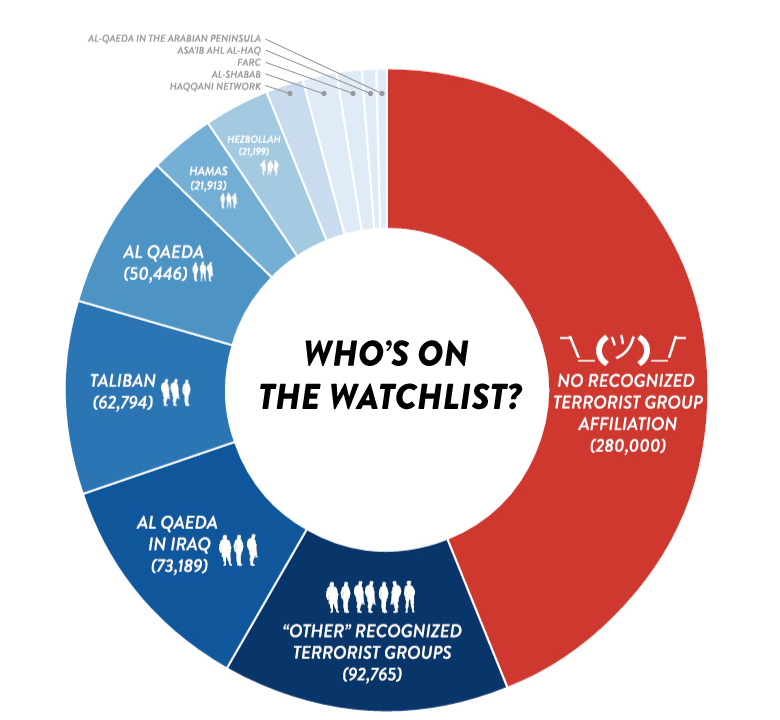
Yesterday, Jeremy Scahill and Ryan Devereaux reported that almost “half of the people on the U.S. government’s widely shared database of terrorist suspects are not connected to any known terrorist group, according to classified government documents obtained by The Intercept”:

Of the 680,000 people caught up in the government’s Terrorist Screening Database—a watchlist of “known or suspected terrorists” that is shared with local law enforcement agencies, private contractors, and foreign governments—more than 40 percent are described by the government as having “no recognized terrorist group affiliation.” That category—280,000 people—dwarfs the number of watchlisted people suspected of ties to al Qaeda, Hamas, and Hezbollah combined.

The documents, obtained from a source in the intelligence community, also reveal that the Obama Administration has presided over an unprecedented expansion of the terrorist screening system. Since taking office, Obama has boosted the number of people on the no fly list more than ten-fold, to an all-time high of 47,000—surpassing the number of people barred from flying under George W. Bush.

Timothy B Lee asks, “Is this a good way to fight terrorism?”

A lot of people don’t think so.

Critics point out that having too many people in a terrorism database can be just as bad as too few. If law enforcement and intelligence agencies are “watching” hundreds of thousands of people, that could mean they’re not actually watching anyone very carefully at all.

Civil libertarians also argue that the secret nature of these lists can run afoul of basic concepts of due process. If you’re put on a watchlist by accident, as the late Sen. Ted Kennedy once was, it can be extremely difficult to get off. And government critics such as Laura Poitras and Jacob Appelbaum have reported being detained and harassed by US officials when they’ve traveled to and from the United States.

The government counters that it can’t tell people who is on its lists and why without compromising intelligence sources and methods. But the result has been to turn airports into a kind of Constitution-free zone, where ordinary principles of due process don’t apply.

Ambinder’s take:

Watchlisting is fine; the uncertainty about the identities of terrorists implies that the list of suspected al Qaeda members will be much larger than the actual list. But providing to the National Counterterrorism Center bulk biometric data from all Americans in a certain number of states? The disproportionate targeting of Muslims in Dearborn, Michigan? The ease with which the government can open a file on you? Not only does the noise drown out the signal, but the actual harm done to people — inconvenience at airports, harassment at border crossings — is tangible.

Scott Shackford sighs:

[T]he first thing this report for 2013 (pdf) describes as an “accomplishment” is adding its one millionth person to its database:

On 28 June 2013, the Terrorist Identities Datamart Environment (TIDE) passed a milestone of one million persons in TIDE. While NCTC’s Directorate of Terrorist Identities (DTI) seeks to create only as many person records as are necessary for our nation’s counterterrorism mission, this number is a testament to DTI’s hard work and dedication over the past 2.5 years.

It’s a monument to the twisted incentives that drive bureaucracies. Having a watch list of a million people is considered an accomplishment even though it contains hundreds of thousands of people with no known ties to terrorist groups.