Looking East From Africa

20140809_gdc460_2

President Obama is hosting 51 current and former African leaders in Washington this week for a grand summit on revitalizing American engagement on the continent. Reviewing Obama’s mixed record on this issue, Jay Newton-Small sees the summit as an attempt to make good on some of the expectations he raised early in his presidency. But like most issues in international politics these days, it’s also about China:

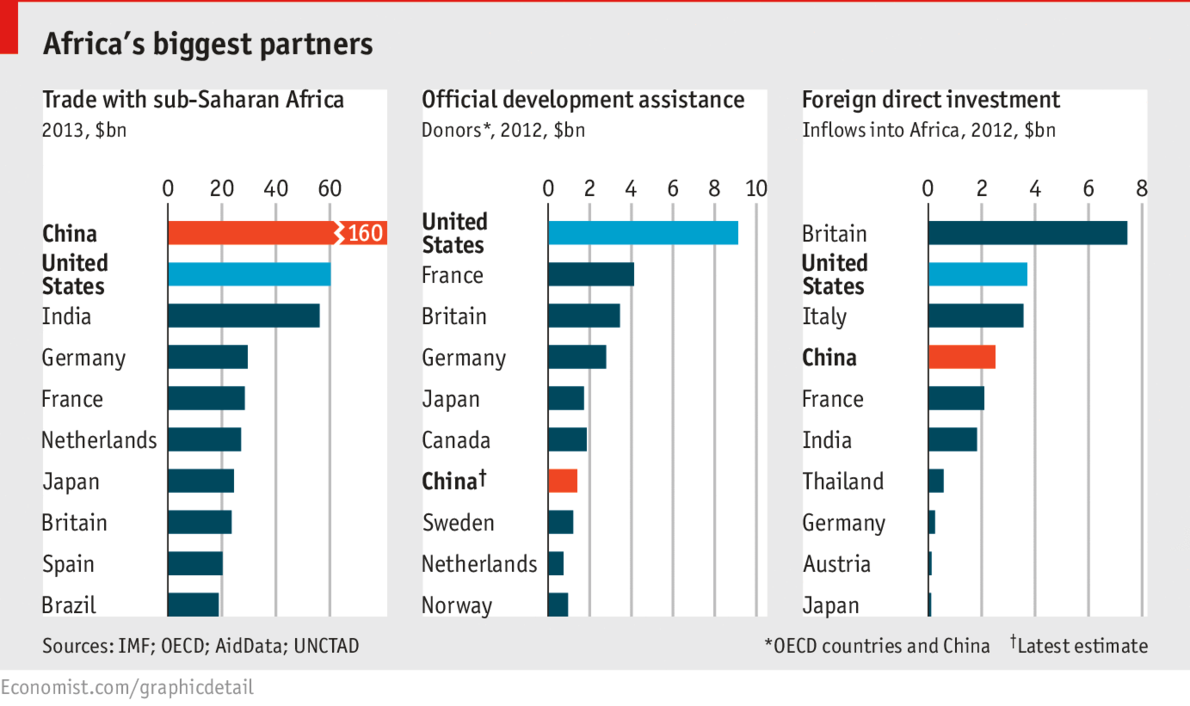
As the U.S. is pivoting to Asia, Asia is pivoting to Africa. China’s investments in Africa surpassed those of the U.S. in 2010 and are now five times as big—$15 billion to U.S.’s $3 billion. China’s investment in the raw-resource laden continent is expected to reach as high as $400 billion over the next half century. While, Obama says “the more the merrier,” as he told The Economist, “my advice to African leaders is to make sure that if, in fact, China is putting in roads and bridges, number one, that they’re hiring African workers; number two, that the roads don’t just lead from the mine, to the port to Shanghai.”

To that end, Obama has a distinctly American message for African leaders. He has seized upon the conference to underline the power of democracy for emerging nations. It is not by accident that he invited so many former African leaders: a message to Africa’s many aging dictators that it’s okay to step aside and give someone else a chance. Obama has proven that he isn’t Africa’s savior, and there’s only so much he can do.

Max Nisen assesses how our aid, trade, and investment in Africa measure up to China’s:

Evaluating just how much China’s businesses and government have invested in Africa is tough, especially given the opacity of Chinese government dealings. Though the US still leads in UNCTAD’s tallies of direct investments in Africa, that’s declining. One study estimated that China invested as much as $75 billion in unrecorded projects alone from 2000 to 2011. That would boost the figures below from China dramatically:

China’s FDI has grown at about 53% a year since 2001, compared to 14% for the US. Less than 1% of US FDI investment goes to Africa, and $14 billion won’t do much to change that. By contrast, China invests 3.4% of its worldwide FDI stock in Africa. Its massive investments in infrastructure dwarf US efforts. Since China surpassed the US in 2009 to become the continent’s biggest trading partner, the gap has only grown. Last year, the US had about $85 billion in bilateral trade with Africa; China reported more than double that with $210 billion.

Stephen Mihm looks to history to explain why the US isn’t as robustly invested in Africa as it is in other parts of the world:

By the early 20th century, the U.S. had managed to get a foothold in places such as South Africa, but in general, its trade paled compared with that of Britain. Moreover, it was lopsided. Americans, in other words, didn’t actually buy a whole lot from Africa. The continent was instead viewed simply as a dumping ground for U.S. products. In 1901, for instance, goods from Africa constituted a mere 1.2 percent of total U.S. imports. That figure barely budged in the succeeding years.

And actual direct investment in Africa was negligible, with the exception of Firestone’s investment in rubber plants in Liberia before the outbreak of World War II. Africa, when it appeared on the radar of U.S. businessmen, was a place to sell, not a place to make long-term investments. That job fell to imperial powers such as Britain, which had little interest in, say, setting up a competing manufacturing power in a colony.

Gordon Adams explores the US-Africa relationship from a security standpoint:

The money, equipment, training, counseling, intelligence, and operating support the United States provides in Africa will only be reinforcing the militaries as institutions in their countries. These militaries already have, at best, a mixed history of corruption, political domination, and seizure of power. And U.S. military investments provide these militaries with additional arms and operational training, making it even more difficult for civilian governments to restrain the military’s assertion of political power.

This deeper issue is a central one in Africa, and the one payoff of all the U.S. investment that we should put above all others — above development, above social services, above stronger security forces — is the issue of “governance.” Governance is what this summit should be about, above all else. Supporting governance in Africa might be discussed this week, but it is a goal only weakly reflected in U.S. assistance programs in Africa.

(Chart via The Economist)

Why Is This Ebola Outbreak Different From All The Other Ones? Ctd

Jason Koebler surveys the ongoing chaos as overwhelmed health workers struggle to contain the ebola outbreak:

“Every report I’m getting from the ground has health workers in a state of fear, and they’re feeling a siege from populations who despise and loathe them,” said Laurie Garrett, a senior fellow for global health at the Council on Foreign Relations who won a Pulitzer Prize for her on-the-ground reporting on the ebola outbreak in Zaire in 1996, on a conference call this morning. “They’re saying ‘we are terrified, we are exhausted, we want to leave, can someone take over?’” … Problem is, there aren’t many people who can take over. Already, more than 60 healthcare workers have died from the disease, and the countries’ governments haven’t been very successful at shepherding their people—who have never seen the disease before, often don’t speak the same language as relief workers, and don’t fully grasp what’s going on—to treatment facilities.

That’s why you have things like riots outside of health care clinics and patients making escapes from ebola quarantine centers. Healthcare workers have been called “cannibals” by protesters, and Garrett said that workers she’s talked to have been accused of cutting patient’s arms off and selling them on the black market. In other words, the situation is fairly out of control, and it doesn’t look to be getting better anytime soon.

Debora MacKenzie, Philippa Skett and Clare Wilson offer their take on why this epidemic has been so severe:

The overriding factor could be urbanisation.

In the past, village outbreaks remained small, unless people went to hospitals. “Population size and high mobility make it hard to do contact tracing,” says Peter Walsh at the University of Cambridge. Cities provide more chances to spread the virus, something that may also have enabled the spread of HIV. According to the African Development Bank, the continent has had the world’s highest urban growth rate for 20 years, and the proportion of Africans living in cities will rise from 36 per cent to 60 per cent by 2050.

Other factors also favour the virus. Justin Masumu of the National Institute for Biomedical Research in Kinshasa, Democratic Republic of the Congo, found that the increase in Ebola outbreaks since 1994 is associated with changes in forest ecosystems due to deforestation, which displaces bats. The part of Guinea where this outbreak started has been largely deforested. What’s more, wars in Liberia and Sierra Leone, and corruption in Guinea, have caused poverty, says [Tulane public health professor Daniel] Bausch, leading people to migrate for work and spread the virus further. It has also caused widespread mistrust of officials, even in public health – just when Africa’s cities need them most.

Julia Belluz outlines the worst-case scenario:

Even if the outbreak didn’t move across any other country border, intensification within the already affected areas is the most immediate health threat. “The worst-case scenario is that the disease will continue to bubble on, like a persistent bushfire, never quite doused out,” said Derek Gatherer, a Lancaster University bioinformatician who has studied the evolution of this Ebola outbreak. “It may start to approach endemic status in some of the worst affected regions. This would have very debilitating effects on the economies of the affected countries and West Africa in general.”

This dire situation could come about because of a “persistent failure of current efforts,” he added. “Previous successful eradications of Ebola outbreaks have been via swamping the areas with medical staff and essentially cutting the transmission chains. Doing that here is going to be very difficult and expensive. We have little option other than to pump in resources and engage with the problem using the tried-and-tested strategy—but on a scale previously unused.”

But Tara C. Smith emphasizes that the chances of an ebola outbreak in the US remain extremely low:

Ebola is a virus with no vaccine or cure. Any scientist who wants to work with the live virus needs to have biosafety level 4 facilities (the highest, most secure labs in existence, abbreviated BSL-4) available to them. We have a number of those here in the United States, and people are working with many of the Ebola types here. Have you heard of any Ebola outbreaks occurring here in the United States? Nope. These scientists are highly trained and very careful, just like people treating these Ebola patients and working out all the logistics of their arrival and transport.

Second, you might not know that we’ve already experienced patients coming into the United States with deadly hemorrhagic fever infections. We’ve had more than one case of imported Lassa fever, another African hemorrhagic fever virus with a fairly high fatality rate in humans (though not rising to the level of Ebola outbreaks). One occurred in Pennsylvania, another in New York just this past April, a previous one in New Jersey a decade ago. … How many secondary cases occurred from those importations? None. Like Ebola, Lassa is spread from human to human via contact with blood and other body fluids. It’s not readily transmissible or easily airborne, so the risk to others in U.S. hospitals (or on public transportation or other similar places) is quite low.

Cheers To Cheap Beer

dish_champagneofbeers

In a review of Adam Rogers’ Proof: The Science of Booze, Matthew Braga sticks up for the makers of “so-called mass-market swill”:

“Just because Jack Daniel’s comes from a chemical plant,” Rogers writes, “doesn’t mean it isn’t a damn-fine-tasting chemical.” Quality means a lot of things, and to create a mass-market beverage that consistently tastes the same, year after year, you can’t—scientifically speaking—fuck around. …

Be it $12 eggs or some top-shelf bourbon, the supposed authenticity of something handmade is how some of us define quality, for better or for worse. When we pay good money for something, suggests Rogers—a fancy wine or a bottle of scotch, say—we want to know it was worth the price. As a result, many of us have lowered our expectations of what a cheap, mass-market drink can be. Surely not quality, the patio pals with which you’re splitting a pitcher might say. And definitely not as flavourful or interesting as a good craft brew, I’ll give you that. But no less of a challenge to produce on such a mass-market scale. It takes skill to make something taste exactly the same, again and again, no matter when or where or how you have it, and just because the result is cheap doesn’t make it bad, per se. If you’ve never ordered a Labatt 50 while everyone around you is drinking expensive wine, it’s an experience worth having at least once. Even if you don’t like the drink, you can savour the dirty looks.

(Photo by Scott Akerman)

Quote For The Day

“There we were, just enjoying a nice quiet Saturday night at the movies. A slow mover, Linklater’s “Boyhood.” Some popcorn. A few sodas. Nothing really happens in the film, we found. For about 90 minutes or so we stare listlessly at the screen. It’s a thinking man’s film, I say. Beautifully shot. It’s about life, and death and relationships and things of that nature. Just then, at a brief, carefully-timed cinematic pause in dialogue, an enormous fart from somewhere in the back pierces an otherwise silent movie theatre. It had the impact of a baseball bat hitting a leather couch, or George Foreman working the heavy bag. Whack. Loud, deep and masculine.The seat cushion heroically absorbed most of the blow, but not enough that each and every person in the movie theatre instantly burst into nervous laughter. The laughter continued for what felt like a good 5 minutes, until tears streamed down our faces.

Even well after the blast, we quietly chuckled to ourselves with a ‘remember the time that guy farted in the movie theatre’ gleam in our eyes. And just like that, with a soft chuckle and a deep breath, we were back into the film. Things happened, people drove around Texas, relationships came and went, there was crying, there was hope. It was as if we had all forgotten about the fart that had brought us together that night. As the sun began to set on screen, the teenage boy, no longer a boy, transitions into an adult, before our very eyes, and looks, intently, lustfully into a young girls eyes, as if to lean in for a kiss, and braaaaaaap. Another fart from the back row, like two giant hands clapping together, and the screen goes dark, roll credits. We decided, after laughing our way out of the theatre, and all the way home, that this was the best movie that we had ever seen. I imagine the lone fartist sauntering off into the sunset. His work here done.

If only I could say thank you, kind sir. You are truly a master of your craft,” – a Craigslist poster on a memorable day at the movie theater.

“How Miscarriage Deepened My Thoughts On Abortion” Ctd

A fair number of readers are pushing back against the one who wrote, “If you could ban bodies from terminating pregnancies, banning doctors from terminating them might make a tiny bit more sense, at least intellectually. But you can’t, and it doesn’t.” One argues:

We can’t ban bodies from miscarriages any more than we can ban anyone from dying. Miscarriages are natural, as is death. But I don’t think the fact of my inevitable death should excuse anyone from killing me today. The issue isn’t whether miscarriages are natural, but whether it is moral to force a death where none would have otherwise occurred.

Another charges the reader with failing to make “a significant distinction”:

The great majority of miscarriages occur because the embryonic makeup was not consistent with life. In other words, nature selected the embryo for termination. With abortions, it’s not as clear.

While there are certainly many fetuses that are aborted which would have miscarried anyway, there are many (perhaps most?) that would have survived to full term and enjoyed lives as healthy and full as have you and I. In other words, nature did not select them for termination. Rather, a human being – usually the mother– decided not to give the fetus the chance to become fully human. That difference should give us all great pause.

By the way, I am pro-choice (albeit by default). But to say, “Nature terminates pregnancies; why shouldn’t we?” isn’t a very compelling case for the pro-choice movement. Nature does a lot of things that we as human beings feel morally obligated to transcend.

Another:

I nodded along in recognition as I read your reader’s email. Like her, my husband and I have suffered through a miscarriage (in our case at 10 weeks) and also, horrifyingly, a stillbirth at 24 weeks. However, when I reached the last paragraph, I was taken aback:

After I came back to work after being in the hospital, I told my boss I was doing okay, and that it’s such a common thing – a fact known almost exclusively to only two groups of people: doctors, and people who have had miscarriages. And she said, “No. It’s a big deal.” And I’m like, who the hell are you to tell me whether it’s a big deal or not? I feel the exact way about people who want to ban abortions.

I respect your reader’s viewpoint, and I’m not interested in telling other people how they should feel about a miscarriage or an abortion. For me, the fact that miscarriages are common (absolutely true) does not make them any less of a big deal; mine was a huge deal for us.  I can both see a 20-day embryo as a fragile clump of cells, and still mourn the potential, the hopes, the dreams, the life that it represents.

Another shares similar sentiments:

I have thought a lot about this subject over the past several years. Both my sister and I have had early miscarriages. She has had three (that I know of) and I have had two. My sister and her husband are conservative evangelicals, while my wife and I are pretty firmly pro-choice.

Make no mistake, having an early miscarriage is a terrible thing, particularly your first, when you have no idea how common they are. My sister, her husband, my wife, and myself all went through periods of horrible grief and a sense of loss after each miscarriage.

That being said, I think my sister has taken these losses much worse than my wife and I. If you asked her I think she would consider the miscarriages to be children that died. I can’t help but think she feels this way in large part because she hears over and over again that life begins at conception.

After our first miscarriage, my wife and I struggled to put into words what we felt like we had lost. It certainly was not a child. But just a grouping of cells seemed not quite right either. Eventually we came to think of it as promise, or hope of a child that had been taken from us. Painful, absolutely, but not on par with losing a child.

My wife is now six months pregnant with our first child. At this point if we were to lose her, I would feel that I have lost a child. I am not sure when that switch happens, but it absolutely on a continuum. A mass of cells does not seem to be a person, but a two-pound fetus that I have seen on a sonogram, and whom I have felt kick, most certainly is. I guess that goes to show you that this is a really complicated subject and not one that lends itself to a black-and-white interpretation of when life begins.

A word of thanks: Your Misery of Miscarriage series, as well as the It’s So Personal series on late-term abortions, really helped me put my own thoughts in order.  I don’t know where else you would find that variety of viewpoints on subjects that are generally so taboo.

Google, Crime Fighter

The company reported a sex offender to the police:

A Houston man was arrested after Google detected that he was trying to email sexually explicit photos of a young girl to his friend. After its data-crawling algorithms detected the images, Google tipped off the National Center for Missing and Exploited Children, which then alerted police. The man, John Henry Skillern, is now being held for $200,000 bail on charges of possessing child pornography.

Rich McCormick explains how Google’s algorithm works:

Google makes use of Microsoft’s PhotoDNA technology to scan emails, and calculate a mathematical hash for an image of child sexual abuse that allows it to recognize photos automatically even if they have been altered. The tech is now also used by both Twitter and Facebook, after Microsoft donated it to the NCMEC in 2009. Videos, too, have become the focus of such digital fingerprinting programs. Google has its own Video ID software for detecting footage of child sexual abuse, and British company Friend MTS donated its Expose F1 detection program to the International Centre for Missing & Exploited Children (ICMEC) earlier this year.

While the technology has helped to halt the activities of people such as John Henry Skillern, the automated image detection systems used by Google and others have some flaws. For one, new pictures won’t be caught by software such as PhotoDNA: only images already recorded in the user’s database can be spotted. They also raise some privacy questions.

Lauren Williams looks at the legality of Google’s actions:

Courts largely support service providers monitoring content for child pornography as long as they don’t conspire with police to do so, Orin Kerr, a computer crime law professor at George Washington University in Washington, D.C., told ThinkProgress. “The big issue is the Fourth Amendment. Google needs to make sure that they are not acting as agents of the police,” he said.

Shafer fears where Google’s kiddie-porn offensive will lead:

Like cannibals, murderers, pedophiles and rapists, child pornographers — and customers of child pornography — constitute the worst of the human worst. They are the exemplars of the retrograde. Our natural impulse will always be to use whatever means, legal or technological, to expose and punish such unrepentant deviants.

Today, I’m fine with Web companies using scanning technology to uncover those who trade in child pornography. But the powers conjured up out of universal abhorrence have a way of spinning out of control, leading us to commit immoral acts in our pursuit of morality. It wasn’t that long ago that marrying across racial lines was a crime. Or that homosexual acts were punished by law. Or that pot smokers were jailed for decades. Or property covenants prevented Jews from buying properties.

Map Of The Day

Alison Abbott explains the genesis of the above video, which depicts 2,600 years of cultural change:

Maximilian Schich, an art historian at the University of Texas at Dallas, and his colleagues used the Google-owned knowledge base, Freebase, to find 120,000 individuals who were notable enough in their life-times that the dates and locations of their births and deaths were recorded. The list includes people ranging from Solon, the Greek lawmaker and poet, who was born in 637 bc in Athens, and died in 557 bc in Cyprus, to Jett Travolta – son of the actor John Travolta – who was born in 1992 in Los Angeles, California, and died in 2009 in the Bahamas.

The team used those data to create a movie that starts in 600 BC and ends in 2012. Each person’s birth place appears on a map of the world as a blue dot and their death as a red dot. The result is a way to visualize cultural history – as a city becomes more important, more notable people die there.

Mark Byrnes cautions:

Of course, devoting such a study to only ‘notable individuals’ of Europe and North America leaves out all sorts of people; most people, in fact.

The visualization of North American migration, for example, suggests the continent was uninhabited until Colonial times. The reason for the omission of so many kinds of people is quite simple: “[t]he poor are simply not as well recorded,” one of the researchers, Maximillian Schich, an asso­ciate pro­fessor in arts and tech­nology at the Uni­ver­sity of Texas at Dallas, tells National Geographic.

What we see in these videos is an example of how powerful data visualizations can be. But when it comes to charting thousands of years of world history, they’re still only as good as the records researchers can access.

Eliza Berman adds:

The video and accompanying article, which appear in Nature, an international science journal, have generated some criticism on Twitter, since Nature fails to qualify the phrase “visual history of human culture” with the words “Western” or “European.” Still others question how much the places where a man—and these are mostly men—was born and died can really tell us about cultural history.

These critiques are valid, and perhaps they’ll be addressed as Schich’s team releases further research. But if we take the video for what it is and nothing more—a mesmerizing view of the migrations of people whose contributions Western culture values—it’s a compelling look at the interplay between culture and geography.

Dissents Of The Day

A reader writes:

With regard to your post “The Last And First Temptation Of Israel,” let’s dispense with all pleasantries and call these racist warmongers what they are.  There is no excuse for this sort of language and belief and even under the worst of circumstances, you cannot justify it away.

With that said, a few things.  One, Feiglin is one of eight deputy speakers.  So, let’s be ISRAEL-PALESTINIANS-CONFLICT-GAZAclear that his power in Israel slightly less than you claimed. Second, while nothing can justify these comments, the fact remains that the government that controls Gaza outwardly supports the genocide of Jews and ethnic cleansing of Israel.  They were elected by the Palestinian people which, regardless of Israelis’ actions, means Palestinians voted for a party committed to genocide against the Jews.

Against this backdrop, I find it highly offensive that you are so narrowly focussed on the sins of Israel to the complete and utter exclusion of culpability of Hamas. Can you honestly say, given the sophisticated tunnels that were found, that there is no justification in Israel’s actions?  I know you’ll shoot back “but the settlements” and I will counter with “they should be dismantled, but, let’s protect lives while we wait for politicians to wise up.”

The idea that this blog has focused on Israeli sins “to the complete and utter exclusion of culpability of Hamas” seems to me a deluded function of how polarized this debate has become. I’ve repeatedly and vehemently used clear language to denounce Hamas’ tactics as war crimes and their ideology as poisonous. Yes, I’ve become deeply concerned about Israel’s lurch toward eliminationist rhetoric – but my focus on that is partly because the story is ignored by much of the US media, and also because Americans are financing Israel – and not Hamas – and Israel portrays itself as a Western society. Another reader notes:

I think you make too much of “deputy speaker” – here’s another person who currently holds that title:

Ahmad Tibi is an Arab-Israeli politician and leader of the Arab Movement for Change (Ta’al), an Arab party in Israel. He serves as a member of the Knesset (the Israeli Parliament) since 1999, and currently serves as Deputy Speaker of the Knesset. Tibi was acknowledged as a figure in the Israeli-Palestinian arena after serving as a political advisor to the late Palestinian president Yasser Arafat (1993-1999).

Another pulls no punches:

Andrew, your blog post was a total hack job and you should be embarrassed. I had a funny feeling during your postings about the latest Gaza conflict that you may have some cringe-worthy lapses in basic facts about both the Palestinian street and the Israel street. To exploit nutty extremists and malign Israelis in a rush job for your blog proves my theory that you really don’t know anything about Israel – and sadly, you probably don’t care because you’ve made up your mind.

The Times of Israel pulled the blog post from this asshole immediately, and nobody gives a shit about the deputy speaker or pays no attention to him. It’s like writing about David Duke and the late Fred Phelps to expose the real truth about Americans. If you actually knew about life in Israel you wouldn’t exploit these jerks or worse, take them seriously and somehow connect the dots to Israel character.

If you knew ANYTHING about life in Israel you would certainly understand that a majority of the population is secular, liberal and progressive (not at all like you portray in this blog post); including a very high profile and large LGBT community. You would also know that these very large moral issues, like what to do about about Hamas and civilian causalities, the occupation, etc, is front and center in the media, in coffee shop conversations and in the workplace. Most of the conversations include a firm rebuke of the nuts you’ve decided to highlight in your blog post.

You’re an idiot if you think this is Israel. You’re a bigger idiot if you’re exploiting this just to be provocative. You know you should go there and spend some time. See what it’s like to be living in a free and progressive society surrounded by utter lunacy and religious and sexual intolerance. It’s not fun.

On the other hand, another notes:

Speaking of voices in Israel advocating various forms of genocide: one you may have missed came earlier in the year in the Jerusalem Post calling the Armenian Genocide “permissible“:

Every nation has the right to employ whatever means it has to fight for its survival, and should not have to do so at the expense of its moral standing in the eyes of other nations. This is a belief both Israel and Turkey share.

Note that Haaretz recently published an article showing that the perpetrators of the Armenian Genocide presented the Jews in Palestine a brutally clear picture of how far “whatever means it has” extends:

A telegraph recently uncovered in the Turkish prime ministerial archive reinforces these accounts. Sent by the Turkish interior minister, Nazar Talaat, to the governor of Beirut, who also oversaw Zichron Yaakov, the telegraph read: “In the village of Zamrin (Zichron Yaakov,) in the Haifa district, the Kamikam (governor) told the people that if they do not hand over the spy Lishansky, their fate will be like the Armenians, as I am involved in the deaths of the Armenians.”

Another reader:

I have a few Israeli friends and have always been against the casual slaughter of Palestinians. My own support for the end of the war and criticism of the death of Gazan children has been vocal in situations both virtual and in physical conversation. I have discovered that there seems to be a violent pushback from many Israeli and Jewish people against my opinion (what a surprise!), usually revolving around the idea that A) I don’t understand B) You have no right to criticize us C) those in government don’t represent their opinion. Those are never fair reasons, because A) I do read enough to know B) I am human, the dead and injured are human and thus I have every right to have an opinion C) Then what are you doing about it.

I don’t mean to rant – but it would be helpful to readers to have a thread about this experience …. to share responses outside the media coverage. The mainstream coverage has been distorted and nothing has been said about how, one-to-one, others have been grappling with this. America has a unique position on this, as I live in New York (say what you will) and there is a huge number of Jews that have opinions about the conflict, nuanced or not, right or wrong. Compared to any other conflict, there seems to be a closer, perhaps more personal relationship with how we carry a discourse and there might be something valuable that a reader out there can share with the rest, beyond my own.

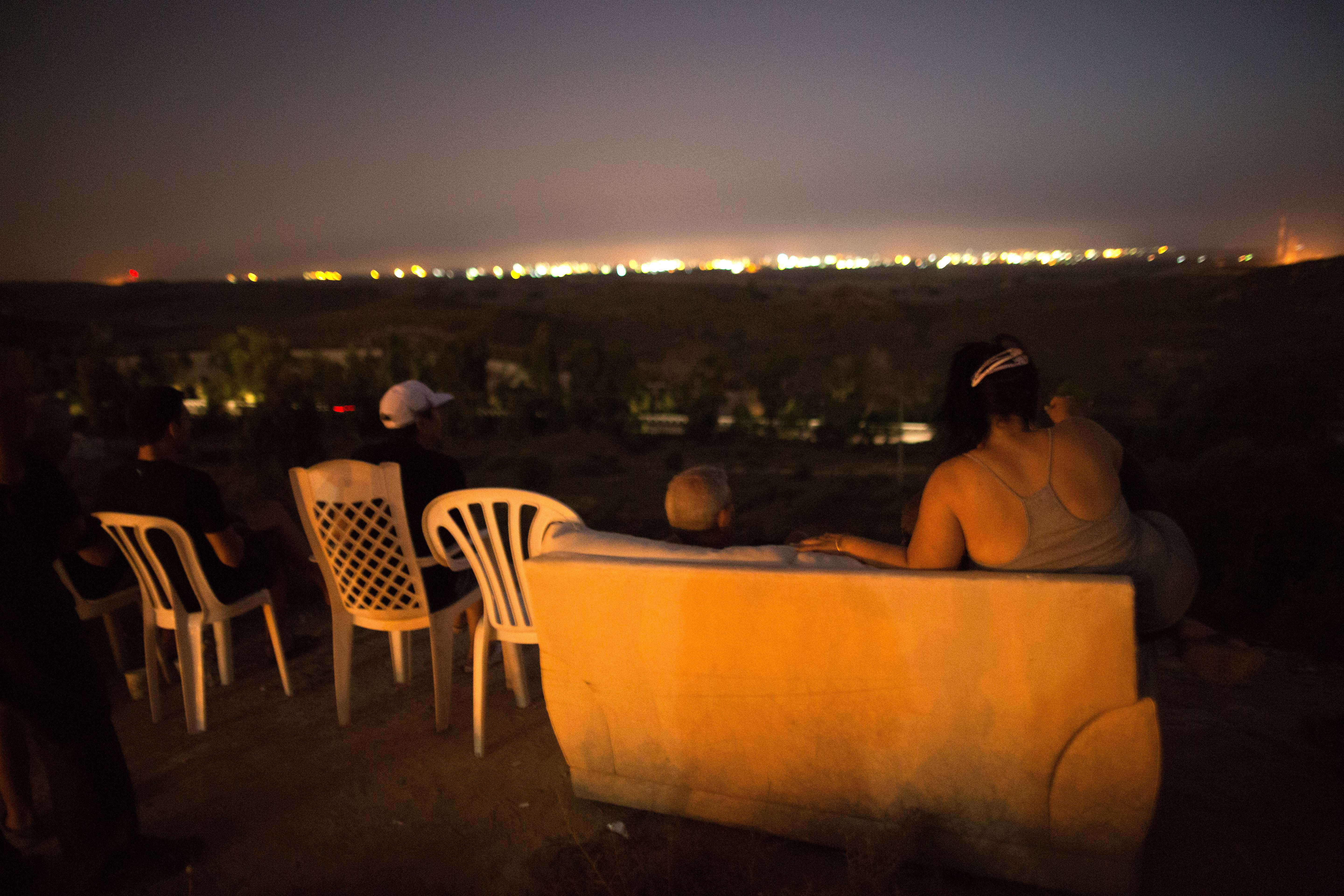
(Photo: Israeli residents, mostly from the southern Israeli city of Sderot, sit on a hill overlooking the Gaza Strip, on July 12, 2014, to watch the fighting between the Israeli army and Palestinian militants. By Menahem Kahana/AFP/Getty Images)