The GOP’s Opening Move On Immigration

President Obama to Announce Executive Action on Undocumented Immigration Issue

After yesterday’s vote in the House, Francis Wilkinson asserts that “Republicans are now openly supporting mass deportation for the nation’s estimated 11 million undocumented immigrants”:

Republicans voted for what might be called “comprehensive anti-immigration reform.” As promised, they backed an amendment to a Department of Homeland Security appropriations bill to roll back President Barack Obama’s November 2014 executive action easing deportations for up to five million undocumented immigrants living in the U.S. Then they kept pushing. They proposed to undo Obama’s 2012 executive action easing enforcement against more than half a million “Dreamers” — undocumented immigrants who were brought to the U.S. as children. And to unravel the administration’s edifice of enforcement discretion, which enables government agents to prioritize enforcement against different classes of undocumented immigrants — thugs now, grandmothers later — and dates back to Obama’s first term.

Dara Lind’s take is more nuanced:

What’s interesting about these amendments is that they would return to a world where unauthorized immigrants lived in constant fear of deportation — but they don’t do much to ratchet up deportation itself.

Republicans were reportedly considering some measures that would require state and local law enforcement to turn over all unauthorized immigrants in local jails to the federal government, for example, or even to allow local police to force the federal government to take any unauthorized immigrant they’d picked up. But that wasn’t reflected in the bill they brought to the floor.

And while the bill maintains the current mandate for ICE to keep 34,000 beds in immigration detention facilities (while providing more money for detaining families and children coming over the US/Mexico border), it doesn’t force ICE to expand detention capacity for people living in the US — nor, importantly, does it actually require those beds to be filled.

So the bill isn’t exactly mass deportation.

Not all Republicans voted for the bill:

Notably, eight of the ten Republicans who voted against the funding bill did so because they rejected the attached anti-immigration provisions. Though all five amendments passed, the one amendment that received the most opposition was also the one that exclusively rolls back President Obama’s existing 2012 executive action for the undocumented community. More than two dozen Republicans opposed Rep. Marsha Blackburn’s (R-TN) amendment, which strips away the Deferred Action for Childhood Arrivals (DACA) program that has already granted temporary legal presence and work authorization to more than 600,000 undocumented immigrants.

What [Michigan’s Republican Gov. Rick] Snyder—and [Ohio’s Republican Gov. John] Kasich, to some extent—are articulating is a viewpoint on immigration from the Midwest that is different from the national debate, which tends to center on border fences and deportation. In these post-industrial states, which have seen huge population loss and economic distress in cities such as Detroit and Cleveland, Snyder and other Republican political leaders are seeing immigration as a tool to help the region “grow and thrive,” as Snyder said in his statement. Or as Karen Phillippi, deputy director of Michigan’s Office of New Americans, puts it: “The focus of our immigration policy is more on economic impact than on social justice.”

The main thrust of the Midwestern pro-immigration argument is based on two points: first, that immigrants tend to be more entrepreneurial than native-borns and therefore are job creators; and second, Midwestern colleges and universities have large numbers of foreign students, and the region wants to keep them after they graduate by opening up the number of visas available.

Sargent wants to know where the presidential contenders stand:

Does today’s House GOP stance have the support of Jeb Bush (who has explicitly called for recognizing the moral complexity of illegal immigrants’ plight); Mitt Romney (who presumably learned the pitfalls of a hard line on immigration); and Marco Rubio (who championed the Senate bill)? Spokespeople for all three have not answered emails asking that question.

(Photo: A man walks next to the U.S. – Mexico border wall on November 19, 2014 in Calexico, California. By Sandy Huffaker/Getty Images)

The CIA Kicks Its Outgoing IG In The Nuts

I wrote a little about this yesterday, but the actual details of the fallout of the CIA’s spying on its Senate overseers are jaw-dropping. The CIA “Accountability Review Board” (try not to burst out laughing) put out a report over some Senators’ objections exonerating everyone at the CIA and castigating the CIA’s out-going inspector general, David Buckley, for finding fault with the spying on the Senate ordered by John Brennan, Obama’s duplicitous, self-serving CIA chief. Buckley announced he was quitting only last week.

So the CIA wins yet one more round against the Senate, its purported over-seer, cementing its role as the government agency in which no one is ever held accountable for anything, including torturing innocent prisoners to death:

Feinstein noted that Brennan himself had previously apologized for the actions of some CIA officials in the dispute. “The decision was made to search committee computers, and someone should be found responsible for those actions,” Feinstein said in her statement. But Bayh, in a statement, said the board found that no discipline was warranted for the five CIA employees — two of whom were lawyers — because “they acted reasonably under the complex and unprecedented circumstances.”

That would require reversing every conclusion made by the previous inspector-general; and so the report does exactly that:

The accountability board headed by Bayh and Bauer rejected nearly every finding by the inspector general. It concluded that there was “no basis” for the Justice Department referral, noting that one of the officials who oversaw the matter “reasonably believed” he was acting under the authority of Brennan himself and that the director had cautioned against intruding on the Senate’s internal work product.

The board also found there was no basis for the charges against the officials for showing a lack of candor, noting that the inspector general’s office did not record its interviews with the officials or keep a record of the questions it had asked them. Among the panel’s recommendations were that the inspector general keep “more complete records of interviews.”

So the only two men actually held accountable in any way by the CIA and the president on the issue of torture and of unconstitutionally wire-tapping the Senate staffers’ emails are the whistle-blower on torture and the very inspector-general who had the integrity to call a crime a crime. They are thorough at the CIA. Anyone guilty of war crimes must be protected at all costs; anyone who challenges that cover-up will be jailed or publicly castigated. And the president is fine with all of it. He has created precedents which essentially grant impunity to future torture, which many Republican candidates will surely want to bring back, and to future wire-tapping of Senate staffers tasked with oversight.

Obama has made torture much more likely to return – and will bequeath to his successor a CIA that knows it can do anything and no one can touch it. In this long game, the torturers have won. Because the president surrendered.

Where Censoring Muhammad Drawings Leads

Alyssa Rosenberg thinks “it’s important that we acknowledge the full spectrum of speech that’s in potential danger.” She contends that “more moderate people should recognize that they owe a debt to blasphemers and satirists, who create a free speech zone in which the rest of us can operate”:

The violent responses to “The Innocence of Muslims,” the provocative – and low-quality – film that played a role in sparking protests that gave cover to the attack in Benghazi, Libya, might not seem to be an indicator of risk for a more respectful project about Muhammad, like two that are in production in Qatar and Iran. But as the Hollywood Reporter explained in 2013, one of the projects had already been met with calls that it be banned on the grounds that it showed part of the prophet’s body, though it does not reveal his face.

Among other incidents, she highlights “when Yale University Press published an academic book about the response to the [Danish Muhammad] cartoons that declined to reproduce those images or other depictions of Muhammad, discussing them in absentia“:

[Reza] Aslan suggests that while such decisions often come out of a desire to be respectful, they don’t just deny audiences important opportunities to see powerful relevant images, but they reinforce a kind of soft anti-Muslim sentiment.

“The idea that Yale University Press thought that a book that 13 people would read anyway, an academic tome about the cultural, political and religious ramifications of these images,” he said, “that somehow that would threaten the lives of Yale University Press employees, it’s that kind of silly, knee-jerk cowardice that only feeds into this notion that Muslims are this kind of irrational, almost animal-like being who have to be handled with gloves.”

Satire intended for a small readership of Danish nativists no longer stays in Denmark. Cartoons that work for a sophisticated Parisian audience are now flashed around the world to an audience that wouldn’t know the difference between brie and Beaujolais. All that most people in places like Yemen or Pakistan see in those cartoons is someone defiling a religious tenet. They also fail to understand the difference between Charlie Hebdo and Le Monde, or Mad Magazine and Time.

This, I think, is the crux of why, in this day and age, “those damn cartoons” seem to be so uniquely inflammatory. Cartoons, because they’re mostly visual, can uniquely carry satire across cultural and language barriers. In some ways, this is a great asset, but that transmission of images doesn’t mean the joke, the intent, the cultural resonance is transmitted as well. In fact, the tone and humor often are lost in transmission while the offense and provocation are not.

Taking A Stand On The Can, Ctd

drunk-octopus

Probably the last batch of the bunch. A reader sends the above photo:

I had to share my favorite piece of bathroom graffiti – not the most sophisticated I’ve ever seen, but it made me laugh out loud.

This one probably will:

A buddy of mine is in the U.S. Navy. In one of the restroom stalls at his naval base someone wrote, “Describe your shit using the name of a movie.” Dozens of people contributed to the list. Some examples from the crowd-sourced latrinalia: Children of the Corn, The Green Mile, Grease, Little Rascals, and (my personal favorite) Big.

Another passes along an apocryphal story:

Abraham Lincoln loved to tell a story about [Ethan] Allen. He returned to England after the war, and the British made fun of him. One day they put a picture of George Washington in an outhouse where Allen would be sure to see it. He used the outhouse but said nothing about he picture. Then the British asked him about it and Allen said it was a very appropriate place for an Englishman to hang the picture because “nothing will make an Englishman shit so quick as the sight of General Washington.”

Many more below:

Okay … okay … I can’t resist submitting my favorite one.

I think I saw this at Cafe Intermezzo on Berkeley’s Telegraph Avenue back in the mid-’90s. Of course, someone had written “Free Mumia” on the wall. Someone edited that to read “Free Mumia action figure included with every Happy Meal!”

Another:

In one of the stalls at school in the UK in the ’80s, I still remember it fondly …

The US has Ronald Reagan, Bob Hope, and Stevie Wonder.
The UK has Maggie Thatcher, No Hope and No Bloody Wonder.

Another reader:

Here are a few I have enjoyed over the years. Above the urinals in Waggoner Hall at the University of Texas at Austin and home of the Classics and Philosophy Departments, circa 1972: “Veni, Vidi, Wee Wee.”

In the same men’s room: “Don’t throw toothpicks in the toilets. The crabs here can pole vault.” And written just below: “Yeah, but do they throw the javelin?”

Another passes along this photo “from the bookstore here in Greenwood”:

unnamed (29)

Another:

I’ve hesitated to join in on the bathroom graffiti thread, simply because the two I remember are not quite the stuff for family viewing, but I still thought they were funny. One was in a bathroom at the famous Hole in the Wall club in Austin, Texas: “I don’t care how gorgeous she is – somebody, somewhere, is sick of her shit.”

And another, spotted in a stall in Arkansas during a road trip: “What does Texas have in common with a old lady’s [vagina]? Everybody knows it’s down there, but nobody gives a shit.”

(Upon reflection I think either could be transposed to the other sex.)

Another:

Many years ago I read an article (in Esquire, I think) about graffiti on the walls of women’s public restrooms.  My favorite was “Let him sleep on the wet spot tonight.”

Another:

Seen in ladies room, Oslo, Norway, 1974:

I saw a man ride up on a bike.
He took off his knickers and said,
“Take what you like.”
I didn’t like his knickers
So I took his bike.

Another:

Could I submit one that I saw in Germany many years ago? Translation wouldn’t carry the rhyme.

In diesem Hause wohnt ein Geist,
Der, wenn man drin zu lange scheisst,
Kommt, und dir in die Eier beisst.

Update from a reader:

Oh, but I have to try and translate and still make it rhyme:

In this house there lives a Geist (Ghost)
Who, when you sit too long and shites
Appears and you in the cajones bites

In another update, a reader provides a “variant on the German submitted by a reader, this one with a reply (and my own rhyming translation)”:

In diesem Hause wohnt ein Geist,
Der jedem, der zu lange scheisst
Von unten auf die Eier beisst.

Mich aber hat er nicht gebissen,
Ich hab ihm auf den Kopf geschissen.

Translation:

Within this stall a ghost doth flit
Who, if you take too long to shit
Will nibble on your balls a bit.

So far I’m safe, he hasn’t bitten,
Because upon his head I’m shittin’

Wunderbar. Another reader:

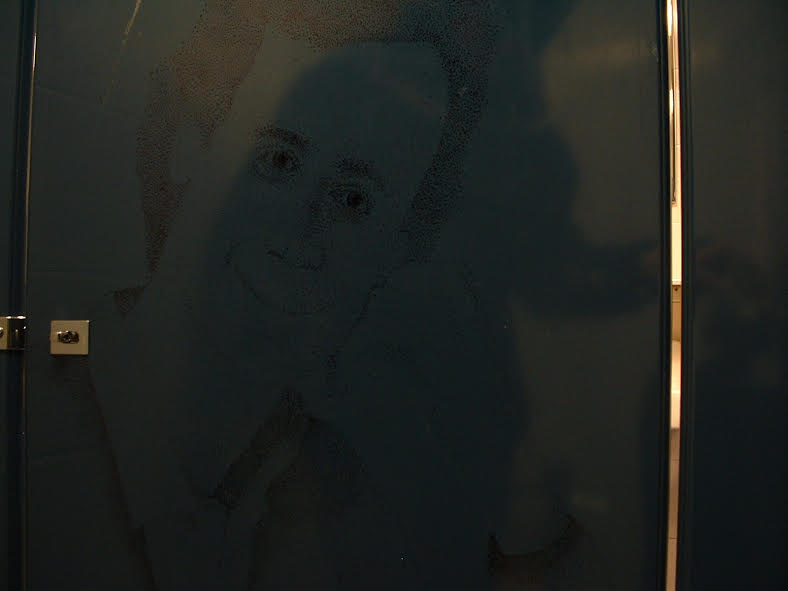
If you happened to sit down in the first stall of the fourth floor bathroom of the Folsom Library on the campus of Rensselaer Polytechnic Institute in 2006, you would find a portrait of Bob Saget staring directly at you – in pointillist style of course:

unnamed (30)

Why did someone spend hours of their own time on this? Because Bob Saget.

Another:

My all-time favorite: “I’d rather have a bottle in front of me than a frontal lobotomy.”

And one more:

My personal favourite from college (between the Theology and Ancient History departments):

Don’t worry if you don’t know what eschatology is
It’s not the end of the world …

Censoring Charlie‘s Cover On Live TV

This is appalling:

 captions:

On Sky News, former Charlie Hebdo journalist Caroline Fourest was trying to explain how “crazy” it is that certain journalism mills in the United Kingdom won’t show the cover of the latest edition of the magazine. Well, Sky News provided a stronger explanation than Fourest ever could have.

Allahpundit chews out Sky News:

Why humiliate a grieving person this way? She has the balls to stand by her work in the name of free speech, at great personal risk to herself, and this is how she’s treated? Literally pissing on Stephane Charbonnier’s grave would be less hurtful, I think, than taking up his killers’ cause this way.

Allahpundit also points to Buzzfeed’s list of Western outlets that did and didn’t show the cover. And Barbie Latza Nadeau looks at which publications ran the cover around the world.

The Plan To Make Community College Free, Ctd

Popping up in the in-tray, Freddie comments on the discussion thread:

I note with a little frustration that one of your readers has endorsed the “trade school is the answer to our economic problems” meme. I don’t blame that particular reader, as it’s a very common claim. But as I noted in a piece last year, there’s essentially no credible evidence to suggest that we need to send more people to trade school. The ranks of the jobs with the highest unemployment are riddled with skilled trades, which is not surprising in the post-financial crisis world; skilled trades are massively exposed to the boom-and-bust cycle of the housing market. I’m not saying that I’m sure that more people going to trade school is a terrible idea, and like the reader I am an opponent of the “college for everyone” attitude. But it’s an idea that gets asserted as a solution a lot with a remarkable lack of compelling evidence for it.

While I agree that more education is not the solution, I differ from your reader (with his complaints of Marxist academics) in that I believe the problems with our labor market stem from very deliberate policy choices to favor the desires of a tiny percentage of the vastly rich over the needs of the great mass of working people.

Several more readers sound off at length:

Your readers who think Obama’s community college plan is a good idea would do well to read the September 2013 article from the Washington Post titled “Is Government Aid Actually Making College More Expensive?

To anyone who has studied economics, the thought immediately comes to mind. The rapid increase in tuition costs happened right when the government started spending extraordinary sums to subsidize college tuition. It seems very unlikely this is a coincidence. As with anything, there is a market price for college, and giving out money to people to be spent specifically on college allows colleges to charge more than the market price. The Post article reviews all the research on this topic. From the last paragraph of the article: “All but one study I’ve seen found some evidence of a price response to increases in aid, for some section of the higher ed market.”

Here’s a likely outcome if government starts paying for two-year community college: four-year universities will raise their prices. The reason for this is because their customers were always willing to spend a certain total amount of money on an education. If government foots the bill for the first two years, the university providing the second two years can raise its prices and find its customers still willing to attend, since they got the first two years for free.

Another illustrates a point made by Shackford that, in the reader’s words, “Obama’s proposal will incentivize community colleges to dilute their curriculum to ensure they get a steady stream of funding from the federal government”:

The proposal requires student maintain a C- average.  Instructors and teachers will be pressured to grant C’s even when students don’t deserve it or will back students who appeal their low grades. This already occurs to some extent.  The Mrs. is an adjunct at a local community college for a course program that requires students keep a C- in all classes to maintain enrollment.  Her students who have prior military service get their tuition paid by the federal government.  She has some students who are barely literate.  When they inevitably fail, they often dispute the grade and the administration always backs the student for the simple fact they want the money.

The average incoming college freshman reads at the 7th grade level because these same incentives promote grade inflation at the high school level.  School simply do not flunk and expel students because the number of students enrolled determines the funding they receive from the state and federal government.

And regarding your reader’s comparison of another to Judge Smails, a more apt movie analogy may be Ben Kingsley’s character in Searching for Bobby Fischer

Are we actually helping young adults, or society at large, just because we give students a certificate that is meaningless?  Like Josh’s Grand Master certificate in the film, a community college degree will mean nothing.

Another provides “a view from a Community College Professor”:

Many of the statements by readers reflect a lack of specific knowledge regarding community colleges, their role and their student populations.  They seem to equate some idyllic image of Harvard+Animal House with all of college; a dream world of fuzzy ideas, tweed wearing professors and Voltaire.

1. In NJ, all of our courses are legally transferable to public (and most private) schools in NJ.  The Lampitt Bill has streamlined a lot of our coursework.  Gone are the electives – there’s no time for leftist indoctrination of academians.  Also, community college is overwhelmingly taught by part-time adjuncts.  They are not researchers, writers on sabbatical and certainly not Marxist indoctrinators (BTW, Marxism-Leninism-Stalinism failed, so no one indoctrinates that philosophy anymore, or ever – please take a history course at your local community college to find out how and why).

If you took a factory and transferred the model to education you would have a modern community college.  I really wish community college was that idyllic dream of high-minded liberalness the political right accuses us of but, alas, we go to work, teach our classes overfull classes, prep more classes, deal with student problems and concerns, and then grade, edit, and comment on papers and tests – all for a pay significantly less than the level of required degree would indicate. Ph.Ds are held by less than 1% of Americans yet professors earn decidedly middle American wages. I could triple my income if I went into international corporate consulting, for example.

2.  We have over 100 certificate programs, from cooking to nursing.  Our dental program is 35 years old  – and gives free cleanings to kids in the community.  The great lie of education is that the for-profit schools do this training while college does some soft liberal arts reading and thinking stuff.  In fact, we offer more programs than the three for-profit schools in our neighborhood and do it at a tenth of the cost.  (Our advertising budget though can’t compete.)  Air conditioner repair – we got it.  Computer animation – got it.  Want to build apps for a startup? We got all the hands-on coursework you need. Community colleges have filled this space for a long time – but the stigma that they are the “13th grade” looms large.  More money would mean more services, which would mean more programs, certificates and training.

3.  70% of our students are remedial.  This means they are not prepared for college-level reading, writing or math.  Reading I is a third grade reading level – and those classes are full.  So while we should spend more money on pre-K education, there is still a massive number of people failed by K-12 education.  With high-stakes testing, No Child Left Behind, and teacher pay tied to grades, these numbers have gone up.  There is less incentive to educate and more incentive to pass high-cost standardized tests.

4. Community College students are, in our case, poorer, less educated, and much more racially diverse than the surrounding schools.  Those with means and drive head off to the private schools of Philadelphia, Baltimore and Washington.  Or they go to the public schools of Northern Jersey and Pennsylvania. We also take in a far larger number of immigrants, ESL students, first-time college families, working adults, mentally and physically handicapped, and military veterans than the surrounding colleges.  All of these students require expensive services and programs.   The idea is that we educate a large number of people who have limited choices in their education – and who are expensive to educate.

Which brings us to the most important part of the President Obama’s proposal: forcing states to pay. Our school was set up in the 1960s, and the charter indicated that for tuition, the state and the county would each contribute an equal share to operating costs (33% each).  In 2014, our budget received 12% from the county and 17% from the state meaning tuition made up 71% of our operating budget.  All the pledges of “no new taxes” is being paid for by higher tuition, fees and less services.  This budget situation is simply breaking the back of the school and the students.  We are not a school that can charge $50K for tuition nor can we pre-screen our students.  If the state just paid the amount it guaranteed in our charter, we could educate students pretty easily and cheaply.  So if the president can force states to pay their actual fair share (or more), that would be a budgetary godsend for us.

Obama’s State-Level Losses

GOP-state-surge

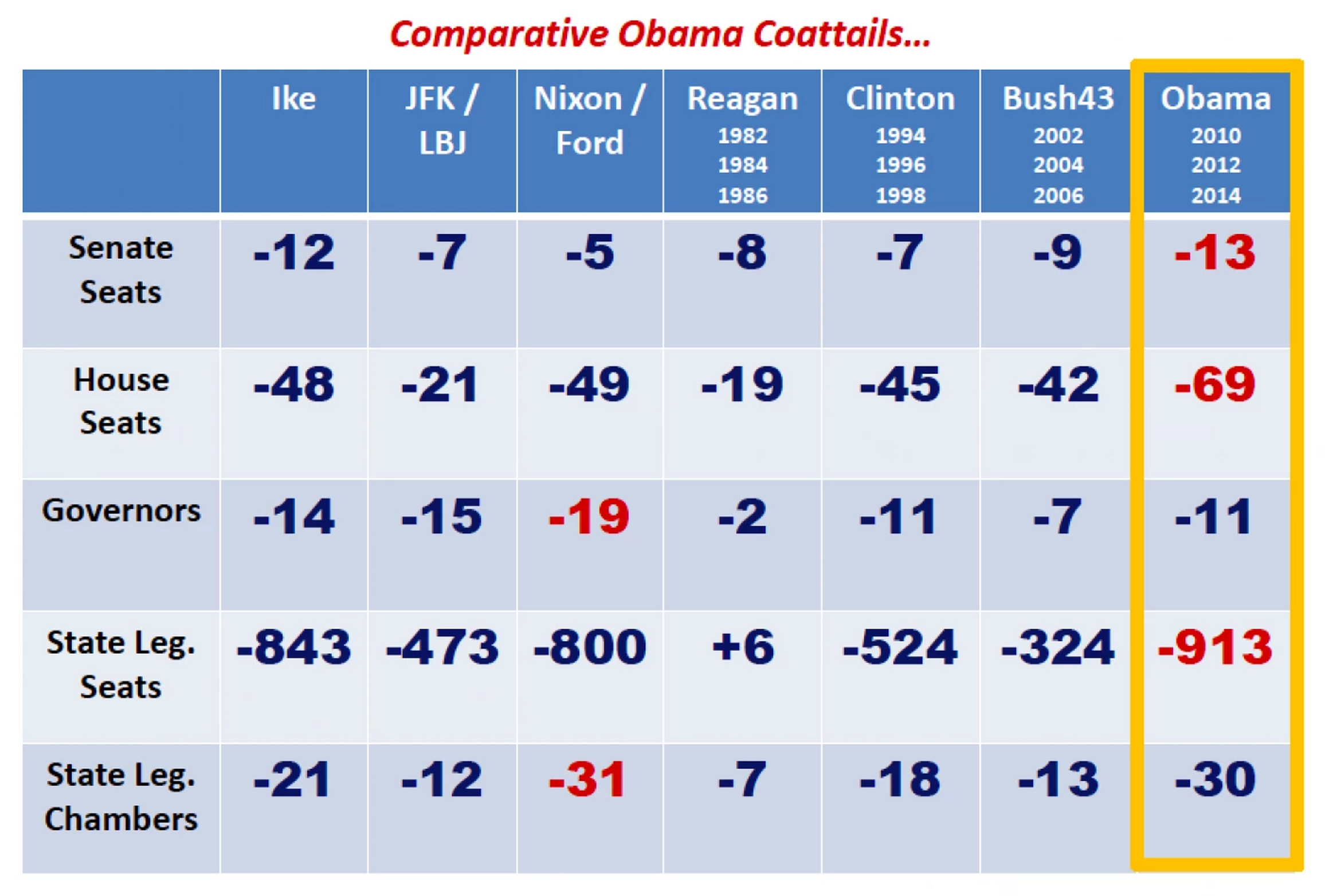
Based on Sabato’s calculations, Cilizza charts the Obama effect on Dems in state legislatures:

Now, there are more 7,000 state legislative seats in the country, according to the National Conference of State Legislatures, which makes that 913 number slightly less eye popping. Still, the Democratic losses between 2010 and 2014 amount to 12 percent of all state legislative seats nationwide. As NCSL notes, Republicans now control over 4,100 seats  — their highest number since 1920. After taking over 11 legislative chambers from Democrats in 2014, Republicans now control 30 state legislatures completely — and have full control of state government (state legislature and governor) in 23 states.

He points out how it also gives the national GOP an advantage in prospective candidates:

State legislatures are the minor leagues. Most of the politicians — Barack Obama included — who have gone on to great things, politically speaking, honed their craft in the state legislature of their home (or adopted home) state.

Why Do Women Get Weepier?

Melissa Dahl, who admits she cries “embarrassingly easily,” investigates the question. One reason? Women seem to have shallower tear ducts:

“There are several studies over the years that have shown that men have larger tear ducts in their eyes, so that it is less likely for the tears to well up to the point of spilling over the eyelid onto the cheek,” said Dr. Geoffrey Goodfellow, an associate professor at the Illinois College of Optometry in Chicago. There’s also this paper from the 1960s, in which a physician from the University of Michigan reports how he used male and female skulls to measure the length and depth of tear ducts, finding that women’s were shorter and shallower.

Hormones may also play a role:

[Researcher Ad] Vingerhoets believes [testosterone] inhibits crying. Male prostate cancer patients, for example, tend to become more emotional when treated with medications that lower their testosterone levels.

But this isn’t just about testosterone: Back in the 1980s, biochemist William H. Frey and his team analyzed the chemical makeup of emotional tears and compared them to tears caused by irritants. They found, among other things, that emotional tears tend to contain prolactin, a hormone produced by the pituitary gland that is associated with emotion. … Lauren Bylsma, an associate professor in psychiatry at the University of Pittsburgh who has studied crying with Vingerhoets, said that this difference in prolactin levels “may help explain these differences in crying, as well as other differences in emotional expression and depression vulnerability between men and women.”

Speaking of such differences, Walt Hickey compares men and women when it comes to the movies that make them cry.

Reasons To Keep Oil Prices High, Ctd

Screen Shot 2015-01-15 at 2.20.51 AM

A reader addresses Chris Edwards via our post:

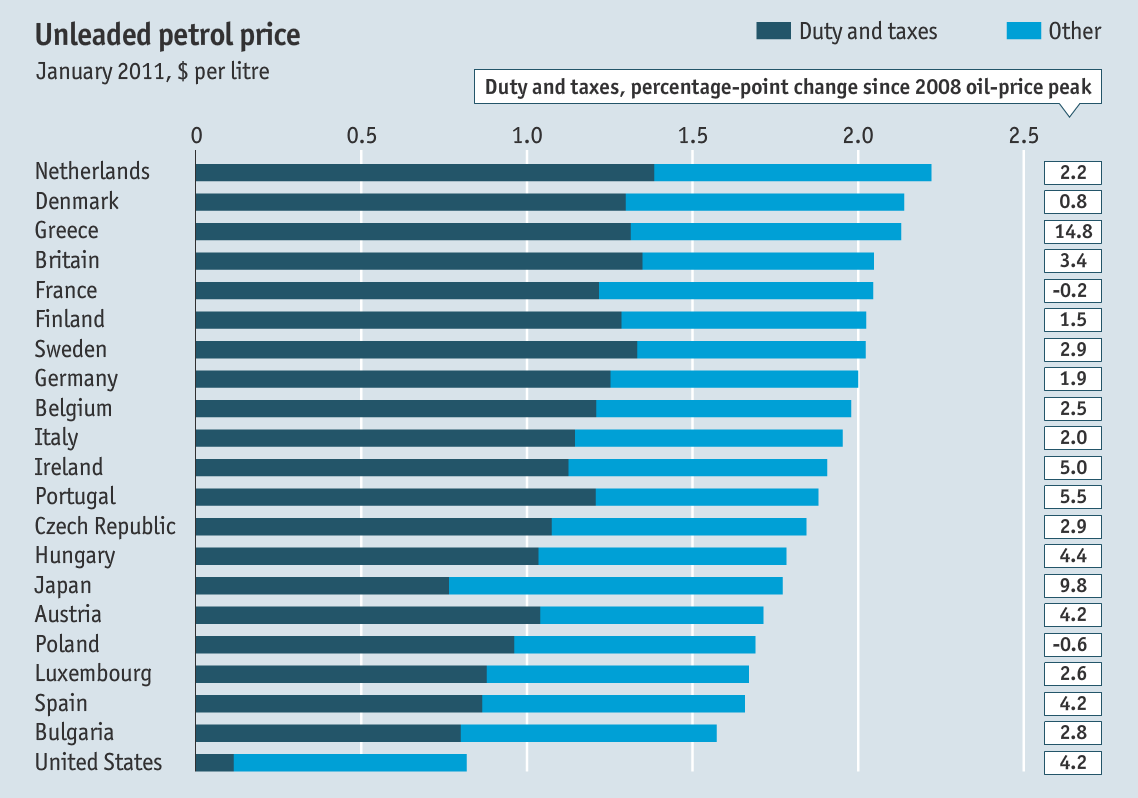
Yes, Mr. Edwards, the percentage increases in the gas tax between 1984 and 1992, seems rather large, but this a rather lazy argument and ignores almost all of the developed world. Take a look at this article in The Economist from 2011. My coworker – back when I used to work at the Energy Information Administration – used to have [the above] graph contained therein posted outside his door for a good reason. Developed countries’ gas taxes are almost all at least a $1 higher than ours!

Another also pounces on Edwards:

You know what else happened between 1982 and today? A wee bit of inflation. The 18.4¢ today is equal to just 7.5¢ when adjusted for inflation. That’s a slightly less meteoric rise. But what’s perhaps even more disingenuous – and this is from someone who apparently has a masters in economics – is where Edwards starts his chart and analysis.

There’s really no good reason for him to start that chart in 1982 that I can find. If you extend it backwards, the gas tax was unchanged at 4¢ from 1959 to 1982. The 4¢ gas tax in 1959, had it been adjusted for inflation, would stand at 32.5¢ today (about what the 18.4¢ 1993 figure would buy today if adjusted). In other words, thee gas tax that built the Interstate Highway system 50 years ago was nearly double what it is today. Of course, we now have to maintain that system, but no longer have the tax base to do so. The 1993 hike merely brought it up to where it had been originally, but it has slipped by nearly half that value in the past 20+ years.

Unlike most other taxes that are per dollar, gas taxes are per gallon (which makes some sense due to the volatility of gas prices), but unlike those taxes, they don’t rise with inflation. They should, but good luck getting that through Congress. So any time inflation ticks up, it’s a backdoor tax cut for drivers, with the only side effects being the condition of the roads they drive upon.