The Heavy Cost Of Iranian Sanctions

Extends to the US:

new study published this week by the National Iranian American Council argues that the various trade sanctions the United States has maintained on Iran for more than a decade actually hurts the American economy. The NIAC, a U.S.-based organization that pushes for a peaceful resolution of differences between Washington and Tehran, calculated that between 1995 and 2012, the United States has forfeited between $135 billion and $175 billion in export revenue as a consequence of not doing business with the Islamic Republic. …

In the United States alone, write researcher Jonathan Leslie, NIAC director of research Reza Marashi, and NIAC president Trita Parsi, “this lost export revenue translates into between 51,043 and 66,436 job opportunities lost per year on average. In 2008 alone, as many as 214,657 to 279,389 job opportunities were relinquished.”

Natasha Schmidt talks with Trita Parsi about the study. Schmidt asserts that  lifting sanctions will leave the international community “with very little leverage when dealing with Iran on a range of issues, from the nuclear program to human rights.” Parsi disputes this:

On the contrary, the West has very little leverage precisely because there is so little interaction. If the U.S. had not eliminated its trade with Iran in 1995 and if in 2009 there actually was a significant American presence in Iran, do you think the Iranian government would have had a harder or easier time to cheat in the elections? Would the US have had more or less leverage? Part of the reason the US had so little leverage in 2009 is because it had nothing in Iran. No embassy, no diplomats, no companies—no Americans. That’s no guarantee that it would have used its leverage constructively, but it is very difficult to argue that America’s complete absence from Iran has given it more leverage.


Separate Rules For Sexual Assault

Kat Stoeffel explains why colleges have such a poor track record when it comes to handling rape cases:

Title IX requires administrators to exercise their power to remove sexual offenders from the environment – temporarily, permanently, until the accuser graduates — even if the accused wouldn’t be found guilty in a criminal court. That’s explicit: In a 2011 open letter, the Department of Education reminded colleges that these civil cases have a much lower burden of proof than criminal cases. Instead of proving “beyond a reasonable doubt” that they were raped, victims need only a “preponderance of evidence.” That’s taken to mean showing that it is more likely than not that sexual assault occurred.

Granted, suspension or expulsion is a far cry from being convicted of a felony, imprisoned, and branded a rapist for life. But some experts worry that sending accused rapists off on vague leaves of absence only enables them to land safely at other campuses and victimize more students.

Meanwhile, a reader writes:

I think this story fits in well with your “The Victims Of False Rape Accusations” thread. Here’s an excerpt:

I had a really brief relationship with this girl in college; her dorm room was next to mine, and after a few evenings staying up talking all night, we made out.

We spent a few nights in each others’ rooms, but we never had sex and neither of us pressured the other into doing anything we weren’t comfortable with. After a few nights, I broke things off in the cowardly way that 19-year-old guys do, and I just stopped returning her calls and texts. I can imagine she was hurt by this, I know that I would be hurt if someone broke up with me that way.

I haven’t spoken to this girl in nearly ten years. If she felt I did something wrong in our relationship, she never confronted me about it or brought the issue to the school.

But yesterday, as near as I can tell, she saw a newspaper article about me in the Baltimore Sun, and made a Facebook post attacking me and Cards Against Humanity:

Several people that I went to school with have posted a Baltimore Sun article from 2012 about the success of Cards Against Humanity, a popular indie party game created by a Goucher alum. That is my rapist.  Having his face pop up on my news feed unexpectedly in any context has the capacity to ruin my day. Seeing him praised in the press is giving me a panic attack. He should not be held as a good example of the excellence that Goucher grads have, can and will continue to achieve.

Her more recent posts have called for a boycott of my work, and she (or her friends) started a Twitter account to tweet at celebrities and organizations that I work with calling me a rapist.

The Dish’s extensive coverage of sexual assault on college campuses is here.

Kurdistan, Then And Now

https://twitter.com/Kurdistan_612/statuses/487633429048332288

Comparing the Iraqi Kurdistan of today with what she saw when she last visited in 2002, Robin Wright views the Kurdish push for independence as the culmination of a longstanding effort:

[E]ven in 2002 the Kurds were drifting into an autonomous statelet. The Kurdish language was making a comeback in government offices and workplaces, displacing Arabic. The school curriculum was Kurdicized; the younger generation barely identified with Iraq. Levies from smuggling and illicit trade produced revenues of a million dollars a day; even trucks exporting goods from Saddam-land to Turkey had to pay bribes to win passage. The Kurds had their own flag, too—a big sun emblazoned over red, white, and green stripes.

So, a dozen years later, it isn’t surprising that the Kurds now increasingly appear to be decoupling from Iraq, whether formally or de facto. When I returned, four months ago, this time on a direct flight from Istanbul to Sulaymaniyah, Kurdistan had evolved from the least developed part of Iraq to its most stable and prosperous region. I stayed at a new five-star hotel and attended a conference at the new American University of Sulaymaniyah, which brought together panellists from around the world. The Kurds also have a new pipeline for transporting oil to Turkey, which could result in exports of up to four hundred thousand barrels a year, with an estimated forty-five billion barrels of crude in reserve.

Luke Harding also observes how oil has transformed Kurdistan’s fortunes over the past decade. All is not rosy, however:

Some worry that this oil-fuelled boom is pushing Kurdistan in the wrong direction.

Kamaran Subhan, a writer based in Sulaimaniyah, wonders if it is becoming not Norway but a rentier Gulf state. A friendly Bangladeshi waiter – there were no Bangladeshis here in 2003 – brings my coffee. “We are becoming lazy,” he says. Subhan worries that culture in Kurdistan has scarcely improved, despite the consumer splurge visible in the shiny new Land Cruisers on the roads.

The town still has only one art gallery, founded in the 1990s, with a mulberry tree in the courtyard and works by Kurdish artists hanging in a bright upstairs floor. “The government has little interest in art,” owner Dilshad Bahadin says. Nearby is a small cafe where Kurdish men discuss ideas and play backgammon. Subhan’s books enjoy a print run of 500-1,000 copies, he adds – not much in a country, or near-country, of 4.5 million people.

Meanwhile, Kurdistan’s two tribal families, the Barzanis and the Talibanis, continue to dominate politics – as well as the economy and employment. The Barzanis run Irbil, while the Patriotic Union of Kurdistan (PUK), headed by Iraq’s former president Jalal Talibani, controls Sulaimaniyah. Critics accuse both of corruption, nepotism and patronage politics, keeping thousands of party workers on the public payroll. In 2007, a breakaway faction of the PUK formed a new, pro-transparency party, the Change Movement or Gorran.

Previous Dish on the prospect of an independent Kurdistan here.

92 Percent? 99 Percent?

Josh Barro has a useful piece drilling down on quite how effective Truvada is in preventing HIV-truvadainfection. It’s a dense statistical article and worth reading in full. The basic gist is that while a big study found zero HIV infections among those taking Truvada as prescribed, the sample size is too small to declare it 100 percent effective. So they use statistics to come up with the 99 percent figure. One reason to qualify it: there may have been other factors preventing HIV infection in those taking the pill regularly (like having fewer sex partners) than those who didn’t adhere closely to the regimen. If you add in those not taking the medication every day, but almost every day, you can get a statistic of 92 percent effectiveness.

Does this matter? Psychologically, there is a difference between a one percent chance and an eight percent chance of getting infected. But in reality: not so much. Anything well above 90 percent (and indeed, so far as we have actually measured, 100 percent) is a huge deal, especially since regular condom use only seems to lower the chance of HIV transmission by 70 percent. But it’s worth reminding ourselves of the statistical nuances here.

Russia Isn’t Winning Any Popularity Contests

Russia

It’s losing support around the globe:

In the United States, unfavorable views of Russia had jumped by 29 points in just one year. Similarly, in Europe, they climbed 20 points. Latin America, Asia and Africa had also seen their opinions of Russia grow more guarded, albeit by a far smaller margin.

In sum: more than two-thirds of people in the United States, Europe and the Middle East — all the regions most interested in what comes next — are pretty much anti-Russia. Any way you slice the data, Russia has few allies beyond China and a smattering of others that include Greece, Bangladesh and Vietnam.

The Other Jihadist Menace

On top of the fact that most of the schoolgirls kidnapped by Boko Haram in April are still missing, Erica Schwiegershausen reminds everyone that the Islamist militants are also still terrorizing northern Nigeria:

[V]iolence by the Boko Haram has continued to escalate: Human Rights Watch reported yesterday that the terrorist group has been responsible for at least 2,053 civilian deaths in the past six months — a dramatic increase from last year. Recently, Boko Haram fighters allegedly killed over 300 people in the northern Nigeria town of Gamboru Ngala, setting houses on fire and shooting residents who attempted to escape (possibly in response to security forces from the town, which were reportedly going after the kidnapping victims), and are believed to have abducted another 91 people (60 women and 31 boys) from the Nigerian village of Kummabza last month. In the video released over the weekend, the Boko Haram also claimed responsibility for two explosions at a fuel depot in Lagos last month, and The Wall Street Journal reported this morning that the group has killed 44 civilians in the past two days.

After relaying the grim prognosis from Western diplomats who believe the girls may never be rescued, at least not all at once, Colin Freeman addresses “the wider challenge for Nigeria of defeating Boko Haram itself”:

Neither the Nigerian government nor the vast majority of northern Nigerians want the kind of medieval caliphate that the group seeks to impose in return for laying down its arms. Meanwhile, the economic improvements that will drain Boko Harm of its millions-strong recruiting swamp of jobless young men will take decades, not years. So far, the only effective strategy has been to set up citizens self defence groups – known as civilian joint task forces– which have had some success in identifying and chasing known Boko Haram sympathisers from major cities. But even they have done little more than push the threat into the countryside, while critics say their rough brand of vigilante justice will sow the seeds of future problems.

Instead, many observers believe that the most likely solution appears to be an amnesty, which will tempt less committed commanders away with offers of jobs and freedom from prosecution. That might sound like soft terms for people who have killed so many of their own countrymen. But in Nigeria, it is not without precedent. Many believe the group is holding out for a repeat of the amnesty offered to Nigeria’s Delta insurgents, who caused mayhem in the oil-rich south until a deal in 2009.

Whence This Shrinking Labor Force?

residual

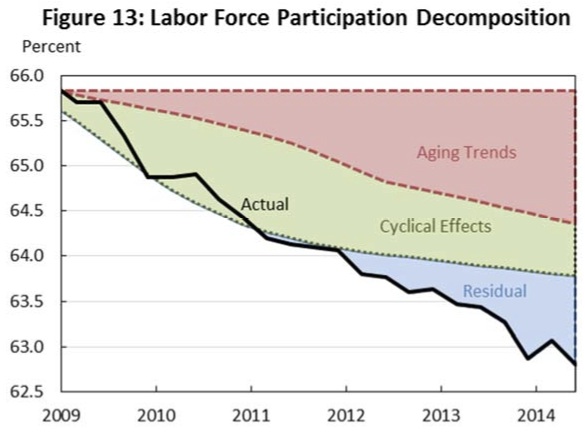
One of the mysteries of the recovery that feels like a recession is that since 2012, more Americans have been dropping out of the workforce than demographic and cyclical trends can account for. Zachary Goldfarb peruses a new report from the White House Council of Economic Advisers that seeks to explain why:

The first theory is that higher levels of long-term unemployment as a result of the Great Recession are causing more workers to exit and remain outside the labor force. A well-chronicled feature of the economic recovery has been the very large numbers of Americans unemployed for more than six months — 3.1 million in June. The report highlights other economic research that has shown that jobless Americans have lower odds of finding a job the longer they’re unemployed. And a big part of the reason is that employers discriminate against those with long spells of joblessness. …

The report’s second theory essentially boils down to the idea that the participation rate is lower because when the recession started, the labor market was already much weaker than was widely recognized.

Nearly every demographic group saw labor force participation declines ahead of the recession. It was especially problematic for men, who have been beaten down by declines in manufacturing, advances in workplace automation and expanding trade. The report does not specify how exactly the Great Recession would have led to an intensification in those trends. But it’s not hard to imagine that the severe economic contraction would have kicked out many workers, particularly men, who were just hanging on to the labor force before the economic decline even began. It’s startling to think about, but as a percentage of the population there are far fewer men working today than at any point in the past 50 years.

As the above chart illustrates, the CEA estimates that the “residual” accounts for about one-third of the decline. But as Ben Casselman remarks, this estimate itself carries a political charge:

Economists more or less agree on what the factors are behind the decline in the labor force. What they don’t agree on is how much of the decline to assign to each factor. The debate has huge policy implications. If the drop in participation is mostly about the weak economy, that means the labor market is much worse than the 6.1 percent unemployment rate would normally indicate; there are millions of Americans who don’t count as unemployed but would be working if there were more jobs available. That means the government should be doing more to help boost the economy, whether through monetary policy, tax cuts, government stimulus or other programs.

On the other hand, if the drop is mostly about aging and other long-term factors, then the recent decline in the unemployment rate accurately reflects a rapidly improving economy. Rather than trying to stimulate the economy, policymakers should be focused on making sure it doesn’t overheat and lead to faster inflation.

Borderline Politics On The Right

Contra Conn Carroll, Ross argues that Republicans in Congress need to do something about the border crisis:

It would be one thing if the G.O.P. genuinely didn’t think anything should be done about the current crisis: Then they could stand by their inaction on principle and blast the president for making extralegal moves. But the party’s official (and correct!) position is that we need more funding for immigration enforcement, both in the context of the current inflow and more generally, and that the Wilberforce Act’s guarantee of hearings should not be applied to most of today’s child migrants. Regardless of what the president does or doesn’t do, I just don’t see what Republicans lose from passing legislation that reflects both positions: If the president fails to execute it faithfully or if it ends up amended in some counterproductive way, they can attack the White House and the Democrats for that, without carrying the burden of looking like do-nothings who are weirdly demanded more of the kind of executive “creativity” they officially oppose.

But Ted Cruz is now pushing for any legislative response to the border crisis to include language ending the president’s Deferred Action for Childhood Arrivals program. Sargent comments on what this means for the prospects of Congressional action, as well as for the GOP’s public image:

Ted Cruz is essentially calling on Republicans to formalize in their legislative response to the crisis what is already their actual position on immigration in general. (House Republicans already voted in 2013 to end DACA.) And not only that, National Review reports that more and more conservatives are now giving voice to the Cruz stance, arguing that Republicans must not offer any legislative response to the crisis because Obama’s “amnesty” for the DREAMers proves he cannot be trusted to work with them even on the current border debacle.

In the short term, this Cruz gambit could make it tougher for John Boehner to get any border bill through the House, and increasingly reliant on Dems to do so. But beyond this, it’s a reminder that even if the crisis is very tough politics for Obama and Dems, it is also putting Republicans in a terrible position, dramatizing that they have only moved further to the right on immigration since their 2012 loss led to a big round of soul searching about how to broaden the party’s appeal beyond core constituencies.

Weigel theorizes as to why Cruz would throw such a bomb, knowing that a bill ending DACA has no real chance of passing Congress:

Well, Cruz believes in it, and as far as he’s concerned it focuses the blame for the current crisis on DACA. A worried House Republican aide (remember, lots of these people still sort of want the House to pass an immigration bill before the election) tells Joel Gerkhe that Cruz’s bill “could look like an overreach, particularly given how the mainstream media will distort it.” But Cruz has previously found that the media’s coverage of his effort bounces right off of Republican voters. He has been able to spin the 2013 Obamacare funding fight not as a tragic own goal on the GOP, but as the very reason Obamacare riled the 2014 electorate. It’ll be dead easy to tell Texas (and Iowa) crowds that he wanted to kill the border crisis at the root, but mushy Republicans failed to stand with him.

Allahpundit, in character, is disappointed that Cruz only wants to end DACA going forward, rather than repeal it entirely and re-outlaw the immigrants who have already benefited from the program. He sees that as a political choice, too:

If you already qualify for amnesty under DACA, you get to keep your amnesty. This is all about ending eligibility for future illegals, not taking it away from people who already have it. That makes sense in light of what I said above. Cruz wants to show that he’s tougher on illegal immigration than his GOP rivals but not so tough that he’s a punching bag for “YOU HATE CHILDREN!” attacks from the left. He’s willing to let children currently involved in the program keep their eligibility. Which makes this a miniature version of comprehensive immigration reform: So long as future waves of illegals are turned away, the ones who are already here enjoy legalization.

Previous Dish on the politics of the border crisis here and here.

Who Is Putting Gazan Lives At Risk?

PALESTINIAN-ISRAEL-CONFLICT

Philip Klein flags an UNRWA statement about rockets its relief workers found stored in a vacant Gaza school, offering it as proof of Hamas’s disregard for the lives of Gazans:

UNRWA said it had taken steps to have the weapons removed. As I noted on Wednesday, the fact that Palestinian terrorists store and fire rockets from schools, hospitals and residential areas increases the likelihood of civilian casualties.

But does that justify bombing the school? Max Fisher thinks not:

Israel has overwhelming military superiority in the conflict, and while that does not make Hamas rockets disappear or obviate their very real effects on Israeli civilians, Israel is strong enough to choose not to bomb a mosque and a center for the disabled in Gaza, as it did on July 12. It can choose not to bomb Gaza beaches frequented by civilians, as it did on Wednesday, killing four boys between the ages of 9 and 11. …

This is the one thing that both Hamas and Israel seem to share: a willingness to adopt military tactics that will put Palestinian civilians at direct risk and that contribute, however unintentionally, to the deaths of Palestinian civilians. Partisans in the Israel-Palestine conflict want to make that an argument over which “side” has greater moral culpability in the continued killings of Palestinian civilians. And there is validity to asking whether Hamas should so ensconce itself among civilians in a way that will invite attacks, just as there is validity to asking why Israel seems to show so little restraint in dropping bombs over Gaza neighborhoods. But even that argument over moral superiority ultimately treats those dying Palestinian families as pawns in the conflict, tokens to be counted for or against, their humanity and suffering so easily disregarded

Both sides are putting innocent Gazan lives at risk. And Israel cannot grotesquely pin the deaths of, say, those four boys, or countless others, on Hamas. Omar Baddar adds that the question of who is using “human shields” is also not as clear as Israel would like it to be:

While human rights organizations haven’t yet addressed “human shields” allegations in the ongoing round of Israel-Gaza violence, they did after the 2009 round when Israel killed at least 773 Palestinian civilians, compared to three Israeli civilian casualties (a ratio of 257:1), and used the same “human shields” argument to deflect responsibility for those deaths. When the dust settled, Amnesty International investigated the matter and concluded that there was “no evidence that [Palestinian] rockets were launched from residential houses or buildings while civilians were in these buildings.” …

By contrast, the same report found that “in several cases Israeli soldiers also used [Palestinian] civilians, including children, as ‘human shields’.” Going back in time just a little further to put this into context is important: when the Israeli Supreme Court ruled in 2005 that the Israeli military had to stop using Palestinian civilians as human shields, the Israeli “defense” establishment objected to the ruling. The appeal against the ruling failed, and the practice remains technically illegal, but Israel implicitly encourages it to continue by offering an “inadequate … slap on the wrist,” as Human Rights Watch put it, to Israeli soldiers caught using this reprehensible tactic.

Christa Case Bryant and Ahmed Aldabba examine why Gaza doesn’t have bomb shelters like Israel does:

If Gaza’s leadership were able to replicate [Israel’s] civilian infrastructure, would it be able to achieve similar protection in the face of Israel’s military superiority? “If there is a direct [Israeli] hit … the shelter will not stand,” says Lt. Col. Avi Bitzur (res.), former head of the Israeli military’s fortifications branch. “If [the munitions] will fall next to the shelter, it can stand against it.”

From an urban planning perspective, it would be feasible to build an extensive network of civilian shelters in Gaza despite the outdated infrastructure, says Bitzur, who now serves as deputy head of Homefront Defense Studies at Beit Berl College.  But financially it is unworkable, he says. “It’s too much expense, too much to do it now. You cannot give now a shelter for 1.5 million people,” he says, estimating that it would require billions of shekels and at least five to six years.

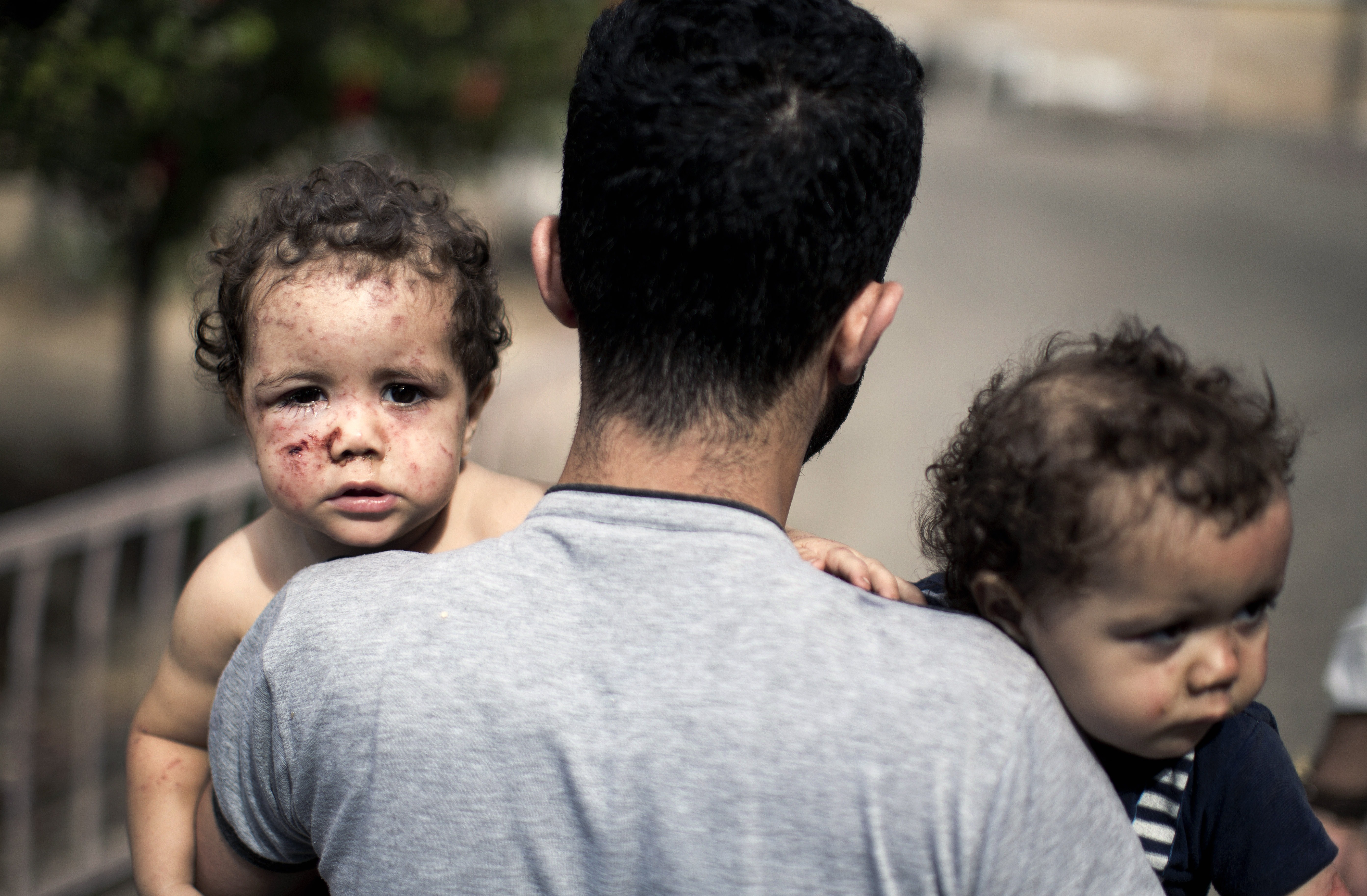
(Photo: A Palestinian man holds his daughters, Shada and Lama al-Ejla, who were injured in an Israeli tank attack, as he leaves al-Shifa hospital on July 18, 2014 in Gaza City. Israel warned it could broaden a Gaza ground assault aimed at smashing Hamas’s network of cross-border tunnels, as it stepped up attacks that have killed more than 260 Palestinians. By Mahmud Hams/AFP/Getty Images.)