A Crash Course In Perversity

Zadie Smith revisits J.G. Ballard’s controversial 1973 novel Crash, which, like the David Cronenberg movie it inspired, features characters who get off on car crashes. She writes that the “real shock of Crash is not that people have sex in or near cars, but that technology has entered into even our most intimate human relations”:

When Ballard called Crash “the first pornographic novel based on technology,” he referred not only to a certain kind of content but to pornography as an organizing principle, perhaps the purest example of humans “asking for the use.” In Crash, though, the distinction between humans and things has become too small to be meaningful. In effect things are using things. … Crash is an existential book about how everybody uses everything. How everything uses everybody. And yet it is not a hopeless vision:

The silence continued. Here and there a driver shifted behind his steering wheel, trapped uncomfortably in the hot sunlight, and I had the sudden impression that the world had stopped. The wounds on my knees and chest were beacons tuned to a series of beckoning transmitters, carrying the signals, unknown to myself, which would unlock this immense stasis and free these drivers for the real destinations set for their vehicles, the paradises of the electric highway.

In Ballard’s work there is always this mix of futuristic dread and excitement, a sweet spot where dystopia and utopia converge. For we cannot say we haven’t got precisely what we dreamed of, what we always wanted, so badly. The dreams have arrived, all of them: instantaneous, global communication, virtual immersion, biotechnology. These were the dreams. And calm and curious, pointing out every new convergence, Ballard reminds us that dreams are often perverse.

Great Good Job, Kids!

Carlin Flora delves into the complicated world of praise studies, which investigate how children react to adult feedback. She cites a study published earlier this year that shows that “overpraise (That’s incredibly beautiful! versus That’s nice!) can be harmful for children with low-esteem, but be helpful for those with high self-esteem”:

First, the study confirmed the researchers’ hypothesis that parents would be more likely to overpraise children with low self-esteem than those with high self-esteem. …

[T]hey had children between the ages of eight and 12, all previously rated for self-esteem, visit an art museum. The children were asked to paint pictures, which were then critiqued by a supposed ‘professional painter’. As a final step, they were asked whether they wanted to attempt a second, more difficult drawing exercise or a relatively easy one. All children receiving inflated praise viewed that praise as sincere, regardless of their level of self-esteem. Yet as predicted, children with low self-esteem who received inflated praise were less likely to accept the difficult challenge than their counterparts who received non-inflated praise. On the other hand, children with high self-esteem who received inflated praise were more likely to choose the challenging task than their counterparts who received non-inflated praise.

It makes sense, since people with high self-esteem are generally self-promoting and seek out situations to demonstrate their abilities, while those with low self-esteem are afraid of failure and avoid situations that might reveal their worthlessness. The authors write: ‘Thus, inflated praise can cause children with low self-esteem to avoid crucial learning experiences – a process that may eventually undermine their learning and performance.’ Here’s the complicated flip-side, though: ‘Non-inflated praise may reduce fear of failure for children with low self-esteem and thus foster their challenge-seeking, but it might fail to provide sufficient impetus to seek challenges for children with high self-esteem.’

Cool Ad Watch

14617969851_fd4256b8dc_z

Scott Beale spots one in the backseat of his cab:

The Uber car we were riding in was equipped with Delta-branded USB ports attached to the top of the passenger seat, making it easy for riders to charge their USB powered devices. The ad campaign promotes the availability of USB ports on Delta’s long-haul international flights.

The World’s Largest Failed State

The answer isn’t what you’re thinking:

In June, Foreign Policy and the Fund for Peace published the annual Fragile States Index, which analyzed the social, economic, and political stability of countries across the globe. But the list may have left out one particularly unstable region: the ocean. According to former British Foreign Secretary David Miliband, co-chair of the Global Ocean Commission, the 65 percent of the ocean that lies beyond the territorial waters of nations should now be considered “a failed state.”

“Here, beyond the jurisdiction of any government, lie the high seas,” Miliband said in an email, “where governance and policing are effectively non-existent and anarchy rules the waves.” Echoing Miliband, Carl Safina, founding president of the Blue Ocean Institute (now called the Safina Center), an environmental advocacy organization, called the ocean “a pre-state apocalypse. It is like the Wild West in the Space Age.”

The report portrays an ecosystem in crisis.

Fish stocks are being rapidly depleted. Half of the world’s coral reefs have already died, victims of rising water temperatures and ocean acidity. And according to the report: “[U]p to 60% of ocean species could be extinct by 2050 if climate change is not urgently addressed.”

It is not that global standards purportedly meant to protect marine life do not exist. Rather, they are largely toothless. The United Nations Convention on the Law of the Sea (UNCLOS), which establishes generalized guidelines for the management of marine resources, lacks enforcement mechanisms. Even now, 20 years after the convention was established, the United States and several other countries have not yet ratified the treaty, which means they are not legally bound to its principles. …

In the absence of capacity or will to enforce legal standards, the ocean’s plunder has accelerated. Underage fish are being taken both in and out of season, catches are underreported, no-fish zones are violated, and quotas are routinely ignored. Indiscriminate fishing practices are laying waste to whole fish populations and even underwater ecosystems.

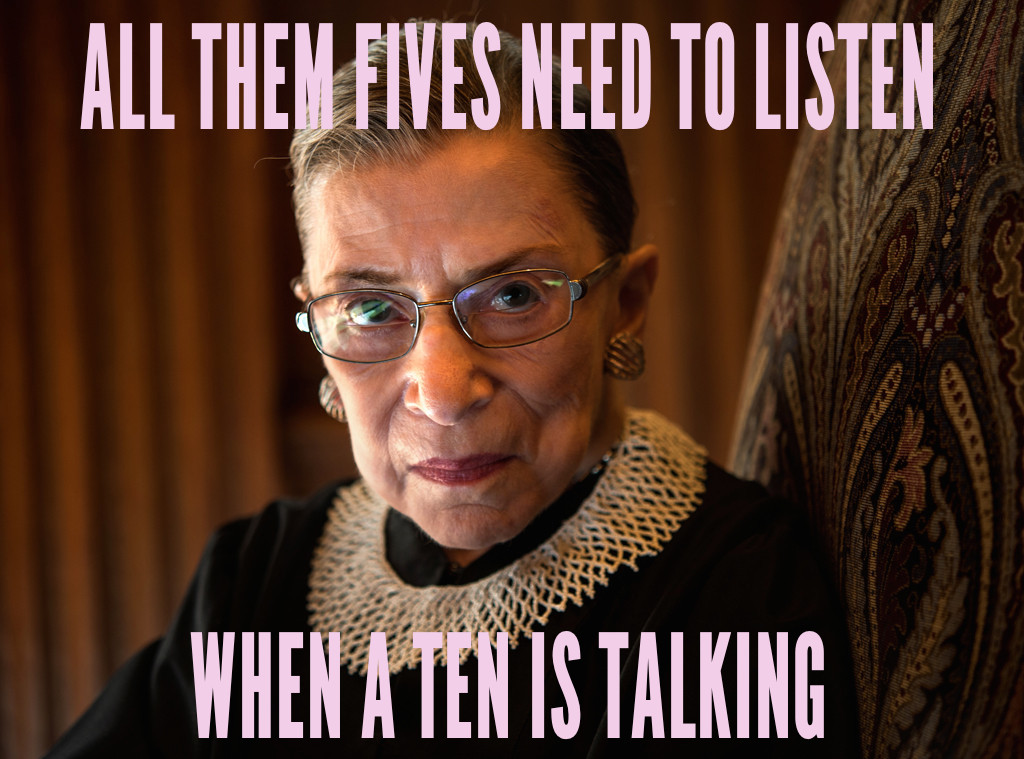
The Rise Of The Notorious R.B.G.

tumblr_n8f945hbWV1tgadxro1_1280

Rebecca Traister is thrilled by Ruth Bader Ginsberg’s rise to meme-hood:

Throughout history, we have acknowledged male strength, especially in its seniority, as serious and authoritative. Older women, on the other hand, have existed mostly as nanas, bubbes! Those sturdy, ambitious souls who also staked claims to public eminence were cast as problematic; tough ladies who no longer slide easily into Lycra are ball-busters, nut-crackers, and bitches.

Overriding these entrenched assumptions has been nearly impossible, even in the hundred years since women have had the vote, and in the 60 years [sic] since the feminist revolution of the ’70s. Recall that just six years ago, there was simply no popular script available to positively convey then-presidential candidate Hillary Clinton’s identity as a strong and ambitious politician. … It was in those same years that Justice Ginsburg was barbecuing the court’s decision to uphold the partial-birth abortion ban in Gonzales v. Carhart, furiously pointing out that the protection of reproductive rights is not about “some vague or generalized notion of privacy” but rather about “a woman’s autonomy to decide for herself her life’s course, and thus to enjoy equal citizenship stature.”

Back then, when Twitter was just taking off and Tumblr was being launched, and we still were relying on a largely centralized media to bring us our news, there was no one who set those words to music (though there should have been). Now, mercifully – finally – young people who are creating a new vocabulary, a library of visual and aural iconography that warmly appreciates female power in not just its nubile, but also its senior, its brainy, its furious, and its professionally brawny forms.

(Image via Shana Knizhnik’s Notorious R.B.G. tumblr)

The War Over The Core, Ctd

The country’s second-largest teachers’ union has withdrawn qualified its support for the Common Core:

After years of battling conservative groups opposed to Common Core, supporters of the testing standards discovered Friday morning that one of their most avid allies, the American Federation of Teachers, is bailing on them too. … [The AFT’s] decision to distance itself from its once-avid support for the Common Core marks a major – and, some say, even potentially lethal – blow to the standards, which the White House has emphasized as its key priority in education. The real danger is not that the Common Core will be thrown out entirely, but that state policy directors in charge of implementing the standards will be cowed by what they see as a groundswell of anger from teachers, said Michael Brickman, the national policy director at Fordham Institute, which supports the standards.

Update from a reader and a “lead author of the math standards” who objects to characterizing the AFT’s move as a “withdrawal of support”:

The Time article you cited was from last Friday; the union actually adopted its resolutions over the following weekend. Here is the actual result:

What does the resolution actually do? It says that the AFT will “continue to support the promise” of the common standards, “provided that a set of essential conditions, structures, and resources” is in place. Among other measures, the AFT will advocate that states create independent boards of teachers to monitor the implementation of the standards, and will support teachers’ having input into the “continuing development, implementation, evaluation, and as necessary, revision of the CCSS.”

One could say, then, that the AFT qualified its support. But one can’t accurately say that the union withdrew its support.

Fair point. The resolution in question reads, “[T]he AFT believes in the promise and potential of the Common Core State Standards (CCSS) but is deeply disappointed in the manner in which they have been implemented” – far from a blanket condemnation.

Meanwhile, on Sunday, the AFT passed another resolution that stopped just short of calling for Education Secretary Arne Duncan to resign:

[The resolution] calls for Obama to set up and implement an “improvement plan” for Duncan to hold him accountable for his job performance. It says the plan should, among other things, require Duncan to enact specific school funding equity recommendations in a report issued by a congressionally charged bipartisan Equity and Excellence Commission, and end the “test and punish” accountability systems of No Child Left Behind and Race to the Top. If an accountability plan is not put in place and Duncan does not “improve,” then he should resign, the AFT resolution says.

The country’s largest teachers’ union, the NEA, called for Duncan to resign earlier this month. Stephanie Simon considers the significance of these recent events:

[P]olicy analysts see this weekend’s moves as an escalation – a stark signal that union opposition has switched into high gear, potentially threatening an initiative that both conservatives and liberals have supported for years and that has become one of President Barack Obama’s key education priorities. Advocates of national standards have been working for more than two decades toward their goal “and now that it’s coming close to implementation, it’s all blowing up,” said David Menefee-Libey, a political scientist at Pomona College.

Meanwhile, Stephanie Grace sees former standards supporter Bobby Jindal’s reversal on the Common Core as emblematic of Republicans’ acceptance of a new political reality:

As anger [over the Common Core] grew, Jindal gradually ratcheted up his professed concern until he finally renounced his earlier position this spring. From there, he was off and running, trumpeting his defiance in speeches to GOP groups, declaring on Twitter that Louisiana wouldn’t be “bullied by fed govt.”, and issuing rhetorically loaded statements like this: “Let’s face it: centralized planning didn’t work in Russia, it’s not working with our health care system, and it won’t work in education.”

And after he failed to convince the Louisiana Legislature to follow his lead, Jindal went unilateral, announcing in mid-June that “we want out of Common Core,” and ordering his staff to invalidate the contract being used to pay the multi-state testing consortium called PARCC. The move set off chaos in schools, which suddenly didn’t know which tests they’d be using in the new year, and open warfare with Jindal’s longtime allies in reform, including the state’s top business leaders, a media-savvy education superintendent and a state education board that’s now mulling a lawsuit – all of whom accuse him of playing politics at students’ expense.

Despite the ostentatious flip-flop, Jindal’s underlying agenda hasn’t changed; he’s still fixated on positioning himself for national GOP prominence, just as he’s always been. The landscape, though, has shifted dramatically, and potential candidates eyeing the party’s 2016 presidential nomination – from Jindal to U.S. Sens. Ted Cruz to Marco Rubio – are recalibrating accordingly.

All of the Dish’s coverage of the Common Core is compiled here.

The Best Of The Dish Today

Metropolitan Police Passing Out Parade

So I broke down and today carefully took the Pew political typology quiz to determine which segment of the electorate I fit into. I can’t say I found the process that easy. To pick between two ideals, when you really fall somewhere in between both, doesn’t capture quite where you are. But maybe the cumulative weight of 23 answers balances that out. I don’t know. But here’s where I am, according to Pew:

Screen Shot 2014-07-14 at 1.36.19 PM

I’m a “Young” Outsider. Here’s how Pew describes them:

This relatively young, largely independent group holds a mix of conservative and liberal views. And while more lean toward the Republican Party than the Democratic Party, Young Outsiders generally express unfavorable opinions of both major parties. They are largely skeptical of activist government, as a substantial majority views government as wasteful and inefficient. Yet many diverge from the two conservative typology groups – Steadfast Conservatives and Business Conservatives – in their strong support for the environment and many liberal social policies.

I’m only going to endorse one aspect that seems completely apposite to my particular case: “relatively young.”

Today, I made the case that Greater Israel is a permanent thing, and that all diplomacy that rests on a two-state solution has become largely pointless. I also assume that this fact will perhaps never be conceded by an American president, let alone the American Congress. So our traditional kabuki dance on this question is fast becoming an eternal one. And the deaths – almost entirely Palestinian – will simply mount and mount.

If you read one summary of the legal arguments for and against the Boehner lawsuit against Obama, check out this one. If you still believe that Iraq is a country, then check out the latest rift between Shi’a and Kurds, even as the Sunni revolution knock on Baghdad’s door. A classic Dish thread on under-tipping has started with gusto; and we covered a rare but real phenomenon – people who die of grief. Plus: a window view from a drone operator Dishhead in Afghanistan.

The most popular post of the day was Understanding the Permanence Of Greater Israel, followed by The Revenge Doctrine, Ctd.

Many of today’s posts were updated with your emails – read them all here.  You can always leave your unfiltered comments at our Facebook page and @sullydish. 14 18 more readers became subscribers today. You can join them here – and get access to all the readons and Deep Dish, including our recently released Matthew Vines podcast – for a little as $1.99 month.

See you in the morning.

(Photo: Not a sketch from Monty Python. Police cadets who have completed their training take part in their ‘Passing Out Parade’ in the grounds of West Ham United Football Club on July 14, 2014 in London, England. By Oli Scarff/Getty Images)

Face Of The Day

BRITAIN-RELIGION-ANGLICAN-WOMEN

Reverend Kat Campion-Spall weeps as she celebrates outside the venue after members voted to approve the creation of female bishops at the Church of England General Synod in York, northern England, on July 14, 2014. The Church of England overcame bitter divisions on July 14 to vote in favour of allowing female bishops for the first time in its nearly 500-year history. The decision reverses a previous shock rejection in 2012 and comes after intensive diplomacy by Archbishop of Canterbury, Justin Welby. By Lindsey Parnaby/AFP/Getty Images.

Dissent Of The Day

A reader takes a stand:

There are a lot of great things about The Dish, and I was happy to be part of the initial subscription wave. But you just reminded me again why I refuse to re-subscribe. It is your persistent, deplorable habit of using terms like “Baby Boomer”, “Gen X”, and “Millennials”.  These terms are utter nonsense. They are preposterous, deeply-misleading sweeping generalizations, grotesque caricatures of reality. There is no such thing as a so-called “generation” except in the strictest biological/anthropological sense, within kinship lines. The use of such terms as social descriptors has been a disaster for our discourse. (One need only look at the wave of idiotic “generation” articles pouring out of Salon for confirmation of this.)

You say every issue is discussed on The Dish? This one evidently can’t be. I have never seen any discussion challenging the ludicrous concept of “generational traits”. That seems to be strictly off-limits.

These so-called “generations” you assert the existence of cannot be defined coherently.

Each “generation” is wildly diverse and contains tens of millions of individuals, saints, sinners, and everyone in between. Yet certain people seem to think – wrongly – that they “know all about” others because they know what year these people were born in!Moreover, each “generation” contains tens of millions of individuals with unique biographies. (And yes I do need to emphasize that.) These individuals have interacted with a whole host of other humans, very many of them of other so-called “generations”, in deeply complex patterns of reciprocity. These individuals have been shaped by the whole of the human biological and cultural inheritance. They did not grow up in some sort of generational isolation box. Please stop slapping labels on them, as if they were figures in a bad editorial cartoon.

As a former history teacher and (minor) historian, it almost makes me grimace when I see such terms used to explain the nature of human society. Nothing could be more misleading. It’s as if we asked a 10 year-old how we can explain human history and society and he replied, “Well, it all depends on what year you were born in. That’s what makes you what you are. People born in 1944 are WAY different than people born in 1946. People born in 1957 are WAY different than people born in 1965.” We’d smile at such childishness – and then watch as a lot of adults make exactly the same childish arguments. It’s time to put away this childish nonsense.

I guess since I was born in 1952 and am routinely lumped together with 76 million other Americans as a so-called “Baby Boomer” that I am more sensitive to this phenomenon. In Esquire magazine, Paul Begala called people like me “locusts”. (I’d like to see Begala call my 59-year-old wife, a woman who has borne inconceivable burdens in her life and shown heroism on many occasions, a locust to my face. He would regret it.) The Atlantic said that people like me “ruined everything”, thus casually negating the lives and careers of millions of dedicated individuals. (Let’s Dick Cheney, born in 1941, off the hook, too.)  Imagine such descriptions being made about a group other than the so-called “Baby Boomers”. What kind of speech would they be considered? (BTW, I’m sick and tired of insults, not by you, directed toward the so-called “Millennials”. A lot of my 20-something former students are my friends.)

I want to be judged for my own successes and failures. Please stop assuming you know me, Andrew: you don’t. Please stop assuming that I’m just like everyone else in some mythical, arbitrarily-defined group that supposedly encompasses everyone born between 1946 and 1964. I’m not. OK? When you’re ready to do that, I’ll be ready to come back.

The South-Of-The-Border Crisis

In a must-read counterpoint to the media narrative that the Central American children pouring across our border are fleeing gang violence, Saul Elbein argues that the problems in Guatemala are far more extensive. He paints a picture of a failed state offering a veneer of legitimacy to a corrupt, feudal “deep state” that maintains itself through violence and exploitation:

The only model of power that exists in Guatemala is … terroristic, extra-legal, and dominated by violence. So is it any surprise that after the war, on the streetswhere people grasped for the scraps that weft, where children grew up with no chance at wealth and less at respectpirate organizations like the MS-13 grew? What we’re seeing in Guatemala is not quite, in other words, a crime wave. It’s simply the way things have been there for a long time, pushed to the next level. If you are a civilian there, beneath the labelssoldier; gangster; policeman; army; cartelis but one underlying reality: men with guns who do what they want and take what they want. Your options are to buy your own security and gunmen; to join a gang yourself; or to leave.

And so many leave.

Meanwhile, Central American migrants are now being barred from Mexican cargo trains:

On Thursday, a freight train derailed in southern Mexico. It wasn’t just any train, though:

 It was La Bestia—”the Beast”—the infamous train many Central American immigrants ride through Mexico on their way to the United States. When the Beast went off the tracks this week, some 1,300 people who’d been riding on top were stranded in Oaxaca. After years of turning a blind eye to what’s happening on La Bestia, the Mexican government claims it now will try to keep migrants off the trains. On Friday, Mexican Interior Secretary Miguel Ángel Osorio Chong said in a radio interview that the time had come to bring order to the rails. “We can’t keep letting them put their lives in danger,” he said. “It’s our responsibility once in our territory. The Beast is for cargo, not passengers.”

In light of the situation, Keating advocates a major rethink of how we respond to chaos in Latin America, not to mention our own role in creating it:

I don’t claim to have an immediate fix for Central America’s ills, but surely there are more creative strategies out there than pouring money into a failing drug war and then walling ourselves off from the victims. Latin American issues tend to get shortchanged in the U.S. foreign policy conversation relative to more remote regions. I suspect this is part of the reason why Central America’s instability is only garnering attention now that the consequences of it have quite literally arrived at our doorstep.

On a broader level, the crisis should be a reminder that the U.S. is not immune from events to its immediate south. We’re an American country—in the regional sense of that word—and it’s time to start thinking like it.

(Photo: Central American migrants boarding the “La Bestia” train. By Pedro Ultreras.)