Will Washington Weed Get Whacked?

The state’s licensed cannabis stores are set to open next week, but “they won’t have much to sell,” Sullum says:

A slow state licensing process for marijuana producers, combined with the difficulty of obtaining local approval for grow operations, will result in shortages that are apt to be more severe than those seen in Colorado after recreational sales began there in January. The result could be prices almost twice as high as those charged by medical marijuana dispensaries and black-market dealers. … [P]ot store customers will face taxes that are projected to make retail prices about 60 percent higher than they would otherwise be. Add to those factors the costs of establishing businesses that comply with state and local regulations, and the upshot, as I explain in my recent Reason cover story about legalization in Washington, is that prices for legal pot will be substantially higher than current black-market prices.

Hobby Lobby: Your Thoughts, Ctd

A reader quotes me:

I hope at least some liberals grasp that being required to finance something you believe to be murder is a legitimate area of conscientious objection.

Alito’s opinion said that the alternative was to let the government pay for this coverage. What’s to stop Hobby Lobby from embracing your argument and saying “Hey wait a minute! What’s the difference between us paying for this directly through the health insurance that we had been forced to buy, and now having to pay for it indirectly through taxes?” Yes, Alito said that was an exception, but how soon will it be before that is overturned? We’re talking nuclear minefield!

No we’re not. The argument against Hobby Lobby would then be quite simple: you can no more object to your taxpayers’ money going to health insurance subsidies than pacifists can with their tax dollars going to the Pentagon (a point Alito explicitly made on page 47). And look: until the ACA, there was no government subsidy for contraception. Now there is – with a few religious exemptions. It’s had to see how the change over the last few years isn’t a big victory for liberals, with a small silver lining for religious conservatives. So take a deep breath and get some perspective. Another reader also finds my argument “specious”:

At what point does religious belief trump scientific fact and understanding?  The science, with about the same level of agreement as on climate change, says that none of these forms of contraception cause fertilized eggs to fail to implant or prevents implantation.  The belief that these types of contraception are also abortifacients is based on old hypotheses that have pretty much been disproved.  Those hypotheses though lit a fire under the pro-life movement – a movement not known for really following, understanding or believing in science – and they have stuck with it. These are real women’s lives, real women’s healthcare and bodies we are talking about, being put aside over a debunked hypothesis that has been taken as gospel.

That’s a perfectly valid point, since much of the abortifacient debate centers on the precise definition of pregnancy:

The plaintiffs in Hobby Lobby define conception as the point when the sperm and egg come together to make a zygote, which is why they object to these birth control methods—they can interfere after an egg has already been fertilized. The American Congress of Obstetricians and Gynecologists, on the other hand, defines conception as the moment when a fertilized egg implants in the uterus. The Supreme Court noted in its decision that federal regulations also define conception this way—“pregnancy encompasses the period of time from implantation to delivery,” one reads.

But not everyone agrees on this definition, and the court did not weigh in on the timing of conception or what kinds of birth control may or may not be abortifacients. “It is not for the Court to say that the religious beliefs of the plaintiffs are mistaken or unreasonable,” the decision reads.

If the federal regulations have the same definition, then we’re in murky territory. For my own part, I don’t think IUDs are abortifacients. In fact, the Dish has closely examined in the past whether Plan B could cause what some consider to be abortion: “Indeed, an overwhelming number of studies in the past decade back up the reader’s point that Plan B does not prevent implantation.” Aaron Caroll addresses similar concerns over the IUD:

Research does not support the idea that they prevent fertilized eggs to implant.

The journal Fertility and Sterility published a study in 1985 that followed three groups of women for 15 months. One group had an IUD, one group had their tubes tied, and one group was trying to get pregnant. They then measured hormone levels to see if fertilization occurred. It did so only in the group trying to get pregnant.

Another study found that a telltale sign of fertilization — a surge of the hormone human chorionic gonadotropin — occurred in only 1 percent of 100 cycles in women using IUDs. This would be consistent with the failure rate of IUDs in general. In other words, IUDs do not appear to work by aborting a fertilized egg.

So there is an extremely small area of gray. A reader adds:

The reason the FDA cannot say with 100% certainty that the drugs do not prevent implantation is there is no means of conducting an experiment to prove it. But logic says it is unlikely. My IUD would have to fail to prevent ovulation, at the same time it fails to prevent fertilization, within a window where there was sperm available. That’s statistically almost impossible. Also consider that fertilized eggs naturally fail to implant all the time, and many of those that do are incapable of cell replication and get, um, flushed out with the menstrual cycle.

Back to readers on the question of conscientious objection:

If you as a corporation want the tax break for providing insurance, provide the insurance. You don’t get to pick and choose what is in the package. If you as a corporation sincerely believe you can’t in conscious participate in providing insurance that includes medicine you consider to be morally wrong, then don’t. Don’t take the tax break for providing insurance. Pay the fine. Let your employees go onto the individual market and buy their own.

Sounds like a good idea in principle. But in practice, junking the whole thing because of an objection to four out of 20 contraception methods? Seems a little drastic to me. Another reader asks a “sincere question, not snark”:

If an employee of Hobby Lobby buys an IUD out of pocket or through a separate insurance policy she’s paid for herself, hasn’t Hobby Lobby actually paid for that anyway, since they’re the ones providing her with the money through her salary? Health insurance is just another form of compensation, so why can they put stipulations on that but not on her salary? No one’s suggesting that a company can make a potential employee sign a contract that stipulates they can’t use any part of their salary to fund what they consider abortion, but why isn’t that a logical conclusion of this decision?

Another notes:

I grant that this is a legitimate area of conscientious objection, but when Hobby Lobby’s 401(K) funds have invested in companies manufacturing some of these same devices, it seems more about exerting power than moral objections.  (Can you say hypocrisy?) Or perhaps it’s about sticking it to Obama. Here’s an article in Forbes – which isn’t a liberal source – discussing this issue.

I agree that there appears to be a whiff of political posturing here as well.

The End Of The Union Era?

density

In light of yesterday’s ruling in Harris v. Quinn, which limited the ability of public sector unions to collect dues from non-members, Philip Bump explores the shifting landscape of organized labor in America:

The decline in union membership is itself in part due to politics. In 2012, Michigan and Indiana passed “right to work” laws backed by conservative groups that allow workers to benefit from union-negotiated contracts without having to make any contribution to the union. That’s the issue at the heart of Harris. And there’s a reason groups opposed to unionization focus on it: Ending the practice would grievously harm public sector unions.

Public sector unions have been a bright spot in the labor movement. The graph [seen above] shows how membership has plummeted overall, but held steady in public sector employment. The dashed lines, incidentally, shows those employees covered under a union contract but who are not union members.

Jake Rosenfeld pushes back against the fears of the pro-labor left – and the hopes of anti-labor right- that “right-to-work” laws will deal a death blow to unions:

Despite all the heated rhetoric on both sides of the union divide, there isn’t much evidence that “right-to-work” laws actually reduce union representation. Consider the following:

  • In the United States, according to research by the economist William Moore, the vast majority of workers covered by collective bargaining contracts in “right-to-work” states pay union dues. Freeriding is rare. Many workers likely feel guilty for receiving benefits for free—and their union-contributing co-workers serve as constant reminders that they are benefitting from others’ labor.
  • In recent years, the success of unions in Las Vegas—most notably the Culinary Workers Local 226—has been a real bright spot for organized labor in the United States. Las Vegas, of course, is in Nevada, a “right-to-work” state. (Other “right-to-work” states have quite low unionization rates, but their rates were already low prior to passing “right-to-work” legislation.)
  • Across other industrialized nations, research finds that “closed-shop” provisions that compel the paying of union dues in unionized workplaces have little correlation with union strength.

And Andrew Grossman comments that the law at issue in Harris was part of an effort to bring home care workers into the Service Employees International Union, more for the union’s sake than for the workers’:

Though a recent phenomenon, the use of sham employment relationships to support mandatory union representation has spread rapidly across the nation.  In just the decade since SEIU waged a “massive campaign to pressure [] policymakers” in Los Angeles to authorize union bargaining for homecare workers, home-based care workers “have become the darlings of the labor movement” and “helped to reinvigorate organized labor.”  From around zero a decade ago, now several hundred thousand home workers are covered by collective-bargaining agreements.

This quick growth is the result of a concerted campaign by national unions, particularly SEIU, to boost sagging labor-union membership through the organization of individuals who provide home-based services to Medicaid recipients.

Toxic Butts

Of the cigarette variety:

By one estimate, around two-thirds of the 6 trillion cigarettes smoked worldwide every year end up being dropped, flicked or dumped into the environment – around 750,000 tonnes in total. … Used cigarette butts are not just pieces of non-biodegradable plastic. They also contain the carcinogens, nicotine and toxins found in all tobacco products. We have found that one cigarette butt soaked in a litre of water for 96 hours leaches out enough toxins to kill half of the fresh or salt water fish exposed to them.

And Thomas Novotny adds this shocking revelation: “We have also found that the tobacco industry has thoroughly distanced itself from any sense of responsibility.” The industry initially created filters for comfort but misled people into thinking they made the cigs less harmful:

Filters were originally designed to keep loose tobacco out of smokers’ mouths, not to protect their health. So they are really a marketing tool. They seem to reassure smokers that they are doing something to limit the health consequences of smoking and thus may discourage them from quitting. They also make smoking more palatable and make it easier for children to start. The ventilation provided by the filter may reduce the tar and nicotine yields of cigarettes as measured by a machine, but smokers compensate by changing their puffing behaviour and inhaling more deeply.

For these reasons, filters may be considered a health hazard. If their purpose is simply to market cigarettes and make it easier to get addicted, they should be banned.

Or maybe just better labeled? Update from a reader:

Discarded butts is such a pet peeve of mine. Many people who are otherwise more than decent enough not to throw any other sort of litter onto the ground will casually toss their cigarette butts anywhere without a second thought.

I’ve got a young daughter who’s just emerging from the “pick up anything you can find and put it in your mouth” phase, so putting her down on the ground to run around is like tossing her in a cigarette butt minefield in so many public places. In front of a restaurant, on almost any sidewalk, even in a public park, butts are laying around everywhere. She doesn’t know any better, but I sure as hell don’t want those filthy things in her hands or her mouth.

Total Recall, Ctd

The auto giant recalled another 8.4 million cars yesterday, raising the grand total for this year to 28 million vehicles, including 25 million in the US:

To put that in perspective, the entire auto industry recalled 22 million cars in the US last year.

Morrissey notes:

Recalls don’t come cheap, either. This recall will cost the automaker an additional $500 million, adding to the $700 million charge it took in the second quarter for the previous recalls. That’s a big loss for a defect known to GM long before the bailout, and known to the National Highway Transportation Safety Administration (NHTSA) during it. That’s why some investors are likely also saying, “Are you kidding me?”

Treasury divested itself of its GM stock in December, just coincidentally before all of the defects became important enough to address. The people who bought that stock had no idea that GM would need to pull 27 million vehicles off the road for critical repairs, but the question will be whether the NHTSA and Obama administration knew about it before dumping their stock. Had any individual investor done that, he’d be looking at a criminal probe from the SEC.

Noting that GM has now recalled more cars this year than it sold in the previous three, Alison Griswold wonders whether anyone cares:

At this point, it’s hard to know whether to be shocked, worried, or just unimpressed when GM initiates another tremendous recall—by now it feels like par for the course. And as I wrote in Slate earlier this month, consumers don’t seem to be paying much heed to the news: GM’s monthly sales in May rose to their highest level since August 2008.

Previous Dish on the recalls here and here.

And Now Kentucky

Does Anyone Give A Shit About Iraq?

Not the Iraqis:

The much-anticipated session of the country’s parliament started on Tuesday with enough members in attendance to ensure the nomination of a speaker would go ahead. However, the meeting quickly descended into farce, with Sunnis and Kurds using an unscheduled recess to withdraw their legislators, ensuring the session collapsed.

And not Americans:

So far, the growing crisis in Iraq has not drawn strong interest from the American public. As Sunni militants extend their control of large swaths of Iraq, 25% say they are paying very close attention to the growing violence and political instability in Iraq.

Young Americans – the ones we could send to die for a battle between Sunnis and Shi’a – have twice as much interest in the World Cup as in Iraq. And yet the hegemon staggers onward …

A Warrior’s Heart

In a review of Jonathan Shay’s Achilles in Vietnam: Combat Trauma and the Undoing of Character, Elizabeth Schambelan contemplates notions of wartime masculinity and friendship:

The broadest political implications of Achilles in Vietnam lie in Shay’s powerful critique of MikeynBrianwhat might be called martial masculinity. The entire book enacts this critique, but it is most explicit in Shay’s discussion of the intense bonds that often form between one soldier and another.

“Combat calls forth a passion of care among men who fight beside each other that is comparable to the earliest and most deeply felt family relationships,” he observes. When Patroclus dies, Achilles no longer wants to live. To Shay, the age-old question of the pair’s relationship status is irrelevant: “Achilles’s grief . . . would not have been greater had they been a sexual couple, nor less if they had not been.” The failure to recognize “love between men that is so deeply felt” greatly amplifies the survivor’s pain. “If military practice tells soldiers that their emotions of love and grief—which are inseparable from their humanity—do not matter,” Shay writes, “then the civilian society that has sent them to fight . . . should not be shocked by their ‘inhumanity’ when they try to return to civilian life.”

In a recent interview, Kash Alvaro—an army veteran who served in Afghanistan and who has been diagnosed with both PTSD and a traumatic brain injury—alludes to the lingering, interlinked stigmas around the disorder and around masculine expressions of “love and grief.”

We’ve been through things that—that’s never going to leave your mind, and it’s always going to be there. . . . And just to come back and have someone tell you, “Oh . . . you’re just acting out. You’re just looking for sympathy,” and those people just don’t understand. Not everybody—I mean, if you have a strong heart, that’s good. That’s good. But there’s people in the world that don’t. You know, you lose somebody, and it’ll break you. . . . And if—you know, if I make it another year, two years, three years, I’m fine with that. If I make it ’til next week, I’m fine with that, too.

The irony that makes this statement all the more painful to read is that, even as Alvaro reels off a checklist of PTSD’s symptoms and triggers (intrusive memories, “acting out,” death of a close friend, parasuicidal fatalism), he seems to have internalized the notion that his post-traumatic stress could have been prevented by a “strong heart,” i.e., by the inhuman lack of feeling to which Shay refers.

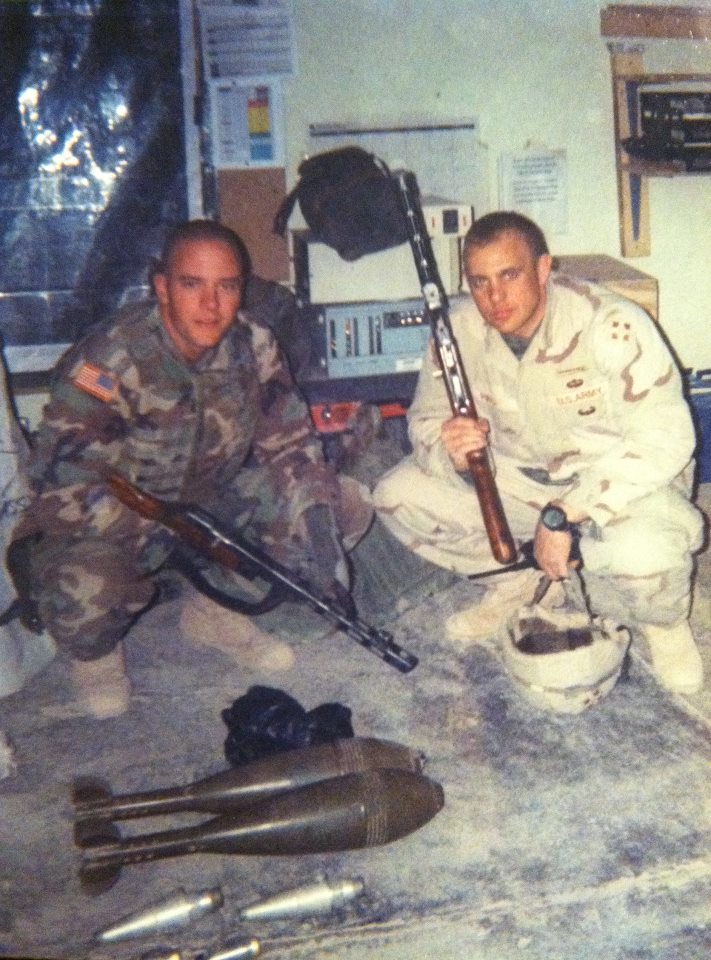
(Photo of two-time Iraq War veteran Mikey Piro and his comrade-in-arms, Brian. Mikey did a podcast with me last year about his post-war experience with PTSD. Follow his blogging at PTSD Survivor Daily. The Dish has covered much of those writings here.)