A Poem For Sunday

A reader writes, "Any comparison of pubs and churches brings to my mind 'The Little Vagabond' by William Blake":

Dear mother, dear mother, the church is cold,
But the ale-house is healthy and pleasant and warm;
Besides I can tell where I am used well,
Such usage in Heaven will never do well.

But if at the church they would give us some ale,
And a pleasant fire our souls to regale,
We'd sing and we'd pray all the live-long day,
Nor ever once wish from the church to stray.

Then the parson might preach, and drink, and sing,
And we'd be as happy as birds in the spring;
And modest Dame Lurch, who is always at church,
Would not have bandy children, nor fasting, nor birch.

And God, like a father rejoicing to see
His children as pleasant and happy as he,
Would have no more quarrel with the Devil or the barrel,
But kiss him, and give him both drink and apparel.

The Wounded Healer

Vaughan Bell measures the professional against the personal in the life of counter-culture psychiatrist R.D. Laing:

Madness, [Laing] argued, was a transformative experience, rich with personal meaning, that functions like an existential rite of passage. Delusions and hallucinations were the expression of the unmentionable, illustrating the emotional double-booking keeping of the family with an unignorable tear in the fabric between the conscious and unconscious mind.

When you talk to psychiatrists from Laing’s generation, they are rarely complimentary. The fact he fuelled the ‘anti-psychiatry’ movement (unwittingly, he claimed) is secondary to the fact that they chiefly remember his decline from a brilliant thinker to a tacky drunk.

If Assange Is A Savior…

Tim Challies questions the philosophy of Wikileaks:

[Assange] hopes for a perfect market and believes that we can achieve perfection if we just have perfect information. …

Naturally the Christian must disagree here. There can be no perfect market when markets are run by humans who are, at heart, entirely imperfect. There can be no market utopia this side of eternity. There can only be varying degrees of corruption. And what this means is that Assange’s entire philosophy is broken and impossible to achieve. …

We tend to imitate. It may not be long before we all expose one another, or we at least all live with the fear of exposure. It may not be long before there is more virtue in stealing information and making it public than there is in seeking to make good and wise decisions and asking others to trust that we’ve done what is best.

What We Talk About When We Talk About The Dead

Choire Sicha ruminates on the shape of obituaries:

I tend to think of obituaries as having a funnel-shape. They start off wide and broad, and usually pretty, with the big announcement—whether they start with the news announcement of a death or not or not, the fact of the obituary itself serves the purpose. Then we go circling inwards, like in a comic book version of a black hole. It's the twisting and turning where obituaries often get odd. One obituary style that's popular is the news obit, which circles down in distinct phases: Big Broad Sketch; Details Revisited; and then Further Minutia As My Editor Has, Bizarrely, Asked For Three More Inches. …

And so here we have the strange case of the Times obituary of Elizabeth Edwards. In times past, there would (wrongly) be little mention of the popular scandal of her marriage; still, now, to have the word "infidelity" appear in the first paragraph seems nearly shocking. That her husband's affair circles around and around as the obituary spirals down seems even odder—so much so that , in the end, this seems like a cruel and cold remembrance. Although, to be fair, perhaps that's the most accurate take?

Beyond Billboards

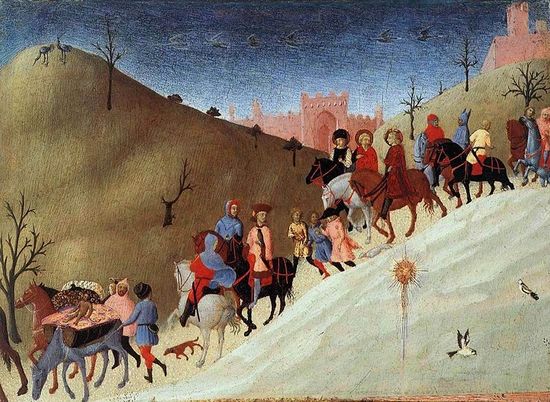
800px-Sassetta_004

In response to the Lincoln Tunnel atheist billboard (which reads “You Know It’s a Myth. This Season Celebrate Reason.”) Rami Shapiro responds:

The characters found in myths represent aspects of our own psyches. The Virgin Birth is neither a miracle nor a biological act of parthenogenesis (asexual reproduction). It is a story about how something new and potentially redemptive comes into the world. As a myth Christmas speaks to all humans. As science and history it makes no sense at all.

If we reclaimed the power of myth, and understood its role in our lives, we could reclaim the world’s religions as keepers of myth and train clergy to be guides to myth who can help us live out the mythic and imaginal dimensions of our lives through acts of compassion and contemplative spiritual practice.

The Christmas stories in the Bible – and they are multiple and contradictory – are obviously myths. They are obviously not to be taken literally. They are meant as signs to the deeper, profounder truth that Christians hold to: that the force behind all that exists actually intervened in the consciousness of humankind in the form of a man so saturated in godliness that merely being near him healed people of the weight of the world's sins. This is so enormous and radical an idea that it is not suprising that early Christian writers told stories to bring it more firmly to life. But they were stories, telling of a deeper more ineffable truth. If only contemporary Christians could let go of the literalism in pursuit of the far more extraordinary fact of the Incarnation.

(Painting: the journey of the Magi, by Sassetta.)

Do As I Do

Why are Mormons so good at keeping their children within the faith? Eve Tushnet explains:

Parents who show, by their words or their actions, that the tenets and practices of their faith are vague, unimportant, or only tenuously related to daily life, produce teenagers whose faith is vague, marginal, and unlikely to shape their actions and plans in any significant way … 

Mormons, by contrast, challenge their teenagers and require a lot of time, study, and leadership from them. Mormon parents rise at dawn to go over their church’s history and doctrine with their children. More than half of the Mormon youth in the study had given a presentation in church in the past six months. They frequently shared public testimony and felt that they were given some degree of decision-making power within their community. They shape their plans for the immediate future around strong cultural pressures toward mission trips and marriage. Whatever one thinks of the actual beliefs of the Church of Jesus Christ of Latter-day Saints, it seems obvious that both adult Mormons and the teens who follow them really, really believe.

In Hillary’s Dreams

Yoni Brenner mocks idealistic diplomacy by imagining other Wikileaks cables:

DATE: 2010-10-21

SOURCE: Embassy Tel Aviv

SUBJECT: TWO-STATE SOLUTION

1. (S/NF) Israeli Defense Minister Ehud Barak visited post to review new State Department-sponsored peace initiative. After carefully reviewing the one-page, six-hundred-word document, Barak removed his reading glasses and whispered, “By God, you’ve done it. You’ve actually done it.” He continued in a quavering voice, “And who could have guessed it was so simple!”

2. Within two hours, Barak was joined by Benjamin Netanyahu and Mahmoud Abbas, who both reacted with the same combination of relief and euphoria, and Abbas estimated chances of success at somewhere between “one hundred per cent and one million per cent.”

Why Not Bomb Iran?

Karim Sadjadpour's warning:

According to best estimates [a military strike] could delay Iran’s nuclear progress by 2-3 years, but it would likely entrench Tehran’s most radical elements for years, if not decades, to come. I think Iran’s hardliners—including Khamenei—would welcome a military strike; they would use it as a pretext to crush dissent and repair the country’s internal political divisions.

As one Iranian democracy activist once told me, there should be "less focus on the gun, and more focus on the bandit trying to obtain the gun." Bombing Iran will strengthen the bandit and only increase his desire to get the gun.