Eating In Red America

In this polarized country, even food is now political. Richmond Ramsey reflects on how the culture war is affecting eating habits in the South:

I’ve seen emerging back home a growing sense that food intake is not something that can be held up for moral analysis and judgment. Those who attempt to do so are typically seen as liberal snobs trying to impose their own preferences.

There’s no doubt that liberal foodies can be horrible snobs, and excruciatingly moralistic (to shop at the organic co-op in my uber-liberal neighborhood is to rub shoulders with people every bit as prissy and intolerant as the Church Lady). But at some point, it’s downright absurd for conservatives to ignore that food choices have moral implications. For me, going to my home county is an occasion for culinary culture shock, because middle-class people there simply do not have the same outlook on eating – especially for their children – as middle-class people do in my liberal city. Put plainly, people eat whatever they want, and lots of it, without giving it a second thought. More to my point here, they see the idea that one ought to care about such things as a sign of effete, high-handed liberalism.

It comes as news to my churchgoing conservative friends here in Coastal Liberal Land that making sure your kids limit sugary snacks and junk food is something only liberals care about. None of us are what you’d call foodies, and none of us go to the gym. It’s just understood that living responsibly, especially in a culture that celebrates the abolition of limits, requires a great deal of vigilance, especially when it comes to child-raising. That’s why though fasting is not really a part of American religious life today, there is still among my conservative friends real moral awareness of a religious duty to live a self-disciplined life, and to avoid the sin of gluttony. Why is the South – the most culturally conservative part of the country, in most respects, especially in Christian piety – so thoughtlessly permissive about eating?

But they are also in fact permissive about many things, while merely claiming piety: pre-marital sex, divorce, abortion, adultery, pornography, illegitimacy, gun crime, etc. The Christianism is as much a neurotic response to the collapse of measured restraint as it is an attempt to address it. 

Why Obama Won

Just do the math:

Of [the deal's] estimated $900 billion-plus cost over two years, roughly $120 billion covers the high-end tax cuts and the estate tax cut, $450 billion covers Mr. Obama’s wish list and $360 billion covers the tax cut extensions both parties favored.

The core reason to be angry at this deal is fury that the richest will keep their tax rates. I agree that, given the need for revenue, this is irresponsible. But, unlike some liberals, I'd prefer no income tax rises at all for anyone, and tackling the debt through ending tax breaks, reforming the code, and cutting entitlements and defense. I'd be open to a consumption tax if necessary (and I'm sure some revenue increase is necessary). But the core fact of the post-election deal is the following: Obama gave the GOP their symbol while grabbing a huge amount of substance – substance that Democrats should like and substance that will likely help him win re-election.

Bucking The Left And Right

Joyner sees the logic of Obama’s press conference yesterday:

[M]aking enemies of the extremists on both sides is a win.   It makes it easy for Obama to dodge the “socialist” and “most liberal ever” labels.  And it both belies the Republicans’ newfound zeal for fiscal responsibility and makes it harder to keep the Tea Party zealots on the reservation.

Does McConnell realize he just struck a huge blow at the FNC/Talk Radio demonization of Obama as an alien? Suddenly, this president is a deal-maker with Republicans. His ability to deal with conservatives was long a feather in his cap. Finally, he has the chance to prove it – and disprove the conspiracy theories, and crazy fabrications on the responsibility-free right. Win-win-win – if only the Dems could see it.

The End Of National Security Journalism As We Know It

Adam Serwer notes what’s at stake when Senator Dianne Feinstein calls for Julian Assange to be prosecuted under the Espionage Act of 1917:

If WikiLeaks is prosecuted under the Espionage Act as it currently exists, then no journalistic institution or entity is safe. The idea that anytime that a journalist obtains a document that has “information related to the national defense” that could be used “to the injury of the United States” they could be subject to prosecution would destroy national-security journalism as it currently exists. Also frightening is the reality that government officials looking to skew public debates one way or another regularly leak information to the press, so the government would really only be prosecuting people for publishing leaked information they didn’t want leaked.

I think there’s this idea that because the New York Times and the Washington Post are treasured journalistic institutions the government wouldn’t dare engage in the kind of coercion it has leveled so effectively against Assange, and that even if he were prosecuted under an archaic unconstitutional law like the Espionage Act, he’s a scary foreigner and there’s no way that Americans would be treated the same way. But it really wasn’t that long ago that Republicans like Bill Kristol and Rep. Peter King were talking about the NYT in the same kind of language they’re using to describe Assange.

Winning Back The Independents

Fi06fyezt0ek0gny2zbb9w

My view is that the McConnell-Biden deal – for that’s who negotiated it – is great for Obama. Why? Because it will greatly add to economic growth in the next two years, the sine qua non of survival in this economic climate; because, once the Democrats had failed to pass a budget before the election, this was the best Obama could possibly get; and because Obama – especially in his riveting press conference yesterday – took the angry and beleaguered position of doing the post-partisan best for the American people, rather than trying to score one against the GOP or for the Dems.

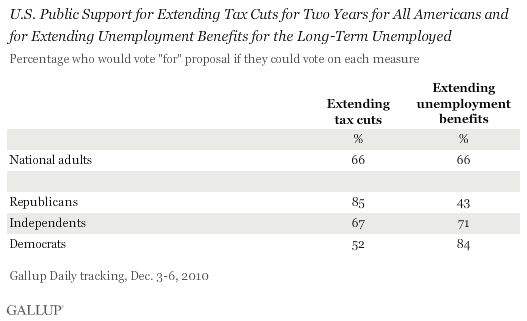
I know many Democrats voted for him to get revenge on Bush (I sure understand the sentiment) but many others voted for him to get past this partisan crap and get things done that would pragmatically ease America’s economic woes, tackle deep issues such as the debt and healthcare and end the wars responsibly. In my view, that‘s his core identity, and why he’s president. Taking on his base as he did yesterday will help him. Gallup’s early polling suggests I’m not crazy or so in the tank I should be dismissed as delusional:

By yielding on the tax cuts, Obama extracted Republican leaders’ support for extending unemployment benefits for the long-term unemployed — and large majorities of independents support both measures. Additionally, according to a post-election Gallup poll, by 49% to 24%, independents are more inclined to favor partisan compromise over principled standoffs in Congress. Thus, rather than get mired in a partisan squabble that could result in higher taxes for the middle class come January, Obama can present himself as the architect of a new era of compromise.

While Republicans generally don’t agree with extending unemployment benefits, they broadly support extending the tax cuts, and at least a slim majority of Democrats support both measures. In fact, the only groups not supporting both proposals are liberal Democrats and conservative Republicans. The more moderate members of both parties join independents in generally supporting the proposals. 

Bloomberg’s polling focuses on the unpopularity of tax cuts for upper-income Americans. What’s needed now, of course, is for Obama to pivot from this to using his State of the Union for a major push for long-term debt reduction in the next two years. He’s gotten all the pro-growth spending he needed to get re-elected, now he needs to cement his standing with Independents, centrist Democrats and Republicans, and make saving our fiscal future his overwhelmingly dominant theme of the next two years.

The rationale? He was elected to tackle the hard stuff, as pragmatically as possible. He has tackled the recession and health insurance; he has reshaped the war on terror; he now needs to revolutionize America’s long-term fiscal health along Bowles-Simpson lines. And Paul Krugman will just have to stomach it.

The Long Game: A Mirage?

Larison makes the case:

The most tiresome response to this deal I have seen is the claim that it somehow helps Obama with “the center” because the left is unhappy about it. It seems clear to me that he has put himself in the position of being identified with the interests of the wealthy and powerful yet again, which has been one of the administration’s problems for two years. Something like two-thirds of the public favored letting the top rate go up, and that includes the precious voters of “the center,” and Obama has now effectively taken the very unpopular side of this debate.

Too-clever-by-half interpretations of this hold that Obama is playing a cunning long-term game. However, it is never cunning to abandon a core commitment, disillusion one’s most active supporters, and cede an opponent everything he wants from a relative position of strength in the hopes that the opponent will later be easier to outmaneuver after he has become even stronger. “Centrist” and conservative pundits who have been urging Obama to capitulate on this issue are rather like Gollum urging Frodo on into Shelob’s lair. “No, really, this is the right way to go!” Obama’s defenders on this are reduced to saying that the lair could have been a lot worse. Provided that he isn’t eaten by the spider, all will be well. 

Cannabis On The Campaign Trail

MarijuanaChristopherFurlongGettyImages

GOP presidential hopeful Gary Johnson used marijuana to treat pain after breaking his back in a paragliding accident. Scott Morgan spies a political advantage:

Johnson's medical use creates a unique opportunity to bring personal experience into the discussion and powerfully expose the cruelty and ignorance of any opponent who dares to defend arresting sick people. This could play out any number of ways, but if I were Mitt Romney or Tim Pawlenty, I'd already be worrying about how to handle the situation. When it comes to medical marijuana, Gary Johnson will enter the debate with the American people on his side, and he has everything to gain by going on the offensive early and often.

The Economic Effect

Macroeconomic Advisers does the math on the compromise:

Based upon what is currently known of these three key [tax cut compromise] proposals, our preliminary analysis suggests that GDP growth in 2011 would be boosted by roughly ½ to ¾ percentage point. This is on top of the 3.7% growth of GDP anticipated for 2011 in our recently published forecast. Growth in 2012 could also be expected to be several tenths of a percentage point higher, with modest drag on growth in 2013, as the temporary provisions expire.

What Obama Should Do Next

Noah Millman's pitch:

To make a difference in budgetary terms, we’ve got to put new, broad-based taxes on the table. So here’s a proposal for the new year: make the payroll tax cut permanent in exchange for the establishment of a new consumption-based tax – the latter not to take effect until 2013. The next two years should feel like a sales-tax holiday, pulling consumption forward, which supposedly is what we need, and the payroll tax cut would put money into people’s pockets to spend during that same period. Of course, businesses would plan for an expected slowdown as a consequence of the tax hike to come in 2013 – but any massaging of the business cycle would have that problem (which is why some argue it can’t be done). But the budgetary consequences of delaying implementation of such a tax for two years would be negligible over the long term, while laying down the marker that new, broad-based taxes are possible – and that we need to levy at least some of them on consumption rather than wages or income – would be worth far more than anything President Obama gave up in this deal.