The Nuclear War That Wasn’t

It was a terrifyingly close call:

Liu Chenshan, the author of a series of articles that chronicle the five times China has faced a nuclear threat since 1949, wrote that the most serious threat came in 1969 at the height of a bitter border dispute between Moscow and Beijing that left more than one thousand people dead on both sides.

He said Soviet diplomats warned Washington of Moscow's plans "to wipe out the Chinese threat and get rid of this modern adventurer," with a nuclear strike, asking the US to remain neutral. But, he says, Washington told Moscow the United States would not stand idly by but launch its own nuclear attack against the Soviet Union if it attacked China, loosing nuclear missiles at 130 Soviet cities. The threat worked, he added, and made Moscow think twice, while forcing the two countries to regulate their border dispute at the negotiating table.

Just in case you were feeling complacent about North Korea.
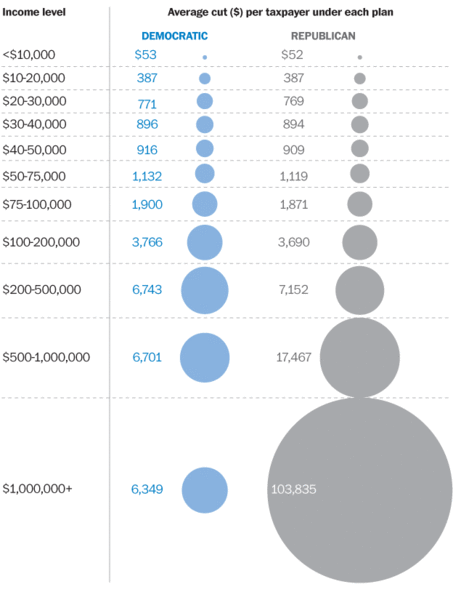
The Tax Cut Game Of Chicken: The Chicken Wins?

Weigel previews the disappointment on the left:

[Liberals] were promised by Obama — by every Democratic candidate, really — that the tax rates would be restored to pay for social programs. They thought they proved in the 1990s that these were fair tax rates under which the economy could grow wildly, and that Bush proved in the 2000s that lower marginal tax rates for the wealthy didn’t spur real economic growth. It was an important debate, and they won it. They have polls telling them they won it, and most Americans are find with restoring the top rates. And here’s Obama, about to throw the game, affirming the conservative line that tax cuts of any size at any time are good for the economy.

But he isn’t. He’s saying that he’d prefer to raise taxes on those earning more than $250,000 a year, but cannot in this political climate at this particular time. Nothing prevents Obama from sunsetting them in their entirety if he wins re-election on a sturdier economy. And nothing prevents him from campaigning on long-term debt reduction from now on, as a way to restore the confidence that can keep the recovery moving.

The Arabs vs Iran? Please. Ctd

Peter Beinart turns the debate on its head:

[F]or all their crowing about the fact that various Gulf princes want war with Iran, American conservatives seem not to have noticed that the most democratic Muslim countries in the region—Turkey, Iraq and Lebanon—want the softest line on Tehran. 

The bald reality is this: The vast majority of people in the Middle East loathe our military presence in the region and our largely uncritical support for Israel. The more devoted to those policies conservatives are, the more at odds with Middle Eastern democracy they’ll be. 

Dissent Of The Day

A reader writes:

You wrote: "I don't see this as surrender. I see this as Obama's cold-blooded pragmatism." I disagree – it's a total capitulation and isn't good strategically, either.

Why? Because in two years, when the extension of the tax cuts expire, it will be the 2012 campaign season. So either Obama will be stuck between raising taxes then, or being slammed with accusations of being weak on the deficit/debt. Just as no one recalls that the Bush tax cuts are a huge part of why we're in this hole to begin with, no one will recall that extending them dug us even deeper. Americans have short memories – better to take the bitter pill now by letting all the tax cuts expire (and forcing Republicans to revisit the issue in 2011) and watch as the deficit eases and the economy improves over the next two years.

As for the "compromise" with getting unemployment benefits extended, I think Obama should play hardball there too – let them expire for a few weeks while going on the offensive and blasting Republicans for blocking an extension. Soon enough he'll get some movement.

The Decaying Foundation Of DADT

David Link gets inside McCain's head:

McCain cannot seem to accept that the world might have changed around him, and that the transcendent importance he attributes to sexual orientation isn’t so widely shared any more.  And the context of the hearings couldn’t better illustrate the disproportion of the obsession with homosexuality.  However important – or not – DADT is, is funding the nation’s entire military really the secondary consideration?

Yes, attaching repeal to the funding bill was a political move — big surprise.  But it’s political mostly in the sense that it illuminates the self-indulgence of politicians who are hellbent on catering to a dying prejudice.

To McCain, it is the status quo – the institutionalization of prejudice – that is transcendently important.  He is defending DADT as if it were a principle, rather than a political compromise that no one liked in the first place, but everyone could agree on in order to extricate Bill Clinton from his failed political promise to gays.  

The Grand Compromise, Ctd

Leonhardt has genuine worries about the Bush tax cuts lapsing, while Chait wants Obama to reverse the Bush tax cuts during his next term – provided he has one:

If Obama is re-elected, he simply has to veto any extension of the upper-bracket tax cuts. If it means all the tax cuts die, so be it. Why, you might wonder, would he be willing to do that then but not now? Well, hopefully the economy will be in better shape. (If it isn’t he probably won’t be re-elected anyway.) On top of that, canceling all the Bush tax cuts would have a real depressing effect on the economy, which in turn would also harm his re-election chances.

It's called strategy; and it beats the Krugman-Rich purism that is pure tactics.