Credible reports are now reaching the Dish that it recently moved.
Author: Andrew Sullivan
Palin And The Caribou, Ctd
A reader writes:
Well as I am a part of the Alaska hunting community, I forced myself to watch last night's episode of SPA. I wanted to see how Alaska hunting was portrayed, and particularly how Alaskan women hunters were portrayed.
One thing is patently obvious to any real hunter: Sarah Palin is a poseur; she is not at all familiar with a bolt action rifle. As far as real Alaskan women hunters, lest viewers think otherwise, no woman hunter I know does not operate her own bolt when extracting the brass and inserting a new cartridge. Very odd to see her dad operate the bolt for her as she fired all those bullets downrange. I have my doubts she actually killed that caribou with the other rifle, but we'll never know.
Rifle scopes can sometimes be bonked, a rifle dropped on rocks etc, to where they do go off sight. But there was no indication anything like that happened with Sarah's rifle.
And when they do go off sight, often it's a matter of inches up or down or left or right, and shooting at a broadside caribou from that distance as Sarah was, it is more likely to wound the animal than completely miss it when aiming at the shoulder/lung area.
On top of that, when a rifle scope does go off and needs to be sighted in again, one doesn't take something that small (a 10" diameter paper plate in this case) and put it downrange as a target to check the sighting. Missing something that small doesn't really prove anything … if the rifle scope really was off, it could be six inches off left or right or up or down and still miss the plate, but would still have hit the caribou in the lung/shoulder area. It could be ten inches off and would still have hit the caribou. For Sarah to completely miss that caribou at that range would mean the scope would have to be waaaay off. That just isn't a very likely scenario with today's modern equipment. And taking that (supposed) final shot with the other rifle, when the caribou was no longer broadside (which is the much preferred shot because it provides a much large killing zone) but facing directly toward Sarah … I don't know any hunter who after missing so many times would then choose to take that kind of shot at such a smaller target. It just doesn't add up.
Neither does a 72 year old man walk "four or five miles" from camp on that tundra – which is really undulating ankle-twisting tussocks – as they claimed during the episode, then walk the same distance back. A ten mile hike on that tundra with a loaded pack is a feat for someone young and physically fit. I'm not sure why they chose to lie about that, certainly the camera crew also could not walk that distance carrying their equipment. But that's "reality" television for you. Any hunter who watched that episode should come away with the knowledge that Sarah Palin the "hunter" was a big bold lie.
Another writes:
My favorite moment of this episode was her comment that having the binoculars made this a “fair” contest. I have nothing against hunting, but there is obviously nothing fair about this contest. Palin and her company are equipped with high powered killing machines—rifles with long-distance scopes, so they don’t even have to get near the target. And the caribou obviously hears the shots that miss, but doesn’t understand what they mean, so it makes no effort to get out of the way. This allows Palin to take 6 or so shots before finally killing the animal. How is that fair? How is that even a contest?
I have now seen all episodes but the immediately prior one. I can only say that:
(1) the visuals in the show are spectacularly unspectacular. I expected to see some really terrific vistas of Alaska, but for the most part it’s been less than memorable visually. In last night’s episode, for example, we see lots of very flat, unattractive tundra.
(2) Palin’s speaking parts remain totally banal and uninteresting. I understand that her comments while actually on location are trite and unmemorable, but there are plenty of voice-over segments and segments where she is sitting down and speaking. However, she never says anything particularly insightful about what she has done or is doing or about Alaska. She almost never takes the opportunity to present any facts about the subject matter of the show and when she does the information is minimal. She’s hunting caribou. Is it too much to ask that she tell us something about the origins of this animal or its relation to elk, moose, deer, etc., or that she say something about how large the caribou herds in Alaska are or whether they are growing or shrinking, or something about what they eat or, for that matter, anything at all about the caribou’s habits?
This seems to be a consistent failure on the part of this show. We see Palin engaging in a number of activities that supposedly are typical of Alaska, but she offers no insight into the activities and she gives no “bigger picture” sense as to how these activities fit into the Alaskan economy or way of life. Although she keeps talking about how wonderful Alaska is, the show is all about her, her, her.
And you were expecting … ?
Mental Health Break
Man's most badass friend:
“The Ideal, Perfect Zombie”
Scott Meslow interviews Robert Kirkman, creator of The Walking Dead comic series:
There's very little "new" that's brought to the zombie plate here. [The Walking Dead] is kind of my effort to canonize zombie lore. Vampires have a set bunch of rules, werewolves have a set bunch of rules—but a lot of time, when people try to do something with zombies, they try to reinvent the wheel … It's confusing, and they have to explain it all. So I decided to start with the base, core—what I consider to be the ideal, perfect zombie—and go from there.
Quote For The Day IV
"I think there are a lot people of other faiths who wonder also, why do they always pick on the Christians?" – Senator James Inhofe, upset that Tulsa's “Christmas Parade of Lights” was recently renamed "Holiday Parade of Lights".
But wasn't Inhofe's Oklahoma the state that just banned Sharia law?
Reality Check: Taxes Edition
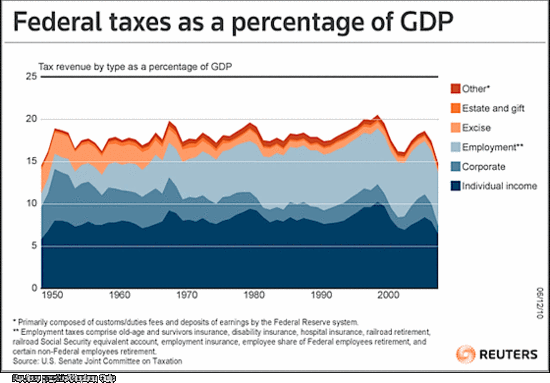
Felix Salmon provides important context for Bush tax cut debate:
- Federal taxes are the lowest in 60 years, which gives you a pretty good idea of why America’s long-term debt ratios are a big problem. If the taxes reverted to somewhere near their historical mean, the problem would be solved at a stroke.
- Income taxes, in particular, both personal and corporate, are low and falling. That trend is not sustainable.
- Employment taxes, by contrast—the regressive bit of the fiscal structure—are bearing a large and increasing share of the brunt.
In One Case, The Possibility For Justice
Tim Lynch reports the happy news:
The Mississippi Supreme Court has ordered a new trial for Cory Maye.
You may remember the story: Maye was at home one night when he thought he heard someone trying to break in. He grabbed his gun and shot at them as they came crashing into his bedroom in the dark. When the lights came on, it turned out that the intruders were from the police department. With a police officer shot and killed, the case was twisted from self-defense into “murder.”
When Radley Balko was researching his Cato report on no-knock drug raids, he discovered the travesty of Maye’s case and started writing about it. His work attracted the attention of top lawyers at DC’s Covington and Burling, which entered the case pro bono on Maye’s behalf. It has taken several years, but those lawyers have now secured a new trial for Cory Maye.
Congrats to the attorneys at Covington, Radley, and Cory Maye.
From the Dish too.
Happy Repeal Day
On the anniversary of Prohibition’s repeal, Jacob Grier reflects on tobacco:
The speakeasy has been replaced by the smoke-easy as bar owners hide ashtrays from sight from meddling health inspectors. Smoking bans have gone from California oddity to standard practice, creeping to ever more absurd extremes. Outdoor bans are increasingly common, extending to wide open beaches, parks, and golf courses. Dedicated cigar bars and tobacco shops are under fire. Even the home, the last refuge for many smokers, is no longer free from the government’s encroachment in some cities.
Though smoking remains legal, legislators are doing everything in their power to make it as expensive and unpleasant as possible. Smokers are an easy target for tax hikes and cigarette taxes now exceed any reasonable estimate of smoking’s social cost. Federal taxes on cigars may soon rise from five cents per stick to as high as three dollars and this year Congress came perilously close to explicitly forbidding certain types of cigarettes. Their only hangup was over whether to ban all tobacco flavorings or merely some of them.
Beyond Hackery
Lo! Mark Halperin has a new column. See how much conventional wisdom, hoary cliches, dead language and zero facts someone can shoe-horn into a few hundred words.
Where Does Sexism Come From? Ctd

A reader writes:
The interesting question to me is not "Did religion create sexism?" The question is, "Does religion perpetuate sexism?" Much of human progress comes not from accepting the societal forms of male domination and violence that we inherited from our ancestors, but innovating ways to avoid them.
Another writes:
Perhaps the simplest explanation for the prevalence of sexism is a biological one. Until the mid part of the last century, reproduction was dangerous business for women.
Mortality due to complications during childbirth hovered at 10% (or higher) prior to the widespread availability of antibiotics. In addition, ectopic pregnancies often killed women before they knew they were pregnant. (Thus the female characters who just lie down and die in 18th and 19th century novels.) As much as anything, improved obstetric outcomes parallel the rise of women in society. It’s difficult to reliably provide for yourself if you come close to bleeding out with each child, or are permanently incontinent due to obstetric fistula.
Millennia ago women made a pact with men: Take care of me during and after childbirth, and of the children I leave behind, and I’ll abdicate control of my fate in society. This was a valuable bargain for men because without it they had uncertain control over their reproductive fate. Now that reproduction isn’t Russian roulette for women, they don’t need male-provided resources and protection. What keeps male dominance in place is the institutionalization of male power in societies. A harbinger of its end is the growing number of single women having children via artificial insemination.
Another:
Ebert wrote, "Indeed, if we study other primates we see that their cultures are also male-dominant." Not true. Bonobos, perhaps our closest relations, live in a female-dominant society.
Other primates have widely varying social structures. Gorillas have a family group-based culture, with one male and several females. Orangutans are highly solitary, with relatively strong bonds existing mainly between mother and offspring. Chimpanzees have the most similar social structure to our own, living in large groups where inter-sex competition is important. The idea that we see human culture reflected in our close relatives is a limited concept that we should be very suspicious of.
Another:
All religions do not view women as inferior! In fact, since its inception 167 years ago, by pronouncement of its Prophet-Founder, the Baha'i Faith has articulated the absolute equality of women and men. While the Baha'i Faith is not well known, it is the most persecuted faith in the Iranian regime, and one of the most wide-spread of religions.
Another:
The cultural historian William Irwin Thompson has an interesting hypothesis on where sexism came from: In an ultimate twist of fate, the women did it when they sexually selected for the strongest most possessive men who would protect them. These men, ironically, would be the ones who treated them as property to be owned and defended. See his "The Time Falling Bodies Take to Light: Mythology, Sexuality and the Origins of Culture."
Another:
I think you should involve Craig Barnes in this conversation: "In Search of the Lost Feminine: Decoding the Myths that Radically Reshaped Civilization".
A review of that book here.
(Photo: Pope Benedict XVI presides over a Mass at Westminster Cathedral during the third day of his State Visit on September 18, 2010 in London, England. By Leon Neal/WPA Pool/Getty Images.)
 The Dish