This cable, in particular, discusses the Chinese government's requests to the U.S. government, to make Google fuzz up or alter some of its Google Earth imagery, to avoid revealing "sensitive" locations. This is a longer discussion for another time (previous mention here or here), but the perceived subversive power of maps and satellite images in many societies is profound. For instance, as I've mentioned before, Google Earth shows a gigantic airport on the west side of Beijing (right) that I have never seen on a Beijing city map. I've meant for months to do a post about the odd aspect of online satellite imagery of China: if you go to a site with both a "map" and a "satellite" view and click back and forth, you'll see that they don't exactly match. There's an offset built into almost all of them. Main point: the cables show that the Chinese officials are well aware of what these images can mean.
Author: Andrew Sullivan
Face Of The Day

A Lebanese Muslim girl stands near men praying for rain at Mohammed al-Amin mosque in downtown Beirut on December 3, 2010. The special Muslim prayers known as Salat al-Istisqa – a ritual practiced since the time of the Prophet Mohammed – are frequently held across the Middle East, where water is a precious resource. By Joseph Eid/AFP/Getty Images.
Dark ≠ Deep
Peter Steinfels questions reviewers who praise the new Harry Potter movie for its darkness:
Dark means serious. Dark means shadows. Dark means not evading the sad and inexplicable complexities of life—or even worse. Dark is grownup. … Profound = deeper = darker. I understand the subterranean metaphor. But could we turn it around? What of the image of light? Though darkness is inescapable in our faith, could we write, even if somewhat paradoxically, that a poem touched a deeper, brighter place than any before it?
A Poem For Sunday
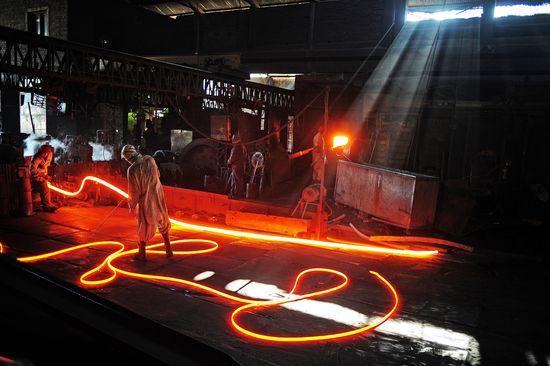
"Psalm" by Mark Jarman first appeared in The Atlantic in June, 1997:
Lord of dimensions and the dimensionless,
Wave and particle, all and none,Who lets us measure the wounded atom,
Who lets us doubt all measurement,When in this world we betray you
Let us be faithful in another.
(Image of steel workers at Ittehad Steel Mill in Islamabad, Pakistan on November 30, 2010. by Carl De Souza /AFP/Getty Images)
Breaking Up With Hotmail
Jack Shafer pens a Dear John letter:
I have never been embarrassed to have a Hotmail address—something I can't say about my AOL account. In fact, I wouldn't be writing this today if Hotmail had stuck to being Hotmail. But no, these days it wants to stand between me and the entire Web, monitoring my every step. When I sign on to collect Hotmail, it immediately starts hectoring me to connect my account to Facebook, MySpace, and LinkedIn. It implores me to "Share something new" with people in my network. It begs me to upload photos. Right now, the opening page of Hotmail is alerting me to the upcoming birthday of somebody I don't even know.
The Drug Artist
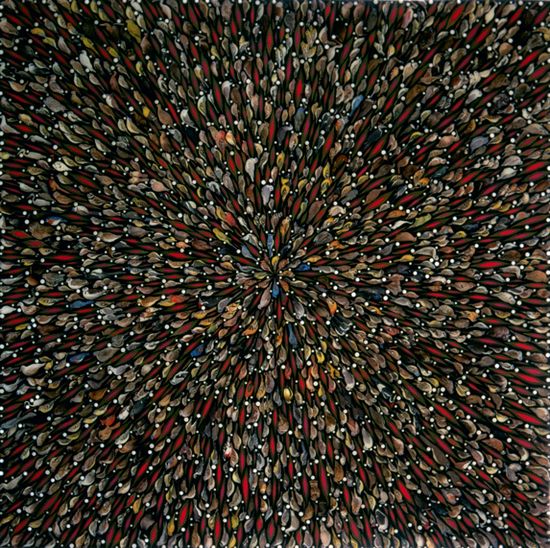
Paul Laster reviews Fred Tomaselli's retrospective at The Brooklyn Museum:
A practitioner of psychedelic dreams, artist Fred Tomaselli turns mindscapes into visual landscapes. Layering print media, marijuana leaves, pills, and paint under layers of resin, Tomaselli constructs networks of awe-inspiring elements that come together to form a transcendental vision of parts of the universe. …
Creating a touchstone for important global issues — from the war in Afghanistan to the discovery of underwater uranium in Bolivia — Tomaselli turns our mediated, consumer-saturated world into a marvelous play land, where we can jump on a ride to the next realm.
(Image of Dead Eyed Bird Blast, by Fred Tomaselli, which includes hemp leaves, pills, photo collage, acrylic, and resin on wood panel.)
The Original Dirty Hippies

Jason Zasky interviews Richard Francis about his history of “Fruitlands,"the utopian experiment led by Bronson Alcott—father of Louisa May Alcott, author of “Little Women”—and English Transcendentalist Charles Lane:
Their regime was to eat fruit and vegetables—preferably raw, though they did eat cooked potatoes. They washed in cold water and wouldn’t use any spices. They also wouldn’t use alcohol or tobacco, and wouldn’t use any animal products in their clothing. And they wouldn’t use cotton [because] it was the product of slavery, so they wore linen. It’s not surprising that they got cold, and that the community began to falter as winter came on.
(Photo from Detroit by Jason Tester via David Pescovitz)
Technology Before Politics?
Aileen Gallagher talks with sci-fi novelist William Gibson:
If you’re born now, your native culture is global, to an increasing extent. There are things that are unknowable for futurists of any stripe, be they science-fiction writing charlatans like myself or anthropologists in the employ of large automobile companies who are paid to figure out what people might want in ten years. One of the things that’s unknowable is how humanity will use any new technology. …
Technology trumps politics. Technology trumps religion. It just does. And that’s why we are where we are now. … This is not only what we do, it’s literally who we are as a species. We’ve become something other than what our ancestors were.
What They Least Want To Give Us
Linda Hirshman notes why the resistance to marriage equality and military service is so important to sustaining anti-gay stigma:
The right knows it can't make the state punish gays as sinners, for various constitutional reasons, so it is trying to make the state deny them the closest thing it has to consecration: the sacred bonds of warriors and the sanctity of marriage. …
It's a fight worth having, because the society rewards these secular symbols of goodness in countless unseen ways. Sure, military service is not a constitutional requirement for running for office, but it's a big leg up.
But what both do is imprint homosexuality with the core values of the right: marriage and service. Hence the cognitive dissonance. If being gay is the permanent "other", how can they also be the most admirable among "us"?
The Gift Of Animals
Says Cate MacDonald:
Animals have been given a much more significant role in the created order than just that of biological necessity in the natural economy. They have been imbued with relational capacity, a capacity that is both their own and reveals God’s. Like the rest of the natural world, they have impact, sometimes significant impact, on our souls.
 The Dish