The Smithsonian's decision to withdraw a short David Wojnarovicz video from its remarkable new exhibit, Hide/Seek, at the National Portrait Gallery is discussed below. If you are in DC, a silent protest of this act of cowardice and the bullying that prompted it will take place today at 5.30 pm. Details here.
Author: Andrew Sullivan
Tweet Of The Day
Adam Serwer at today's Senate hearings on Don't Ask Don't Tell:
McCain, five minutes ago: DADT repeal needs more time, hearings. McCain, five minutes later: Let's use DADT time to talk about Wikileaks.
“Just Let Her Do Her Thing”
Nicolle Wallace on Palin:
"No one's gonna cut her off at the legs. Only Sarah Palin can beat Sarah Palin, and let me tell you why no one will take her on. Her defenders and supporters, the likes of Rush Limbaugh and Sean Hannity — people I admire — are so powerful on the Right that nobody wants to anger any of those people, nobody wants to end up in the crosshairs, and nobody wants to look like they are unwilling to let her do her thing… Just let her do her thing, she is going to be exposed enough to the American public that she will reveal what her nature is. I think her nature has been revealed lately as very prickly, very cynical."
(PS: How much do you believe her when she says she admires Rush Limbaugh and Sean Hannity? Sometimes on the right, it sounds like you're reading minor functionaries in the North Korean bureaucracy.)
My fear, by the way, is Bob Reich's. The fundamental reason for Palin's strength is the despair of the white working class – a despair certainly merited given the economic forces of the past couple of decades. Their jobs aren't coming back – they've gone to India and China for ever – and their wages have barely risen in a generation. And their response is to blame cultural, not economic elites – as is usually the case in America:
According to the right-wing narrative, the calamity that’s befallen the white working class is due to the global and intellectual elites who run the mainstream media, direct the government, dispense benefits to the undeserving, and dominate popular culture. (The story and targets are not substantially different from those that have fueled right-wing and fascist movements during times of economic stress for more than a century, here and abroad.)
Sarah Palin has special appeal because she wraps the story in an upbeat message. She avoids the bilious rants of Rush, Sean Hannity, and their ilk. But her cheerfulness isn’t sunny; she doesn’t promise Morning in America. She offers pure snark, and promises revenge. Over and over again she tells the same snide, sarcastic, inside joke, but in different words: “They think they can keep screwing us, but (wink, wink), we know something they don’t. We’re gonna take over and screw them.”
And by "screw them", she means putting them in a tank and knocking them senseless over the head like a halibut until our small, still-beating hearts are held in the hands of Bristol.
Bill Donohue’s World AIDS Day
I got to see the extraordinary and powerful exhibit at the National Portrait Gallery, Hide/Seek, over a week ago. It's impressive, subtle and involving. It is about American portraiture's navigation of sexual difference and homosexuality in the twentieth century. From Paul Cadmus and Thomas Eakins to Annie Leibovitz and Andy Warhol, it's a fascinating glimpse into how gay artists managed to be honest in their work, even while being constrained by society's strictures of what could or could not be presented in public. So much of it gains strength from its codedness; in many of the portraits, it takes a while to see what is really going on. And yet there are also pieces of quite shocking frankness and beauty.
I mean, look at this George Bellows take on a "shower bath":
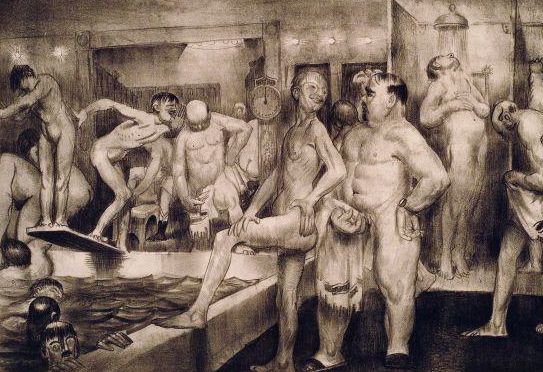
This is a lithograph from 1917. Yes: 1917. Exuberant, self-aware gay life has been around for much longer than we usually acknowledge. And one of the most impressive decisions by the directors of the exhibit is their refusal to portray this history of gay portraiture as linear or progressive. And so the hilarious bath-house scene above leads forward to such heart-breaking pieces as the Keith Haring 1989 painting below, which says so much about the AIDS epidemic in such economy:

I say all this to urge you to go see it, if you can, or to peruse the online version here. A rave review of it can be read in the Washington Post here.
For me, the portraits from the era of AIDS, of mass death in the teeth of great hostility, fear and discrimination, struck home most powerfully. That is when I came of age as a homosexual man, and it is what necessarily soldered my heart to those of my brothers and sisters. It was an anguished and angry time, and few portrayed that as graphically as David Wojnarovicz. His self-portrait – his gaunt, dying face half buried in dust – brings back the cold, deathly panic of the time. And his 30 minute video, A Fire In My Belly", is a stream of visual consciousness about his dying, his grief at his friends' dying, his fear and his anger. It is disturbing, discordant, sexual and morbidly focused on death and stigmatization, so watch it at your own risk:
And it is this that has now been withdrawn from the exhibit because the Catholic League's blowhard, Bill Donohue, called the video – absurdly – something "designed to insult and inflict injury and assault the sensibilities of Christians," and John Boehner jumped when pulled by Donohue's string.
Well, I'm a Christian and far from feeling insulted or injured or assaulted, I saw something as raw as it was orthodox. The whole video incorporates the image of Jesus as a dying, tortured man like those with AIDS: "unclean" as the audio shrieks over the image, rejected, covered by insects. It splices that image with grotesque attempts to sew a loaf of bread back together, to sew a human being's lips back together, along with desperate images of fire and decay. We are looking at the hysterical images of a dying man suddenly surrounded by the dying, overcome by the attempt to sew life back together. To see a rejected Jesus left on the cross and on the ground to be covered by ants, is, in this context, clearly neither offensive nor heresy; it's orthodoxy, for Pete's sake, with the death of Jesus one of countless images of suffering and isolation.
As Blake Gopnik notes:
The irony is that Wojnarowicz's reading of his piece puts it smack in the middle of the great tradition of using images of Christ to speak about the suffering of all mankind. There is a long, respectable history of showing hideously grisly images of Jesus – 17th-century sculptures in the National Gallery's recent show of Spanish sacred art could not have been more gory or distressing – and Wojnarowicz's video is nothing more than a relatively tepid reworking of that imagery, in modern terms.
This is so obvious in context that one simply wonders what on earth the fuss could be about. Maybe what is truly offensive to men like Donohue is the notion that gay men might actually seek refuge in Jesus' similar experience of marginalized, stigmatized agony. Since the message cannot be objectionable – Jesus shares in our suffering and exemplifies it – maybe it is merely the association with gay men that appals. For the powerful and privileged like Donohue, Jesus belongs in the corridors of power and respectability, among the mainstream, depictions of him restricted to images of pristine, prissy reverence rather than the alienated, despairing, naked agony he actually suffered. The idea that Jesus died for homosexuals is insulting to Donohue; but it is what the church teaches and what Jesus lived.
Which is why this reflexive, culture war spat is so depressing, so sad, so illustrative of how the alleged defenders of Christianity do not understand it at all. And how even after all these years, these young men, tens of thousands of whom died in agony or alone, are still despised, ignored and feared by men like Donohue and Boehner. May Jesus one day forgive them.
How Wikileaks Reassures
The quality and candor of the cables is impressive:
The British scholar Timothy Garton Ash concurs, writing in the Guardian, "My personal opinion of the State Department has gone up several notches. [W]hat we find here is often first-rate." It is also often well wrought. The account of a wedding in Dagestan filed by William Burns, now the No. 3 person at the State Department, is — as Garton Ash writes — straight out of Evelyn Waugh. When foreigners encounter U.S. diplomats and listen to their bland recitation of policy, they would do well to keep in mind that behind the facade lie some very clever minds.
And as Fareed notes, it's not as if we discovered the US government pursuing policies at odds with its public statements. These are not the Pentagon Papers.
A Republican Civil War?
Doug Mataconis counters Dave Weigel:
This is in many ways the same position the GOP was in after the 1994 elections. While there were many factions in the new Republican majority, they were united in opposition to President Clinton and in the goal of defeating him in 1996. It wasn’t until after the `96 election, and the disaster that was the Bob Dole campaign, that the fissures in the GOP began to reassert themselves. I suspect that this phenomenon will be even more pronounced this time around as opposition to Obama becomes the central theme of the conservative talking heads on Fox News Channel and talk radio, but there’s another factor in play that could end up setting off a Republican civil war sooner rather than later.
Unlike 1996 when Bob Dole was the clear heir apparent for the GOP nomination, the race for the 2012 Presidential nomination is as wide-open as the 2008 race was, perhaps even more so. The fight for the nomination, which in some sense has already begun in earnest, is likely to be long and potentially divisive, especially if a certain former Governor from a certain northern state throws her hat in the ring …
A Uniform Doesn’t Make A Cop A Cop
Joel Wing worries about the quality of Iraq's police force:
By at least 2020 the Iraqi government plans on transferring internal security of the country from the army and Defense Ministry to the Interior Ministry. That poses the question of whether the Iraqi police are up to the task. In October 2010 the Special Inspector General for Iraqi Reconstruction (SIGIR) conducted an audit of the American police training effort. It found that the U.S. had always focused upon the number of officers it could produce rather than whether they were competent or not. The mission also lacked continuity, coordination, long-term planning, and effective measures of success. There’s no telling whether the police will be ready then by 2020.
Chart Of The Day
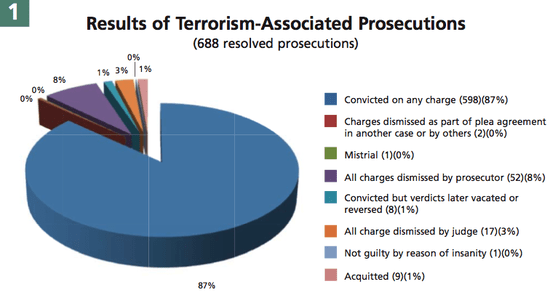
From Adam Serwer, who vents:
Exactly 1 percent of terrorism-related cases end in acquittal. That's so low as to be genuinely disconcerting. Except for conservatives, who presumably think that number is far too high and proves we should be using military commissions.
Ossifying The Spooks, Ctd
Douthat takes this insight on Wikileaks' grand strategy to its logical conclusion:
The hyperbole of certain Republicans notwithstanding, Assange is not a terrorist. But he has this much in common with al Qaeda: In response to what they perceive as the inherent injustice of the American empire, both the jihadis and the Australian anarchist are willing to take steps that they know will make the United States more imperial in the short term — in Al Qaeda’s case, acts of terrorism that inspire American military interventions in the Muslim world; in Assange’s case, information dumps that inspire ever-greater secrecy and centralization in the federal bureaucracy — in the hopes that the system will eventually collapse under its own weight and “more open forms of governance” (or, I suppose, a global caliphate) can take its place.
The problem, though, is that the American national security state is almost certainly more resilient than either Assange or Osama bin Laden seems to think. Which means that their efforts at sabotage have little chance (by design) of prompting any actual reforms in the system they despise, a vanishingly small chance of actually bringing the whole thing to its knees — and a substantial chance of just making life worse for everybody, inside and outside the United States government alike.
Bipartisanship In Name Only
Ezra Klein calls out the GOP:
Republicans have … made their approach to bipartisanship clear: It's a useful tool in service of their agenda, not in service of compromise. They used meetings to delay action on the tax cuts and are now using the time they wasted as a reason to obstruct action on everything else. They have prioritized shows of power and partisanship over negotiations and governance.
 The Dish