“The Bathtub Gin Of Cannabis” Ctd

SpiceGetty

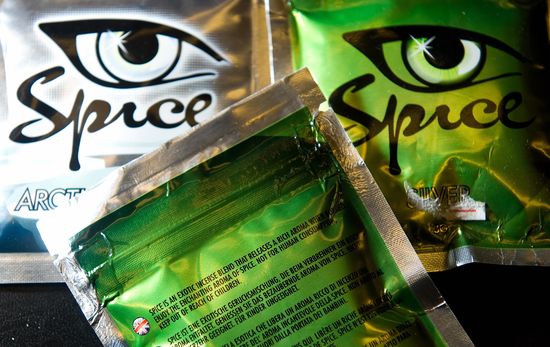
The DEA recently announced that is it going to ban cannabis substitutes like K2 and Spice. Scott Morgan doesn't think that this will stop use:

K2/Spice possesses one unique characteristic that ensures its survival: it will remain an effective option for getting high and still passing a drug test. Drug screening products allegedly capable of identifying the unique compounds contained in K2/Spice are beginning to enter the market, but an industry-wide overhaul incorporating new technology will be far too costly to implement in an organized or efficient manner. 

Morgan's larger point:

Once the ban takes effect, police will be confronted with a potent, odorless, and easily concealed substance that's suddenly commanding high prices in the pot market. As distribution is pushed underground, new and more dangerous forms will emerge and the familiar horrors of prohibition will be exhibited before our eyes yet again, as another drug that was never meant to exist establishes a permanent foothold in the illicit market. Whatever unpleasantness arises from all of this will owe its origins entirely to the mindless war on marijuana, and it's truly the height of irony that K2/Spice will soon be subjected to the same failed prohibition policy that made it popular in the first place.

(Photo: Leon Neal/AFP/Getty Images)
Bloomberg’s Only Shot At 2012

Steve Kornacki isn't ready to write Bloomberg off just yet:

[I]f, come early '12, the economy is still stuck in neutral and the GOP is poised to nominate a polarizing, Palin-ish nominee, there will be … room — at least initially — for a third-party candidate. In that environment, Bloomberg might fare better than 11 percent. When Perot's name first began circulating in late February and March of 1992, he barely cracked double-digits in national polls; but the idea of a third option quickly caught on, and by May he was leading Bush and Clinton in three-way polls. Bloomberg is more broadly known now than Perot was in early '92, but plenty of Americans haven't yet formed an opinion of him — so he does, at least potentially, have room to grow.

Weigel differs:

Insofar as Americans want a third party candidate, they want one who will tackle issues that both parties are, in Washington, to their left on — immigration, spending cuts. And Bloomberg is to the left of Congress on those issues. So why support him?

Your Christmas Gift – From The Dish

Identity-collection

We've never done this before in our decade of existence, although we've been asked many times by readers. But on our tenth anniversary, we decided we'd try and put together some t-shirts for Dish readers to wear with pride. The reason we kept putting this off is because we didn't want the usual CafePress-style (no offense) online merch. We wanted something that would be a much higher quality, would last much longer, and would be subtle and cool. We wanted something, in other words, worthy of our readers – not crude personal advertizing, but subtle, beautiful and fun to wear for anyone, Dish-addict or non-Dish-addict. So we asked the fashion company, Rogues Gallery, to come up with some designs. And they did.

We think they're awesome. Check them out for yourself.

RG t-shirts are vintage shirts, hand-printed, repurposed and redesigned. They last for ever, are extremely comfortable and easy to wear, and look, well, they even make me look well turned out. The main reason I love them so much – they don't shrink. That Atlantic t-shirt I was wearing for Big Think? RG classic. I've bought many over the years and it's a thrill to have three custom-designed for us. They're more expensive than most t-shirts, but once you wear one, you realize why. Always comfortable, always cool, wearable anywhere, hand-printed in Rogues' Gallery's Portland, Maine, workshop, they're classics.

ASDDTees

To see them up close, go here. They're a limited edition, sales were brisk today and we have no idea what the demand will be, so don't delay if you want the first ever Dish merchandise in time for the holidays.

The designs themselves are really subtle and retro and stylish. Two will only resonate with other Dish readers (a kind of beagle whistle to one another if you see them in public) – but if you share the basic philosophy of being "of no party or clique," they work as as a general t-shirt design anyway. I'm particularly fond of the middle one with the howling hound. Beagles are our patron canine, after all.

Wear them with pride as Dish readers; or if one of your friends or family-members is a Dish fanatic, buy them one as a gift for the holidays. Better still, buy all your Dish friends a t-shirt.

And a Merry Christmas, Happy Hannukah, Blessed Kwanzaa, and Super Holidays from all of us here.

[Re-posted from earlier today.]

The Daily Wrap

Today on the Dish, Andrew raged against the dickishness of the GOP and the prospect of a failed DADT repeal. Andrew skewered Douthat on the idea that during W's reign the right showed anything like the integrity of the left under Obama. And in another round with Goldberg, Andrew cited a recent poll on what Arab countries really think of a nuclear Iran, to demonstrate that these countries aren't really aligning with Israel.

On Wikileaks, Andrew argued Julian Assange is a red herring for a new era in internet culture, and that it has helped expose torture by the U.S. government. Aaron Bady pointed to the real damage done by Wikileaks, by hindering the government's own internal ability to communicate. Karim Sadjadpour pondered a democratic Iran, Kristol wanted to whack Wikileaks, and Matt Welch called him "flippantly authoritarian." Drum simmered down the partisan sniping, and Robert Gates shrugged.

Andrew was moved by Palin on Trig's future adult life, and wondered about the whereabouts of the anti-Palin brigade. Frum would settle for a Romney-Huckabee ticket, and Allahpundit insisted Palin wins the Huckabee followers if he doesn't run. The Fiscal Commission released their final proposal, and the next leak was aimed at a big bank. Bernstein defended why deficits don't matter politically, but Andrew wouldn't totally excuse it. We parsed Mike Pence's speech on economics, the housing bubble was still popping, and AGs waged ideological warfare. Andrew sang his own tribute to World AIDS Day, and it wasn't his offer to "die digitally." Gregory Johnsen didn't think killing Al-Awlaki was going to solve the problem of Al-Qaeda in the Arabian Peninsula. Dish readers divulged their own spousal diaspora tragedies, and defended Lennon's "Imagine." Ryan Avent pined for an American version of the British pub, and movie spoilers are as old as Greek tragedies.

Cool ad watch here, fails of November here, MHB here, Malkin award here, 2010 in photography here, Yglesias award here, VFYW here, FOTD here, and your Dish Christmas guide here.

–Z.P.

What If Huckabee Doesn’t Run?

Allahpundit wonders:

Palin’s the big winner. She takes 34 percent of [Mike Huckabee's] supporters as a second choice compared to just 19 percent for Gingrich and 17 percent for Romney. That’s a considerable spread, to the point where I wonder if there aren’t some establishment anti-Palin Republicans out there suddenly getting very nervous at the thought that Huck might not run and that social conservatives will unite behind Palin. They’re going to need a stalking horse to bleed some of those votes away from her. But who, if not Huck?

Face Of The Day

EunuchsRizwanTabassumAFPGetty

Pakistani eunuchs take part in a rally to mark Worlds AIDS Day in Karachi on December 1, 2010. Pakistan's Sindh province is home to a total of 3,437 HIV positive people, including 30 children, 179 women and 3,228 men besides 192 people suffering from AIDS, a provincial AIDS Control Programme official said. By Rizwan Tabassum/AFP/Getty Images.

Protecting American War Criminals

In Spain, the Wikileaks revelations have dominated the headlines for the last few days. The reason? They reveal an extraordinary effort by the US embassy and the Bush and Obama administrations to cajole, pressure, redirect and try to rig legal cases that could reveal the war crimes of the previous administration. Scott Horton has the goods. Money quote:

Diplomats routinely monitor and report on legal cases that affect national interests. These cables show that the U.S. embassy in Madrid had far exceeded this mandate, however, and was actually successfully steering the course of criminal investigations, the selection of judges, and the conduct of prosecutors. Their disclosure has created deep concern about the independence of judges in Spain and the manipulation of the entire criminal justice system by a foreign power.

One reason I am not as alarmed by Wikileaks as some others – although I do see the damage they have done to the very possibility of frank and discreet governing and diplomacy. They have helped expose for real the US government's attempt to protect itself and its agents from the rule of law with respect to the torture and abuse of prisoners. Without the Internet – in which digital photos can be spread far and wide – we would also have no idea of the graphic horror of the Bush-Cheney torture regime.

So what do you prefer? Old-fashioned secrecy or our own governments getting away literally with murder and torture? Since Bill Keller won't even call it torture, doesn't Julian Assange merit some praise for helping expose it in full?

The Housing Bubble: Still Popping?

Case_shiller_sept

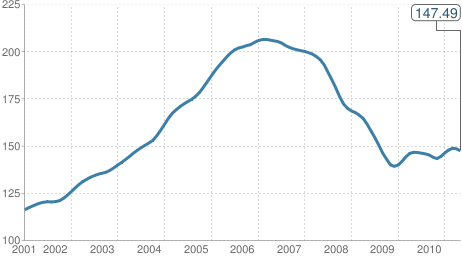
Jacob Goldstein thinks that housing prices are likely to fall further. Ryan Avent's two cents:

Falling home prices are nice for those looking to buy new homes. But falling prices also exacerbate ongoing crises, including the economy's flirtation with deflation and the problem of rampant negative equity. As values fall, ever more homeowners find themselves owing so much more on their homes than they're worth that default becomes the most attractive option—which leads to rising bank-owned supply and more downward pressure on prices.

The bright side is that these data are released on a significant lag. The outlook for the American economy as a whole was deteriorating during the months represented by the latest index. From October on, the outlook has improved. So, too, may home prices.

The Rise Of The Agitating AGs

Suzy Khimm calls Tea Party Christianist and climate change denier, Ken Cuccinelli, Virginia's attorney general, "one of a group of crusading lawyers who've helped transform the state attorney general's office—a position once considered a bureaucratic backwater—into a launching pad for ideological warfare":

[U]ntil the 1990s, the job rarely drew much attention. "It used to be as exciting as being head of the highway department," says Michael DeBow, a law professor at Alabama's Samford University and a former advisor to the state's onetime Republican attorney general Bill Pryor. Then, in 1994, Mississippi's Democratic AG, Mike Moore, took on Big Tobacco, leading an unprecedented multistate lawsuit to recoup health care costs from cigarette manufacturers. The case, which led to a landmark $246 billion settlement, inspired other progressive AGs to launch their own campaigns against corporate malfeasance—then use them to climb the political ladder. New York AG-turned-governor Eliot Spitzer, for one, earned his reputation as "the people's lawyer" by suing big Wall Street firms. …

Such swashbuckling also began to rouse the opposition. Alarmed by the tobacco suits and the dwindling number of Republican AGs in office, Alabama's Bill Pryor created the Republican Attorneys General Association (PDF) in 2000 to get more conservatives elected. … Sure enough, the ranks of Republican AGs have grown—and the position has become increasingly politicized. Before Cuccinelli, for example, there was Kansas AG Phill Kline, who launched an investigation aimed at shutting down abortion doctor George Tiller.