The Tax Cut Game Of Chicken

Brian Beutler considers the various Bush tax cut compromises. One scenario:

Dems agree to a two year extension of all the tax cuts in exchange for a few goodies like extending unemployment insurance. And then…what? That's when you have to start asking yourself what the politics of late 2012 will look like — and for that matter who will control Congress and the White House in 2013. A two year extension of all the tax cuts is cheaper than the Schumer plan if taxes on the wealthy go up in 2013. But what if Dems punt again for two years? There goes the cost advantage. What if a Republicans control the government in 2013? Then all assumptions fly out the window. 

The “Get Assange” Chorus

Joe Klein wants Assange in jail:

I am tremendously [concerned] about the puerile eruptions of Julian Assange. Let's say you're an American diplomat in a provincial reconstruction team in Kandahar Province. Let's say you're a woman, reporting on the conditions of women in this largely Taliban-controlled area. Let's say you mention one or two of your contacts in a cable. They are now extremely vulnerable–indeed, they are likely to be rounded up, defigured or murdered for merely talking to the Americans. This is not improbable, it is likely–and even m0re likely in a country like China, with the resources to examine every last one of the 250,000 documents leaked. These are not the sort of stories that make it into the news, but they are where the real collateral damage occurs.

This is indeed a terrible possibility, but would arresting Assange really put an end to Wikileaks or something like it? The point, surely, is that Assange is to Wikileaks as bin Laden is to al Qaeda or Mark Zuckerberg is to Facebook.

The "culprit" is the Internet, and how it facilitates asymmetrical power and transparency and removes any individual's responsibility for that transparency and asymmetry. No single editor or newspaper editor had to take the hit for this. No one could stop it. Even if every MSM outlet refused to publish these, the blogosphere would soon swarm over downloads which could be shifted from server to server.

The only way to stop this is to ensure that no one in the entire government has access to non-top-secret info (impossible) or that government itself return to the days of carrier pigeons. This is our new reality. The character or crimes of Julian Assange are a red herring.

The Dickishness Of The GOP

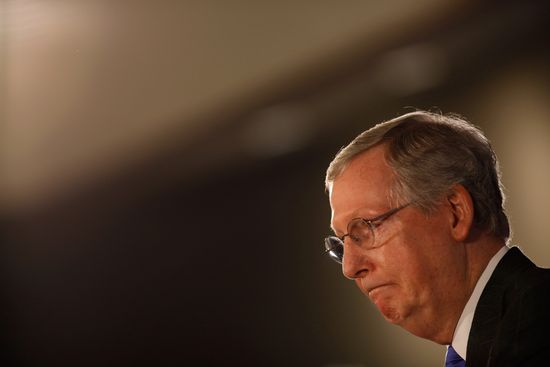
MCCONNELLChipSomodevilla:Getty

What we've observed these past two years is a political party that knows nothing but scorched earth tactics, cannot begin to see any merits in the other party's arguments, refuses to compromise one inch on anything, and has sought from the very beginning to do nothing but destroy the Obama presidency. I see no other coherent message or strategy since 2008. Just opposition to everything, zero support for a president grappling with a recession their own party did much to precipitate, and facing a fiscal crisis the GOP alone made far worse with their spending in the Bush-Cheney years. There is not a scintilla of responsibility for their past; not a sliver of good will for a duly elected president. Worse, figures like Cantor and McCain actively seek to back foreign governments against the duly elected president of their own country, and seek to repeal the signature policy achievement of Obama's first two years, universal healthcare.

I know it is the opposition's role to oppose. But the sheer scale and absolutism of the opposition, and its continuation in the lame duck session, even over such small but integral reforms such as the new START and DADT repeal, is remarkable.

The two parties are evenly spread in this 50-50 country, but only one can brook no compromise in its accelerating rush to the far right. And that is what it seems we have to contemplate for the next two years – total paralysis in the face of urgent problems as part of a game of cynical partisan brinkmanship. They simply cannot bear that another party might actually have a role to play in government.

This is not conservatism, properly understood, a disposition that respects the institutions and traditions of government, that can give as well as take, that seeks the national interest before partisan concerns, and that respects both the other branches of government and seeks to work with them. These people are not conservatives in this core civilized sense; they are partisan vandals.

And if the GOP block the repeal of Don't Ask, Don't Tell, despite the careful Pentagon study, a slow roll-out of its provisions, and support from the Joint Chiefs chairman and the defense secretary, then we will find out something else. The contempt the GOP has for gay lives, gay citizens and those who wear the uniform of the United States is as deep and as vile as we ever thought it was. Yes, I'm angry at this general nihilist partisanship, and wounded once more by these people's profound, obsessive homophobia. But I cannot, alas, say I am surprised. The degeneracy has been building for a long time. It is just the stench of it right now that overwhelms the nostrils.

(Photo: Senate Minority Leader Mitch McConnell (R-KY) delivers an address at the conservative Heritage Foundation November 4, 2010 in Washington, DC. The Republican party made big gains in the Senate but failed to take control of the chamber. 'If the administration wants to cooperation then it's going to have to move in our direction,' McConnell said. By Chip Somodevilla/Getty Images.)

When Spoilers Wouldn’t Matter, Ctd

A reader writes:

Posnaski wrote, “There is in some of us a capacity to not only like a predictable movie, but like it BECAUSE of it’s predictable.” Isn’t predictability the heart of tragedy? You know that Oedipus will kill his father and sleep with his mother, but you enjoy the ride. Do you know of any tragedies with a twist? It’s not just vapid Hollywood fare that thrives on being predictable. Just sayin’.

Another writes:

Predictable plots are much, much older than Hollywood and are about much more than laziness or corporate profits.

Where would Western culture be without the Greek tragedies and comedies, the Roman farces and melodramas, the great theatrical traditions of the troubadours and the commedia dell’arte? All of these relied on stock characters (“types”) and well-known traditional/mythological figures, and the ending was well-known to everyone in attendance before the play began. For the vast majority of the history of theater and storytelling, ingenuity in plot design was not of any concern; what mattered was in the telling.

Ever thought it strange that Shakespeare’s plays were nearly all adaptations and histories? Human beings, deep in our souls, love repetition and ritual. The idea that innovative, unpredictable storylines are something to be desired is largely an invention of the last 150 years or so.

Another:

Me, I like classic Hollywood films.  The 1930s and 1940s – the Golden Age.  Once the Production Code was in place, for all its flaws, you knew that the good girl and good boy would get married; you knew the bad girl would lose everything; you knew the crooks would get caught; you knew that the cops or detective would be triumphant.  The template “Boy meets girl, boy loses girl, boy gets girl again” doesn’t exist without reason.

Sometimes you can tell from the first 10 minutes exactly what will happen. The fun is in seeing the execution.  Is the dialogue snappy?  Are the leads terrific stars?  Will there be dancing and music?  Sometimes a few good wisecracks and classic reaction shots can take the most mundane plot and turn it into a classic.

It’s Not 1980 Anymore

Bruce Bartlett reads Mike Pence's speech on economics:

[S]tagflation isn’t the problem today. We have stagnation all right, but the “flation” we are suffering from today doesn’t stand for inflation, but deflation. But because it is always 1980, right wingers are incapable of seeing that monetary policy functions very, very differently in an inflationary and a deflationary environment. They seem utterly incapable of comprehending constraints like the zero-bound problem, which sets a floor on how low interest rates can go. They are also incapable of seeing the exchange value of the dollar except in macho terms, which demands that the dollar be strong at all times.

Yglesias follows up:

There do seem to be a lot of people, Pence among them, who have a weird amount of trouble with the idea that you do different things in different circumstances. If inflation’s too high, you need tighter money—that’s the early 1980s. But if nominal expenditures are too low, you need looser money. If high deficits are forcing the central bank to keep nominal interest rates high, you need a lower deficit—that’s the early 1990s. But if nominal rates are at zero and total spending is still too low, then you need a bigger deficit.

Ossifying The Spooks

Aaron Bady's post on Wikileaks' overall strategy is among the most insightful:

[W]hile an organization structured by direct and open lines of communication will be much more vulnerable to outside penetration, the more opaque it becomes to itself (as a defense against the outside gaze), the less able it will be to "think" as a system, to communicate with itself. The more conspiratorial it becomes, in a certain sense, the less effective it will be as a conspiracy. The more closed the network is to outside intrusion, the less able it is to engage with that which is outside itself…

An example:

[T]he point is not that particular leaks are specifically effective. Wikileaks does not leak something like the “Collateral Murder” video as a way of putting an end to that particular military tactic; that would be to target a specific leg of the hydra even as it grows two more. Instead, the idea is that increasing the porousness of the conspiracy’s information system will impede its functioning, that the conspiracy will turn against itself in self-defense, clamping down on its own information flows in ways that will then impede its own cognitive function. You destroy the conspiracy, in other words, by making it so paranoid of itself that it can no longer conspire. 

(Hat tip: Jesse Walker)

Shut Up And Sing: John Lennon And Yoko Ono, Ctd

A reader writes:

Regarding the “I wonder if you can" line in the song, when Neil Young performed it at the concert to honor the victims of 9/11, he changed the line to “I wonder if I can?”  Not so sanctimonious that way, but rather a humble challenge to himself.  That one word changes the whole song.

Another writes:

On Lennon's "Imagine," here's a vomit-mitigating factor: 

As he played it live (see: "Sometime in New York City"), he changed the line to "Imagine no possessions; I wonder if WE can." I give Lennon credit that he often knew if he was being sanctimonious and frequently turned his barbs toward himself in this way.  Similarly, he's claimed that his criticisms of Paul McCartney in "How Do You Sleep?" could apply equally to himself.  Either way, the point of "Imagine" seems to be a thought-experiment – to imagine a possibly-unattainable goal.

Another:

Something you wrote in the latest entry really irked me. To point out the hypocrisy in John Lennon’s “Imagine,” you wrote:

Lennon did not have to imagine, he could have sold every thing he owned to the poor as Jesus recommended to the rich young man. But life in the Dakota was somehow preferable.

This reminds me of the attacks that conservatives often use on wealthy Democrats who advocate for better policies for the poor. It brings to mind the attacks on John Edwards. Critics said that he had some nerve talking about poverty when he lived in a mansion. Now, I realize this is a bad example. Edwards’s character was worthy of criticism, to say the least. But what about FDR? What about Warren Buffett? What about the countless other millionaires who support tax cuts for the middle class and tax increases for the rich? These people understand that success in life is – to a great extent – about luck as much as hard work, skill, or talent.

John Lennon advocated for a world with no materialsm, no unnecessary war, and no bigotry and hatred posing as religious piety because he knew that people would listen to him. In this world, you have to have the means to get your voice heard if you want to make a difference. I could quit my job and stand on a street corner, singing “Imagine,” but I doubt that my voice would carry very far. But according to you, having those means renders him unsuitable to make the statement. In this world, the poor will never have a voice, and the rich will only get richer.

The Smug, It Burns, Ctd

This deserves a pile on. A reader writes:

If we raise $2 million, will they stay dead? That's a cause worth throwing some money at.

Another writes:

Stephen Colbert hit it on the nose last night:  "Just stop at $999,999.00.  That's the best of both worlds!"

Another:

It took me a moment to realize they had to get the $1m collectively. Because otherwise … Swizz Beatz?