It’s Her Party Now, Ctd

The latest PPP poll of Republicans finds Palin just at the top of the list of possible candidates, with the highest favorable ratings, followed a little after by Huckabee. Among Republicans, her favorable/unfavorable rating is 68/22. Among the entire population it's 39/52. As the GOP marinates some more and becomes increasingly sealed off from everyone else, those numbers may become even more distant.

I've been watching Sarah Palin's Alaska diligently, although I recommend some form of consciousness alteration if you want to dive in. The latest was quite something, if only as proof that she isn't the only smoking hot member of her family. Former-teen-vandal now soldier Track is a dream-boat (although his facial hair seems to fluctuate from one scene to the next). But he's also clearly useless. I don't know what they edited out, but his alleged attempt to take over his dad's salmon run was obviously a total dud. I counted very few fish. And he seemed unable to get up in the morning and wrecked the boat-trailer wheels.

There was also a rather moving segment with Sarah Palin brought close to tears by the thought of Trig growing up like another, older child with Down Syndrome that we met. I remain as always in awe of those who seek to rear and love children with special needs; and I think the show is worthwhile if only to provide a glimpse (an obviously manicured and propagandized glimpse) of what that means. No, my desire to know the facts behind the pregnancy and labor and birth has not faltered (it's my job to scrutinize strange claims by public figures). But I was moved nonetheless – and if I was moved, other surely will be. Whatever else you say about her, rearing Trig – and including him fully in family outings – is a blessed thing to do.

This is a reality show, of course, however preposterously Palin denies it. Do nature documentaries begin with portraits and names of family members?

And like most reality shows, it tried to coerce what would otherwise be an utterly banal attempt by one family to go fishing (and fail) into some kind of strained narrative. Palin kept repeating it to us – this episode was about Track finally earning respect from Todd. He didn't, obviously. It was silly, obviously. The outtakes would have been much more interesting. But without that arc – and just the sheer hathos of listening to Palin go on and on and on as if silence would kill her – the whole thing would have been beyond dull.

Still, I wouldn't under-estimate this kind of stuff. It's for her base, of course. But the propaganda is powerful, intense and the sheer energy she must expend doing all of this, while tweeting and speaking and flying all over the place is, well, impressive in a deranged kind of way. If anyone thinks this neurotic, delusional force of nature is not going to run for the White House, they should watch the show.
The Coming Leak

Megan pre-spins news that Wikileaks is going to target a big bank next:

It is, of course, not impossible that someone innocent managed to stumble onto an explosive treasure trove of evidence.  But I'd say it's at least as likely that the documents reveal little in the way of malfeasance, and a great deal of bankers saying things that sound bad: making fun of customers and other bankers, whining about regulators, and so forth.  In other words, much like the diplomatic cables, a bunch of stuff that is embarrassing, but doesn't actually tell us much of anything that we desperately need to know.

Yglesias Award Nominee

"I view it as a little naïve. First of all, you can’t shut down the government. There are public safety, national security issues, that override a well-intended point, I’m sure, that government is way too big. Better to have a plan on how you reduce the debt by reducing the deficit. And that plan is out there… You can create a roadmap where you have declining deficits that would create a whole lot of confidence, a lot more confidence than shutting down government for a couple of weeks and then admitting that its not going to be finished. It’s harder to build consensus around the tough choices that have to be made, but that’s what has to be done," – Jeb Bush, in an interview with Newsmax.

Malkin Award Nominee

"[The TSA's non-discrimination hiring policy is] the federal employee's version of the Gay Bill of Special Rights … That means the next TSA official that gives you an 'enhanced pat down' could be a practicing homosexual secretly getting pleasure from your submission," – Eugene Delgaudio, an elected official in Loudoun County, Virginia.

The Arabs vs Iran? Please.

08_arab_opinion_poll_telhami_page_graph2

Much hooey has been made about the Wikileaks documentation of various Arab autocrats wanting the US and/or Israel to "cut off the head of the snake" in Iran. In fact, my colleague Jeffrey Goldberg has even gone so far as to call this confluence of the interests of the Israeli right and the Arab dictators a "pan-Semitic" lobby – that both allegedly destroys the notion of a pro-Israel lobby being the main driver for war against Iran and the fiction of its apparent power. Apparently, a lobby for a foreign government is useless if it cannot instantly get the US to launch World War III to maintain said foreign government's regional nuclear monopoly for a few more years.

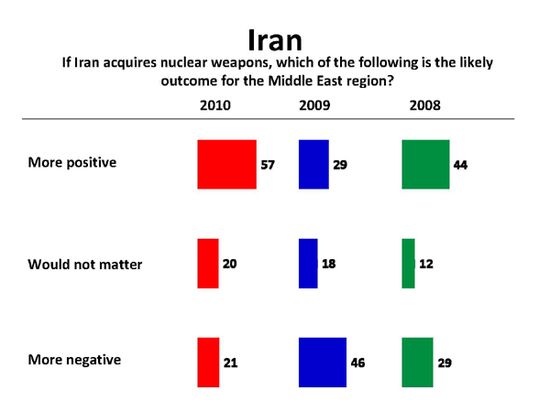
But a little reality check. Here is the latest poll of what the people of various Arab countries, Egypt, Saudi Arabia, Morocco, Jordan, Lebanon, and the United Arab Emirates, actually say they think about an Iranian nuclear weapon:

While the results vary from country to country, the weighted average across the six countries is telling:  in 2009, only 29% of those polled said that Iran's acquisition of nuclear weapons would be "positive" for the Middle East; in 2010, 57% of those polled indicate that such an outcome would be "positive" for the Middle East.

So, in fact, the Arab population, unlike their corrupt, gutless, torturing autocrats, is increasingly in favor of a nuclearized Iran. 77 percent of those surveyed said that Iran had a right to its nuclear program, even though close to 57 percent (a three-year high) viewed it as a military program designed for nuclear bombs (only 39 percent believed that three years ago).

When the Arab public was asked which foreign country was the biggest threat to them, a full 88 percent said Israel, 77 percent said the US and … drum-roll, Jeffrey … 10 percent said Iran.

The spectacle we are now watching is neocons hailing the Arab dictators they once claimed to abhor, while profoundly misleading Americans about the disastrous and catastrophic effect a US or Israeli war on Iran would have.

President Palin? Ctd

Frum believes that there are many Republicans who feel "Romney-Huckabee is the party’s natural ticket in 2012":

They may be business oriented Republicans who prefer Romney or religiously oriented conservatives who prefer Huckabee, but they recognize that the ticket probably needs both. Such Republicans recognize something else: the real divide among the 2012 candidates is that between those who are primarily political figures and those who are primarily media figures.

Businessman Romney and multiply reelected governor Huckabee belong in the first category, along with Mitch Daniels and Tim Pawlenty, while Palin, Gingrich and John Bolton belong in the latter category. The solution is to let everyone do what they do best: Nominate the politicians to run for office, leave the media figures to talk on Fox.


“WikiLeaks Itself Isn’t The Problem”

Kristol, among others, wants to "whack Wikileaks." Kevin Drum blames this line of attack on partisanship:

The United States has considerable control over actions by its own citizens on its own territory, but not over noncitizens who reside overseas and work primarily in cyberspace.

But then, I suspect most of the bloviators know this. WikiLeaks is, for most of them, just a good opportunity to bash the Obama administration (as if George Bush would have been able to act any differently) without having to actually offer any concrete solutions. And what makes this especially great for Obama's critics is that there's not really a lot Obama can do about it, aside from bloviating a bit in return.

Bloviating aside, though, we should be focused not on Julian Assange, but on figuring out how to keep anyone from providing this kind of information to him in the first place. That's more boring, but much more effective.

Where Are America’s Corner Pubs?

After a trip to England, Ryan Avent pines for an American equivalent to the British pub. Why it doesn't exist:

London, like cities and towns across the British Isles, is filled with pubs. They vary in type, quality, and clientele. I was very lucky this time around to find a near-perfect gastropub just a five minute walk from my flat. It was quiet and well-maintained with a great menu, and while there were always people there, there was also always a free seat. Kids were welcome during the day, as were dogs. Every time I went I thought to myself how great it would be to have such a place close by back in Washington. And every time I thought that, I immediately reminded myself that such a place, back in Washington, would be perpetually packed and fairly unpleasant. In the Washington area, you can’t have a place that’s both really good and quiet in a neighborhood-y sort of way.

That’s largely because it’s very difficult to open new bars. And the result is a pernicious feedback loop. With too few bars around, most good bars are typically crowded. This crowdedness alienates neighbors, and it also has a selecting effect on the types of people who choose to go to bars — those interested in a loud, rowdy environment, who will often tend to be loud and rowdy. This alienates neighbors even more, leading to tighter restrictions still and exacerbating the problem.

 Matt Steinglass fingers culture instead of economics:

[W]hat strikes me overwhelmingly about the difference between bars/pubs in London, New York and Washington is that these three cities have completely different nightlife cultures. Those cultures are irreducible to the regulatory environment or to economic behaviour. The regulatory environment in London doesn't do much to explain why, when you walk through Southwark on a winter's evening at 6:30pm with the thermometer tipping 0 degrees centigrade, you see crowds of men and women in long dark coats standing on the sidewalk sipping pints of bitter. It doesn't explain the fact that up until 1990 there basically wasn't a decent atmospheric bar with good food in Washington, DC, or not one that would be recognised as such by someone from New York or London. It doesn't explain the fact that even though breweries are allowed to own pubs in England, and are prevented from doing so in America, most pubs in London that are bought up by breweries or conglomerates have retained their individual characters and atmospheres, while in America they would almost certainly be swept under by company-wide branding campaigns. It doesn't even explain why bars in Washington have gotten so much better over the past 15 years that when I go back, I barely recognise the place.

The Promise Of A Democratic Iran

Karim Sadjadpour made an important point in yesterday's FT:

The WikiLeaks revelations make clear that Arab officials believe Iran to be inherently dishonest and dangerous. The feeling is probably mutual. But they hide perhaps a more interesting issue, namely what type of Iranian government would actually best serve Gulf Arab interests.

President Mahmoud Ahmadi-Nejad and the Islamic Republic may be loathed, but equally the advent of a more progressive, democratic Iran would enable Tehran to emerge from its largely self-inflicted isolation and begin to realise its enormous potential. In the zero-sum game of Middle Eastern politics, a democratic Iran would pose huge challenges to Persian Gulf sheikhdoms.

(Hat tip: Norm)